Introduction
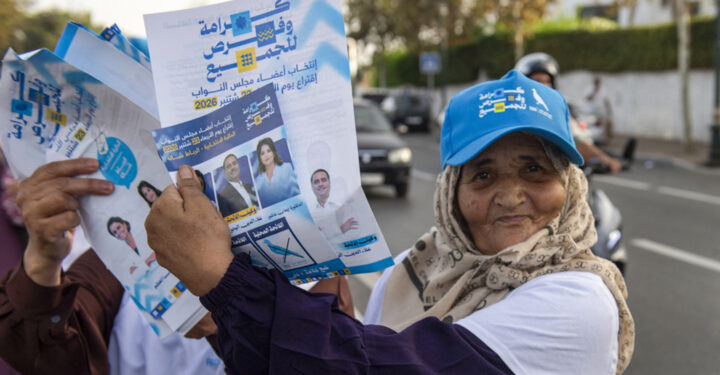
The parliamentary elections that will determine Morocco’s twelfth legislature are scheduled for 23 September 2026. Sixteen million Moroccans registered to vote are expected to cast their ballots – a figure lower than in the two previous elections, reflecting a persistent trend of voter abstention. Successfully curbing this phenomenon is one of the main challenges of the 2026 elections, which are pivotal in every respect. Morocco is engaged in several strategic projects that it plans to complete by 2030. However, these projects do not enjoy unanimous support among Moroccans, as demonstrated by the GenZ 212 protests and the massive influx of migrants toward Ceuta: the kingdom’s development model suffers from structural and territorial shortcomings, marginalizing a significant portion of the population – a phenomenon commonly referred to as “two-speed Morocco.” For political actors, the shadow of fragile legitimacy looms over the elections. It therefore appears that one of the key challenges of this election will be to ensure the credibility of the government – which is responsible for implementing large-scale projects – by addressing the phenomenon of voter abstention.
Morocco Faces the Challenge of Democratic Transition
Roles and Evolution of Parliamentary Institutions in Morocco
From the moment of independence, political institutions have been the arena for a rivalry between the monarchy and various political actors. To prevent the Istiqlal Party – which had been at the heart of the struggle for independence – from gaining dominance, King Mohammed V established a form of “authoritarian pluralism,” encouraging a multiparty system while acting as an arbiter above the parties. The Palace continued to pursue this strategy: on the one hand, by fostering factional splits and realignments to weaken opposition parties, strip them of their substance, and ultimately contain them or co-opt them into a “loyal opposition” through their integration into the political system; and, on the other hand, by supporting the creation of so-called administrative parties, which would serve as extensions of the Ministry of the Interior. This has led to the consolidation of a political class close to the Palace and the weakening of opposition actors (both left-wing and Islamist).
Since the 2011 constitutional reform, Morocco has defined itself as “a constitutional, democratic, parliamentary, and social monarchy,” according to Article 1 of the Constitution. The Parliament is bicameral, consisting of the House of Representatives, with 395 members elected by direct universal suffrage for a five-year term, and the House of Councilors, elected by indirect suffrage for a six-year term. The establishment of a democratic constitutional monarchy was one of the demands of the 20 February 2011 movement. The reform agreed upon in response to the protest movement brought about several changes without, however, introducing any significant transformations: according to constitutional law expert Omar Bendourou, the monarchy remains “the cornerstone of the political system.” The main aim of this reform was to project the image of a Muslim kingdom with diverse cultures, reconciling tradition and democracy, and aligned with the democratic values of its Western partners.
While the 2011 Constitution has strengthened the government’s powers – particularly in the legislative sphere, for example by granting the head of government the authority to appoint civil service officials – it does not make the government an autonomous executive body. It is the King who appoints the head of government from among the members of the winning party, as well as the members of his government, upon the latter’s recommendation. Ministers of strategic departments – Justice, Defense, Foreign Affairs, Habous, and Islamic Affairs – are appointed by the Royal Palace. Furthermore, the government’s program must be approved by the Council of Ministers, which is chaired by the King. In essence, government actions conform to royal directives. Thus, in December 2020, Prime Minister S. El Othmani of the Justice and Development Party (PJD, Islamist) signed the Tripartite Declaration between Rabat, Tel Aviv, and Washington, even though one of his party’s principles is opposition to all forms of normalization with Israel.
Added to this is an electoral reform introduced in 2021, revising the electoral quotient. Whereas it had been calculated since 2002 based on votes cast, it is now calculated based on the number of registered voters – whether they vote or not. According to several analysts, this reform dilutes the votes cast and favors small and medium-sized parties at the expense of those with a high partisan base. Here, electoral engineering appears to serve the purpose of electoral control, as scholar Inmaculada Szmolka points out: “Morocco’s proportional system […] is designed to co-opt political parties, prevent the emergence of a predominant party and promote party system fragmentation.”
The Reasons Behind “Critical” Abstention
The 2011 constitutional amendments did not lead to an increase in civic engagement in the electoral process, which has been characterized by high voter abstention. Typically, around 52% since 2002, it reached a record high of 63% in 2007. The number of people registered to vote stands at around two-thirds of eligible voters, according to official figures: 69.4% in 2021 and 64% in 2016. However, not all registered voters actually cast a ballot on election day. In 2021, only 35% of registered voters went to the polls , despite media campaigns encouraging people to vote.
According to the High Commission for Planning, the majority of potential voters registered on the electoral rolls come from rural areas and are 35 years of age or older. Residents of urban areas and young people aged 18–24 are the least likely to vote. In fact, one in five young people say they do not intend to vote in 2026, according to a report by the association Les Citoyens. These figures highlight the phenomenon of “distrust” toward the electoral process.
To explain this phenomenon, some analysts point to low development indicators. In their view, challenges related to literacy and education, as well as the precarious living conditions – or even extreme poverty – of certain segments of the population, coupled with the isolation of certain regions and rising youth unemployment, account for voter abstention in Morocco. However, these explanations are contradicted by the numbers: 94% of rural residents were registered to vote in 2021[14] – making this group the most likely to vote, while, paradoxically, urban middle-class populations are the least likely to vote.
The real reasons for citizens’ reluctance to vote lie in collective perceptions: a large portion of the population views parliamentary institutions as corrupt and limited in their powers. There is a crisis of confidence in Moroccan political institutions, which came to a head with the GenZ 212 movement in October 2025. According to a 2024 Arab Barometer survey, two-thirds of Moroccans do not trust their government.[16] This rate has remained roughly constant since 2006. For example, the Parliament’s reputation has long been tarnished by the principle of parliamentary immunity, which was enshrined in the Constitution until 2011 and whose application allowed certain members to evade legal prosecution with complete impunity.[17] Between 2021 and 2025, under the Akhannouch government, 30 members of Parliament were prosecuted or convicted of financial crimes.
Furthermore, the “clan-based and opportunistic” logic of political parties – perceived as serving “their own interests” – undermines their credibility among citizens. As for the electoral process, while the Ministry of the Interior no longer plays a dominant role as it did during the reign of Hassan II, certain underhanded practices persist: in this regard, vote-buying reflects the persistence of a form of electoral rashwa (corruption), which is rampant in disadvantaged and marginalized areas, taking the form of direct distribution of money, food, or even offers of temporary jobs.[21]
Pivotal Legislative Elections
Objective: Governing “Morocco on the Rise”
The 2026 legislative elections are notable for taking place against a unique economic and diplomatic backdrop for Morocco. The kingdom is completing several initiatives launched as part of its “Horizon 2030” strategic objectives, with the ambition of becoming an emerging regional power. Co-hosting the 2030 FIFA World Cup with Spain and Portugal is Rabat’s flagship project. Several strategic initiatives revolve around this event: land-use planning, airport modernization, expansion of hotel capacity, and the construction of soccer infrastructure that meets international standards. This major event, presented as a catalyst for development and a sign of international confidence, is nevertheless contested by a segment of the population. For example, certain urban projects affecting residential areas – including Rabat 2030 – have sparked intense tensions with residents over issues of demolition, compensation, and relocation. The 2030 World Cup bid comes at a high cost: the kingdom’s investment needs are estimated at 50 billion dirhams (5.3 billion US dollars), a sum that some members of the population view as out of step with the kingdom’s socio-territorial priorities: failing public services, rural isolation (highlighted by the Al Haouz earthquake), and high unemployment.
On the international stage, Morocco has achieved several diplomatic successes since the normalization of bilateral relations with Israel in December 2020, under the auspices of the United States. US support has had a ripple effect, leading many countries to back Morocco’s autonomy plan. This plan was endorsed by the UN Security Council in October 2025 as the basis for future negotiations with the Polisario Front. Rabat intends to build on this diplomatic momentum by accelerating development projects in the territory, where stability and economic development are essential for attracting international investment.
In the Face of Risks of Social Unrest
There is a plausible risk that social tensions could emerge and undermine the country’s stability at a time when Morocco is seeking to attract investment, finalize preparations for the 2030 World Cup, and promote an image as an emerging power. Since the early 2000s, the kingdom has been rocked by citizen protests. These protests – which are local in nature and target the marginalization and isolation of certain regions, corruption, unemployment, and soaring prices, while advocating for social justice and access to resources – are, however, “scattered and powerless,” and are often suppressed. Among the most notable are those in Sidi Ifni (2005-2016), Zagora (2017), Jerrada (2018), the Rif Hirak (2016-2017), and, more recently, in October 2025, the GenZ 212 movement.
Socioeconomic divisions, the outbreak of protests, and voter abstention are closely linked. Moroccan institutions have so far failed to fully grasp the protesters’ demands. The main challenge of the 2026 elections appears to be overcoming these failures in order to prevent protest-related unrest. The number of registered voters, deemed insufficient, is viewed as an alarming sign by political leaders: the risk of an ensuing government that is unpopular and lacking credibility is unthinkable given the challenges ahead. The Minister of the Interior has therefore called on the parties to “seek out unregistered voters, even in the most remote areas,” ahead of the exceptional reopening of voter registration from 15 May to 7 June 2026. In addition, three laws passed in the fall of 2025 paved the way for a reform of the electoral process in Morocco, aimed at ensuring greater transparency and inclusion and combating electoral corruption: the ineligibility of individuals sentenced to prison terms, mandatory digital candidacy, the digitization of voter registration, and financial assistance now granted to candidates under 35 and to women. As for the main political parties (the RNI, the PAM, the Istiqlal, and the PJD), they focused on social issues during their election campaigns, promising a committed welfare state.
Conclusion
At a time when nonvoters constitute the “largest party” in the kingdom, when political parties and institutions are viewed negatively by a significant proportion of citizens, and in a context marked by strategic projects to be carried out for the kingdom, political actors have implemented a range of measures to boost voter turnout. These range from the digitization of campaigns – without neglecting grassroots efforts – to legislative reforms promoting transparency and inclusion in the electoral process, while focusing their messaging on socioeconomic issues.
https://www.hcp.ma/Quelques-caracteristiques-des-primo-votants-aux-elections-de-2021_a2742.html
The views represented in this paper are those of the author(s) and do not necessarily reflect the views of the Arab Reform Initiative, its staff, or its board.