





1. Introduction and Background
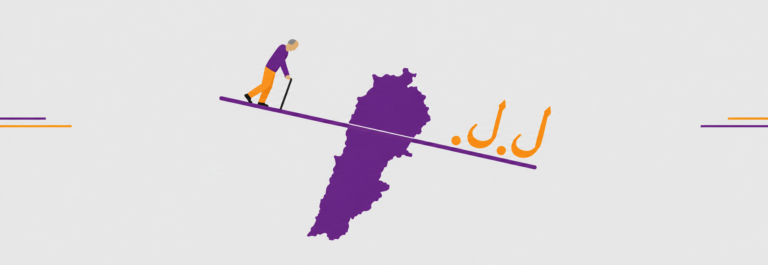
Lebanon’s social protection system is often described as broken by crisis: a fragile state overwhelmed by a “triple crisis” of macroeconomic collapse, fiscal restructuring, and the humanitarization of welfare provision.1 Such framing is accurate yet incomplete in a way that matters for policy. Lebanon’s social protection system was not simply overwhelmed by the compounding crises of 2019-2026; it was built, well before those crises, in fragmented and exclusionary forms structurally incapable of absorbing shocks. This fragmentation itself has served identifiable political interests. The governance crisis of the National Social Security Fund (NSSF) predates the 2019 collapse by decades, rooted in the state’s own decision not to pay its legally mandated contributions and to push the Fund’s reserves into treasury bonds later rendered worthless.2 The “patchwork” of donor-funded humanitarian programs that now substitutes for a national system was designed and financed by international financial institutions (IFIs) whose poverty-targeting model has entrenched division rather than built solidarity.3 The fiscal adjustment that followed 2019 was never announced or legislated as austerity. It was absorbed instead through the collapse of the national currency, which eroded the real value of wages, pensions, and public spending without any decision on who should bear the losses.4
This report builds on original quantitative and qualitative data to develop a critical analysis of the policies and financing of Lebanon’s social protection model(s), aiming to examine not just the current system’s adequacy, but how such a system came about, the interests served through these arrangements, and what would need to change politically, not merely technically, for an alternative to be effective and viable. The central argument is that Lebanon’s social protection deficit cannot be explained by scarcity alone. The resources are genuinely scarce, since the state’s budget contracted sharply after 2019, but the scale of that scarcity and the way it is distributed are themselves the product of political choices. The country’s low, regressive revenue base, its captured contributory institution, the allocation of banking-sector losses, and its donor-substituted humanitarian architecture were sustained across successive governments and have benefited a narrow set of elite interests at the expense of universal5 coverage. Reversing this requires a transition toward a state-led, rights-based, universal social protection system that is designed and owned domestically and, over time, financed predominantly through domestic resource mobilization: progressive taxation, deep debt reduction that leaves room for social spending, and a rebuilt, solidarity-based contributory system. Given the scale and speed of need, Lebanon will rely on substantial external support in the short term. The argument is not against foreign funding as such, but against financing that is time-bound, donor-designed, and conditional in ways that substitute for domestic capacity and ownership instead of building them.
This argument draws on original survey and interview research for the Finance4All project, alongside published fiscal and economic data (original quantitative and qualitative data can be found in Annexes 1.0 and 2.0 respectively). The report proceeds as follows. Section 2 briefly covers this project’s research design and methodology. Section 3 critically analyzes the origins of the financing model, its current design, and then draws on this project’s original quantitative and qualitative data to assess who wins and who loses under it, ultimately providing the evidence base and argument for alternative financing. Section 4 offers tiered, actor-specific recommendations organized around a power map, and Section 5 concludes.
Background
Lebanon’s social protection system operates across several parallel and largely disconnected tracks. The NSSF, established in the 1960s on the French social insurance model, remains the primary institution for private-sector workers, providing health insurance, family allowances, and (until recently) end-of-service indemnities. Civil servants, the military, teachers, and university staff each have their own dedicated schemes.6 This institutional multiplicity mirrors and reproduces Lebanon’s confessional power-sharing system, in which control over social provision is distributed across political and sectarian actors as an instrument of patronage rather than consolidated into a universal architecture.7 Before 2019, this meant that formal-sector, unionized and politically organized workers, often disproportionately urban and male, received the most protection, while informal8 workers, rural communities, refugees and migrants received the least.9 The collapse then eroded the value of formal-sector entitlements as well, as later sections show.
Lebanon’s socio-economic precarity and its inadequate social protection architecture predate the current crisis by a full economic cycle. Lebanon moved from a period of rentier stagnation between 2011 and 2019 into stagflationary contraction from 2020 onward, and poverty had already more than tripled over the preceding decade even before the 2019 collapse, reaching 44%. This national average, however, conceals geographic and gendered disparities. Poverty in the Akkar-North governorate for example had reached 62%, against 2% in Beirut, which remained the hub of dollarized wealth and international presence, and female-headed households with young children faced an 80% poverty rate.10
Recent years have seen four notable reforms to Lebanon’s social protection schemes: the National Social Protection Strategy (NSPS), the National Disability Allowance (NDA), the merger of the National Poverty Targeting Program (NPTP) and the Emergency Social Safety Net (ESSN) into the unified AMAN program, and Pension Law 319, which aims to convert the NSSF’s end-of-service indemnity into a monthly pension. Each represents genuine, if partial, progress, yet each has stalled at the point of execution. The NSPS remains unfinanced, the NSSF’s administrative council still lacks the cross-sectarian agreement needed to implement Law 319, and implementation decrees for other measures are repeatedly deprioritized whenever a new political or security crisis emerges.11
The events of 2019 onward transformed a fragile system into a near-dysfunctional one. The post-2019 collapse wiped out savings, pensions, and insurance coverage, and the lira’s loss of over 90% of its value left lira-denominated NSSF benefits worth a fraction of their former value.12 The COVID-19 pandemic arrived simultaneously, compounding damage across health, education, and livelihoods. The August 2020 Beirut port explosion then displaced hundreds of thousands of residents at the moment state capacity had already been depleted. Subsequent Israeli military operations in the south added further displacement. By 2026, Lebanon had entered what is best described as “fragile stabilization”: real GDP has fallen by more than 40% from its pre-crisis level, poverty stands at 44% in monetary terms and multidimensional poverty above 78%, and the renewed 2026 regional Iran-US war has erased any modest recovery signs visible in the second half of 2025.13 Against this backdrop, the typical policy response of a relief-focused model reliant on IFI loans and scattered humanitarian programming is, as this report argues, structurally insufficient social protection for people living in Lebanon.
Endnotes
- World Bank Lebanon Economic Monitor, Winter 2025, available at https://documents.worldbank.org/en/publication/documents-reports/documentdetail/099525001212610449 ↩︎
- Osmat, Bashir. “Social Security in Lebanese Political Economy: A Critical View from within the National Social Security Fund.” Arab Reform Initiative, 11 May 2023. ↩︎
- Al Shami, Farah. “Financing Universal Social Protection Systems in the Arab Region: What Alternatives to Debt and Austerity?” Arab Reform Initiative, 2024, available at https://www.arab-reform.net/publication/financing-universal-social-protection-systems-in-the-arab-region-what-alternatives-to-debt-and-austerity/ ↩︎
- KII 3; KII 5; KII 6, (see Annex 3.0). ↩︎
- Universal social protection, as used in this report, means a rights-based guarantee of a basic floor of protection for everyone residing in Lebanon, regardless of nationality, legal status, or employment status. That floor covers access to health care, income security in childhood, disability and old age, and protection against shocks. It does not imply identical benefits delivered through a single scheme, nor that every instrument must be paid to every person. It means that no one is excluded by category, that entitlements follow life-cycle risk and need, and that the system is financed collectively and progressively rather than left to donors or to individual contributions alone. The report does not treat formalization as the goal: protection should not depend on employment status, which is what a rights-based universal floor means. ↩︎
- Osmat, B. Arab Reform Initiative, 2023. ↩︎
- Cammett, Melani. “Sectarianism and the Ambiguities of Welfare in Lebanon.” Current Anthropology 56, no. S11, 2015, available at https://www.journals.uchicago.edu/doi/pdf/10.1086/682391; Loewe, Markus. “Caring for the Urban Middle Class: The Political Economy of Social Protection in Arab Countries.” In Social Protection in Developing Countries. Routledge, 2013, available at https://www.researchgate.net/publication/256063609 ↩︎
- Informal employment is used here in line with the International Labour Organization’s definition: Informal employment refers to working arrangements that are in practice or by law not subject to national labour legislation, income taxation, or entitlement to social protection or other employment guarantees. (“What is informal employment?”, International Labour Organization, 2023, available at https://researchrepository.ilo.org/esploro/outputs/995264844802676) ↩︎
- Cammett, M. Sectarianism and the Ambiguities of Welfare in Lebanon, 2015; Loewe, M. “Caring for the Urban Middle Class,” 2013. ↩︎
- World Bank Lebanon Poverty and Equity Assessment, 2024, available at https://www.worldbank.org/en/news/press-release/2024/05/23/lebanon-poverty-more-than-triples-over-the-last-decade-reaching-44-under-a-protracted-crisis; UN-ESCWA, Multidimensional poverty in Lebanon, 2021, available at https://www.unescwa.org/sites/default/files/pubs/pdf/multidimensional-poverty-lebanon-english.pdf ↩︎
- This pattern of legislation existing without implementation recurs so consistently across Lebanon’s social protection domain that it constitutes, in itself, a finding about how the system is governed, examined and elaborated upon in Section 3. ↩︎
- World Bank Lebanon Economic Monitor, Winter 2025. ↩︎
- World Bank, “Fragile Stabilization Fuels Growth in Lebanon,” press release, 19 June 2025; World Bank, Lebanon Economic Monitor, Summer 2026: A Conflict-Torn Economy, August 2026; World Bank, Lebanon Poverty and Equity Assessment, 2024; UN-ESCWA, Multidimensional Poverty in Lebanon (2019–2021), 2021; Al Jazeera, “Mapping Israeli attacks and the displacement of one million in Lebanon,” 17 March 2026. ↩︎