Introduction
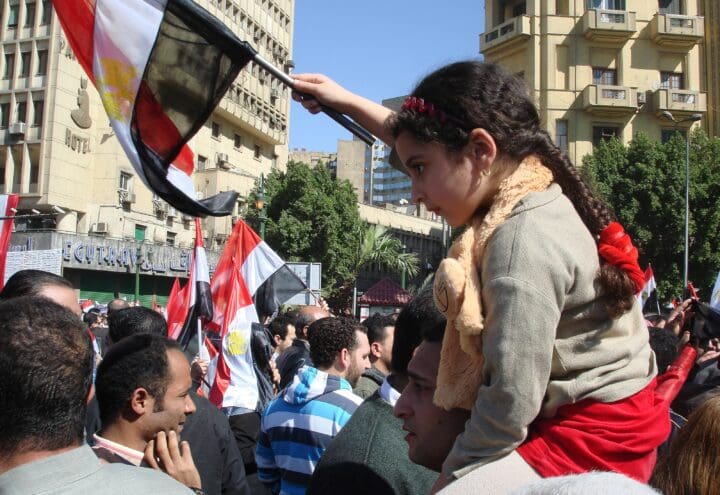
“I wish I had been one of them… all my life I have had this nostalgic feeling toward 2011 despite not living it myself.” This is how a 22-year-old female university student described her feelings toward the January 25 uprising, an uprising she lived through only as an eight-year-old. Generation Z (who were children during the uprising) express striking nostalgic identification with the 2011 uprising, speaking of Tahrir Square with admiration, consuming songs, films, and digital media about the uprising, and often describing it as a moment of courage and collective hope. Their understanding of the events is not autobiographical; rather, they reconstruct their memory through the lens of their present struggles. This admiration toward the uprising among Generation Z raises an important question: how can a generation feel nostalgic for an event without having experienced it directly?
Generation Z in this regard does not merely represent those born between the late 1990s and 2000s. Rather, following Mannheim's framework, it is understood as a group bound together not by mere chronological coincidence but by shared exposure to the “social and intellectual symptoms of a process of dynamic destabilization.” In Egypt, this destabilization dynamic stems from the 2011 uprising and its subsequent democratization failure. While older generations experienced this event as a transformative rupture, Generation Z experienced it as the background against which they came of age. As such, their shared exposure to conditions of political constraints and economic hardship is what gives them their common generational consciousness.
This paper does not claim to represent Egypt’s Generation Z as a whole. Rather, it offers a micro-level analysis of six individuals from a particular social milieu: educated, urban, digitally connected, and from the middle and upper-middle class. This segment is particularly significant as it is the most exposed to alternative digital mnemonic narratives; the segment that has attended university, where critical frameworks may be developed; and the segment in which the gap between the promises of the 2011 uprising and the post-2013 realities is most felt, as these individuals came of age expecting upward mobility and political participation only to be confronted with economic and political barriers. While these findings cannot be generalized to all of Egyptian Generation Z, they offer insights into the mechanisms through which nostalgia without experience is constructed, and how present political and economic struggles can shape the reconstruction of the past.
In doing so, this paper draws on six semi-structured interviews conducted with members of Generation Z. At the time of the interviews, participants were between 20 and 28 years old and were residents of Greater Cairo. However, during the uprising, two participants were residents of the Nile Delta, and one was a resident of the Suez Canal governorates. The sample included four male and two female participants from university student and graduate backgrounds, generally belonging to the middle and upper-middle classes. Interviews were conducted in Arabic both in person and online (via phone and video calls).
The paper proceeds in five sections. First, it presents the profiles of the six interviewees, situating them within their social location and tracing their trajectories of education, political socialization, political attitudes, and civic engagement. Second, it demonstrates the historical and political context of the 2011 uprising and the state's subsequent efforts to construct its official memory. Third, it examines how interviewees’ fragmented memories of the revolution are reconstructed, producing a nostalgic identification with the revolution. Fourth, it analyzes how interviewees turn to emotionally charged alternative sources of information (songs, films, social media). Fifth, it reflects on the implications of this nostalgic identification. Through these six testimonies, the paper reveals that interviewees’ nostalgic memories of the January 25 uprising are shaped by their ongoing political and economic struggles. Unlike older generations who evaluated the uprising through direct experiences with the events, interviewees treat January 25 as a symbolic resource that resonates with their own struggles, a mirror of what they have lost rather than a historical lesson to learn from. For interviewees, this nostalgic identification produces divergent political outcomes, ranging from activism and critical engagement to cynicism and deliberate withdrawal.
Interviewee Profiles
Despite stemming from similar socio-economic backgrounds, the profiles of the six interviewees (pseudonymized here) demonstrate different family histories and relationships toward the 2011 uprising, as well as different attitudes toward politics today.
Salma was nine years old in 2011 and living in one of the Suez Canal governorates; her parents were mostly cynical of the revolution while her two older siblings supported it. She experienced the revolution primarily through television. Salma attended public school in Suez and later moved to Cairo to study political science, which transformed her understanding of the uprising and subsequently her childhood memories, making her sympathize strongly with the movement.
Dina was seven years old in 2011, living in the Nile Delta; she first encountered the uprising through her sister, who left home for Tahrir Square, causing family panic. Dina’s political consciousness developed later, particularly around the time of the September 2019 protests, which she followed intensively on Twitter. This event in particular made her nostalgic for 2011 and made her want to participate in something similar, and later shaped her decision to pursue social sciences.
Khaled was 11 years old in 2011; he was in preparatory school at the time and recalls the period as one of confusion and increasing awareness. He described how it was hard for him and his school peers to understand the revolution. He later studied chemistry at university. He speaks positively about how this period shaped him and opened his eyes to politics and describes himself as someone who is interested in politics and wants to know what is happening around him.
Tarek was seven years old, living in the Nile Delta in 2011; he is now an engineering student. He recalls seeing protests in the streets and being encouraged by them, though without actually understanding the purpose behind them. He describes the uprising as a moment of hope but now avoids discussing the topic of the revolution because of disappointment with its trajectory.
Youssef was eight years old in 2011 and lived in an upper middle-class family that he described as comfortable and politically moderate. His first memory of the uprising was his family's anxiety when his older brother was in the streets protesting. His family was cautiously optimistic about 2011 but grew increasingly critical during the Morsi period. He later studied social sciences and now sees the 2011 uprising as a moment of ambition and hope. However, he views June 30 as a necessary step on the security level, though he acknowledges it had negative implications.
Fady was seven years old in 2011 and comes from a Christian family. His memories of 2011 are largely positive; he describes the atmosphere as happy despite the chaos and uncertainty. However, his experience of 2013 was markedly different: as a Christian, he recalls fear of the Morsi government and the Muslim Brotherhood, and recounts watching the announcement of Morsi’s removal with relief. Fady studied programming and mostly focused on his personal economic concerns. Now he expresses detachment from politics, believing that it will not result in real economic improvement.
Memory Politics and Official Narratives in Post-2013 Egypt
The post-2013 discourse has carefully constructed an official memory of the revolutionary moment, not merely commemorating it, but as an attempt to shape public understanding of recent history, through selective incorporation and reinterpretation of the Arab Spring events. In 2016, the regime first framed 25 January 2011 as a noble uprising based on legitimate grievances, yet it was immediately subordinated to the correction of 30 June 2013, widely recognized as a turning point in Egypt’s post-2011 transition, marked by mass nationwide protests calling for President Mohamed Morsi’s resignation. The military removed Morsi from power on 3 July 2013, suspended the constitution, and appointed an interim president. Abdel Fattah El-Sisi, then defense minister, was later elected president in 2014.
By 2020, the official commemoration had been almost entirely subsumed into Police Day – the anniversary of a 1952 battle against British colonial forces, celebrating security forces rather than popular protests, and replacing the revolutionary date with a more established national memory. By 2026, the discourse had shifted further, framing 25 January 2011 as a moment where “a cohesive nation was fragmented,” departing from the hijacked good-faith revolution discourse that persisted before and instead framing it as a near-fatal fragmentation of national unity that must never be repeated.
The regime has shown particular attention to how the memory of January 25 is transmitted to younger generations, recognizing that the uprising remains a lived memory for those who experienced it but is less tangible for the younger generation who were children at the time. As such, the narrative that reaches this generation becomes an explicit concern, stressing the need to protect young Egyptians from alternative narratives they might encounter through modern technology. This effort to shape generational memory is institutionalized through school textbooks, which serve as a primary vehicle for transmitting the official narrative to Generation Z. Shortly after the 2011 uprising, the Ministry of Education moved to incorporate the events into the curriculum, with the 2012-2013 school history books providing a detailed narration of the uprising and its triggers. However, following the events of 30 June 2013, the curricula started to change substantially, as the texts started to equate both January 25 and June 30 in importance, portraying both as “revolutions” and both as positive and necessary.
By 2017, textbooks had revealed a clear revision in their discussion of January 25 and June 30, omitting information and summarizing the most significant political events in a way that reflected the key elements of the official narrative. Today, the revolutionary presence in official textbooks has been significantly reduced, a policy shift that has particular significance for the extent to which memory of the revolution is being transmitted to Generation Z via the national school system. In the current curriculum, the uprising is mentioned only in brief terms, presenting the uprising as a series of preludes and triggers, while highlighting that the one primary outcome was a state of instability that engulfed the country.
In Assmann's sense, school education and media reflect the institutionalized, fixed memory message of the state. Nevertheless, many interviewees reject these narratives and recognize the motives behind them. For instance, Fady treats the official discourse as routine propaganda, neither believing nor fighting it, stating that “the regime must have its reasons, but for the citizens what matters is living in security.” Other interviewees rejected this narrative privately while avoiding open confrontation. Both Salma and Dina accuse the media of manipulating people's memory, particularly through commemorating 25 January as the Police Day instead of the revolution’s anniversary. Moreover, Tarek observes how public education tells the same story (“what is on TV is also in school textbooks”) while Youssef shares concerns about how this period is portrayed in school, suggesting that it is too cautious in mentioning the reasons behind the uprising.
University education further explains interviewees’ reaction to the official narrative. Salma, Dina and Youssef studied social sciences at university, which made them more critical of dominant narratives and provided them with analytical tools to understand the official discourse. Nevertheless, for Salma and Dina, doubt concerning the official narratives was established prior to their university education. Salma was already reading about Khaled Said and questioned how June 30 was represented in her textbooks, while Dina's political attitudes were already shaped by her online activism and the September 2019 protests. As such, it was not university education that made them critical; rather, their educational choices were influenced by their political attitudes. On the other hand, Fady and Tarek, who studied programming and engineering, also do not advocate for the official narrative and treat it as routine propaganda; however, they encountered no framework at university for analyzing these narratives. Without those tools, they saw no reason to contest the narrative or to engage politically.
Reconstructing Fragmented Memories and the Making of Nostalgia
The January 25 uprising does not constitute a formative event for interviewees in the same way it did for Millennials, who experienced the uprising as a transformative rupture. Given that they were children at the time of the uprising, Generation Z has limited and fragmented recollection of the events, often reduced to specific sensory impressions that nonetheless have not faded away. Through later reconstruction, they have assembled an emotional connection to a past they never fully lived, nostalgically identifying with the uprising and romanticizing it as a lost moment of revolutionary courage, unity, and hope. In this context, nostalgia refers to “an orientation of desire towards a lost object or a time that involves multiple, sometimes contradictory emotions.”
For interviewees, although they express a nostalgic identification with the uprising, their recollections are incomplete, merely remembering President Mubarak as the person whose photos are hung in the street, “a man who seemed important,” at whom anger was directed. They sensed that people were angry, but could not fully grasp the reasons or purpose behind that anger, nor did they understand the revolution’s trajectory themselves. For instance, Tarek described the general understanding among his generation: “What I heard was that people went out for freedom and social justice, but we didn’t understand why exactly they were asking for these things, and I still don’t fully understand everything.” Similarly, Salma recalls her confusion watching the uprising unfold on television, saying, “I didn't understand why a camel was running in the middle of the street.” Yet, these fragments carry emotional weight, evoking images of courage and solidarity. For instance, Fady recalls being taken as a child to a popular committee (neighborhood groups that formed spontaneously during the uprising to protect local areas), describing it as a space of collective joy and mutual aid.
Despite fragmented memories, the testimonies of those interviewed here reveal that they later identified with and romanticized the uprising. Many expressed a deep longing to have been part of the events. Dina expressed this feeling, saying, “I always wished to be one of them… if something ever happens, I would want to be part of it,” while Tarek expressed wishing that he was older so that he could have participated in the uprising, labeling it as days that “can never be forgotten.” In speaking with them, what comes out is that this longing is not just about missing the events themselves, but rather about missing a moment of collective possibility that was taken from them.
The uprising is often described in the language of dreams and hope. For instance, Salma described it as if someone stole hope from you and broke it to pieces, while Khaled called it a “dream that never came,” and something that expanded his thinking beyond personal concerns. This nostalgic identification is rooted in their own lived experiences of ongoing political constraints, which in turn shape the lens through which they evaluate the uprising. As such, the uprising is not judged against what it actually achieved but as an anti-repressive movement that resonates with their struggles. Dina expresses, for example, how contemporary conditions are a product of the uprising’s trajectory, which is affecting her generation in particular, seeing in the revolutionary movement an effort to address the same struggles they now face. For interviewees, the uprising is romanticized as it represents a world in which their present constraints were not inevitable. The uprising is thus treated as a site of ethical reflection and self-formation, not just a past event.
Tools of Nostalgia: Songs, Movies, and Digital Media
As demonstrated above, interviewees' relationship to the official memory of January 25 is characterized not merely by disagreement but also by a distinct disinterest. While they recognize the attempts to control their memory, their response is often pragmatic detachment rather than active opposition. In this context, interviewees recount turning to alternative sources to reconstruct the past, and in particular revolutionary songs about the uprising that carry an emotional weight that official media, textbooks, and historical records cannot replicate. These revolutionary songs are a diverse and evolving body of work. They are uncommon in state-sanctioned television and radio but have become a crucial source of memory for interviewees. Unlike traditional media, these songs are not passively consumed but are actively sought out on digital platforms like YouTube, Facebook, and streaming services.
The music that interviewees mention as key to their understanding of the revolution ranges from themes of hope to expressions of disappointment, reflecting the revolution's trajectory. The group they listen to the most is the band Cairokee, which rose to fame with their 2011 hit Sawt al-Hurriyya (Voice of Freedom), composed during the first 18 days of the uprising. Since then, they have been known to produce music that represented the political landscape of the time. These songs include Ethbat Makanak (Stay in Your Place), which expresses resilience and defiance in the face of repression; Ya El-Midan (Oh Tahrir Square), which celebrates collective protest and solidarity in Tahrir Square; and Matloub Za'eem (A Leader is Needed), which expresses the need for a president amid the 2012 presidential elections. Beyond Cairokee, other less popular artists who contributed songs reflecting on the revolutionary moment are also mentioned by interviewees. These include Bened'eelko (We Pray for You), a revolutionary song written by the poet Mostafa Ibrahim and performed by Mohamed Mohsen, which pays tribute to the martyrs of the January 25 revolution and the sacrifices they made for others to live a better life. Another protest song, Āh Ya Magles Yaa Ibn al-Ḥaram (Oh Council, You Bastard), is also mentioned. That piece is associated with anger toward the Supreme Council of the Armed Forces (SCAF) after the 2012 Port Said Stadium massacre, in which more than 70 football fans, mainly supporters of Al Ahly, were killed amid accusations of state negligence and complicity.
For those who witnessed the uprising as adults, these songs reflect the shifting sentiments and emotional stances of the protesters, from euphoria at the beginning of the uprising to disappointment and nostalgia later. However, for those who did not have a chance to participate in the revolution, popular culture functions as a counter-hegemonic archive. Even without understanding the politics, the songs transmit an affective attachment to the revolution, offering a nostalgic connection to a distant moment. For instance, Salma reiterates that songs represent a core part of her memory of January 25, particularly as she did not witness the events herself, believing that this is the primary method her generation engages with the uprising’s memory. Similarly, Dina expressed that she remembers the revolution’s martyrs particularly through songs about them.
Likewise, movies and social media play a significant role in the past’s reconstruction. Interviewees frequently cited watching movies like 18 Days, Clash, and other documentaries as a primary source of information. Some, such as Youssef and Salma, expressed that they ignore television and the official narrative by extension, and rather rely on social media, especially YouTube and Facebook, or even older political satire shows like Bassem Youssef’s Al-Bernamag to gather information about the revolution. These digital fragments act as living archives that bring the past to the present through juxtaposing old struggles with contemporary ones. As revealed in the interviews, these songs, films, and digital content became the primary vehicles through which members of Generation Z reconstruct the revolutionary past, where their struggles are represented. This transmits an affective attachment without experiencing the events they are longing for themselves.
The Implications of Nostalgia
Social movement scholars emphasize the role of memory in the construction of social movement identities and inspiring activism. For those interviewed here, the uprising represented a foundational moment for political engagement. For instance, Dina describes how nostalgia toward the uprising shaped her activism on Twitter and her desire to participate in the September 2019 call for protests, translating her nostalgia into readiness for political action and providing an emotional goal template that she wants to recreate in the future. Khaled describes the uprising as an eye-opening event that made him follow political developments regularly, while Salma links her inability to shoot with a camera in Cairo to the uprising trajectory, tracing her grievances back to the revolution and the subsequent over-securitization of the state.
However, nostalgic memories can also function as a vehicle for demobilizing. Norman notes that nostalgia has a “mystical quality” that makes replicating the past feel out of reach, particularly in the context of contemporary political constraints. As such, nostalgic connection toward January 25 pacified individuals’ political frustrations and foreclosed the impulse to express dissent or become politically active. Several of those spoken with here who strongly identified with the 2011 uprising express their disappointment with its trajectory, describing their generation as the one that inherited the bill, not the Square, which in turn drove them away from politics entirely. For instance, Youssef expresses how the revolution's failure made him cynical of mass protests' effectiveness, while Tarek and Fady state that they are no longer interested in learning about politics and in fact that they actively ignore it, attributing this to their disappointment with the revolution's trajectory and their focus on their personal economic survival.
What comes out from the stories that they tell is that nostalgic memories of the 2011 uprising are foundational in shaping their political attitudes and modes of engagement. For Dina, nostalgia produces a schema that sees activism and mass protests as the only viable solution to authoritarianism. For others, such as Khaled and Salma, the memory of the uprising represents a foundational political education, fostering political consciousness and critical engagement with current affairs. On the other hand, the same nostalgic memories of the uprising produced resignation and deliberate political disengagement, resulting in depoliticization and cynicism toward collective actions, as in the case of Tarek. In this way, even across a small sample of six interviewees coming from a relatively homogeneous background, the same nostalgic memory is revealed to produce divergent outcomes depending on how participants interpreted the uprising’s failure and related it to their present struggles.
Conclusion
D'Orsi observed that Turkish revolutionary militants’ nostalgia functions as an emotional practice that shapes political subjectivities and moral horizons, strengthening the generational bonds between them while simultaneously contributing to their “moral isolation” from wider society and reducing the possibilities for new ways of acting. A similar dynamic is visible among interviewees here. Despite divergence in how the memory of the uprising shapes political attitudes, the common emotion shared by the six interviewees is a collective nostalgia that produces a romanticized longing for January 25. This romanticization of the uprising resulted in interviewees ignoring the official narrative that equates the uprising with chaos and instability, and instead drove them to alternative sources of information that carry larger emotional weight rather than historical depth. Several participants expressed that those movies and songs made them feel connected to the revolution as if they had participated in person. As such, avoiding historical records, political analysis, or substantive books while relying on songs and movies allows them to feel connected to the revolution, providing a sense of belonging to a community of memory without requiring the commitment that would come with fuller understanding. Although Ramzy has shown how a vaguely known past could be used as a resource for mobilization, the six people spoken with here treat the memory of January 25 as a mirror of what they lost, rather than as a symbolic resource for mobilization or a historical lesson to be learned.
The views represented in this paper are those of the author(s) and do not necessarily reflect the views of the Arab Reform Initiative, its staff, or its board.