Drawing on more than 100 conversations held between January 2025 and May 2026 with politicians, activists, and officials across the Middle East and North Africa, activist Hussein Baoumi argues that authoritarian resilience in the region owes less to regime strength than to a credibility gap within the democratic opposition itself.
1) Your career has allowed you to speak with a range of different political and social actors since the 2011 revolutions. Broadly speaking, can you tell us more about the profiles of democratic forces you have been interviewing over the years, and their trajectories over the course of democratic opening and closure?
I started my activism in Egypt in the protest movement under Mubarak back in 2008. Over the years, I have met many democratic actors, first from Egypt and then from across the Middle East and North Africa. I have also had the opportunity to meet democratic actors from Latin America and Eastern Europe, particularly when I lived in Bogotá and later in Budapest. I define democratic actors as politicians and activists who are broadly committed to establishing and sustaining a system in which political authority is determined through free, competitive, and inclusive elections; where governments can be peacefully removed from office; and where political participation, pluralism, and basic civil liberties are protected. This excludes both those who seek non-democratic forms of government and those who view democracy merely as a stepping stone towards an undemocratic system. Having emerged from this milieu myself, I am therefore offering a critical reflection on a political community of which I have been part.
The people I have met have been extremely diverse, and include formal opposition leaders, movement activists, old-school politicians, exiles, and intermediaries. Among democratic actors, there have been broadly three main trajectories. I will try to draw some broad lines around them.
There are democratic actors who entered formal politics after 2011, before being marginalized or repressed following the closure of public space. During the peak of their respective democratic eras, some of these figures became ministers, or even president in the case of Moncef Marzouki. Following democratic erosion, some were arrested, some went into exile, and others managed to maintain some political presence. Today, many remain active in formal politics, run opposition parties, or continue to command significant respect within political circles. This group essentially represents the leadership of the opposition.
There are also opposition activists who have moved between activism, exile, prison, and informal politics. Initially, they played a major role in shaping the narrative and discourse of the post-2011 period and often had the most radical objectives, before becoming disillusioned and violently repressed as authoritarianism returned. Over time, some managed to become more institutionalized, but many others now operate in politics-adjacent spaces, for example, in media, public law, professional associations, unions, or civil society organizations, or live in exile, whether in the physical or political sense. This is the rank and file of the opposition.
Then there are actors who were able to operate before 2011 and have largely managed to remain politically active, albeit within a shrinking public space. They are old-school politicians with a deep understanding of how Arab regimes function. During periods of political opening, they competed in elections and even joined governments, but they too were increasingly marginalized as autocrats realized that they were not fully committed to the regime’s project. Still, they were not repressed as violently as other actors, partly because they continued to play a useful role as channels of communication with the wider opposition. They usually refrain from public criticism of regimes and prefer to work within available margins to advance limited reforms. I think this group receives unfair criticism when it is lumped together with the regime, and its members are often misunderstood as opportunists. In many cases, they serve as interlocutors between the opposition and regimes.
2) In these discussions you’ve been having with them, how do they understand their own setbacks and the return to ever more closed political systems?
Democratic actors’ understanding of their setbacks has evolved over time. In the immediate aftermath of authoritarian resurgence, there was a mix of disbelief, followed by a search for external explanations as the new reality set in. Over time, however, more and more people became willing to take responsibility, sometimes in public, but mostly in private.
I have heard several explanations, which can be grouped along the following lines. One explanation tends to come from nationalists and some on the far left, and points to foreign intervention, for example, the role of Gulf states, Israel, Turkey, Russia, the US, or Europe in bankrolling or militarily backing anti-democratic forces. Another tends to come from liberal politicians, who blame citizens themselves for failing to prioritize democracy, or for voting for or supporting anti-democratic forces. A third, which often comes from the left, tends to blame business elites for actively conspiring to bring down democracy. A fourth, which tends to come from some secularists, blames Islamists for their behavior, their attempts to monopolize power, and their role in polarizing society. What all these explanations have in common is that militaries and security bodies are seen as the tools through which democratic aspirations were ultimately stifled through violence and repression.
But some actors have indeed taken a degree of responsibility for the failures of democratization attempts. In Egypt and Syria, for example, some politicians have written articles or given interviews looking back at their own failures. In Tunisia, some politicians also appear to have pointed to some of their own failures, although from what I have seen, they have refrained from personally accepting blame, instead pointing to the broader failure of the opposition of which they were part. But this is largely where publicly available self-assessments end. In private conversations with politicians across the region, there is more willingness to criticize democratic forces, particularly among rank-and-file actors or people who are not themselves in positions of power.
Those critical of democratic forces tend to point to fragmentation, irresponsibility, and detachment from the public. The criticism is that democratic actors made fatal mistakes in the post-2011 moment, which either wasted opportunities to take power, mismanaged transition periods, failed to prioritize key reforms, or prevented them from embedding themselves in their societies. This criticism has persisted to this day and has driven many people toward apathy.
3) From your vantage point, what are we missing in our understanding of authoritarian resilience in the region?
A common theme I heard in private conversations with democratic actors across the region is that autocrats’ biggest blessing is the incompetence of their democratic opponents. This statement may sound hyperbolic on its own, but I think it captures a key gap in how we think about authoritarian resilience. We misunderstand authoritarian resilience when we look only at autocrats’ strength. We also need to look at the weakness of the alternative. Autocrats survive not only because they repress, but because publics, elites, state institutions, and international actors often do not see democratic forces as credible enough to risk supporting. That does not excuse repression or blame victims, but it does mean that democratic actors’ choices matter.
When you look at Egypt, there is clear anger and disillusionment with President al-Sisi among all sorts of Egyptians, as well as among some of the government’s international backers, but this has not translated into pressure for regime change. The public would rather grind through devastating poverty, risk dangerous migration routes, or, in the case of the business community, accept unfavorable agreements with regime figures, than take the risk of pressuring the regime.
Then we look at Tunisia, where President Kais Saied swept into power on an anti-establishment platform. Despite deteriorating economic conditions, the larger reaction has been apathy rather than popular mobilization. This is despite the fact that, in Tunisia, there is still some space to organize and some access to the media. A bigger issue, it seems, is that the public is, to a large degree, apathetic and, in particular, deeply disillusioned with the democratic experiment.
Looking at Syria today, many local, elite, and international actors appear willing to treat President Ahmed al-Sharaa as the only actor capable of holding the country together, with some exceptions, although these exceptions are not necessarily backing a democratic model either.
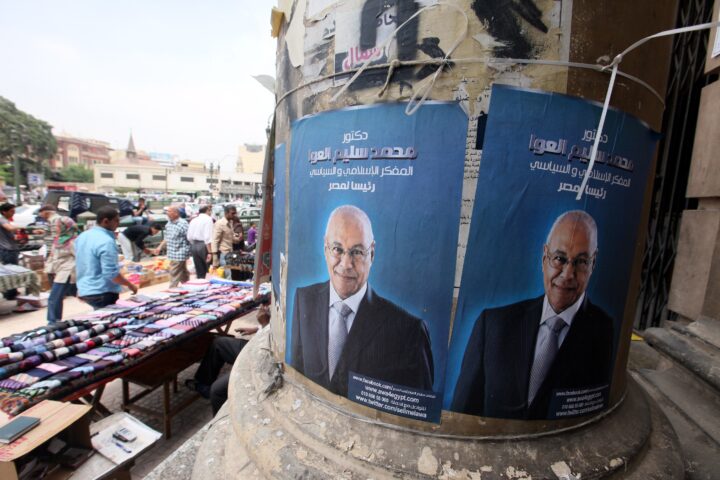
What all three examples have in common is that the democratic opposition has failed to convince the public, the business community, state institutions, and international actors to bet on a democratic model rather than authoritarian leaders. The Egyptian democratic opposition (Hamdeen Sabahi, Abdel Moneim Aboul Fotouh, Amr Moussa, Mohamed Selim El-Awa, Khaled Ali, Abou El-Ezz El-Hariry, and Hisham El-Bastawisy) won a total of 51% of the vote share in the first round of the 2012 presidential election, but fragmentation cost it a place in the second round. In Tunisia, democratic politicians won representation in parliament and municipal councils and, for a period, enjoyed broad access to the media and opportunities to engage the public. Nevertheless, their discourse, internal divisions, and conduct contributed to the perception that they were disconnected from ordinary citizens and unable to govern effectively. This deepened public disillusionment with both politicians and the democratic system. It is possible to imagine a different political trajectory had these actors behaved differently before the 2019 presidential election. Likewise, the Syrian democratic opposition could have done more to embed itself among Syrians, whether in the diaspora or inside Syria, especially after the fall of Assad.
Even beyond our region, comparative experiences from Hungary and Turkey to Latin America and post-Soviet transitions show that contests between authoritarian and democratic forces, some of which have determined the trajectory of democratization or autocratization, are often won or lost by narrow margins.
So I started asking people directly why democracy isn’t seen as an attractive proposition. Almost universally, the answer wasn’t ideological.
While a minority are genuinely and ideologically committed to autocracy, for most others it all boils down to a perception that democrats did not, and will not, deliver stability and economic progress. I find this an important distinction, because the people I spoke with were not saying that democracy is inherently bad, but rather that, under democracy, they have not seen good governance.
The central challenge is how democratic actors can convince the public, business elites, state institutions, and international actors that a democratic alternative would protect their interests, deliver stability and economic progress, and be worth the risks involved in challenging authoritarian rule.
The answer lies in the presence of a credible alternative. In other words, if you want these actors to end their support for autocrats and invest political capital, or even risk their economic interests, liberty, or lives, then they must know that there is a credible alternative worth taking the risks associated with crossing a brutal autocrat.
All of this made me consider the question of what makes a credible alternative, and how democratic forces can become one.
4) In your view, how can democratic forces build this credibility? What do they need to do, and when do they need to do it?
So to answer the million-dollar question, between January 2025 and May 2026 I held targeted conversations with more than 100 politicians, civil society activists, businesspeople and government officials, as well as many citizens, from Morocco, Tunisia, Algeria, Egypt, Jordan, Syria, and Lebanon, where I asked them what a credible democratic alternative would look like from their perspective. I had these conversations while visiting these countries, except in the case of Algeria and Egypt, where the conversations took place in a European city or via secure communication channels. For politicians and activists, I drew on my existing network, speaking with old contacts or connecting with new ones. For businesspeople and government officials, I connected through non-political intermediaries I know in these countries. For the public, I made a habit of raising this question whenever I traveled to or met someone from these countries. I also drew on conversations with Gulf, European and American officials and politicians involved in Middle East policy arising from my work on EU-MENA relations in Brussels and other European capitals, as well as from visits to Arab capitals over the past several years. Across these conversations, three elements consistently emerged: cohesion, responsibility, and public support.
First, democratic opposition forces need to build cohesion among their ranks. I cannot stress enough how damaging fragmentation among democratic forces is in the eyes of different stakeholders. I understand that democratic actors may see such fragmentation as democracy in action, but for the public, the business community, the deep state, and third states, what they see is chaos and uncertainty. If there is one thing democratic actors need to do, it is to build cohesion. They need to unite behind a clear project to demonstrate that, if and when they come to power, they will be able to govern without descending into factional infighting.
Second, democratic actors need to be responsible. By responsibility, I mean demonstrating the political judgment, inclusiveness, and governing competence required to pursue democratic change without generating unnecessary conflict, exclusion, or instability. Our region has been going through tumultuous events, and the future seems bleaker. Few are willing to take risks on adventurous ideas. For the public, elites, and international actors, the prospect of uncalculated adventures or radical politics is frightening. Democratic actors therefore need to demonstrate responsibility in the eyes of all these stakeholders. This can mean different things, but at its most basic level, democratic forces need to understand these different constituencies, their hopes and fears, and then act and speak in a manner that assuages their concerns while painting a future that matches their hopes.
In their discourse, democratic forces should lay out realistic and gradual reforms that would improve people’s lives and explain how they can implement these reforms. They should also abandon, and if necessary, acknowledge the mistakes involved in pursuing proposals that have generated widespread and legitimate fears of exclusion, conflict, or institutional instability.
In their organizing, democratic forces should engage with actors across the political spectrum, including those close to or within government, and attract figures respected by the public and elites who project stability and good governance. Equally, they should avoid placing individuals widely associated with inflammatory, exclusionary, or destabilizing politics at the forefront of democratic movements. Once in power, whether at the national or local levels, or in professional associations, they should prioritize pragmatism, competent governance, and tangible improvements in people’s lives.
Third, democratic forces need to seek and maintain public support. This is a long-term process, as it requires building constituencies and overcoming a restrictive media environment. In every country, there are different avenues for doing so. Where it is possible to ensure adequate access to the public, it is vital to work closely with constituents to build trust and support. Even in more restricted environments, there are sometimes avenues available through syndicates, unions, or semi-governmental bodies. Media, and social media in particular, can also be major avenues for doing so.
As for when, the best time to plant a tree was 20 years ago. The second-best time is now. Democratic actors need to start building credibility before crises, successions, elections, economic shocks, or elite splits occur, because by the time a transition opens, it may already be too late. Moreover, the more credible they become, the more likely such opportunities are to appear in the first place.
Indeed, some actors are already pursuing this approach, with varying degrees of success. These efforts include forming platforms dedicated to democratization to promote unity among the democratic camp, reaching out to respected figures with records of governing experience to be part of such platforms, and competing successfully in professional associations, local and parliamentary elections, or for government-associated bodies, and even managing or governing them in a manner that delivers to their stakeholders. Likewise, some politicians have been exploring ways to engage the public through the limited channels available to them, particularly social and independent media, while adopting a discourse that projects responsibility and even admitting past mistakes.
But there have been setbacks as well. Some attempts to build coalitions or platforms have collapsed, some democratic actors have been arrested after gaining traction, and others have failed to deliver to their constituencies after entering public office. Nevertheless, my conversations suggest that at least some actors are learning from the failures and the successes of both themselves and others.
Ultimately, change in our region can take two forms. One is a gradual shift, where growing pressure from different stakeholders leads a regime to conclude that its grip on power is no longer tenable, resulting in a gradual process of change, often around moments of succession or power vacuums. It can also happen more abruptly, when some elements of the regime decide to change leadership in response to popular protests or rapid economic or political deterioration. I am purposefully not including other scenarios, such as total state collapse, as I do not believe there is any appetite for such a prospect.
In short, the democratic opposition needs to start becoming a credible alternative so that, if change does take place, it is a formidable force that cannot be ignored and is therefore able either to take power or at least share it. Moreover, the more credible the opposition is, the more likely stakeholders will be willing to put pressure on the regime, and the more likely some elements within the regime will be willing to take chances on political change.
5) What obstacles do they need to overcome to succeed in building democratic accountability? Are they working to overcome these obstacles (and if not, why not)?
Building democratic accountability is a long process. At its core, democratic forces need to convince the public and elites that democracy is the most appropriate form of government and that it can deliver their interests. Only then will they be willing to hold whoever is in power accountable. We are a very long way from that, and democratic actors need to overcome apathy, repression, and media capture in order to build democratic accountability. Importantly, we need to abandon strategies that have long proven to be ineffective.
The most obvious barrier is the lack of credibility of democratic actors. Polls and voter turnout rates show widespread apathy among the Arab public toward elections across the board, as there is a belief that voting will not change their material conditions, or that the alternative to current regimes is chaos. In other words, if the public does not believe that credible alternatives exist, it is less likely to see the point of holding regimes accountable for violating democratic norms. I think we have seen some opposition actors across the region beginning to build up their credibility, or at least acknowledging their own mistakes and thinking of ways to do so, whether by building their cohesion, responsibility, or public support. However, I think much more work is needed, as many other democratic actors have not even recognized the need to build their credibility. Further, I think not enough work has been done to engage Arab diasporas, which can be important sources of funding and can help amplify messaging.
The second obstacle is repression. This is where the democratic opposition needs to be savvy and measured. Let me be clear that I am not in any way victim-blaming, but we live in a reality where repressive regimes are willing to use violence to maintain power. I think there are two ways to deal with repression. On the one hand, democratic actors can increase the cost of repression through ties to elites and international actors, and by gaining popular support. In that sense, the more credible the opposition becomes, the more difficult it is to repress it. On the other hand, the more control and discipline a democratic opposition exercises, the more difficult it becomes for a regime to crack down on it. Across the region, we are seeing an increasingly mature democratic opposition, as many actors are building ties with elites in order to raise the cost of repression. At the same time, we are seeing political discourse mature, with actors learning how to carefully push red lines.
The third obstacle is media capture. A key element of democratic accountability is access to information. If the public is unable to access information, then anti-democratic actors are able to shape public discourse and collective thinking. Autocrats tend to exercise massive control over the media and to police social media, leaving opponents largely shut out from speaking to the public. I have seen some evidence that democratic actors are managing to speak to limited audiences through independent media with restricted circulation, and increasingly through YouTube, which has a much larger audience than written articles. However, I find TikTok in particular to be underused as a tool. It has revolutionized political communication, yet we remain far behind in the region.
But I also think some democratic actors are still investing energy in strategies that have repeatedly failed. The first is waiting for international actors to force authoritarian leaders to democratize. External advocacy still matters, but European and American policymakers increasingly work from the assumption that authoritarian leaders are here to stay, especially when they do not see credible democratic alternatives. The second is overemphasizing institutional reform without first building the political power needed to make such reform possible. Independent institutions and the rule of law matter, but under authoritarian regimes they are unlikely to emerge simply because business elites or international investors ask for them. Moreover, business elites and international investors have shown a preference for coexisting with dependent or captured institutions, rather than risking unknown outcomes. The third is preaching democracy and liberalism in abstract terms, rather than showing how democratic politics can deliver stability, dignity, and economic progress. The fourth is treating Islamists as the main barrier to democratization and therefore accepting alliances with autocrats. That logic is itself anti-democratic and has repeatedly strengthened authoritarianism rather than opened democratic space.
Ironically, all four approaches have been tried for decades, with limited results. For democratic actors to advance democracy, they need to convince the public and elites, through their actions, that they can deliver stability and economic progress. Only then can democratic accountability become a real political force rather than simply a principle.
The views represented in this paper are those of the author(s) and do not necessarily reflect the views of the Arab Reform Initiative, its staff, or its board.