Maryam Ben Salem is an associate professor of political science at the Faculty of Legal, Political, and Social Sciences in Tunis. In this interview, we discuss her latest publications that address the crisis of political parties in Tunisia since 2011, and, more recently, perspectives on politics shaped by social class and cultural capital in Kais Saied’s Tunisia.
Your article in the Tunisian Journal of Political Science observes that concern over the nature of the regime generally affects only those with high cultural capital. In a way, your observation is reflected on the streets, where opposition mobilizations struggle to draw support beyond the educated middle- and upper-classes, while those of the regime must make a massive logistical effort to bring people out onto the streets. In your view, how can this lack of interest in institutions and institutional forms be explained?
First of all, I would like to clarify that in this work I relied on focus groups, which are obviously not representative. Quantitative surveys would provide a clearer picture of this link between cultural capital and interest in politics. What sociological literature suggests on this subject is that the higher one’s cultural capital, the greater one’s interest in politics, one’s ability to situate oneself within the political landscape, and one’s capacity to interpret the political landscape. These focus groups showed that, indeed, those who are less culturally and socially advantaged have very little interest in politics.
Of course, there is a widespread crisis of trust, which manifests differently depending on the individuals’ social and cultural characteristics.
Those socially and culturally disadvantaged will tend, when seeking information on political issues, to do so via social media – especially TikTok, Instagram, and Facebook – without necessarily verifying the information in question. They favor video formats, without the ability to distinguish between fake news and verified facts. The trust deficit is evident in both the media and political institutions. This group also tends to interpret information based on their social experiences: if they see a piece of news or a video that reinforces their perceptions, attitudes, or beliefs, they will take it seriously. This is the case with racist, xenophobic, misogynistic, or homophobic attitudes. Whereas those who are more culturally sophisticated are more likely to instinctively verify the information – especially if statistics are published. Given the nature of their work or their job, they will check those figures, for example, by looking up data from the World Bank or similar.
Although distrust in political and media institutions is widespread, interest in and an ability to understand political issues vary. The connection you rightly draw between participating in protests and sociocultural characteristics of those protesting against the regime tells us something about inequalities in people’s engagement with politics. This does not mean, however, that those with greater cultural capital will necessarily oppose the regime. We will find people who support the current regime, but who will use different arguments and rely on other sources of information to back it up. Similarly, those with less cultural capital may hold highly critical views of the regime.
Your previous work, notably the chapter “The Delegitimation of Political Parties in Democratic Tunisia”, describes political parties disconnected from mass concern during the democratic transition. How do you explain this party's detachment from society? And today, how does this detachment play out politically?
What my work, as well as that of other researchers, has shown is that Tunisian political parties can be split into two categories. First, there are the historical parties – that is, those that emerged before the revolution – and second, the parties created after the revolution. In this second category, some still exist today, while others had a very short lifespan.
The main characteristic of the historical parties – which Camau and Geisser call “proto-parties” – is that, in reality, they are not true political parties, insofar as they were founded and developed within an authoritarian context. They never had a real opportunity to govern or participate in competitive elections, even though they sometimes fielded independent slates or a candidate. It is well known, of course, that the elections were neither fair nor transparent. As a result, they did not function as political parties in a democratic context.
There was therefore a disconnect between these historical parties – which lack the social or territorial roots necessary to establish themselves as genuine parties – and the requirements of a democratic system. Nor did they develop any programmatic capacity. Why? Because the development of electoral platforms is closely linked to the existence of competitive elections. Thus, during transition, when it came time to mobilize voter support, these parties found themselves unable to propose platforms for mass mobilization.
There is often a tendency to view Ennahdha as the most professionalized party among them, one that most closely resembles a political party in the strict sense. In my view, it was indeed better than the others. That said, Ennahdha, in my opinion, also failed to truly propose government programs. This led them to exaggerate the identity divide. This was because they had little else to offer and were unable to formulate genuine programs; political competition from 2011 through to 2019 revolved around the identity divide – namely, Islamists versus non-Islamists.
Ennahdha, for example, was caught off guard by the revolution when it came time to propose an economic program in 2011. My interviews with movement leaders, particularly program drafters, show that they put it together “in a hurry”. Social and economic issues, moreover, constitute a dimension that has attracted little interest from political parties. Many remained stuck in protest mode, focusing on struggle, defense of human rights, or freedoms. Suddenly, they found themselves in an electoral contest for which they were unprepared.
The issue of social and territorial roots is essential here. To mobilize mass support, one must maintain relationships with citizens and be capable of representing their interests. What I am saying, drawing on Gaxie’s work, is that parties are both autonomous and heteronomous: autonomous because they follow internal logics specific to the political sphere, but are also dependent on citizen support whose interests they are supposed to represent. This tendency toward autonomy is precisely the consequence of their weak social and territorial roots.
I recall a field survey in southern Tunisia following the 2011 elections: many left-wing parties were completely absent. Their ability to go door-to-door, to run an election campaign, to speak with people, and to mobilize their support was extremely limited. It is therefore not surprising that this disconnect occurred.
As for the parties that emerged after the revolution, many of them were built around a single figure: a media personality, a political actor, a Tunisian government technocrat, or someone who had attended prestigious universities in Europe. These were often ad hoc formations with very short lifespans. Even when they managed to mobilize support, they remained fleeting: a flash in the pan, before disappearing.
One of the best examples is Nidaa Tounes, who succeeded in mobilizing support around the promise of ousting Ennahdha, once again capitalizing on an identity divide. The party ended the 2014-2019 legislative term with, I believe, only three members of parliament, even though it had started with 86 seats!
Today, we find ourselves in a context marked by a clear public rejection of the very idea of political parties. At the same time, we see attempts by certain historic parties to revive the symbols that were theirs during the struggle against Ben Ali. The Joumhouri Party (formerly the PDP), for example, is repositioning its headquarters as a site of resistance, and so on. This gives rise to a certain paradox: parties that have failed to establish themselves within the democratic framework and have not found a way to represent and translate social and regional interests into a program are donning their old roles as opponents of the regime, as if this position were ultimately their most natural stance.
What has been happening since 2021 is that, quite rightly, they are returning to familiar modes of action: dissent and protest. In another text on Ennahdha’s leaders, I spoke of a sort of “regression toward habitus”, meaning that they revert to their old ways, or at least return to familiar patterns. Today, they have no choice. There is, once again, an interruption preventing political parties from evolving into anything other than protest parties fighting for human rights and political and individual freedoms.
This is not about placing more responsibility on political parties than they should bear. They are obviously partly responsible for the failure of the transition, but they inevitably needed time to transform themselves into political parties capable of representing the interests of citizens – interests that are divergent and even opposed. They needed time to move beyond a mindset in which the opposing camp is a political adversary rather than an enemy to be annihilated. Admittedly, there has been an acceptance of peaceful alternation in power, but it has remained merely formal. Deep down, the logic of eradication persists, so that, once again, the question then becomes: “In the struggle against the current regime, do we do it with or against the Islamists?”
It is always the same issues that resurface, and 2021 has brought them back into the spotlight. The parties have not had enough time to move on.
What would a positive evolution of the partisan landscape have looked like?
What could have happened is that a large number of political parties would inevitably have disappeared because they are not really political parties. Alternatively, others would have had the opportunity – though I don’t particularly like this term – to professionalize, to truly transform themselves into political parties dedicated to representing citizen interests.
But, in a way, the Tunisian political class never acknowledged that it was inexperienced. During the democratic transition, we rarely heard politicians say that they were still learning, that they needed time. There was a lack of humility that is costing them dearly today.
What you’re saying is absolutely right, but I think the problem they faced – and this is true of all political parties, everywhere in the world – is that they fear that by making this kind of statement, they’ll lose their voters. A party exists to claim that it is the most legitimate and best suited to steer the ship during this phase. There is this logic of electoral competition that prevents political parties from making this kind of statement because it will make them look like novices. They simply can’t afford it.
In the focus groups you analyze in your article in the Tunisian Journal of Political Science, we see that people’s concerns are very concrete: transportation, prices, unemployment, etc. What I found interesting is that there is a “quaintness” to people’s concerns that political parties have failed to address. I’m not even talking about social or economic programs, but really this idea that there are everyday problems, that daily life is fraught with difficulties, and that the role of politics is to resolve these difficulties. I get the impression that this aspect of politics was given very little attention during the democratic transition, and that one of the pillars of the current regime is to present itself as “solving” or at least paying attention to these everyday problems. In short, as trivial as it may be, there is a concern for everyday life that was relatively absent during the democratic transition.
It’s a way to create a sense of closeness with citizens and their concerns. And it’s true that if we think back to the early years of the transition, it was the Islamist versus non-Islamist opposition that took precedence over everyday life, and that worked for a while. That was all anyone talked about: whether Islamists were a threat or leftists were a threat to Islam, and so on. But then people very quickly realized that, in the end, it made no sense and didn’t change anything in their real lives.
And the political parties themselves, including the Islamists, quickly realized this. I remember that Abdelhamid Jelassi, who is currently in prison, told me during an interview: “Ultimately, people don’t want us to take them to paradise. What they expect from us is that we fix the roads and the streetlights.” I think that, as early as 2014, even before that, they realized that the identity issue wasn’t that important after all. The Ennahdha-Nidaa Tounes alliance in 2014 drove that point home. Everyone could see that identity competition was just empty rhetoric.
However, reforms that were supposed to be implemented never were. And besides, when we talk about reforms, that doesn’t necessarily mean they’ll improve people’s daily lives – quite the opposite, in fact, when you consider subsidy reforms. Furthermore, debates on these issues have received very little attention and have been barely present in the media. This brings us back to the original question: inequalities among citizens in terms of their relationship to politics. Take a televised debate, for example, on the issue of subsidies, or social security, or the privatization of Tunisair – people do not all have the same ability or the same skills to understand them. So, for a large number of citizens, what matters is having clean streets, safety, and that when they go out to shop, the prices of sugar, milk, and bread don’t go up.
Currently, the regime is building a rapport by addressing issues that directly concern citizens, including the issue of trash.
What’s unique about what’s being done now is posted on Facebook: “The president has ordered the streets to be cleaned,” and so on. It’s a direct message to citizens: “We truly care about you and what matters to you.” Of course, here we see the same distinction in levels of political understanding. There are people with political expertise who will tell you: “This is nonsense; it’s not the President of the Republic’s job to deal with these matters,” while the average citizen will think to themselves: “Ah, he’s thinking of us, he cares about us.” This is characteristic of populist discourse and modes of action, where the aim is to get as close as possible to citizens and what supposedly concerns them. Here, of course, I’m referring back to Bourdieu’s work, whether we’re talking about political parties in general, or the President of the Republic, political parties do not accurately represent citizens’ interests; they also help shape them.
There is one thing these two groups have in common that caught my attention: whether they support or oppose the regime, whether they are critical of it or not, the issue of sub-Saharan immigration weighs heavily on their minds. However, the interest in the issue of sub-Saharan immigration – or the “Great Replacement” theory – is something that has been fabricated from scratch and constructed as the current concern and imminent danger threatening the Tunisian population. Focus groups showed that the issue of sub-Saharan immigration is a concern that has been imposed on citizens. This is essentially the result of the media, propaganda, and social media.
I wanted to come back a bit to the role played by conspiracy theories. Often, conspiracy theories are treated as a manifestation of popular ignorance. In your paper, we see that they are used to explain things that are going wrong, such as the economy, shortages, employment, etc. What do you think this tendency to explain crises through conspiracy theories is symptomatic of?
I think focus groups showed that people don’t fall into or embrace conspiracy theories spontaneously. There is a predisposition to embrace these conspiracy narratives due to the current crisis and the need to find someone to blame for it. On the other hand, there is a supply of conspiracy theories; that is to say, if this sense of crisis did not encounter a corresponding supply of conspiracy theories, it would not necessarily translate on its own into a conspiracy theory. These conspiracy theories circulate on social media and are propagated through political discourse, offering people answers to their problems. If there are shortages, it is because of sub-Saharan immigration. If society is under threat, it is because of feminist organizations and foreign funding aimed at subverting Tunisian society. If there are no jobs, it is because of sub-Saharan immigration and women working as much as men; if women stayed at home, we could solve the unemployment problem.
This kind of rhetoric creates the impression that there is an imminent threat, that society and the state are under attack by powerful forces operating in the shadows. There is a level of comfort: it makes you feel important while fueling your emotional engagement. Someone who says, “I oppose sub-Saharan immigrants, or I’m interested in the issue of sub-Saharan immigration,” isn’t speaking in terms of state policy regarding Frontex, Italy, and our agreements with European countries. For this person, it’s not about the technical or political aspects of the issue, but about feeling a threat, a conspiracy being hatched by others: the “traitors” in Tunisia, and the Western powers aiming to destroy the country. This emotional mobilization is precisely what makes the very debate around sub-Saharan immigration impossible, because you will be directly branded a traitor. It is precisely in patriotic terms that the president approaches this issue of sub-Saharan immigration.
I wanted to return to this question of the interests that parties represent. It seems to me that there is a certain irony in seeing that parties have failed to address and represent divisions and divergences in public interest. For example, by representing a particular social class or even a specific region, and, instead, parties opt for so-called consensus policies among themselves, only to be eliminated from the political scene and criticized by just about everyone for representing their own interests.
The idea that political parties represent only their own interests and that their sole ambition is to come to power was already prevalent in 2012, when carrying out fieldwork in southern Tunisia. That’s what the respondents were saying at the time. And there was far from a consensus back then. The idea that parties are only in it for power, that they are indifferent to citizens and their interests, has only grown over time. Ultimately, this led to a total rejection – as symbolized by the public jubilation on the evening of 25 July 2021. Someone like Camau, for example, says that there were in fact two revolutions. There is what he calls the revolution of dignity, referring here to the social and economic demands of those who revolted against the Ben Ali regime. And there is the institutionalized revolution. He believes that political parties focused on institutional issues – particularly political system transformation – while neglecting socio-economic issues. This is what led to political parties being discredited. I don’t know if this is ironic, but I believe, in any case, that a combination of factors amplified this in Tunisia compared to other contexts, particularly in older democratic contexts where political parties took much longer to lose legitimacy. In Tunisia, however, it happened extremely quickly.
Furthermore, it’s important to remember that when a political party or actor addresses issues directly linked to citizens’ real concerns, they do so in a populist manner. Remember, as early as 2011, there was “The People’s Petition”, which sought to ensure free public transportation and bread at 100 millimes. We were caught between truly populist – even irresponsible – parties and political parties that were on another planet, completely out of touch with citizens.
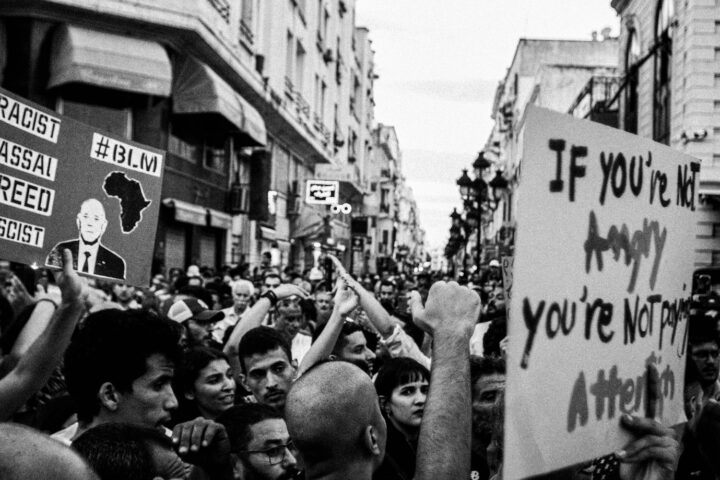
When we look at the statistics on social movements compiled by the FTDES every quarter, we see that “civic” mobilizations – that is, mobilizations around political, civic, and democratic rights – and social mobilizations – whether for labor, wages, or the fulfillment of promises by the state – are vying for the top spot in the mobilization rankings. These mobilizations give the impression of being two parallel lines that never intersect. Why is this intersection so difficult, and what role do political parties play in this difficulty?
On this subject, I think we need to revisit something that has defined the entire post-2011 period: the opposition or rivalry between civil society and political parties. They haven’t worked together, or at least very little. At times, civil society claimed to be doing concrete things, to be connected to society and its needs. It organized training sessions and grassroots initiatives, while political parties were on another planet and became increasingly illegitimate.
What is happening today prompts us to return to Camau’s distinction between the institutionalized revolution and the revolution of dignity, and thus this separation between socio-economic concerns and demands and institutional and political issues. This distinction persists to this day and is particularly evident in the suspicion toward political parties, with the feeling that as soon as political parties get involved, things will fall apart. Moreover, civil society organizations are in a tough spot right now because they, too, are under the thumb of the ruling power, through financial and tax controls, etc., so they, too, are operating in an extremely difficult context. Perhaps aligning with political parties would make things even more difficult.
But on the other hand, that’s a rather simplistic view. In real life, in practice, there are connections and actions that are carried out together. There isn’t a strict separation where no form of collaboration is possible. In fact, when you see protests against the regime, you’ll find political parties there. For example, during the November 29 demonstration – the one where Chaima Issa was arrested – there was a procession where every association and every political party had its own group, and they marched one after another. The connections exist, but there is a lot of suspicion. Let me give you an example. When a protest is organized, the rule is that there should be no political affiliation and that no political party, for example, should display its slogans or flag. Yet, many political party leaders do just that; they break the rules and put themselves forward because they want to claim credit for the action in the name of their party. This kind of behavior increases or reinforces the bonds of rivalry or suspicion between political parties and civil society.
The views represented in this paper are those of the author(s) and do not necessarily reflect the views of the Arab Reform Initiative, its staff, or its board.