






Despite the broadening of opportunities for political participation since 2011 and throughout the democratic transition, the most pressing paradox has been that all indicators point to a gradual decline in participation, particularly among young people, as reflected in voter apathy and a lack of trust in political parties.1 In contrast, others have chosen to join horizontal protest movements as an alternative to traditional structures that impose restrictions on political action and freedom of initiative.2 Under the system established by the 2022 Constitution, however, the roles of all intermediary organizations, as well as channels for both electoral and non-electoral political participation, have been restricted. In this context, Attayar al-Dimuqrati (Democratic Current) in Tunisia has distinguished itself by championing youth representation within its structures and relying on young people to assume various positions outside the party. This is reflected in their high level of representation, particularly in the party’s last two Political Bureaus (2023-2026 and 2026-present), despite the general lack of serious prospects for political activism.
Attayar al-Dimuqrati is a Tunisian political party founded in 2013 that presents itself as a social-democratic party aiming to achieve the revolution’s goals of employment, freedom, and dignity, alongside reform and the fight against corruption.3 Some might readily classify it as center-left because of its social-democratic label, although its positions have not aligned with this classification in practice. This reflects a programmatic and pragmatic orientation that the party has consistently defended and used to justify its reluctance to declare a position on contentious issues such as equality in inheritance, rights, and freedoms. Paradoxically, while this orientation drew criticism from both sides of the secular–Islamist divide, as well as from the right and the left, during the democratic transition, it also became a factor attracting young people within Attayar al-Dimuqrati.
Like most of the political class after 2011, Attayar al-Dimuqrati also sought to establish deeper roots for its platform and organizational activities within Tunisian society. However, the initial surge in party formation (2011-2014), followed by party fragmentation and instability (2014-2021), confirmed that political parties were, by and large, an elite-driven phenomenon that did not necessarily reflect genuine social representation,4 ultimately facilitating their marginalization in the political arena under the current regime.
Despite the above – namely, Attayar al-Dimuqrati’s downplaying of explicit ideology and the weakness of the party system in the country – youth participation figures within the party remain the most significant in Tunisia’s political and party landscape. This makes it imperative to conduct a serious analysis of youth representation within Attayar al-Dimuqrati and monitor its development. Their presence appears to run counter to the broader context, its transformations and upheavals, and most indicators of youth political participation in public affairs. On this basis, drawing on available data and documents, responses from young party members to a questionnaire prepared for this purpose, and findings from three interviews with prominent young figures, this paper seeks to present a general and objective picture of youth participation,5 its sources, and its contexts beyond the figures, however statistically striking. The paper draws on a 26-question questionnaire covering five main themes, ranging from individual and family political history and the reasons and circumstances surrounding party membership, through relationships with party leaders and participation in decision-making, to the impact of political activism on individual career paths and its relationship to the current political context under the 2022 Constitution. Gradually, a complex picture emerged of the relationship between individual political identity and organizational identity, the influence of personal background on the formation and nature of that identity, and the evolution of young activists’ trajectories according to their contexts, relationships, and organizational structures. This revealed a more complex picture behind the numbers.
These figures do not necessarily mean that youth rejuvenation was merely a rational choice. Rather, interviews and data have shown that circumstances propelled young people to the forefront, without the party – whether its leadership or organizational structure – preventing them from assuming senior positions or bringing about major changes within it. The party, which its young members acknowledge as elitist, has witnessed a shift in the professional backgrounds of its members from lawyers to engineers, with young people making up the majority of those at the forefront of Attayar al-Dimuqrati’s political activities. This shift was also generational, marking a separation driven by political calculations and differing perspectives rooted in the generational gap between the older founders and younger activists. The younger activists absorbed an institutional culture shaped by organizational structures and procedures – a legal legacy that reinforced the principle of party unity in the face of upheavals (mass resignations, party mergers, and political repression after 2022). However, as they advanced through the party’s structures and assumed positions within it, they developed their own political identity, which in turn contributed to the evolution of the party’s political, economic, and social platforms. For example, the understanding of the market, the approach to relations with businesspeople, and the fight against corruption changed, while freedoms gained greater prominence in the party’s political discourse. These changes, however, were not driven solely by internal factors. The broader political context was a major variable that influenced the party both organizationally and ideologically. The closing of political space forced the party to renew itself or disappear, and fortunately – or perhaps by fate – it had a sufficiently trained group of young members ready to assume leadership positions. Both within and outside the party, an important but delicate equation emerged: the figures reflected an internal party dynamic that was simultaneously shaped by external pressures. In practice, this equation combined the rationality of political practice within established organizational structures, rules, and regulations with the unpredictable Machiavellian concept of fortune (la fortuna). This prompted young men and women to engage in politics as a “virtue” in the face of necessity, even without positive prospects. As they emphasize, the danger and threat posed by authoritarianism transformed their political engagement into a politics of resistance, sustained over the years by Attayar al-Dimuqrati’s experience and their own individual experiences.
This paper seeks to explore these dimensions by examining the details of the generational transition that reshaped the party’s leadership and brought a younger generation to the forefront to confront the dilemma of politics: the tension between the public sphere, guided by democratic values, and private concerns, including fear of politics itself and anxiety about personal and professional futures. The paper’s primary concern was to interpret the figures and variables with minimal intervention, particularly as it seeks, above all, to understand the political and democratic question in Tunisia by examining its political actors, activists, and their ideas.
Youth Rejuvenation in Attayar al-Dimuqrati: The Appeal of the Numbers and Prospects for Political Participation
A review of the figures and statistics on youth membership in the third and fourth Political Bureaus (2023-2026 and 2026-present) suggests, at first glance, that youth rejuvenation and renewal are among their most prominent features. With only three members continuing from the previous Political Bureau – Wassim al-Hammadi, Oumayma ben Abdullah, and Wasel al-Hajlawi – 84% of its membership was renewed.
Meanwhile, the average age declined from 35.5 to 34.5 years. Considering that the average age is affected by the representation of retirees (one seat), whose representative is now older, the average would otherwise have been lower. Notably, the youngest member is 23 years old, one year younger than the youngest member of the previous Political Bureau. Accordingly, the proportion of young members under the age of 35 rose from 47% to 52%. When members aged 35-39 are also included, this proportion rises to 71%.
Figure 1 – Distribution of Young Members (Up to Age 35) in the Political Bureau of Attayar al-Dimuqrati
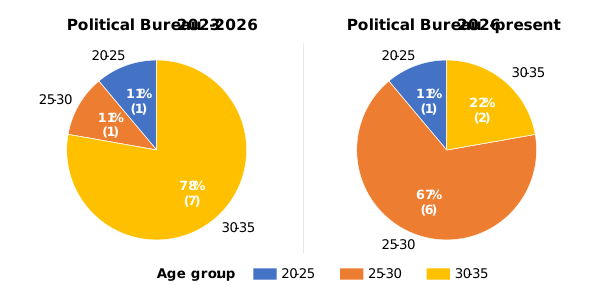
The percentages are also high in the Fourth Executive Bureau, exceeding 57%, with several of its members continuing to serve in the Executive Bureau, the Political Bureau, and the National Congress. Overall, the 30-39 age group dominates membership in both bureaus. Members of this age group have assumed senior positions within the party, including seats on the Fourth Political Bureau, the presidency of the Executive Bureau, and the position of General Coordinator of the party, in addition to membership in the Executive Bureau. A review of the membership of the previous Political Bureau reveals that the most prominent figures have remained active since the third term, suggesting that renewal is carefully planned and managed in practice. This also indicates that these individuals generally possess the necessary training and experience in organizational work and leadership positions. Of the current Political Bureau’s members, three also serve on the Executive Bureau (one more than in the previous two bureaus), while the remaining members previously served on either the Executive Bureau or the Political Bureau.
Nevertheless, despite the significance of these figures, their implications become clear only when considered within the broader context of the party’s evolution – both its identity and organizational structures – and the evolution of young members’ own identities. Their statistically significant presence today is the result of intersecting factors linking their personal histories with the party’s history, culminating in a transition driven by internal factors – changes in the party’s identity and structures, accompanied by the expanding role of young people – and external factors, particularly the rapid shift from democratic transition to authoritarian rule. Consequently, political activism and the role of young people within it have acquired different meanings, reflecting new political stakes and considerable risks alongside declining returns and effectiveness. Political activism has thus become primarily a struggle for survival in the face of systematic restrictions on party-based political activity and civic engagement.
The Generational Shift Within Attayar al-Dimuqrati: Between “Killing the Political Father” and the Maturation of Party Politics
Most of the young Attayar al-Dimuqrati figures active on the political scene today had no political experience before joining the party. A significant number began their activism in the party’s local offices or helped establish them. However, the main factor that initially motivated them to join was the appeal and charisma of the party’s leadership in the political context the country was experiencing. Mohamed Abbou, Samia Abbou, and Mohamed Hamdi emerged as political icons who addressed pressing needs, particularly through their direct and radical approach to the issues at hand, as described by Oumayma ben Abdullah. According to young activists, these figures offered a different perspective, alongside the symbolic and historical legacy they carried as opposition figures dating back to before 2011.
At the same time, according to young activists, none of this would have been possible without the political openness the country had experienced. Parliamentary deliberations, the drafting of the constitution, and debates over public affairs opened up new spaces worth entering as young political actors seeking a place from which to participate actively in society. For these activists, Attayar al-Dimuqrati represented a space where young people’s potential was recognized. Most affirmed that there were no significant obstacles, whether at the local or national level, concerning leadership, communication, membership, or candidacy for positions within or outside the party. This enabled some of them – such as Ziad al-Ghannai, representative of Tunisians abroad for the France 1 constituency, member of parliament, deputy secretary-general of the party, and member of its Political Bureau – to join the party, assume positions within it, or represent it in political institutions. This was possible even during the democratic transition, which created a highly competitive environment, particularly during high-stakes political events such as elections.
These factors appear important in assessing the early stages of youth participation, but the most significant factor was the party itself. In its early years, Attayar al-Dimuqrati did not present a fully developed, traditional political identity that imposed preconditions on young people who were still forming their own political identities. This contrasted with leftist parties, where new members undergo intensive training under the guidance of a more experienced party member, or religious parties, where recruits undergo training courses after receiving an endorsement.6 Attayar al-Dimuqrati lacked substantial ideological party documents that could provide a coherent intellectual and ideological framework, particularly amid the secular–Islamist divide that persisted throughout much of the democratic transition. According to respondents, the party adopted an “operational” and “programmatic” approach, or was simply engaged in “party management,” without a preexisting conventional ideological alignment that would translate the broad label “social-democratic” into theoretical ideas and, subsequently, political positions. This exposed the party to criticism over contentious issues such as equality in inheritance, rights, and freedoms. At the same time, young members themselves generally lacked firmly established political ideas or overarching theories, as they were primarily seeking opportunities and structures for activism and participation. In practice, what mattered most was unconditional recognition and access to opportunities. This recognition was reflected in the party’s organizational structure. Young people were not confined to conventional frameworks, such as youth or women’s representative offices, but instead enjoyed opportunities for representation across all party structures. The party rejected the establishment of such representative bodies on the grounds that they had become mechanisms of exclusion and merely symbolic representation. This approach resonated with young activists who had not undergone training in major political ideas and ideologies before joining party structures that did not restrict them to age or gender categories, as confirmed by Wassim al-Hammadi and Oumayma ben Abdullah. The initial orientation session for new members focuses exclusively on “identity and political line.”7 The latter is a brief document that has lacked theoretical elaboration since 2013. Respondents also made no mention of any publications or references that the party leadership required them to read. At the same time, the fundamental organizational principle was open competition for party positions and political office.
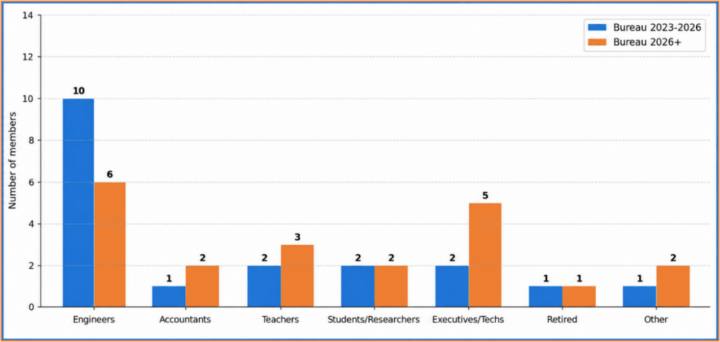
Consequently, political awareness and political organization can be seen as interconnected factors in the development of young activists within Attayar al-Dimuqrati. While their political identities took shape within the party without any major preexisting theoretical frameworks, the party’s organizational structures provided some of them with opportunities to gain experience in organizational work. This was particularly true of the young members who have remained active to this day and assumed leadership positions during critical periods in the party’s history. Younger members took on transitional responsibilities for managing the party following the resignation of Secretary-General Ghazi Chaouachi and a significant number of Political Bureau members in December 2022. This experience was instrumental in absorbing the shock of the departure of prominent and symbolic figures, particularly since these resignations were not the first, having been preceded by the resignation of founding member Mohamed Abbou in December 2020. The departure of these prominent figures created space for the idea of party organization to become firmly rooted among young activists. Their departure, particularly as they were lawyers, also marked the beginning of a decline in the rigid legal and procedural approach that had characterized the party’s internal organization. Meanwhile, a new wave of engineers began to emerge within the party. Oumayma ben Abdullah emphasizes that the legacy of the departing figures lay in their respect for the organization and its structures. However, young activists found themselves in an organization increasingly responsive to operational considerations and freed from the “lawyer’s mantle,” a transformation that eventually found expression in the party’s discourse and documents. History may have favored lawyers as the party’s founders, but subsequent developments favored other professional elites, primarily engineers, who had initially been attracted to the party’s practical, ideologically unburdened character. These same elites would gradually contribute to shaping the party’s identity alongside the development of their own political identities.
Although Wassim al-Hammadi considers the phrase “killing the political father” particularly significant, he agrees that the organization broke away from its iconic figures. As a result, it became a space more accommodating to young people, particularly since the resignations reflected a conflict of interests and a reorganization within the framework of legitimate political activity, involving the Political Bureau and the National Congress, over the party’s future and alliances. At the same time, despite its internal changes and transformations, the party remained capable of accommodating younger political actors. These same changes contributed to the formation of the party’s political identity and its incorporation of the political identities of young people.
Young activists emphasize that the merger with the Democratic Alliance8 (16 October 2017) was significant because it introduced an ideological dimension into the organization for the first time. Notably, the merger document included the term “the left”. This same “left”9 would subsequently distinguish itself, both symbolically and in terms of identity, from the older founding generation following its departure from the party. It would also move away from the rhetorical framing of broad concepts such as justice, the fight against corruption, and reform, which the party’s early leaders had formulated as instruments of political struggle against all sides. Consequently, it can be argued that the development of young members’ political awareness within the party began with these figures and under their influence, before taking on a character of its own through party organization. Accordingly, the party’s documents outlining its major ideological and programmatic orientations did not emerge until the third and fourth bureaus – following the departure of a substantial portion of the older generation. These documents reflected an ongoing process of ideological and intellectual development within the party, as well as a similar process among the young activists who were beginning to assume leadership roles within the organization.
In practice, Attayar al-Dimuqrati’s political identity has taken shape between an older generation, professionally and ideologically rooted in the legal profession, and a younger generation, with a different professional and intellectual background, predominantly drawn from engineering. This reflects an operational approach that came to dominate the party’s thinking, gradually evolving – under the influence of internal developments and broader contextual shifts – toward the adoption of an intellectual and theoretical dimension consistent with the social-democratic identity that all young activists regard as the party’s defining characteristic. As Wasel al-Hajlawi emphasizes, this generational transition was a necessity, but it would not have been possible without the traditions of organizational and institutional work that prepared the younger generation to assume leadership through gradual advancement across all party structures, from the local to the central level.
Figure 2 – Professional Distribution: Bureau 2023-2026 vs 2026+
The transition unfolded in phases and at several levels. One indication of this shift, once the necessary organizational and identity-related conditions had matured, was the transformation of the party’s political discourse. Within this broader trajectory, concepts were recontextualized and redefined through a different relationship with the revolutionary legacy. Wassim al-Hammadi acknowledges that the revolutionary content that dominated the early period gradually receded, giving way to a political orientation aligned with the demands of governance, which had become apparent during the party’s brief experience in government, and with the need to establish a clear political identity that resonated with its target constituencies. As al-Hammadi confirms, the discourse was initially populist but evolved into a party-based discourse grounded in its organizational structures. Nevertheless, the party’s political identity still requires further development, particularly in the current context. According to Wasel al-Hajlawi, who confirms this same trend, this represents both a political undertaking and an existential challenge.
Activists noted that young members had been instrumental in initiating the drafting and development of the party’s policy documents since the previous term, particularly those concerning evaluation and review and economic policy. Wassim al-Hammadi explains that concepts such as the market economy entered the party’s thinking following a reassessment of its anti-corruption slogan. Previously, the fight against corruption had resembled an open-ended war that placed the party in a position of outright hostility toward businesspeople. By contrast, the new policy positions recognize the importance of wealth creation while explicitly affirming the state’s social and economic role.
The Political Dilemma Between Individual Destiny and Civic Commitment
The dynamics of the party’s organizational development and evolving identity were not devoid of personal and individual dimensions, even though the organization, in its structural and procedural sense, remained central to these dynamics. One manifestation of this personal dimension was the charisma of the founding leaders, which did not develop into a personalization of the party that could have led to its disintegration following the departure of its iconic figures. This relates to the notion of political fatherhood discussed earlier. During crises, therefore, the prevailing tendency was always to reaffirm the importance of party organization. One example was the document calling for an easing of internal tensions, which several current members, including some young activists, helped draft in an effort to bridge internal divisions. Although this document did not prevent the resignation of the Secretary-General and members of the Political Bureau, it signaled the emergence of institutional work as an initial, foundational framework shared by the remaining members of the older generation (Nabil al-Hajji, Hisham al-Ajbouni, al-Arabi al-Jalassi, among others) and the emerging younger generation.
In general, the subjective and personal dimension is an inescapable aspect of politics.10 Among young members of Attayar al-Dimuqrati, however, it has taken on another dimension. First, they now constitute a relatively homogeneous group in terms of professional background and age. Second, amid declining party membership and the need to rely on existing activists to establish the principle of rotation in party positions,11 certain names recur, particularly among the party’s most prominent members. This lends organizational relationships a personal dimension through sustained collaboration across different periods and during significant political challenges. Indeed, it gives renewal itself a different meaning, as the rotation of positions has occurred among those who remained active in the party both before and after 25 July 2021.
Consequently, relationships centered on the party have long been a stable and enduring part of young activists’ daily lives. The party has become a “second family,” particularly given that most of these activists do not come from families with a history of political engagement. This personal bond, forged through party membership and organizational relationships, appears more likely to endure because of the benefits of recognition and participation discussed above, as well as positive relationships with party leaders. Young members rate these relationships as good (25%) or very good (75%). They also consider the leadership receptive to their concerns, with all young activists confirming that they have discussed their political and party trajectories and future prospects with party leaders without encountering any significant difficulties.
This does not contradict the party’s organizational culture. However, in the current context, it may also be regarded as a side effect of the isolation of political parties, which, as activists emphasize, have been reduced to reacting rather than acting because of the shrinking public sphere. Most political parties, including Attayar al-Dimuqrati, face considerable difficulties in carrying out their activities. For example, the organizing committee of the party’s most recent congress in 2026 encountered significant difficulties in securing a venue. All the young Political Bureau members interviewed confirmed that the obstacles to political activism stem primarily from the broader political context. Ultimately, alongside the party’s organizational and identity-related transformations, this context appears to have been the decisive factor in bringing young people to the forefront.
In this context, young activists do not deny the existence of an ethical dilemma associated with political engagement. Most respondents (75%) affirmed that political activism does not conflict with their professional activities but rather supports them. Nevertheless, political commitment comes at a high cost, particularly in economic and social terms, including the loss of employment, isolation, or exclusion. Young activists working in the private sector reported experiencing no harassment, unlike those employed in the public sector.12 This makes serious consideration of one’s personal future both necessary and legitimate, particularly for a professional group with substantial employment opportunities in Tunisia and abroad. In practice, however, most respondents believe that politics, even if it has now become a struggle for survival, is a necessity rather than a luxury. They regard it as the only means of realizing the overarching ideals that the party currently represents, although most consider the prospects for change in the near future limited and uncertain. This was reflected in their responses to the question: “How do you assess the hope offered by political activism in the current context?”
Ultimately, youth political participation in Attayar al-Dimuqrati can be understood as the complex outcome of multiple factors and circumstances. These range from organizational flexibility and the party’s approach to political identity, reflected in a broad political orientation and direct, action-oriented discourse within structures based on open competition without restrictions based on social category or gender, to the cumulative experience members have gained both within and outside the party. This experience has contributed to the development of leadership skills and theoretical perspectives, alongside the opportunities created by circumstances that necessitated renewal and a generational transition from older to younger members. Consequently, the party’s organizational structures have changed, its policy documents have evolved, and the political substance of its discourse has been enriched over a period of at least 10 years. While necessity and the broader political context undeniably propelled young people to the forefront, they were able to fulfill their responsibilities only because of party traditions that fostered training and merit-based competition. Ultimately, however, they have found themselves at the forefront of what they themselves describe as a phase characterized by the monopolization of power and the imposition of a single viewpoint.
The generational transition within Attayar al-Dimuqrati required a minimum level of political and organizational culture that enabled young people to engage in political activism. However, this culture emerged and was tested in transitional or authoritarian contexts – exceptional circumstances in which democracy cannot establish its own standards through stable institutions. Necessity, or fortune (la fortuna) in the Machiavellian sense, imposed other considerations, some of which the activists themselves consciously acknowledge. Politics today has become a struggle for survival in the face of authoritarianism, confronting them with an ethical dilemma between protecting themselves and continuing to defend ideals that are eroding within a closed political space where there is no clear upper limit to what can be expected. Overall, the story of Attayar al-Dimuqrati’s young activists transcends their significance as a statistical or demographic category. Instead, it reflects the tension between necessity, political context, and freedom of political action in Tunisia’s democratic process, where democracy itself has yet to become a clearly defined, guiding, and internalized supreme value.
Endnotes
- National Youth Observatory, 2013 Youth Barometer: Youth and Participation in Public Life, available at https://shorturl.at/7DA3v. See also Youth and Electoral Participation in Tunisia: The Case of Ettadhamen Neighborhood, available at https://shorturl.at/YvNkG. See also I Watch, Youth Opinion Survey on Participatory Democracy and Local Governance in Tunisia, available at https://shorturl.at/NPBE6 ↩︎
- Sawsan Fray, “‘Horizontality’ in Protest Campaigns: Critical Perspectives and Lessons Learned,” Arab Reform Initiative, 11 April 2025, available at https://shorturl.at/C58Rp ↩︎
- Attayar al-Dimuqrati, Founding Declaration, available at https://shorturl.at/yGWg4 ↩︎
- Political Parties in the Arab World, Centre for Mediterranean and International Studies, Tunis, 2023, available at https://shorturl.at/Qpija. See also The Political/Constitutional Crisis in Tunisia: Background and Prospects, Arab Center for Research and Policy Studies, Tunis, 2021, available at https://shorturl.at/swRem ↩︎
- In order of interview: Oumayma ben Abdullah, Wassim al-Hammadi, and Wasel al-Hajlawi. ↩︎
- See Jalal al-Din al-Ruwais, The Organizational and Structural Characteristics of the Islamic Movement in Tunisia: Collective Action, Karam al-Sharif Publications, Tunis, 2014. ↩︎
- Attayar al-Dimuqrati, “Identity and Political Line,” official website of Attayar al-Dimuqrati, available at https://shorturl.at/AVnyL, accessed 12 July 2026. ↩︎
- The Democratic Alliance is a Tunisian political party founded in 2012. It emerged from a convergence between members of the Constituent Assembly who had withdrawn from the Progressive Democratic Party as part of its reformist current, the Reform and Development Party led by Mohamed Goumani, and other independent politicians. ↩︎
- The quotation marks are necessary because it became apparent that young Attayar al-Dimuqrati activists believe the party’s ideological orientation requires further development and can be developed further. ↩︎
- Mattei Dogan, “Le personnel politique et la personnalité charismatique,” Revue française de sociologie 6, no. 3 (1965), pp. 305–324. ↩︎
- The author did not have access to relevant figures or statistics, but this information was confirmed by party members themselves. The most recent statistics on Attayar al-Dimuqrati membership date back to 2018. The published figures include everyone who has joined the party since its establishment. ↩︎
- This information applies to all members, including those who are not young people. ↩︎