





Introduction
Since the 2013 coup d’état and the consolidation of President Abdel Fattah al-Sisi’s rule, the human rights movement (HRM) in Egypt has sought to maneuver amid multiple constraints. Its scope of action has narrowed dramatically, as legal persecution, travel bans, asset freezes, and the forced closure of organizations have decimated what was once a vibrant field, especially in the aftermath of the 2011 Revolution. The movement has not disappeared, however. Instead, it has adapted, fragmented, and, in some cases, quietly reconfigured its methods and ambitions. This contribution aims to reflect on the tension between the external appearance of stasis – if not metastasis – and the often-invisible forms of resilience and reinvention that persist under authoritarian pressure.
Rather than offering a nostalgic account of a lost “golden age,” this piece situates the Egyptian HRM within a longer trajectory of authoritarian containment and activist adaptation. It argues that although the political space has shrunk, the field has not been entirely static. New generations are engaging with rights discourse in renewed, hybrid, and sometimes contradictory ways. At the same time, it raises questions about sustainability, political imagination, and whether the movement can regain relevance beyond its traditional constituencies. The first section briefly outlines the context of repression and control in the post-2014 era. The paper then examines how the HRM has shown resilience in recent years. In the following section, we look at how the movement has reinvented itself, exploiting new opportunities. Finally, we sketch out some of the future possibilities for the movement. 1
Repression and Control in the Post-2014 Era
Since 2013-2014, the consolidation of executive power and the progressive closure of independent civic space have reshaped Egypt’s political order. A dense framework of restrictive laws governing protest, counterterrorism, media, and civil society has been paired with the extensive use of prolonged pretrial detention, exceptional courts, and broadly framed charges such as “spreading false news” or “joining a terrorist group.” These tools have been applied not only to high-profile political opponents but also to journalists, lawyers, human rights defenders, labor organizers, and ordinary citizens voicing economic grievances. Criticism of state policy, whether expressed in the streets, online, or through institutional channels, regularly triggers arrest, investigation, or other reprisals.
Patterns documented over the past decade point to the normalization of practices such as enforced disappearance, the “recycling” of detainees into new cases after release orders, and the denial of adequate medical care in detention. Allegations of torture and ill-treatment remain widespread, and impunity for past violations persists. The scope of repression extends beyond the political sphere; women, LGBTQ+ individuals, religious minorities, refugees, and residents of informal housing areas have been subject to discrimination, eviction, or targeted prosecution. Socioeconomic activism in defense of housing rights, labor rights, or environmental protection faces the same security logic as overt political dissent, with police dispersals, arrests, and travel bans limiting organizing capacity. In this environment, repression is not episodic but structural, embedded in the legal, administrative, and security apparatus, and closely tied to a broader political economy that prioritizes regime stability, military-led development, and centralized control over public life.2
These practices have also been echoed in the state’s discourse. Issues such as security and economic development have taken precedence over democracy and the preservation of human rights. For instance, the share of President al-Sisi’s public statements that mention “human rights” has varied over the years (Figure 1).3 Such references appeared in about one speech in nine in 2017, 2019, and 2022, all years of heightened international exposure, against about one in sixteen in 2018, 2020, and 2021. In 2019, as Egypt chaired the African Union and hosted the first EU–Arab League summit, nine of the twelve speeches mentioning human rights were delivered in international fora, while in 2022, hosting COP27 renewed such mentions, often linking environmental concerns to human rights. The year 2021 stands out for a different reason: the launch of the National Human Rights Strategy in September produced the speech with the highest number of references in the entire corpus, delivered before a domestic audience. After COP27, the share fell below 4 percent of speeches in 2023 and 2024, and no speech in the first quarter of 2025 mentioned human rights.
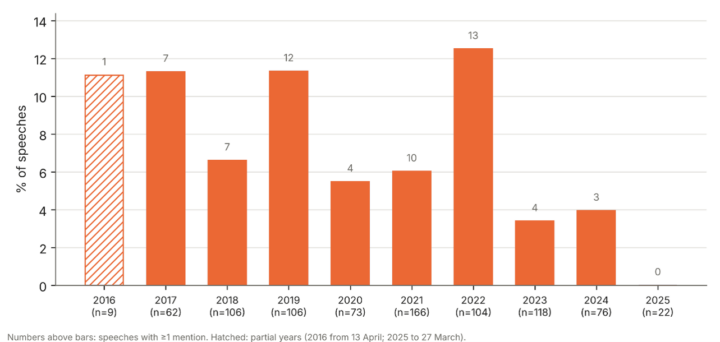
Figure 1. Share of the Egyptian President’s Speeches Mentioning Human Rights, by Year (2016–2025)
But more to the point, when comparing the occurrence of other themes, such as security or the economy, with human rights, it becomes easy to see how little the president mobilizes this theme (Figure 2).
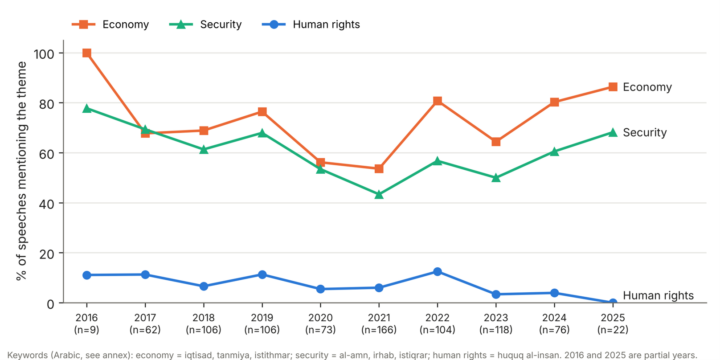
Figure 2. Share of the Egyptian President’s Speeches Mentioning Security, Economy, and Human Rights, by Year (2016–2025)
Moreover, as Figure 3 shows, when the president mentions human rights, he usually does so in formal settings, either in international fora or in bilateral press conferences with foreign dignitaries (heads of state, etc.). International fora account for less than a quarter of his speaking engagements (23 percent) but for three-fifths of the speeches that mention human rights (61 percent), while only one domestic speech in fifty does so.4
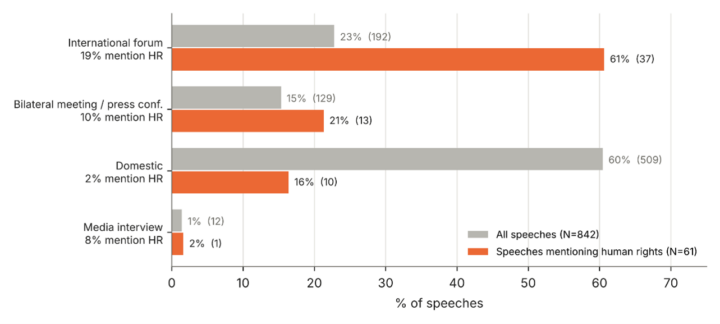
Figure 3. Setting of Public Speaking: All Speeches Compared with Speeches Mentioning Human Rights (2016–2025)
Taken together, this pattern suggests that references to human rights serve less as a consistent policy commitment than as a rhetorical device, mobilized during moments of diplomatic scrutiny. Their selective and situational use underscores both the regime’s instrumental approach to rights discourse and the limited pressure from international actors to ensure that such language translates into substantive change.
Behind the discourse, the tools of repression have evolved over the years as well. Beyond direct forms of repression, state agencies have expanded the legal arsenal to contain public activities more broadly. This was especially visible in 2018-2019, coinciding with President al-Sisi’s reelection in 2018 and the constitutional revision the following year. In 2018, for example, the president promulgated two laws that imposed several constraints on freedom of expression, whether by press organizations or on the internet.5 The clearest attack on the HRM, however, was the “NGO Law” No. 149 of 2019.6 According to Amnesty International, this law gave the authorities “overbroad powers to oversee the registration, activities, funding and dissolution of NGOs,” also limiting the scope of their activities and prohibiting them from conducting research and publishing findings.7 Since then, state agencies have heavily relied on these legal tools to prosecute indiscriminately. For instance, Egypt has become an international “leader” in internet censorship, blocking hundreds of websites.8
State institutions have also invested heavily in shaping public narratives that delegitimize certain causes or actors, framing them as either alien to “national values” or as threats to public morality. This stigmatizing rhetoric has been particularly pronounced toward feminist organizing and LGBTQ+ rights advocacy, which are often portrayed as foreign-imported agendas incompatible with Egyptian society. Such framing not only narrows the space for public debate but also exposes activists to heightened social hostility and legal vulnerability.
The same logic has been extended to cultural and artistic expression. Popular music genres such as Mahraganat have been denounced for undermining “public taste,” while certain forms of online self-expression, especially on platforms like TikTok, have been subjected to targeted crackdowns. In recent years, the police have arrested multiple TikTok content creators on morality charges under Articles 25 and 26 of the Cybercrime Law, illustrating how cultural production and everyday digital activity can be reclassified as criminal acts when they fall outside state-sanctioned norms.9
In other cases, state agencies often seek to depoliticize certain issues by technicizing them. The environment, for example, took center stage during COP27 in Egypt (held in November 2022), when officials promoted a narrative focused on climate change mitigation and adaptation. While this opened some space for environmental activism, state agencies downplayed the political dimensions of the crisis, pushed “greenwashing” initiatives, particularly in large-scale plastic industries, and sought to turn it into a new source of rents from international funding partners.
One final dimension of the constraints imposed on civil society organizations is economic: restrictions on banking and foreign transfers, combined with state interference in donor approvals, have severely reduced revenues, forcing many organizations to downsize or scale back operations.
Resilience: Opportunities, Alliances, and Strategic Shifts
Despite a decade of deepening authoritarianism, Egypt’s HRM has endured through a combination of persistence, adaptation, and creative reconfiguration. This resilience has not been uniform. Some organizations have disappeared, networks have fractured, and capacity has been lost. Yet others have maintained relevance and reach despite intense constraints. Their adaptations can be grouped into three interlinked areas: coalition-building under pressure, broadening operational modalities, and anchoring rights in everyday struggles.
Coalition-Building Under Pressure
One major effect of repression since 2013 has been the fragmentation of the movement. Gender rights groups have often operated in isolation from environmental campaigners; labor organizers have had few points of contact with cultural rights defenders. This siloing has reduced the ability to negotiate with donors or mount broad-based campaigns, and it has allowed the state to compartmentalize dissent. Yet in a handful of instances, cross-sector alliances have produced significant outcomes.
The Titan Cement litigation is one such case. For years, residents of Wadi al-Qamar in Alexandria complained of respiratory illnesses linked to coal use at the Alexandria Portland Cement Company’s plant. Beginning in 2015, environmental advocates, public health experts, and human rights lawyers pooled their expertise to collect air quality data, medical records, and testimonies from affected families. Human rights organizations were instrumental in convening these diverse actors and framing the issue not only as an environmental hazard but also as a violation of fundamental rights to health and dignity. Their role in sustaining legal strategies, coordinating expert input, and ensuring documentation underpinned the eventual ruling. In 2024, after a protracted legal battle, the court awarded 1 million Egyptian pounds in damages to a resident and his child, explicitly citing the company’s liability for environmental harm. This ruling, though limited in scope, set a precedent for corporate accountability and demonstrated that even in a hostile judicial environment, litigation anchored in strong evidence and cross-sector collaboration might yield tangible wins.10
The “30,000 Teachers” campaign offers another model. When the Ministry of Education launched a recruitment drive for public school teachers in 2022, thousands of qualified candidates were eliminated after medical and fitness assessments conducted at a military academy. The fitness assessments disproportionately excluded pregnant women, individuals deemed overweight, and people with chronic illnesses. A leading human rights organization worked with teacher representatives to challenge these exclusions in court, building a coalition that linked labor rights, gender equality, and freedom from discrimination. The case attracted attention from other public-sector workers, notably state-employed imams facing similar discriminatory recruitment practices, expanding the network of allies beyond the original constituency.11 Although the litigation has yet to yield a definitive legal reform, the campaign succeeded in delaying recruitment procedures, drawing national attention to discriminatory hiring practices, and emboldening other public-sector workers to mount comparable challenges.
Gender justice actors have also developed cross-sector collaborations that link gender-based advocacy to broader social and economic concerns. Examples include partnerships with local development associations to integrate women’s rights into community health, literacy, and economic empowerment programs; collaborations with labor rights groups to highlight gendered dimensions of wage discrimination and unsafe working conditions; and joint initiatives with environmental actors around access to clean water and safe public spaces. By embedding gender justice in such multi-issue campaigns, these alliances make it harder for authorities to dismiss them as a “foreign” agenda and help expand constituencies for women’s rights beyond Cairo-based networks.12
At another level, the Warraq Island anti-eviction struggle has shown how community-led resistance can be amplified through alliances with lawyers, independent journalists, and urban rights advocates. Facing a state-backed redevelopment plan, residents have struggled against police raids, travel restrictions, and the closure of the island’s only health clinic. Coordinated legal actions delayed some evictions, while media coverage reframed the dispute from a localized land conflict into a broader question of the right to housing and the social costs of “development.”13
Beyond Egypt’s borders, diaspora actors have become vital partners. Operating from relative safety, exiled defenders and organizations maintain documentation projects, lobby international institutions, and keep Egypt’s rights record on donor agendas. Diaspora feminist collectives have organized high-visibility online campaigns for survivors of gender-based violence.14 Independent media outlets such as Al-Manassa continue to operate inside Egypt despite repeated blocking, legal harassment, and arrests of staff. Their investigative reporting often covers issues absent from state-controlled or pro-government outlets. This combination of diaspora-based advocacy and independent domestic journalism has helped sustain visibility and advocacy channels that would otherwise have been closed.
Broadening Modalities
The closing of civic spaces has forced the human rights movement to diversify its operational tools. In the gender field, the most visible shift has been toward digital organizing, particularly through initiatives that emerged in 2020-2021 to challenge sexual violence and impunity. Campaigns such as Assault Police and Speak Up, Instagram-based platforms for sharing survivor testimonies, played a central role in amplifying women’s voices. This momentum culminated in the Fairmont case, in which several men from influential families were accused of gang-raping a young woman at Cairo’s Fairmont Nile City Hotel in 2014. When details of the assault surfaced years later through social media, they triggered an unprecedented wave of testimonies and pressure on authorities to investigate, ultimately pushing prosecutors to open a case after years of silence. These initiatives mobilized decentralized, youth-driven communities that bypassed state-controlled media narratives and created a new digital feminist public sphere.
Activists have used such platforms to circulate survivor testimonies, crowdsource legal advice, and pressure authorities to act, leading to arrests of perpetrators in a context where sexual violence cases often go unpunished. Campaigns have blended humor, storytelling, and visual performance to address gender-based violence (GBV) and bodily autonomy, while offering audiences participatory roles through sharing, commenting, and submitting testimonies, without the risks of physical presence. This digital turn has been partly defensive, reacting to a surge in morality-based prosecutions targeting women online under Articles 25 and 26 of the Cybercrime Law. Still, it has also expanded the reach and cultural idioms of rights work. By tapping into the immediacy and aesthetics of social media, these initiatives have drawn in new constituencies, especially young women outside traditional activist circles, and created a more diffuse but harder-to-censor feminist public sphere.
Environmental actors have made similar digital pivots to sustain engagement under shrinking civic space. In some cases, environmental NGOs and informal collectives have hosted online art festivals and virtual exhibitions linking ecological issues (e.g., Nile pollution, waste management, and climate change) to cultural expression. These events, often held in partnership with artists, student groups, and diaspora cultural spaces, have drawn audiences unlikely to engage with formal NGO reports and reframed environmental harm as a matter of community identity and public health. University-based “eco-clubs,” now present on over 25 campuses, have used social media to coordinate clean-up drives, tree-planting initiatives, and awareness campaigns, creating decentralized hubs for environmental education that blend rights discourse with practical action.
This digital shift has also been defensive: as environmental advocacy becomes more politically sensitive, especially when linked to state-led megaprojects or industrial pollution, activists have increasingly relied on secure communications tools and encrypted channels to coordinate research, share data, and plan campaigns. Secure communications training thus appears today as a baseline necessity, not only for protecting activists from cybersurveillance, but also for enabling coordination across dispersed networks of scientists, community leaders, and rights advocates.
Legal advocacy remains one of the few arenas where structured action can occasionally deliver results. Beyond Titan Cement, litigation has targeted the privatization of public beaches along the Mediterranean and the industrial pollution of Lake Mariout. These cases have mobilized fishing communities, environmental scientists, and legal experts, framing environmental degradation as a violation of public space, health, and labor rights. In the housing sector, lawyers have defended residents in Ezbet Abu Ragab and other neighborhoods against eviction orders,15 sometimes securing improved compensation or alternative housing even when ultimate legal victories proved elusive.
Anchoring Rights in Everyday Struggles
To broaden their reach and counter accusations of serving foreign agendas, many human rights actors are framing advocacy around material grievances that resonate widely. On Warraq Island, housing rights are inseparable from access to livelihoods and social networks. In the teachers’ mobilization, discrimination is framed as a threat to professional dignity, income security, and the quality of public education. Environmental campaigns connect industrial pollution to healthcare costs, food security, and agricultural sustainability.
In the gender field, anchoring rights in everyday struggles has meant linking GBV advocacy to the economic impacts of austerity and subsidy cuts. Organizations have documented how inflation, wage stagnation, and cuts to public services exacerbate women’s vulnerability to domestic violence, limit their mobility, and reduce access to legal redress. Campaigns that connect safety, income security, and access to affordable childcare have resonated beyond the traditional feminist base, framing gender equality as integral to household survival and community well-being.
This framing has strategic value. It draws in communities with no prior connection to formal rights discourse, builds coalitions across socioeconomic divides, and complicates the state’s efforts to isolate activists from the public. It also supports a shift toward contextual impact metrics: success is measured not only in court victories but in coalition durability, narrative change, and the ability to maintain a visible rights presence despite repression. In cultural rights work, this might mean preserving threatened heritage, as in campaigns against cemetery demolitions, or strengthening marginalized identities, as with the NubaTube digital archive.16
Reinvention
Over the past decade, the Egyptian human rights movement has not only resisted repression but has also reinvented its forms, spaces, and narratives to survive in a context where traditional advocacy channels are blocked. Faced with the closure of physical spaces, the criminalization of public gatherings, and pervasive surveillance, activists have shifted toward digital platforms, opportunistic political interventions, and cultural or socioeconomic entry points that resonate with broader publics.
Digital and Independent Media Ecosystems
The internet has become both a refuge and a battleground for rights work. Independent digital media like Mada Masr, Al-Manassa, Al Mawqef Al Masri, and Zawia3 have emerged as vital platforms for HR-aligned journalism that blends investigation, advocacy, and public engagement. They have documented cases from labor disputes to environmental degradation and corruption in megaprojects, often publishing material that would be impossible to circulate in state-controlled outlets. By operating online and relying on dispersed editorial teams, these platforms adapt to censorship while building transnational readerships, including members of the Egyptian diaspora.
Social media has given rise to an even more decentralized form of advocacy. While social media has long played an important role in Egyptian politics, users have increasingly turned to platforms such as TikTok and Instagram instead of Facebook and X. Feminist campaigns, often led by young activists outside formal NGO structures, have mobilized audiences around gender-based violence, sexual harassment, and bodily autonomy. They bypass official media gatekeepers, use humor and visual storytelling to reach audiences unfamiliar with rights discourse, and offer safe ways for individuals to participate through liking, sharing, and commenting without physical presence. This “social media-native” activism has expanded the human rights movement’s demographic base and injected new cultural idioms into its messaging.
In the socioeconomic field, similar digital adaptations have emerged. Housing rights groups and labor activists have turned to Facebook Live broadcasts, WhatsApp channels, and YouTube interviews to share testimonies from affected communities, bypassing mainstream media censorship. These digital tools have allowed activists to coordinate across cities and villages, maintain public pressure, and connect with sympathetic audiences abroad.
Strategic Use of Political Moments
In a constrained political environment, moments of heightened visibility, whether planned or unexpected, offer rare opportunities for advocacy. The COP27 Alaa Abdel Fattah campaign is one of the most striking recent examples. As Egypt hosted the 2022 UN climate conference in Sharm el-Sheikh, human rights actors leveraged the international spotlight to foreground the plight of a political prisoner emblematic of broader repression. Environmental rights activists coordinated with democracy advocates, diaspora groups, and foreign journalists to insert human rights into an agenda officially centered on climate policy. This convergence forced international delegations to respond to issues of imprisonment and civic space alongside environmental commitments.
This tactic draws on earlier experiences, such as the anti-coal campaign coalition (2011-2015), which united environmentalists, public health professionals, labor groups, and urban activists to oppose the introduction of coal in cement production. While the policy was eventually implemented, the campaign demonstrated the potential of cross-sector mobilization and sophisticated public messaging, tactics that informed later efforts like the Titan Cement case, where joint legal, scientific, and community action resulted in a rare environmental victory in court.
Gender and economic rights actors have also learned to seize such moments. The 2020-2021 online wave of testimonies against sexual harassment in Egypt, sparked by the “Fairmont case” and the Assault Police Instagram account, generated unprecedented public debate and led to limited but tangible legal reforms, such as the adoption of witness protection clauses in sexual violence cases. Similarly, sudden mass layoffs in state-owned industries have prompted labor and housing rights groups to frame the issue as part of a wider socioeconomic rights crisis, drawing links between job loss, eviction risks, and state-led urban redevelopment projects.
Conclusion: Imagining the Future of the Human Rights Movement
After more than a decade of deepening authoritarianism, Egypt’s human rights movement remains scarred and fragmented, but alive. In a context where mere survival should be seen as a strategic achievement, the movement has also developed adaptive capacities that point to new possibilities. Its trajectory is shaped by four interconnected priorities for the years ahead: reinventing tools, spaces, and narratives; building cross-sectoral alliances; grounding rights in everyday material grievances; and sustaining collective capacity under constraint.
The closure of physical civic space has pushed defenders into digital and cultural arenas. Independent online media such as Mada Masr, Al-Manassa, and Al Mawqef Al Masri combine investigative reporting with advocacy, while youth-led feminist campaigns on TikTok and Instagram mobilize decentralized networks that bypass state-controlled media. Cultural initiatives, from the NubaTube digital heritage archive to virtual galleries and arts-based education programs, embed rights discourse in creative formats that are harder to police. These spaces also extend to grassroots arts-based outreach, podcasts, and collaborations with independent digital initiatives. In parallel, research and documentation remain foundational: systematic data collection, environmental monitoring, budget analysis, and legal archiving not only strengthen ongoing advocacy but also preserve memory for future accountability, as the recent developments in Syria remind us.
Some of the most significant recent gains have come from breaking down thematic silos. The Titan Cement case joined environmental advocates, public health experts, and lawyers to win a rare damages ruling, while the “30,000 Teachers” campaign linked labor rights to gender equality and civic freedoms. Comparable cross-sector coalitions are needed in underrepresented fields such as cultural rights, environmental justice, tech governance, and economic rights. Intersectional approaches – connecting gender, class, geography, and environmental concerns – broaden constituencies and strengthen legitimacy. Diaspora-based actors, far from being a liability, play a strategic role in transnational advocacy, media production, and coalition-building, provided they remain connected to the lived realities inside Egypt.
Anchoring advocacy in shared socioeconomic concerns, such as housing, food, wages, access to clean water, and environmental health, has proven effective in countering the “foreign agent” narrative and expanding public resonance. The Warraq Island anti-eviction struggle linked the right to housing to community survival; environmental litigation tied pollution to health costs and agricultural livelihoods; labor campaigns framed discrimination as a threat to family income and to the quality of public services. In the gender field, linking GBV advocacy to the economic impacts of austerity and subsidy cuts has reframed equality as a matter of household survival and community well-being. Such strategies bring rights discourse closer to everyday realities, enabling broader alliances.
Sustaining the human rights movement in this environment requires more than tactical innovation; it demands deliberate investment in the people, structures, and relationships that make the work possible. At the organizational level, integrating collective care and trauma-informed practices is essential for retaining experienced activists, preventing burnout, and mentoring new generations. Strengthening the movement’s social base also means decentralizing beyond Cairo, engaging rural and marginalized communities, and supporting unregistered groups that remain embedded locally despite lacking formal status.
These internal priorities intersect with the external realities of the funding landscape. Current donor models, dominated by short-term, output-driven grants, often fail to match the slow, unpredictable nature of progress under repression, and place disproportionate burdens on grassroots or unregistered actors. Human rights activists have been calling for more flexible, participatory funding approaches, designed with local priorities in mind, that allow for experimentation, long-term planning, and sustained cross-sector collaboration. At the same time, donors have been pointing to their own constraints: shrinking budgets, politicization of aid, and heightened scrutiny from parliaments increasingly questioning the legitimacy and effectiveness of rights work. The erosion of coordinated donor platforms in Egypt and the fragmentation of diplomatic support have further complicated engagement. In this context, donors have been stressing the value of receiving rigorous, evidence-based analysis to inform their policies and justify continued support, warning that disengagement by rights groups risks ceding the narrative space to hostile actors.
Looking ahead, sustainability will also hinge on expanding the social base for rights work and making advocacy more directly relevant to everyday grievances. This involves combining strategic litigation and documentation with outreach strategies that resonate, including youth-oriented digital campaigns, podcasts, grassroots arts-based initiatives, and community organizing that links rights to tangible socioeconomic concerns. This also means that we should rethink impact measurement: in a repressive context, success is better captured through cumulative, context-specific achievements such as coalition durability, narrative shifts, and preserved evidence for future accountability, rather than through rigid numerical targets or sweeping legislative reform.
The future of Egypt’s human rights movement will depend on balancing protection with innovation, deepening alliances across divides, and grounding its work in the lived experiences of those most affected. While the contours of this movement may differ sharply from its pre-2013 incarnation, it may emerge better equipped to endure, adapt, and remain relevant under the political conditions it faces. In this historical moment of defensive survival and cautious experimentation, the challenge is not simply to resist disappearance, but to cultivate the foundations for a more resilient, inclusive, and socially rooted rights field.
At the same time, the regional environment is rapidly reshaping the political terrain in which this movement operates. The cataclysmic wars launched by Israel and the United States across the Middle East and North Africa, from Gaza to Lebanon and the wider confrontation with Iran, have plunged the region into a new cycle of instability whose repercussions extend far beyond the battlefield. In this context, the genocide in Gaza and the escalating regional confrontation reinforce the Egyptian state’s long-standing narrative of stability as a scarce and indispensable public good. For international partners and parts of the domestic public alike, the specter of regional collapse, from Sudan to Libya to Gaza, renders the promise of order more compelling, even as it remains deeply contested. Yet these same conflicts are aggravating Egypt’s already severe economic crisis, intensifying inflationary pressures, fiscal strain, and social hardship for ordinary Egyptians. The result is a paradox. Regional turmoil strengthens the regime’s external legitimacy and its claim to be a bulwark against disorder, while simultaneously deepening the socioeconomic grievances that complicate its domestic governance. The latest parliamentary elections, conducted in a context widely criticized for manipulation and the absence of genuine competition, illustrate this contradiction. Even amid regional upheaval and economic distress, the political field remains tightly controlled and offers no meaningful opening for pluralism or participation. In such a landscape, the challenge for Egypt’s human rights movement is not only to endure repression, but also to articulate a vision of rights and justice that speaks to societies living simultaneously under authoritarian closure, economic strain, and the shadow of regional war.
Annex
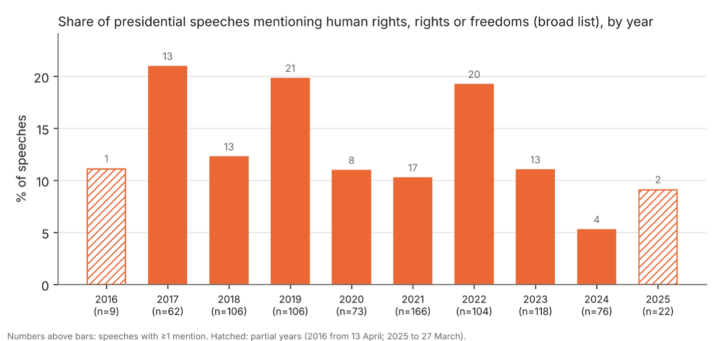
To identify references to human rights, I conducted keyword searches within the corpus of presidential speeches published by Al-Manassa. Two keyword lists were used. The narrow list targeted only explicit mentions of human rights (حقوق الإنسان, حقوق الانسان, حقوق إنسان, حقوق انسان, حقوق الإنسانية, and انتهاكات حقوق الإنسان). The broader list included, in addition, more general references to rights and freedoms (الحقوق, الحقوق السياسية, الحقوق المدنية, الحريات, الحرية). This approach makes it possible to distinguish between speeches that refer directly to human rights as such and those that evoke rights in a wider sense. Results were checked manually to ensure that keyword hits corresponded to substantive mentions in the speech transcripts. Figure 2 relies on the same procedure, with الأمن, الإرهاب, and الاستقرار for security, and اقتصاد, التنمية, and الاستثمار for the economy. All figures report the share of speeches containing at least one keyword in a given year, since the number of speeches varies considerably from one year to the next; 2016 (from April) and 2025 (until March) are incomplete years.
Endnotes
- This paper synthesizes the results of research conducted by several researchers on the current dynamics of the HRM in Egypt. ↩︎
- For more, see the following: Amnesty International, “Egypt 2025”, available at https://www.amnesty.org/en/location/middle-east-and-north-africa/north-africa/egypt/report-egypt/ (accessed 13 March 2026); Cairo Institute for Human Rights Studies (CIHRS) et al., “Egypt: Joint Report on Mounting Human Rights Crisis”, 17 December 2024, available at https://cihrs.org/egypt-joint-report-on-mounting-human-rights-crisis/?lang=en ↩︎
- The search included variants of حقوق الانسان to account for orthographic variation. An extended word search to include closely related notions (rights, liberties, etc.) yielded a similar pattern over time. See Annex. ↩︎
- This analysis relies on an original dataset comprising 842 speaking engagements (including formal speeches, press conferences, Q&As, and informal comments) by the Egyptian President between 13 April 2016 and 27 March 2025. Using a strict definition that searches only for explicit references to human rights (حقوق الإنسان and close variants), 61 speeches (7.2%) contain such mentions. If a broader set of terms is included, covering references to rights and freedoms more generally (الحقوق, الحقوق السياسية, الحقوق المدنية, الحريات, الحرية; see Annex), the number rises to 112 speeches (13.3%). All speeches were transcribed and published online by Al-Manassa. Four texts in the archive that are not statements by the President (a speech by the Prime Minister, two interventions by the President’s wife, and a leaked phone call) were excluded. Speaking settings were coded from speech titles: international fora (192 speeches), bilateral meetings and press conferences (129), domestic events (509), and media interviews (12). Al-Manassa, “نص كلمة الرئيس [President’s Speeches]”, available at https://almanassa.com/columns/president-speeches ↩︎
- See Egypt, Law No. 175 of 2018 on Anti-Cyber and Information Technology Crimes, 14 August 2018, available at https://www.wipo.int/wipolex/en/legislation/details/19959; and Egypt, Law No. 180 of 2018 on Press, Media and the Supreme Council for Media Regulation, 27 August 2018, available at https://www.wipo.int/wipolex/en/legislation/details/19960 ↩︎
- For an analysis, see Tahrir Institute for Middle East Policy (TIMEP), “NGO Law (Law No. 149 of 2019)”, 21 August 2019, available at https://timep.org/wp-content/uploads/2019/08/NGOLaw20198.21.pdf ↩︎
- Amnesty International, “Egypt: Independent Civil Society Organizations at Risk of Closure after NGO Deadline Passes”, 12 April 2023, available at https://www.amnesty.org/en/latest/news/2023/04/egypt-independent-civil-society-organizations-at-risk-of-closure-after-ngo-deadline-passes/ ↩︎
- Elissa Miller, “Egypt Leads the Pack in Internet Censorship across the Middle East”, Atlantic Council, 28 August 2018, available at https://www.atlanticcouncil.org/blogs/menasource/egypt-leads-the-pack-in-internet-censorship-across-the-middle-east/ ↩︎
- For the recent arrest of TikTokers on immorality charges, see Farah Fangary and Sarah Mahfouz, “Seven TikTokers Arrested on Immorality Charges as Authorities Respond to Campaign against ‘Vulgar’ Content”, Mada Masr, 3 August 2025, available at https://www.madamasr.com/en/2025/08/03/news/u/seven-tiktok-creators-arrested-on-moral-charges-as-authorities-respond-to-campaign-against-vulgar-content/ ↩︎
- Egyptian Initiative for Personal Rights (EIPR), “EIPR Wins Court Ruling Ordering Titan Cement to Pay EGP 1 Million in Compensation for Using Coal in Polluting Air”, EIPR, 29 April 2024, available at https://eipr.org/en/press/2024/04/eipr-wins-court-ruling-ordering-titan-cement-pay-egp-1-million-compensation-using-coal ↩︎
- Rana Mamdouh, “Teachers Protest after Mass Rejections from State Hiring Scheme without Clear Criteria for Acceptance”, Mada Masr, 17 October 2023, available at https://www.madamasr.com/en/2023/10/17/news/u/teachers-protest-after-mass-rejections-from-state-hiring-scheme-without-clear-criteria-for-acceptance/ ↩︎
- Documented examples include: (a) a rural women’s group in Upper Egypt that combined literacy training with sessions on inheritance rights and access to health services; (b) an informal coalition of female agricultural workers in the Delta that mobilized around equal pay and safer working conditions; and (c) youth-led initiatives linking women’s mobility and safety in public space to campaigns for cleaner water and greener community environments. ↩︎
- Nadine Abdalla, “Local Activism in Post-2011 Egypt”, Arab Reform Initiative, 28 February 2020, available at https://www.arab-reform.net/publication/local-activism-in-post-2011-egypt/; Saher Ahmed, “Warraq Island: A Case of Egyptian Working-Class Fighting Displacement”, Global Voices, 22 October 2024, available at https://globalvoices.org/2024/10/22/warraq-island-a-case-of-egyptian-working-class-fighting-displacement/ ↩︎
- Examples include the 2020 Assault Police Instagram account and the mobilization around the Fairmont gang rape case, both of which combined testimonies shared by survivors with transnational feminist amplification. These campaigns pressured authorities to act, generated unprecedented public debate on sexual violence, and contributed to the adoption of witness protection provisions in sexual violence cases. See, Amr Marzouk and Gabry Vanderveen, “Fighting Sexual Violence in Egypt on Social Media: A Visual Essay on Assault Police”, Global Public Health, Vol. 17, No. 10, 2022, pp. 2329–2341, available at https://doi.org/10.1080/17441692.2021.1991972; Mada Masr, “Security Forces Detain Witnesses in Fairmont Rape Case”, Mada Masr, 29 August 2020, available at https://www.madamasr.com/en/2020/08/29/news/u/security-forces-detain-witnesses-in-fairmont-rape-case/; Joey Shea, “Disinformation Campaign Targets Rape Victim and Witnesses in Egypt”, The Tahrir Institute for Middle East Policy, 8 October 2020, available at https://timep.org/2020/10/08/disinformation-campaign-targets-rape-victim-and-witnesses-in-egypt/ ↩︎
- Salma Hindy, “At Least 3 Homes Demolished in Ezbet Abu Ragab, with over 200 Households Facing Evictions by April”, Mada Masr, 23 March 2023, available at https://www.madamasr.com/en/2023/03/23/news/u/at-least-3-homes-in-ezbet-abu-ragab-demolished-with-over-200-households-facing-evictions-by-april/ ↩︎
- The archive can be accessed at https://www.youtube.com/channel/UCJDbFq94bvo_nOPpjtYw_2w; for more on it, see BBC Afrique, “Égypte : la jeunesse nubienne se bat contre l’oubli”, BBC Afrique, 3 January 2018, available at https://www.bbc.com/afrique/region-42552948 ↩︎