

Acknowledgment
This report is dedicated to the souls of all those who believed in a free, plural, and dignified Syria. I am deeply grateful to interlocutors from across political affiliations and ideological positions who placed their trust in me and generously shared their grievances, aspirations, and perspectives. I extend particular thanks to my security and civil interlocutors for their time, openness, and willingness to engage under often difficult circumstances. I am also grateful to the Arab Reform Initiative for its support in funding this report as part of the Bassma Kodmani Fellowship.
Coercive Incorporation: Military Integration, Security Restructuring and the Politics of Centralization in Post-Assad Syria
Executive Summary
Syria’s transition has produced an ambitious but fragile restructuring of its military and security institutions. Drawing on more than 200 hours of interviews with 60 interlocutors across three research trips to Syria (February, April and August 2025), followed by interviews in Turkey and Erbil in 2026, this report examines how restructuring is implemented across command structures, internal security institutions and the ranks. It argues that the dominant pattern is coercive incorporation: armed actors are selectively absorbed into state institutions while political authority remains concentrated, accountability is weak and the terms of incorporation are shaped by unequal bargaining power.
The central lesson of this report is not that military integration has failed, but that its political consequences cannot be resolved through organizational restructuring alone. Military integration itself redistributes authority, determines who can exercise coercion and shapes relations between Damascus and local constituencies. Without corresponding guarantees of representation, accountability and civilian protection, stronger central command may coexist with weak institutional cohesion and grievances that threaten longer-term stability.
The Core Argument
The new Syrian army remains a hybrid institution shaped by wartime networks and unequal access to authority. Its restructuring has unfolded in two phases: in 2025, armed factions entered the army largely intact, retaining commanders, fighters and territorial deployments; from mid-2026, the Ministry of Defense moved to break up non-Hayat Tahrir al-Sham (HTS) blocs, redistribute personnel and place HTS-linked cadres in command of a new corps structure. The shift from factional accommodation to more concentrated command has not, in itself, resolved the problems of professional integration, political trust or accountability. These dynamics are visible across three dimensions:
- Military: Initial incorporation preserved wartime chains of command and weapons within existing formations. The subsequent corps restructuring has reduced the autonomy of competing blocs and concentrated command authority among HTS-linked officers, without establishing an equally developed system of professional oversight or accountable appointments.
- Security-administrative: The Interior Ministry’s Internal Security Command is dominated by personnel from HTS and Ahrar al-Sham backgrounds. Its blurred boundaries with military and intelligence functions, together with weak judicial oversight, leave civilian policing vulnerable to factional loyalties and local conflict.
- Ideological: The General Directorate of Moral and Religious Guidance is extending religious instruction, behavioral expectations and loyalty-building practices across the army while developing more conventional military-guidance functions. This points to Islamist saturation of military socialization without yet demonstrating a consolidated Islamist doctrine. An initial target of roughly 1,500 guidance officers should not be treated as a verified staffing figure.
Key Findings
- Army structure: Twenty divisions were formally constituted in 2025, most built directly from wartime factions. In the summer of 2026, the division was abolished as a formation: former divisions became brigades under six regional corps and a central rapid-intervention corps, whose commands are held overwhelmingly by HTS figures. The 50th Division incorporates Turkistan Islamic Party fighters, and its commander, like that of the 56th, is identified here for the first time. The army has no independent fiscal base: in its first year it relied heavily on grants from Qatar and Saudi Arabia, and is now funded through a combination of telecommunications and customs revenues.
- SNA integration: Approximately five of the 20 divisions formed in 2025 were composed of former Turkish-backed Syrian National Army (SNA) factions. In the first phase their commanders were excluded from strategic decision-making within the Ministry of Defense while remaining dependent on Turkish patronage. Three senior SNA commanders appointed to army leadership positions remain under US sanctions for human rights abuses. Since mid-2026 the Ministry has moved to dismantle the former SNA blocs, in coordination with Turkey and the United States. Two key SNA leaders, who had been previously sanctioned internationally, were gradually sidelined. On 5 August 2026, Muhammad al-Jasim, better known as Abu Amsha (he had served as leader of the Sultan Suleiman Shah Division within the SNA) was moved from the 62nd Division to a corps-level post and Sayf Boulad (who led the Hamza Division within the SNA) resigned his command of the 76th Division. Turkey, which had backed both, did not intervene. Former SNA commanders interviewed for this report describe the process as one of marginalization and exclusion, and around 52,000 fighters are reported to have left the army since the restructuring began in August 2026.
- Security sector: The 5 June 2025 restructuring of the Interior Ministry created an Internal Security Command dominated by HTS and Ahrar al-Sham cadres. The Jaramana and Tafas (Daraa) incidents illustrate how the absence of independent vetting, oversight and a clear separation of policing from factional security roles can turn security personnel into parties to local conflicts.
- Doctrinal re-moralization: The General Directorate of Moral and Religious Guidance combines compulsory religious activities, Qur’an memorization incentives and religious courses with an expanding institutional remit. Its personnel networks and teaching practices remain rooted in the Islamist milieu of wartime Idlib, even as the Directorate develops cultural, administrative and professional-guidance functions. The Qasiyoun Center’s reported “Umma Project”, with transnational Islamist symbolism and references to Jerusalem, illustrates the continued mobilization of ideological constituencies, but does not establish a coherent state doctrine or expansionist policy. The emerging pattern is Islamist saturation without ideological consolidation; its implications for religious inclusion and professional military cohesion remain unresolved.
- SDF negotiations: Three successive agreements (10 March 2025, 18 January 2026, 30 January 2026), the last concluded after a government offensive had taken Raqqa and Deir ez-Zor, ended in the SDF’s formal dissolution on 25 August 2026. Around 10,000 of its fighters entered the army as four brigades under former SDF commanders, the one concession that the SDF’s size secured. Constitutional guarantees for Kurdish rights, decentralization and the status of the Women’s Protection Units (YPJ) remain unresolved, and Arab residents of Hasakah have protested against the continuing overlap of authority in the governorate.
The Structural Failure of Mediation
International and regional mediators (principally the United States, through envoy Tom Barrack, together with France, Turkey and, in the northeast, the Kurdistan Region of Iraq) have largely prioritized military arrangements, implementation deadlines and command structures over the political guarantees on which durable integration depends. Civilian oversight, minority protection, decentralization and constraints on executive authority have consequently remained unsettled. External security assistance without effective accountability conditions risks reinforcing the dominant actor while leaving the sources of local grievance intact.
Recommendations for External Actors
- Condition security assistance: Make security sector support contingent on measurable progress toward civilian oversight mechanisms, independent vetting processes, and accountability for documented abuses by integrated commanders.
- Reframe the integration agenda: Shift from technical sequencing – timelines, unit numbers, command charts – to political process: governance guarantees, representation mechanisms, and enforceable limits on factional authority within state institutions.
- Address the northeast’s unfinished settlement: The SDF’s dissolution has resolved the military question in the northeast but not the political one. External actors should support the entrenchment of Kurdish cultural and citizenship rights in the constitution rather than in revocable presidential decrees, encourage a negotiated resolution of the YPJ’s status, and press for governance arrangements in Hasakah that address Arab residents’ grievances over overlapping authority and quota-based appointments.
- Engage the doctrinal apparatus: The moral and religious guidance program remains among the least-scrutinized dimensions of Syria’s security restructuring. International partners should assess how religious instruction, recruitment networks and incentive structures affect professional standards, inclusion and equal treatment, while distinguishing Islamist saturation from evidence of a settled military doctrine.
- Support accountability mechanisms: The absence of an independent judiciary, vetting, or disciplinary capacity within the Ministry of Defense is the single greatest institutional risk. External support for transitional justice processes and civilian oversight bodies would directly address the structural accountability deficit.
Introduction
Syria’s political transition following the collapse of the Assad regime in December 2024 has triggered an ambitious yet deeply complex restructuring of its security and governance institutions. The new leadership under President Ahmad al-Sharaa has moved rapidly to reconstitute a national army intended to stabilize a territorially fragmented state, while simultaneously reconstructing an administrative apparatus meant to underpin a longer-term political transition. These dual processes – security-sector reorganization and administrative consolidation – have defined Syria’s first year of transition and will ultimately determine whether the post-Assad order becomes durable or merely a reconfiguration of wartime power relations.1
So far, the structure and sequencing of these reforms suggest that the emerging military architecture is designed primarily for short-term internal consolidation rather than for the protection of Syrian sovereignty or strategic interests in a shifting regional order. The newly rebuilt army prioritizes rapid deployment, internal containment, and counter-insurgency functions, reflecting an overriding concern with immediate threats and territorial control rather than the gradual professionalization of a nationally integrated defense institution. The army functions less as a sovereign defense force than as an instrument through which a dominant actor consolidates central authority and neutralizes rivals without renegotiating power.
This report describes that process as coercive incorporation: the selective absorption of armed actors into state structures without demobilization, accountability, or renegotiation of authority. It is the common thread of the analysis that follows: it shapes the army’s divisional structure, the composition of the internal security sector, the doctrinal program of the moral guidance apparatus, and the terms on which the SDF was brought into the state.
While recent research on armed faction integration in post-Assad Syria has highlighted how the HTS-led authorities have transformed army-building into a bureaucratic process through which former armed factions are incorporated without collective political representation, comparative scholarship on post-conflict security reform raises broader questions about the political and institutional consequences of such arrangements. Jérôme Drevon (2026) conceptualizes this process as integration without representation, demonstrating how administrative control facilitates the progressive dismantling of factional autonomy and the political neutralization of rival armed groups.2 Yet, as Krebs and Licklider (2016) caution, military integration should not be assumed to generate cohesion, legitimacy, or durable peace merely through the incorporation of former adversaries into common security institutions.3 While these approaches illuminate interconnected dimensions of post-conflict military integration, this report examines coercive incorporation as a broader process of political and institutional consolidation, in which the reorganization of military and security institutions may strengthen centralized coercive authority without necessarily establishing accountability, meaningful political inclusion, or the conditions for sustainable peace.
The implications of this approach are particularly evident in the government’s management of armed actors whose incorporation into state institutions has remained contested, most notably in its negotiations with the SDF. For example, this consolidation-first orientation has been confirmed through the sequencing of agreements and military operations in Syria’s northeast. The initial framework established by the 10 March 2025 agreement between the transitional authorities and the Kurdish-led Syrian Democratic Forces (SDF) collapsed amid disputes over command authority, territorial jurisdiction, and the absence of credible guarantees for civilian governance and political representation. Rather than triggering sustained political renegotiation, the breakdown of the agreement was followed by decisive military action that expanded government control over key territories, including Raqqa and Deir ez-Zor. This shift marked a transition from negotiated integration toward coercive consolidation, underscoring the primacy of military leverage over political accommodation in managing center–periphery relations.
The agreement announced on 30 January 2026 must be understood within this context. Although framed as a stabilization and integration arrangement, it prioritized ceasefire enforcement, territorial consolidation, and the incorporation of armed units into central security institutions. While publicly presented as a step toward national reunification, the agreement was concluded under the threat of renewed military confrontation with the SDF and sustained US pressure, and consequently focused overwhelmingly on military command structures and security coordination. Taken together, the collapse of the March framework, the subsequent military campaign, and the January settlement illustrate how integration in post-Assad Syria is being pursued through a sequence of pressure, force, and elite-level bargaining rather than through inclusive political negotiation. They confirm that the reconstituted army is being deployed primarily as an instrument for managing immediate security threats and territorial control, rather than as the foundation of an inclusive or sovereignty-oriented national defense architecture. The SDF’s formal dissolution in August 2026, discussed in Section IV, was the outcome of this sequence rather than a departure from it.
These developments are consistent with broader patterns observed in post-civil war contexts. Civil wars rarely end with a clean institutional rupture. Scholars in conflict studies highlight that post-war orders remain inherently fragile because credible guarantees are weak and the legacies of violence continue to shape political behavior long after formal hostilities subside.4 Syria exemplifies these dynamics. Thirteen years of conflict produced fragmented sovereignties, militarized identities, and competing systems of local governance. The removal of the Ba’athist regime did not dissolve mistrust, factional loyalties, or grievance structures; instead, these patterns have re-emerged within the post-Assad landscape, shaping how authority is exercised, contested, and legitimized.5
Against this backdrop, debates over Syria’s future political order have resurfaced with renewed urgency. Centralization, decentralization, and power-sharing are advanced by different domestic and international actors as mechanisms for stabilizing the transition, largely in response to Syria’s ethnic, sectarian, tribal, and ideological diversity.6 Yet the past year has demonstrated that these debates are not merely theoretical. Recurrent episodes of sectarianized violence and security breakdowns have exposed both the fragility of the emerging order and the limits of a purely centralized governance model.7 In this context of contested security, questions of political order are being settled through military hierarchy rather than institutional deliberation.
Violence in Syria’s coastal regions in early 2025, followed by sectarian-based atrocities in Sweida in July 2025 and intermittent fighting involving forces aligned with the Ministry of Defense and former SDF units, illustrate this pattern. In each case, security breakdowns exposed structural gaps in integration, accountability, and political inclusion. For example, in Sweida, violence was followed not by a locally grounded reconciliation process but by externally mediated security arrangements negotiated among elite actors.8 These arrangements prioritized de-escalation and territorial stability while bypassing the grievances of key local constituencies, notably Bedouin communities displaced during the fighting and Druze actors excluded from meaningful participation in decision-making.9 De-escalation efforts after July 2025 reportedly involved US-mediated negotiations between Damascus authorities and Druze religious leadership, including Sheikh Hikmat al-Hijri, which focused on detainee exchanges and security arrangements rather than broader political reconciliation or locally grounded conflict resolution.10 Comparative research shows that such elite-centered security bargains may reduce short-term violence but often deepen long-term instability by leaving core grievances unresolved.11
The same elite-driven logic has governed the northeast where, as noted above, negotiations narrowed to command hierarchies and territorial control while civilian governance and political representation were deferred.12 This approach has reinforced Kurdish fears that integration is intended less as a shared political project than as a mechanism for neutralizing autonomy through coercive incorporation.13 In both southern and northeastern Syria, elite-level bargains have substituted for inclusive political processes, reproducing asymmetries between center and periphery and re-embedding wartime patterns of exclusion within post-conflict institutions.14
While comparative research demonstrates that power-sharing can reduce conflict recurrence when supported by credible institutions and external guarantees, these enabling conditions are largely absent in Syria today.15 The emerging Syrian army, though formally reorganized, does not resemble a unified national institution. Instead, it constitutes a hybrid force composed of absorbed factions, regional networks, and former militia commanders incorporated into state structures without meaningful demobilization, vetting, or oversight.16 Integration has proceeded at remarkable speed – often privileging loyalty and political alignment over competence or accountability – suggesting that consolidation of control has taken precedence over institutional professionalism.17
These dynamics suggest that Syria’s transition is unfolding within a context of persistent insecurity, institutional fragility, and unresolved grievances. While security-sector restructuring and administrative reforms are advancing, they risk reproducing wartime hierarchies and reinforcing elite dominance rather than fostering trust and inclusion. Rather than moving toward power-sharing or meaningful decentralization, Syria’s post-Assad trajectory appears to be consolidating a centralized hybrid order in which executive authority is strengthened, armed groups are selectively and coercively incorporated, and local autonomy is managed through security bargains rather than political participation. The most plausible outcome is therefore not a comprehensive power-sharing settlement, but a hybrid political order characterized by centralized authority coexisting uneasily with managed local autonomy and externally mediated security arrangements.18
As such, this report addresses four central questions:
- To what extent does the restructuring of the Syrian army represent genuine integration rather than elite consolidation through coercive incorporation?
- How do the Ministry of Defense and associated institutions shape loyalty, hierarchy, and political control in the post-Assad order?
- What are the implications of ideological re-moralization and organizational restructuring for cohesion and professionalism within the armed forces?
- What forms of power-sharing or decentralization remain feasible, and what should external actors realistically support?
The report answers these questions by combining three kinds of evidence. The first, and principal, is original fieldwork: over 200 hours of interviews with 60 interlocutors in the army, the Ministry of Defense, the Interior Ministry and the moral guidance apparatus, conducted during three research trips to Syria in 2025 and in further interviews with interlocutors in Turkey and Erbil, described in the methodology section below. The second is documentary: decrees and official announcements, the texts of the agreements between Damascus and the SDF, and Arabic- and English-language reporting, which are used to establish chronology and to cross-check interview testimony. The third is comparative. The report reads the Syrian case against the literature on military integration after civil war and against a small number of cases in which armed groups were absorbed into state institutions: Sudan, Mali, Bosnia and Kosovo, and Liberia. These cases are not offered as templates. They appear in boxes alongside the relevant sections, to indicate what a given pattern of integration has tended to produce elsewhere.
Methodology
To investigate these dynamics, this report draws on extensive fieldwork conducted in Syria over the course of three research trips following the Assad regime’s collapse. The first fieldwork period occurred in February 2025, followed by trips in April and August 2025. In 2026, additional interviews were conducted either online or in person with interlocutors located in Turkey and Erbil.
In total, this research is based on in-depth interviews with 60 key interlocutors across Syria’s emerging security institutions. These comprised 12 divisional commanders drawn from the new army’s central command structure, 10 moral and religious guidance officers embedded within military units, 12 security commanders within the Ministry of Defense, six intelligence personnel within the Ministry of Interior, and 20 active soldiers serving across different formations. This breadth of access – spanning command hierarchies, doctrinal and ideological functions, security and intelligence structures, and rank-and-file personnel – provides a grounded account of how restructuring is being experienced and implemented at multiple levels of the emerging security apparatus.
The analysis is further informed by a review of official statements, media reporting, and scholarly literature on post-conflict security sector reform, civil-military relations, and the political economy of armed group incorporation. This comparative perspective helps situate the Syrian case within broader patterns observed in other transitional contexts, while also identifying the unique features and constraints shaping the country’s trajectory.
I.Conceptual Framework: Power, Security, and Hybrid Consolidation in Post-Assad Syria
Since the fall of the regime, the familiar vocabulary of post-conflict governance – power-sharing, decentralization, and centralization – has featured prominently in Syrian public debate, but largely on social media and televised political programs rather than in formal deliberation: the government-sponsored National Dialogue that convened after Assad’s collapse lasted only a few hours and did little to clarify these models. The result has been widespread misconception and deepening polarization, with each concept instrumentalized by competing actors as a tool of political mobilization and mutual suspicion. Yet the transition so far shows that these are not merely alternative policy choices available to political elites. They represent fundamentally different logics of rule, each grounded in distinct assumptions about trust, coercion, and the management of wartime actors, and identifying which logic is actually operative in Syria is essential for understanding both the restructuring of the armed forces and the evolving configuration of political authority.
In Syria’s case, the core dilemma is not whether power-sharing or decentralization is normatively preferable, but whether the structural conditions required for either are present.19 Thirteen years of civil war produced hardened factional identities, militarized social hierarchies, and armed organizations whose survival depended on autonomy, territorial control, and coercive capacity rather than compromise.20 As Sambanis argues, civil wars persist not simply because settlements fail to materialize, but because credible guarantees are weak and incentives to defect remain high when armed actors retain the means of violence.21 Syria exemplifies this condition. The collapse of the Assad regime removed a central authority without dissolving the underlying structures of mistrust that shaped wartime governance, leaving armed capacity intact and political uncertainty unresolved.22
Within such an environment, power-sharing does not appear as an easily available institutional model but rather as a structurally blocked pathway.23 Classical power-sharing arrangements require at least three preconditions: mutual recognition among rivals, partial demobilization of armed actors, and enforceable institutional guarantees capable of constraining defection.24 None of these conditions currently exist in Syria. Armed groups have continued to operate as coherent organizational entities, territorial control remains uneven and contested, and external guarantors have prioritized short-term stabilization over long-term institutional enforcement.25 Under these conditions, inclusion is widely perceived by armed actors not as protection but as exposure to a stronger actor – an invitation to vulnerability rather than a safeguard against coercion.26
This structural context helps explain why the post-Assad leadership has pursued centralized consolidation rather than negotiated inclusion. Rather than distributing authority across rival groups, the emerging order concentrates coercive power within a reconstituted Ministry of Defense while selectively incorporating armed factions on highly asymmetrical terms.27 This pattern is consistent with scholarship on post-war rebel governance, which shows that victorious armed movements often prioritize organizational control and wartime networks over negotiated institutional arrangements. Wartime socialization and mobilization strategies generate organized civilian and military ties that enable post-conflict rulers to consolidate authority and impose social control without broad power-sharing.28 In such contexts, post-war state formation reflects the extension of wartime organizational capacity rather than inclusive political settlement. This process is not power-sharing in any institutional sense. Instead, it constitutes elite consolidation through coercive incorporation: a strategy in which dominant actors absorb subordinate armed groups without renegotiating authority, redistributing power, or transforming organizational cultures.29 Access to and incorporation into the state is conditioned on loyalty, battlefield alignment, and submission to central command rather than on political bargaining or mutual vetoes.30
Such incorporation, however, should not be equated automatically with cohesion or stability. Research on post-war security integration cautions that when armed groups are absorbed without meaningful demobilization, accountability mechanisms, or an accompanying political settlement, integration often reproduces wartime hierarchies inside state institutions rather than transforming them.31 In such contexts, incorporation serves to neutralize rivals, fragment alternative power centers, and extend central control – not to generate shared ownership of the state or durable legitimacy.32
Syria’s emerging military structure reflects this pattern. Armed factions have been brought under formal state labels while retaining internal cohesion, command cultures, and informal loyalties forged during the war.33 This mirrors what insurgency scholarship describes as selective or coercive incorporation, in which dominant actors embed subordinate groups within state structures without renegotiating ideology, authority, or organizational identity.34 As a result, instead of transforming armed authority into a unified institutional order, the state becomes a repository for unresolved factional power relations, structured hierarchically rather than integrated.
Decentralization, often advanced as a compromise solution for Syria’s social and territorial diversity by Syrian non-governmental organizations, requires a similarly careful assessment as it fails to capture the reality on the ground. Decentralization presumes the existence of functional civilian institutions capable of exercising devolved authority and mediating disputes through law rather than force. In Syria, however, territorial control continues to be mediated primarily through armed actors rather than civilian administrations. Where authority is devolved, it is negotiated through security arrangements rather than codified governance, producing what the literature terms hybrid orders – systems in which formal institutions coexist with informal power brokers, militias, and external patrons.35
Crucially, hybrid orders are not necessarily temporary, nor are they uniform across the country. As Whitt et al. demonstrate, populations emerging from civil war often perceive hybrid security arrangements not as cooperation but as confusion and threat, particularly when armed actors retain autonomous coercive capacity.36 In Syria, hybrid governance has already become visible in places such as Sweida, al-Hasakah, and Qamishli, where elite-level security deals substitute for inclusive political processes and where local grievances remain unresolved despite formal claims of stabilization.
This framework does not assume inevitable failure; however, it highlights the structural risks embedded in the current trajectory – most notably the reproduction of wartime grievances within state institutions and the persistence of coercion as the dominant mode of governance.
This conceptual lens informs the analysis that follows by shifting the central question away from whether Syria should adopt power-sharing, and toward how current security practices are actively shaping the distribution of power, legitimacy, and violence in the post-Assad state.
II.Pre-Regime Collapse Coordination and the Formation of Post-War Dynamics
The military order that emerged after the regime’s collapse was not built from scratch. It drew on wartime coordination mechanisms, especially “operations rooms”, that had already shaped command relations, patterns of cooperation, and expectations of authority among armed factions.
Syria’s pre-regime collapse military landscape was deeply fragmented. Armed power was divided among HTS and its allies in the northwest, Turkish-backed SNA factions in the north, the US-backed and Kurdish-dominated SDF in the northeast, the US-backed Syrian Free Army in the tri-border region, and a spectrum of regime-aligned militias. These actors pursued divergent – and often mutually exclusive – political projects, social bases, and external alignments.
Within this fragmented environment, armed factions developed “operations rooms” – ad hoc or semi-permanent coordination structures designed to organize joint military campaigns without dissolving factional autonomy. These bodies established incipient chains of command, shared planning mechanisms, and coordination logics across otherwise autonomous groups,37 yet deliberately stopped short of integrating identities, loyalties, or internal hierarchies.38 Rather than functioning as integrative institutions, operations rooms operated as layered command arrangements that enabled collective military action while preserving factional autonomy. This organizational logic profoundly shaped the political and military terrain inherited by the transitional authorities.
The durability and influence of these operations rooms varied considerably. Some were short-lived tactical constructs tied to specific battles, while others evolved into enduring command architectures that structured armed governance over extended periods. The most consequential of these was the Fateh al-Mubin Operations Room, established in 2019 and led by HTS. Operating continuously until the fall of the Assad regime, Fateh al-Mubin became the backbone of HTS’s military consolidation in the northwest.39 Organizationally, Fateh al-Mubin was not a single faction but a joint command structure bringing together several of the most powerful opposition armed groups in northwest Syria.40
At its core stood HTS, which supplied the dominant leadership, command capacity, and organizational infrastructure of the operations room. Alongside HTS, the structure incorporated factions affiliated with the Turkish-backed National Front for Liberation (which was part of the Syrian National Army (SNA)), as well as nationalist formations such as Jaysh al-Izza, which retained roots in earlier Free Syrian Army networks.41 Crucially, this early cooperation between HTS and elements of the Syrian National Army was neither automatic nor ideologically uniform. It reflected a selective and strategic process through which HTS leadership cultivated alliances with specific SNA factions deemed organizationally compatible or politically manageable.
Many of these groups were embedded within tribal social structures, facilitating the emergence of a hybrid tribal–Islamist alignment that proved particularly effective in the period preceding Assad’s collapse. This configuration allowed HTS to penetrate SNA networks and coordinate their mobilization without dissolving their internal identities or command hierarchies. Cooperation was therefore achieved without organizational fusion, reinforcing a model of coordination that privileged operational effectiveness while preserving factional autonomy.
Through this constellation, Fateh al-Mubin succeeded in combining Islamist and tribal forces within a single operational framework, coordinating manpower, logistics, and battlefield planning across Idlib, western Aleppo, northern Hama, and parts of the Latakia countryside. The command culture that emerged from this experience normalized hierarchical coordination under a dominant actor, while simultaneously tolerating subordinate autonomy – a pattern that would be reproduced within formal state structures following the fall of the regime.
By the final phase of the conflict in 2024, three operations rooms in particular shaped both the defeat of regime forces and the architecture of the post-war military order. Fateh al-Mubin spearheaded the campaign in Idlib and absorbed the most intense fighting against regime forces, producing a highly cohesive cadre of commanders and fighters accustomed to hierarchical coordination under HTS leadership.42 This cohort would later constitute a central pillar of the new army’s officer corps and command culture.
In parallel, the Fajr al-Hurriya Operations Room was established jointly by Turkey, HTS, and SNA leadership to consolidate a coalition of Turkish-backed SNA factions whose primary operational focus was confronting the SDF and constraining Kurdish-controlled enclaves, while largely avoiding sustained engagement with regime forces.43 Many of these factions carried entrenched political and economic interests in northern Syria, alongside documented records of civilian abuse – legacies that now complicate their incorporation into state military structures and raise persistent questions about discipline, accountability, and command control.
The Southern Operations Room represented a markedly different configuration. It brought together a politically and socially heterogeneous alliance of Sweida Druze militias, former opposition factions associated with the Daraa-based Eighth Brigade, and reconciled local committees. Unlike the more centralized and internally cohesive HTS-led northern structures, the southern coalition operated within a political environment shaped by earlier Russian-sponsored reconciliation arrangements, particularly through the incorporation of the Eighth Brigade into the Russian-backed Fifth Corps while retaining a degree of local autonomy. While this coalition succeeded in capturing regime positions in the southwest and advancing toward Damascus in the days leading to the fall of the Assad regime, it lacked the internal cohesion, command discipline, and unified organizational culture characteristic of its northern counterparts.44 Authority within the southern coalition remained fragmented, negotiated, and highly localized, reflecting both its heterogeneous composition and the hybrid patronage structures that shaped security governance in the south.
Recent developments in southern Syria further underscore the contingent and negotiated nature of authority in the region. Following tensions between southern armed factions and the transitional authorities in 2025, the Daraa-based Eighth Brigade – previously formed through Russian-sponsored reconciliation arrangements – was formally dissolved, and elements of its fighters were incorporated into Ministry of Defense structures as part of broader efforts to centralize security authority. However, these measures failed to produce unified command structures. Instead, disputes over leadership, integration, and local security responsibilities persisted, culminating in late February 2026 in armed clashes in Busra al-Sham, when security operations around the properties of former Eighth Brigade commander Ahmad al-Awda escalated into an exchange of fire and a curfew, after which al-Awda was escorted to Damascus.45 These developments highlight both the transitional administration’s attempts to consolidate control and the continued resilience of hybrid patronage networks and locally embedded autonomy in southern Syria.46
These wartime coordination structures now feed directly into the formation of the new Syrian army. Rather than being dismantled at the moment of transition, their organizational logics have been reconfigured into formal state structures. Fateh al-Mubin and Fajr al-Hurriya supply much of the officer corps and rank-and-file manpower of the emerging military, embedding their wartime command cultures, factional hierarchies, and informal loyalty networks within the army’s institutional framework. The looser cohesion of the Southern Operations Room, by contrast, enabled President al-Sharaa to pursue a more selective strategy – negotiating with some factions, coercing or dissolving others, and integrating southern forces unevenly across the army and internal security services depending on their perceived threat, utility, and reliability.47
Moreover, these operations rooms functioned as proto-institutions that shaped expectations of authority, obedience, and autonomy among fighters and commanders alike. Their legacy persists in the army’s factional composition, uneven chains of command, and hybrid character – features that continue to constrain efforts at centralization, professionalization, and unified civil–military control.
III.The Emerging Military Order: The Politics of Integration and Its Constraints
Before turning to the army’s formal architecture in Section IV, this section sets out the political conditions under which integration has taken place: the asymmetric terms on which factions were brought in, the mistrust those terms generated, and the constraints the model has encountered. The victory speech delivered by Ahmad al-Sharaa on 29January 2025 before heads of various armed factions presented the integration of armed factions as a foundational step toward restoring sovereignty and ending fragmented rule.48 This speech stands as the peak of a transformative moment. Emphasizing discipline, unity, and obedience to state authority, the address framed military consolidation as both inevitable and broadly consensual. Subsequent developments, however, indicate that integration has functioned less as a process of institutional unification than as a strategy of coercive incorporation, through which wartime armed actors are absorbed into state structures under asymmetrical terms. These asymmetries are structured primarily by prior proximity to HTS, wartime alignment, and degrees of political trust within the emerging leadership. Actors closely affiliated with HTS or embedded within its command architecture have retained greater influence, organizational continuity, and access to decision-making authority, while more distant or politically heterogeneous factions have been incorporated under tighter supervision or reduced autonomy.
Interviews with Ministry of Defense security commanders from non-HTS backgrounds further indicate perceived disparities in institutional treatment, particularly regarding remuneration. Respondents reported that personnel previously affiliated with the HTS Salvation Government have in some cases continued to receive financial support linked to their former structures while simultaneously drawing salaries from the Ministry of Defense, resulting in higher overall compensation compared to other officers holding comparable positions. Such perceptions of unequal incorporation reinforce existing wartime hierarchies rather than transforming them within formal state institutions.49
The early configuration of the new army reveals the scale of the challenges confronting this project. Two constraints complicate the consolidation effort, and both concern armed actors that cannot be absorbed by the methods that worked with Sunni factions in the northwest. The first is that several major territorial armed actors – notably the Druze armed formations in Sweida – have refused integration under al-Sharaa’s leadership. Unlike Sunni factions previously subordinated under HTS, these groups cannot be absorbed through the coercive or ideological tools with which al-Sharaa is most familiar. Their demographic bases, political demands, and security concerns require negotiated political settlements rather than unilateral incorporation. The massacres on the coast in March 2025 and in Sweida in July 2025 have further eroded trust and sharply reduced the space for any consensual military integration.50
The second constraint is scale. The SDF was too large, too territorially entrenched and too ideologically distinct to be absorbed in a single step, and its integration could not follow the template applied to factions from Idlib or the SNA. Damascus addressed the problem by combining force with negotiation: the January 2026 offensive stripped the SDF of its Arab-majority territories, and the agreement that followed allowed its Kurdish core to enter the army as brigades rather than as individuals (see Section IV.D). The SDF case did not break the model of coercive incorporation, but it required the model to bend, conceding bloc-based entry to the one actor whose size made any other outcome too costly.
External actors shaped how this second constraint was managed. The United States and its partners have supported a consolidated national army, but they have also limited the means by which Damascus could pursue one. The comparatively disciplined conduct observed in confrontations with the SDF may therefore reflect external political constraints rather than institutional transformation. International actors, including the United States, European partners, and regional authorities in the Kurdistan Region, have played an active role in preventing large-scale escalation and encouraging deconfliction between government forces and SDF units in areas such as al-Hasakah and Qamishli. This external mediation has contributed to more controlled operational behavior, distinguishing these engagements from the less coordinated and more violent episodes observed in the coastal regions and Sweida. More broadly, the army’s consolidation must proceed while managing persistent security threats, including ISIS remnants, Salafi-jihadi cells, regime-era smuggling networks embedded in the war economy, and other criminal actors.
These constraints also expose the model’s dependence on a single individual. Al-Sharaa remains indispensable to maintaining Syria’s fragile post-war coalition, even as the methods he employs to consolidate authority risk undermining long-term stability. His moral authority among Islamist factions and wartime credibility enable him to hold together a diverse yet uneasy alliance.51 At the same time, his centralizing approach to governance, exclusionary handling of minority claims, and reliance on wartime networks risk reproducing the structural inequalities and grievances that fueled earlier cycles of conflict. Reconciling rival factions, integrating armed actors into a professional military, and addressing civilian grievances would require constraints on executive power and concessions to political pluralism that could challenge both his authority and segments of his own coalition.
IV.Restructuring the Army: Architecture, Politics, and Control
A. The Structure of Syria’s New Army
Following the fall of the Assad regime, the former military structure was formally dissolved. The new authorities did not preserve the institutional framework of the previous army but instead sought to construct a new force centered on armed factions that participated in the overthrow of the regime and newly recruited volunteers. Only a small number of selected former officers and technical personnel – particularly specialists from the air force – have been incorporated into the emerging military structures in order to retain essential technical and operational expertise. The scope and procedures of vetting and reintegration remain evolving and uneven across sectors.
Rather than constructing new formations from the ground up, the transitional authorities opted for a strategy of coercively incorporating existing militias as divisions, brigades, or battalions with minimal alteration to their internal structures, personnel, or equipment.52 This approach allowed for immediate deployment without the prolonged training cycles typically required to establish basic combat effectiveness. As an officer in the Syrian Ministry of Defense explained, mixing fighters from rival factions within a single unit risks internal collapse and operational chaos.53 In the context of a fragile transitional phase, this assessment is understandable and helps explain why the new army has prioritized preserving intra-unit cohesion over immediate cross-factional integration. While pragmatically defensible in the short term, this approach embeds intact wartime units within the state apparatus, thereby institutionalizing factional loyalty and postponing the construction of a unified, professional military force.
The resulting army has passed through two configurations. Through 2025 and the first half of 2026 it was organized into some 20 divisions, most built directly from wartime factions (Table 1). From mid-2026 these divisions were grouped into regional corps, and in August 2026 the division was abolished as a formation altogether: former divisions became brigades under six regional corps and a central rapid-intervention corps (Table 2). This section describes the divisional army first, since it was the structure into which factions were incorporated and which the corps reform largely preserved, and then turns to the reorganization.
(i) Divisional Structure, Leadership, and Composition (2025 to mid-2026)
On 17 May 2025, the Ministry of Defense announced the formal completion of integrating armed units operating under the transitional authority.54 These new formations include special forces, mixed infantry units, armored brigades, and regional commands designed to stabilize frontlines and consolidate post-conflict governance. Alongside these units, a set of foundational administrative bodies was reconstituted or newly established, including the Directorate of Officers’ Affairs, the Organization and Administration Division, the Armament Directorate, Military Intelligence, the High Military Academy, and the emerging Moral Guidance Directorate tasked with shaping ideological cohesion within the ranks. Collectively, these institutions project the appearance of a consolidated national military while masking the persistence of factional authority and deep structural fissures beneath formal bureaucratic layering.
Divisions were organized around local factional identities, led by former militia commanders, and deployed according to wartime patronage networks rather than unified strategic planning or doctrine.55 The leadership of key divisions illustrated this continuity starkly. The 62nd Division was commanded by Abu Amsha (Muhammad al-Jasim), formerly commander of the SNA’s Sultan Suleiman Shah Division (al-ʿAmshat) – crucially, he commanded his own former units deployed in Hama, their traditional operational theater. The 74th Division was led by Brig. Jamil al-Salih, a former defector; the 86th by Ahmad al-Hays (“Abu Hatim Shaqra”), former commander of the SNA faction Ahrar al-Sharqiya; and the 76th by Sayf al-Din Boulad, formerly of al-Ḥamzat. The 50th Division in Latakia was commanded by Brig. Mahmoud Hamidi, and the 56th in Tartous by Brig. Munir al-Shaykh, an HTS figure. In each case, commanders retained the forces they led during the war, deployed in the areas they previously controlled. The endurance of these factional chains of command directly undermined the Ministry’s claims of centralization and raised serious doubts about cohesion, discipline, and responsiveness during crisis.56 Both Abu Amsha and Boulad were removed from these commands in August 2026, as discussed in the section on the SNA below.
The geographical distribution of the new military structure further compounded these risks. Divisions were allocated according to the territories factions held during the war and the localities from which their fighters were drawn, rather than operational necessity or national defense logic. The 50th and 56th Divisions were concentrated in Latakia and Tartous respectively; the 52nd and 62nd in Hama; the 72nd and 76th in Aleppo; and the 66th and 86th in Deir ez-Zor. This pattern of territorialized militarization risked entrenching regional para-states governed by commanders with distinct political constituencies, economic interests, and external ties. Rather than consolidating a unified chain of command, the emerging force resembled a mosaic of localized power centers formally subordinated to Damascus but operationally shaped by inherited factional logics.
At the senior command level, central institutions such as the General Staff, the Military Training Authority, and specialized directorates were reconstituted; however, leadership appointments overwhelmingly favored HTS-aligned figures, reinforcing perceptions that institutional reconstruction serves ideological continuity rather than organizational transformation.57
Formally, the divisional structure was standardized: each division was nominally composed of six brigades, including multi-branch brigades, alongside specialized Shahin (falcon) battalions – rapid-reaction motorcycle units inherited from HTS wartime practice. In practice, however, only a limited number of divisions were fully staffed, while most remained at a shallow stage of formation.58 Available assessments suggest that the army comprised approximately 20 divisions, most of them undermanned and organizationally fluid. Interviews with defense officials indicate that the stated ambition of fielding divisions of approximately 10,000 troops was neither economically nor institutionally viable in the near term, particularly given that Assad’s pre-war army maintained only 13 divisions, many of which proved unreliable.59
The army’s internal composition during that period reflected a pattern of controlled fragmentation. Some divisions were dominated by a single incorporated faction – such as formations associated with Suleiman Shah, which have all been incorporated into the 62nd Division – while others combined multiple factions administratively segregated into separate brigades. In other cases, militias were incorporated as independent brigades rather than full divisions, limiting inter-factional friction by avoiding joint deployment. Notably, no genuinely multi-faction brigades or battalions were observed.60 This remained the case in 2026: the former SDF formations incorporated after the January 2026 agreement were likewise organized as discrete brigades under their own commanders.61
It is important to distinguish between the formal divisional architecture and the operational logic that actually governed the force. While divisions provided the administrative framework – for budgeting, command designation, and international presentation – the brigade remained the functional unit of the new army. This brigade-centric model drew directly on HTS wartime practices,62 prioritizing flexibility and rapid deployment over hierarchical cohesion. It enabled leadership to manage low-intensity internal threats during the transition63 but was poorly suited to the demands of a nationally integrated, professionally commanded defense force.
Table 1: Syria’s New Army – Divisional Structure, Leadership, and Composition (2025 to mid-2026)64
| Division | Commander | Area of Deployment | Composition / Origin | Notes |
| Div. 90 (mainly: Republican Guard) | Brig. Abd al-Rahman Hussein “Abu Hussein al-Urduni” | Damascus | HTS (Hayat Tahrir al-Sham) | Counter-ISIS operations ranging into the Syrian desert. |
| Div. 70 | Mukhtar al-Turki | Damascus | HTS core; elements from Jaish al-Islam, Faylaq al-Rahman, Faylaq al-Majd, Jaish Souriya al-Hurr | Secures the capital’s periphery. |
| Div. 44 (also: 2nd Division) | Col. Muhammad Khalaf (Cdr) Brig. Mudar Najjar (Dep. Cdr) | Kassoua / Zabadani | Former Jabha al-Shamiya; fighters from northern Aleppo | Deputy Cdr is a prominent figure from factions active north of Aleppo (originally from Mare’). Played major role in recent operations against SDF. |
| Div. 60 | Brig. Awwad al-Jasim “Abu Qutayba al-Manbiji” (prominent HTS figure) | Aleppo & countryside | Fighters from Aleppo and Homs | |
| Div. 72 | Khattab al-Albani | Aleppo & countryside | Various factions | |
| Div. 76 | Brig. Sayf al-Din Boulad “Abu Bakr” (formerly al-Hamzat) | Aleppo & countryside | Al-Hamzat faction origin | Participated in recent SDF operations. |
| Div. 80 | Col. Ahmad Rizq (former defector officer) | Aleppo & countryside | Mixed | |
| Div. 64 | Abu Asid Hawran (Faylaq al-Sham) | Idlib | Faylaq al-Sham | |
| Div. 82 | Brig. Khalid al-Halabi “Abu Khattab” (former defector; ex-Ansar al-Tawhid) | Idlib | Mixed | |
| Div. 62 | Muhammad al-Jasim “Abu Amsha” (formerly Sultan Suleiman Shah Division / al-ʿAmshat) | Hama – traditional area of deployment | Sultan Suleiman Shah Division (al-ʿAmshat) – commanding his own former units in their historical theater | Participated in operations in Latakia and Sweida. Clearest example of factional continuity: same commander, same units, same territory. |
| Div. 74 | Brig. Jamil al-Salih (former defector officer) | Hama | Majority former Jaish al-Izza | Received armored support from Turkish military. |
| Div. 54 | Brig. al-Haytham al-Ali | Homs–Lebanon border | HTS senior commander | Also commands Div. 52 (Homs sector). |
| Div. 98 | Brig. Abd al-Basit al-Jamal “Abu Sulayman al-Hamawi” | Hama | HTS elements and new recruits | |
| Div. 52 | Brig. al-Haytham al-Ali | Homs–Lebanon border | HTS | |
| Div. 42 | Ziyad Arab | Palmyra area | Formerly Syrian National Army (SNA) | |
| Div. 40 | Bunyan al-Hariri (former Ahrar al-Sham) | Daraa | Ahrar al-Sham origin | Active in demining operations. |
| Div. 66 | Brig. Ahmad al-Mahmoud | Deir ez-Zor | Mixed | |
| Div. 86 | Ahmad al-Hays “Abu Hatim Shaqra” | Deir ez-Zor & part of Raqqa | Reflects eastern Syria’s tribal and military landscape | |
| Div. 50 | Brig. Mahmoud Hamidi | Latakia | Includes fighters affiliated with Turkestan Islamic Party | |
| Div. 56 | Brig. Munir al-Shaykh (HTS figure) | Tartous | HTS | Commander confirmed through fieldwork (previously unreported). |
| Div. 84 | Brig. Abd al-Aziz Dawud Khadabardi “Abu Muhammad Turkestan” | Latakia | Foreign fighters; Turkestan Islamic Party | Dedicated foreign-fighter formation. |
Sources: Fieldwork (Syria, February, April, and August 2025; Turkey/Erbil, 2026); Ministry of Defense announcements; open-source monitoring. Commanders for the 50th (Brig. Mahmoud Hamidi) and 56th (Brig. Munir al-Shaykh) Divisions confirmed through fieldwork and are previously unreported. Composition data reflects factional origins at the time of incorporation; unit composition continues to evolve. “Also known as Republican Guard” for Div. 90 reflects transitional-era rebranding. Divisions are listed broadly from Damascus northward and then east and west. The corps structure that replaced the divisions is shown in Table 2. Abu Amsha (62nd) and Boulad (76th) left their divisional commands in August 2026.
(ii) Corps Structure after the Abolition of Divisions (2026)
The army’s formal architecture has since been reorganized twice. At the end of June 2026 the 20 divisions were distributed among five regional corps (Eastern; Northern; Central; Damascus and Southern; and Coastal), each responsible for a defined geographical sector.65 All five corps commanders were drawn from HTS’s wartime command, and four of them continued to command a division of their own. The committee charged with the restructuring reportedly took account of the regional and tribal composition of some factions in allocating divisions to corps. The former SDF formations were not included; their brigades later joined the 60th Division. Neither the air force nor the navy appeared in this or any later version, although the media continue to report the activities of both, and no version has been announced by decree: each became known through leaks to the media.
In early August 2026 the Ministry went further and abolished the division as a military formation. Former divisions became brigades attached directly to a corps, and the number of regional corps rose to six, with the coast divided between a Fifth Corps in Latakia and a Sixth Corps in Tartous and Jableh (Table 2). A further corps, attached to no sector and intended for rapid intervention, reports directly to the Assistant Chief of Staff for Operations.66 Two non-HTS figures, the former SDF commander Sipan Hamo in the east and Fahim Issa in the north, are listed as officials responsible for their regions; whether these posts carry authority over the units is unclear, and Issa’s position at the ministry, discussed below, suggests caution. The structure is not yet stable. Units continue to be merged, moved and dissolved, the 40th Division among them, and the names released to the media do not always correspond to those in use inside the army. What has remained constant across successive versions is the consolidation of HTS commanders at the head of the hierarchy.
The one exception is the First (Eastern) Corps, commanded by Muhammad al-Jasim (Abu Amsha), the former SNA commander removed from the 62nd Division in August 2026 (see below). He holds the command far from his faction’s base in Hama and without the bloc of fighters he led there, an appointment that separates him from both his territory and his men. Because the corps largely follow the territories the divisions already held, the reform adds a layer of HTS supervision over territorially anchored formations rather than dissolving them; the breaking up of the non-HTS blocs within those formations is the subject of the second phase of restructuring discussed below.
Administrative reconstruction has proven equally fraught since the fall of Assad. In this context, administrative reconstruction refers not only to rebuilding bureaucratic structures within the Ministry of Defense but also to reorganizing the distribution of military assets, personnel, and operational specializations within the newly formed divisions. During the initial restructuring of the army following December 2024, this process entailed significant changes to the organization of combat specializations. Under the Assad-era military, combat specializations such as infantry, artillery, and armored units were typically organized into separate battalions or regiments distributed across different formations.67 By contrast, the newly established divisions brought together a range of operational specializations, with artillery brigades, infantry brigades, and other combat functions housed within the same divisional framework. This arrangement allowed divisions to retain many of the operational capabilities, weapons, and equipment accumulated by their constituent factions during the civil war.68 Although preserving combat readiness and limiting immediate logistical disruption, it also reproduced elements of factional autonomy within the emerging military establishment.
Administrative reconstruction is further complicated by the collapse of institutional records. Regime-era archives – particularly those of the Political Directorate – were systematically destroyed or looted, erasing institutional memory and complicating personnel vetting.69 Former military facilities and properties have been appropriated by victorious factions, transforming state infrastructure into factional assets. According to interviews with security personnel within the Ministry of Defense, key administrative posts are frequently filled by underqualified individuals selected for loyalty rather than expertise, weakening bureaucratic capacity at a moment when professional administration is most needed. Civilians with no relevant military background have been tasked with building highly technical directorates, including reconnaissance and electronic warfare, further undermining effectiveness.
Financial sustainability presents an additional structural challenge. The new army has no budgeted source of defense funding. During the first year after the fall of the regime, a large share of military expenditure, including salaries for newly integrated units, was covered by grants from Qatar and Saudi Arabia.70 According to interviewees, the Ministry of Defense now draws on a combination of revenues from the telecommunications companies, customs revenues, and the continuing Saudi–Qatari grant.71 This arrangement provides an immediate revenue stream during the transitional phase, but it reflects the absence of a stable national defense budget and leaves the new military structure dependent on ad hoc fiscal arrangements and on external donors rather than on institutionalized state financing. It also bears on the restructuring discussed below: the salaries through which the Ministry seeks to detach fighters from their former commanders are financed in part from abroad.
Table 2: Syria’s New Army – Corps Structure after the Abolition of Divisions (2026)
| Region | Sector | Corps | Former divisions (now brigades) | Commander / regional official |
| East of the Euphrates and al-Jazira (Hasakah, Raqqa, Deir ez-Zor) | Eastern (Deir ez-Zor, Albukamal, Raqqa, Hasakah) | First (Eastern) | 42, 66, 72, 86 | Brig. Muhammad al-Jasim (Abu Amsha); regional official: Sipan Hamo |
| North and Northwest (Idlib, Afrin, northern Aleppo countryside) | Northern (Idlib, Afrin, northern Aleppo countryside) | Second (Northern) | 36, 60, 62, 70 | Brig. Awwad al-Jasim; regional official: Fahim Issa |
| Center (Homs, Hama, Badia) | Central (Homs, Hama, Badia) | Third | 52, 82 (the 40th recently dissolved) | Brig. Haytham al-Ali |
| Capital and South (Damascus, Daraa, Sweida, Quneitra) | Southern | Fourth | 70 (Republican Guard), 44, 64 | Brig. Mukhtar al-Turki (ʿUmar Jiftshi) |
| Coast and West | Western (Latakia) | Fifth | 50, 56, 74, 84 | Brig. Munir al-Shaykh (Abu Usama) |
| Coastal (Tartous and Jableh) | Sixth | — | Brig. Khalid al-Ali (Abu Haydar) | |
| — | Not tied to a sector | Central (rapid intervention) | — | Reports directly to the Assistant Chief of Staff for Operations |
Sources: Fieldwork, 2026; Al-Modon, 6 August 2026. Numbers refer to former divisions, now designated as brigades of the corps. The structure has become known through media leaks rather than official announcement and is still being revised; some allocations in the available information might look inconsistent (the 70th, for example, appears under both the Second and the Fourth Corps).
The Syrian approach can usefully be compared with the Joint Integrated Units created under Sudan’s 2005 Comprehensive Peace Agreement (Box 1). There, units that were integrated on paper continued to answer to their former commanders. The Syrian army has not attempted even formal mixing at unit level, so the Sudanese case is a cautionary benchmark rather than a parallel: it shows that factional loyalties survived integration even where units were nominally combined.
BOX 1 – Sudan / South Sudan (CPA 2005): Joint Units That Preserved Divided Loyalties
The 2005 Comprehensive Peace Agreement introduced Joint Integrated Units (JIUs) as a compromise mechanism to merge rival armed forces while avoiding immediate disarmament. In practice, these units remained divided internally, with loyalty continuing to flow to former commanders rather than to a unified national chain of command.
What went wrong
• Formal integration without unified command: Units were mixed on paper but retained parallel loyalties and operational autonomy.
• Ambiguity over authority: Unclear command and control arrangements undermined discipline and coordination.
• Integration without trust-building: Military unification was attempted without parallel political or institutional reconciliation.
Lesson for Syria: Unit-level or bloc-level integration without enforceable command unity and trust guarantees risks creating a fragmented “army within the army,” prone to collapse under political or military stress.
B. The Influence of the HTS Legacy on the Army
Beyond leadership composition, the army is structurally shaped by the institutional logic of HTS.72 Its influence permeates recruitment practices, administrative oversight, and the ideological framing of military life.73 The Ministry of Administrative Development – originally an HTS institution – remains the de facto arbiter of human-resource appointments across civil and military sectors. Its practices include kinship-based recruitment, centralized control over personnel files, and the placement of loyal cadres into sensitive posts.74 Developed during governance in Idlib, this system has now been exported nationwide. The result is not a meritocratic national army but a loyalist bureaucratic apparatus designed to reproduce the social networks sustaining HTS power.75
Senior appointments reinforce this pattern. Leadership of the General Staff and the specialized directorates has gone overwhelmingly to HTS-aligned figures (Section IV.A), and the reorganization of mid-2026 extended the pattern to the new corps level: the corps commanders named in successive versions of the new structure, among them Brig. Munir al-Shaykh on the coast and Brig. Haytham al-Ali in the center, have come overwhelmingly from HTS’s wartime command.76 The security sector has followed the same course. In July 2026 Interior Minister Anas Khattab, who led HTS’s security apparatus in Idlib, was placed at the head of a new National Security Office overseeing the Interior Ministry, the internal security forces and the General Intelligence Service (Section V).
The training of new officers points in the same direction. The Ministry of Higher Education’s admissions table for the National University for Defense Sciences offers places in the land, naval and air military colleges and in a Higher Institute for Applied Sciences and Technology, but every program listed is a technical or administrative specialization, among them mechanical, electronic and aeronautical engineering, informatics, management and law. None is a command or combat-arms track, and outside the Higher Institute all are open to men only.77 According to an officer I interviewed from within the Moral Guidance Directorate, students spend three months of each term in civilian faculties and the fourth at the Land Military College, where students of all specializations take a combined military and Shari’a course intended to instill discipline. In his assessment the system produces “neither an officer nor an engineer”: its graduates are officers in name, filling the service functions any institution requires, while command of divisions and corps remains with HTS cadres.78 If this is accurate, the institutions that might in time have produced an officer corps independent of the factions are not designed to do so, and the Shari’a component carries the doctrinal program described in Section VI into officer education itself.
C. HTS–SNA Relations and the Politics of Coercive Incorporation
(i) Variable Integration: Accommodation and Factional Autonomy (2025)
The incorporation of Turkish-backed Syrian National Army (SNA) factions constitutes one of the central challenges in building Syria’s new military. Faced with the SNA’s size (with troop numbers reportedly exceeding those of HTS), cohesion, and continued Turkish backing, al-Sharaa initially adopted a hybrid integration model: neither immediate confrontation nor genuine institutional restructuring, but coercive incorporation under state authority, with deeper reforms deferred. This allowed the Ministry of Defense to absorb SNA formations formally while avoiding a potentially destabilizing confrontation with powerful factional commanders.
This strategy is shaped by historical, military and geopolitical constraints, including longstanding friction between HTS and the SNA. Formed under Turkish sponsorship as a loose coalition, the SNA has retained fragmented command structures, personalized authority, and independent patronage and revenue networks despite repeated Turkish efforts at unification.79 Over time, the SNA’s different factions developed entrenched political and economic interests in northern Syria – interests that were directly threatened by HTS’s drive toward centralization and monopolization of armed authority.80
In response, HTS pursued a strategy of gradual infiltration and weakening of SNA factions rather than frontal confrontation.81 Its tactical alliances with individual factions – most notably in 2022, when HTS supported the Sultan Suleiman Shah and Hamza Divisions against rival SNA factions – were instrumental and temporary.82 Al-Sharaa was unlikely to tolerate persistent SNA insubordination indefinitely, but he initially remained militarily constrained from dismantling or fragmenting these factions without Turkish approval. Given his close relationship with Ankara, he understands that Turkey will support formal incorporation but may resist any effort to neutralize or dissolve militias it has sponsored for years. As a result, integration has proceeded unevenly and selectively across the army’s emerging structure.
These tensions surfaced early. In January 2025, during fighting between SNA factions and the SDF around the Tishreen Dam and the Qara Qozak bridge, Sayf Boulad, who commanded the 76th Division until August 2026, released a video announcing control of the area around the Suleiman Shah tomb, declaring the land Turkish and dedicating the video to Turkish intelligence chief İbrahim Kalın.83 According to security officials, the video triggered internal alerts within the Ministry of Defense, and tensions persisted between Deputy Defense Minister Fahim Issa and the ministry’s leadership over continued direct communication with Ankara.84 The episode predates the formal completion of integration in May 2025, but it helps explain why al-Sharaa has proceeded cautiously: some of the commanders he has incorporated retain lines of loyalty that run to Ankara rather than Damascus.
Before the 2026 reorganization, around five of the approximately 20 divisions were composed of former SNA factions, including formations associated with groups such as the Hamza Division, Sultan Suleiman Shah Division, Sultan Murad Division, and Jaysh al-Islam. Until mid-2026, these units retained substantial internal cohesion and continued to operate largely through pre-existing factional networks even after their formal incorporation into the Ministry of Defense. This changed in 2026 (see below).
Interviews with senior SNA commanders indicate that, despite formal announcements of integration in 2025, SNA leadership exercised minimal political or institutional influence within the Ministry of Defense.85 While Fahim Issa – widely regarded as closely aligned with Turkey – was appointed deputy minister of defense, interviews with senior commanders from former SNA factions suggest that this appointment did not translate into substantive operational authority.86 High-sensitivity security operations such as the Sheikh Maksoud one continued to be led overwhelmingly by HTS-affiliated commanders, reinforcing perceptions that SNA inclusion is largely symbolic rather than substantive. These dynamics have been repeatedly cited by Kurdish actors, including the SDF, as evidence that “integration” functions as hierarchical subordination rather than institutional incorporation.87
Al-Sharaa’s accommodation of SNA commanders also carried serious political and ethical costs. The United States sanctioned several senior SNA leaders – including Abu Amsha, Sayf Abu Bakr, and Abu Hatim Shaqra – and their factions in 2021 and 2023 for abuses against Kurdish civilians.88 Abu Hatim Shaqra, appointed to command the 86th Division, was sanctioned for integrating former ISIS fighters into his faction.89 Human rights organizations continued to document serious violations by these units in 2025, including arbitrary detention, looting, and sectarian violence. Appointing such commanders without credible disciplinary mechanisms deepened mistrust among Kurdish actors, complicated negotiations with the SDF, and reinforced perceptions that integration under al-Sharaa prioritized expediency and battlefield utility over accountability and civilian protection.
The risks of confrontation were substantial in the first year of the transition. In 2022, HTS fielded approximately 15,000 fighters, compared to an estimated 30,000 core SNA fighters.90 The balance has since shifted. By mid-2025 the new army had reportedly recruited around 100,000 men, largely through HTS-controlled channels,91 reducing Damascus’s dependence on SNA manpower, although a direct clash with SNA-origin divisions would still carry serious costs for the transitional government. Al-Sharaa’s past behavior therefore suggests a patient, incremental strategy: waiting until his allies are militarily and institutionally stronger before moving decisively against rival armed actors.
HTS’s suppression of Ahrar al-Sham offers an instructive precedent. Once among the most powerful Islamist coalitions in Syria, Ahrar al-Sham weakened following the death of several senior leaders in 2014.92 HTS defeated the group in stages – cutting deals with local notables, isolating Ahrar strongholds, and applying selective military pressure – before fully suppressing it in Idlib by 2019.93 This model of gradual containment through political co-optation, local bargaining, and calibrated force anticipated the approach later taken toward the SNA.
Executing such a strategy, however, requires institutional capacity that the Ministry of Defense had yet to consolidate in 2025. This includes the ability to pay fighters consistently in order to redirect loyalties away from factional commanders. In 2025, new soldiers and commanders from SNA units – particularly those based in the Peace Spring enclave94 – reported salary delays and discrepancies between the salaries of former HTS recruits and SNA personnel, which weakened the ministry’s leverage and reinforced dependence on external patrons.95
Fighters integrated under the Ministry frequently remained loyal to their original commanders rather than to the formal chain of command.96 Many SNA leaders also remained highly responsive to Turkish direction due to continued financial, logistical, and political support from Ankara.97 In January 2025, a commander from the Hamza Division–dominated 76th Division publicly stated that Turkey was pressing factions under its influence to “integrate” into the Syrian army within two months.98
These dynamics also generate internal grievances. Al-Sharaa’s asymmetric accommodation of factions – granting symbolic recognition to Kurds through Presidential Decree No. 13 while offering no parallel recognition to Turkmen communities – has fueled a sense of marginalization among Turkmen fighters embedded within SNA formations. This perception further incentivizes reliance on Turkey as an external guarantor of political relevance and protection.99
These frictions point to an unresolved contradiction at the heart of Syria’s integration project: a state seeking to centralize coercive authority while tolerating – and in some cases institutionalizing – external loyalty structures within its own armed forces.
Mali’s experience after the peace agreements of the early 1990s (Box 2) indicates where the first-phase pattern of bloc integration can lead. Rapid integration of rebel fighters into the army reduced violence in the short term, but because armed groups entered as blocs and the army’s doctrine and accountability mechanisms were left unchanged, the arrangement preserved the capacity for renewed mobilization.
BOX 2 – Mali (1992 Pact): Fast-Track Integration and the Persistence of Armed Autonomy
In Mali, peace agreements in the early 1990s relied on rapid integration of rebel fighters into the national army and security forces as a confidence-building measure. While this reduced immediate violence, it failed to dismantle parallel command structures or address long-term governance of force.
What went wrong
• Speed over sustainability: Integration was implemented rapidly, without sufficient training or transformation.
• Retention of factional cohesion: Armed groups entered state institutions as blocs, preserving internal authority structures.
• Lack of institutional redesign: The army’s mission, doctrine, and accountability mechanisms remained unchanged.
Lesson for Syria: Compressed timelines and symbolic integration may deliver short-term calm, but they entrench long-term instability when armed autonomy is preserved inside state structures.
(ii) From Bloc Integration to Dismantling: The Second Phase of Restructuring (2026)
In 2025, the integration of Syrian National Army (SNA) factions remained constrained by Turkey’s continued support for its longstanding allies. Ankara appeared reluctant to relinquish its influence over these formations, limiting al-Sharaa’s ability to impose a comprehensive restructuring of the armed forces. Consequently, al-Sharaa proceeded cautiously, initially accommodating existing factional blocs within the emerging military structure while seeking to consolidate central authority. This approach shifted substantially from mid-2026, as the Ministry of Defense moved toward a second phase of restructuring aimed at dismantling factional autonomy from within. Alongside the reorganization of the army into regional corps, personnel were redistributed across formations, new commanders appointed, and units assigned new areas of deployment and operational responsibilities. Jaysh al-Islam was merged into the 70th Division, while the formations of al-ʿAmshat, al-Hamzat and Ahrar al-Sharqiya were broken up. Similar measures had reportedly been applied earlier, albeit more discreetly, to Ahrar al-Sham and al-Jabha al-Shamiya. By September 2026, most formations of the former SNA had reportedly been dismantled, with the Syrian Free Army, previously the United States’ partner force at al-Tanf, also undergoing dissolution.100
The dismantling of these factions also suggests a shift in Turkey’s approach to the restructuring of the Syrian army. While Ankara’s continued support for its SNA allies had constrained al-Sharaa’s efforts to consolidate military authority in 2025, by summer 2026, the more extensive restructuring reportedly proceeded in coordination between Damascus, Ankara and Washington. Turkey appeared increasingly willing to accept the dissolution of formations it had previously sponsored, including those led by Abu Amsha, Abu Hatim Shaqra and Sayf Boulad. This development suggests that Ankara increasingly viewed its strategic interests as better served through its influence over a unified Syrian military establishment than through the preservation of autonomous factional networks. Its opposition to Kurdish autonomy, alongside its involvement in the organization and training of the new Syrian army, remained central to this calculation.101
The change in the relationship between Damascus and the SNA commanders became visible on 5 August 2026. That day, a Ministry of Defense source confirmed that Abu Amsha had been appointed deputy commander of the Central Region Corps.102 The appointment followed media reports that there had been disputes over the defense ministry decisions to merge some military sectors and dismantle others and that Abu Amsha was among the commanders to oppose these decisions. Although formally a promotion, the post removed him from command of the 62nd Division in Hama, his faction’s traditional theater, and placed him under the corps commander, Brig. Haytham al-Ali, a long-standing Nusra and HTS commander regarded as close to al-Sharaa.103 He was subsequently given command of the First (Eastern) Corps (Table 2). The appointment places a commander under US and EU sanctions at the head of a corps, but one far from Hama and from the fighters of his former faction. Sayf Boulad, who had commanded the 76th Division, refused an administrative post in the corps command that would in effect have reduced his rank, and resigned. He was replaced by Brig. Mahmoud Hamidi, and at the time of writing he has not been given any position in the army.104 It is unclear what prompted these appointments and transfers.
Ankara did not intervene on behalf of commanders it had sponsored for years. Its acquiescence appears to reflect a strategic calculation rather than a loss of leverage: for Turkey, neutralizing the factions it supported during the war was less costly than jeopardizing its relationship with the center in Damascus, through which it now pursues broader strategic partnerships. On the same day, al-Sharaa appointed Ahmad Rawad Ramadan, chairman of a portfolio management company registered with Turkey’s Capital Markets Board, as director-general of the Syrian Investment Authority.105 According to an interlocutor that I interviewed, Ramadan is close to President Erdoğan, which would give Turkey an influential figure in the management of investment in Syria.106 On this reading, Turkey has moved from exercising influence through armed clients to exercising it through the economic institutions of the state.
For the SNA, integration has thus proceeded in stages. In 2025 its factions were brought into the army through coercive incorporation, entering as intact blocs under their own commanders. In 2026 the second stage has been the dissolution of their fighters into formations commanded by others and the removal of the commanders who had held those blocs together.
The restructuring appears designed to concentrate key command and decision-making positions among HTS-linked officers, including figures previously associated with Jabhat al-Nusra, while placing former faction commanders and defected officers within chains of command headed by HTS figures. The dissolution of factional formations has also been justified by senior military figures as a prerequisite for unified command, with the prominence of HTS personnel attributed to the organizational and security experience acquired in Idlib. The second phase therefore applies the logic of coercive incorporation more thoroughly rather than departing from it. The blocs being dissolved are those that lie outside HTS; the HTS command cadre is reproduced at the apex of the new structure.
Interviews with senior commanders of the former SNA after the restructuring describe how this process was experienced from within. One characterized it as resting on marginalization and exclusion, or on dissolving SNA personnel into structures controlled by others.107 Another described a sequence of what he called tadfīsh, practices intended to push personnel out of the army. In the first stage, commanders were allowed to retain their blocs of fighters. The Ministry of Defense then began paying salaries directly to individual fighters, a measure he understood as an attempt to detach them from the commanders to whom they had been tied throughout the war. By his account, many third- and fourth-tier fighters did accept this detachment and came to believe in building a national army for the new Syria. Those who did so then encountered exclusionary treatment in military training and qualification, the imposition of prayer and Qur’an memorization, a ban on smoking, and security pursuits.108
More importantly, according to interviews with two former SNA commanders and a Ministry of Defense official, approximately 52,000 personnel were reported to have left the army gradually following the restructuring process referred to by interlocutors as having been announced during the early summer of 2026.109 The interviewees associated these departures with weak institutionalization, an unclear bureaucratic chain of command, and perceptions of preferential treatment for HTS-affiliated personnel. They also described unequal access to military training, grants and opportunities for advancement, alongside dissatisfaction with disciplinary practices perceived as imposing a particularly strict Islamic ethos, including mandatory prayer observance, Qur’an memorization and restrictions on smoking.110
As such, the dismantling of factional structures did not necessarily translate into more equitable integration within the new army nor strengthen the loyalty of interviewees from non-HTS backgrounds to the emerging military institution. Rather, the combination of unequal opportunities, ideological conformity, and limited institutional recognition risked replacing factional divisions with new hierarchies organized around proximity to HTS. Taken together, these accounts suggest that the dismantling of factional blocs could centralize command while producing new forms of alienation among personnel whose incorporation remained politically and institutionally contested.
D. Negotiating with the SDF and the Limits of Centralization
Negotiations with the SDF reveal the clearest limits of al-Sharaa’s centralizing project and the most developed model yet of how Damascus seeks to incorporate territorially entrenched armed actors into the new Syrian state. Three successive agreements – on 10 March 2025,111 18 January 2026, and 30 January 2026 – chart a trajectory in which the terms of incorporation were progressively tightened against the SDF as its bargaining position weakened, culminating in the SDF’s formal dissolution as an independent military force on 25 August 2026.112 The trajectory raises a question that the formal outcome does not settle: whether what took place constitutes integration in the sense used in the post-conflict literature, or a coercive incorporation whose terms were adjusted only as far as the SDF’s size required.
The shift from the March 2025 framework to the January 2026 agreements was driven not by negotiation but by force. After the implementation deadline set by the 10 March 2025 agreement expired at the end of 2025, the deadlock was broken by a government military campaign in early January 2026 that rapidly seized Arab-majority territories in Raqqa and Deir ez-Zor previously held by the SDF, exploiting the relative susceptibility of Arab components of the SDF to defection and tribal mediation. The loss of these territories – which stripped the SDF of strategic depth and economic resources – decisively shifted the balance of power. The SDF’s territorial footprint contracted to the predominantly Kurdish heartland of Hasakah, Qamishli, and Kobani, where its YPG and YPJ core remained cohesive but encircled. It was from this position of acute vulnerability that the SDF entered the January 2026 negotiations.113
Despite the military pressure, interviews conducted with SDF political figures, Kurdish commanders, and government-linked interlocutors suggest that the negotiations continued to be constrained by fundamentally different visions of the Syrian state. The government prioritized a highly centralized political order, while SDF actors framed integration as conditional on three core demands: entry into the army as a unified bloc, retention of deployments in the northeast, and a measure of regional autonomy for Kurdish-majority areas.114 These demands were never fully met. Rather, the January agreements reflected a coercive settlement in which the SDF accepted significantly reduced terms in exchange for avoiding total military defeat. Nor did the SDF negotiate as a single cohesive actor. According to interviews with local political figures and security actors, its Arab components in Raqqa and Deir ez-Zor were more open to defection, tribal mediation and gradual accommodation with Damascus, while the Kurdish YPG core, the SDF’s most cohesive military capacity, remained the real subject of negotiation.115 The speed with which Arab-majority territory was lost in January 2026 confirmed this differential vulnerability.
The 18 January 2026 agreement was announced unilaterally by al-Sharaa following US mediation through envoy Tom Barrack, under conditions in which the SDF’s commander-in-chief Mazloum Abdi acknowledged the deal only after the fact. That agreement demanded the integration of SDF fighters as individuals – effectively requiring full disarmament and the dissolution of the SDF as a coherent military entity. Abdi’s subsequent visit to Damascus produced no agreed framework, and clashes persisted in the days that followed, with both sides accusing the other of ceasefire violations.116
The 30 January agreement, the third reached between the two sides since al-Sharaa took power, revised these terms in one critical respect: rather than requiring individual disarmament, it permitted the SDF to retain dedicated military brigades. Under the agreement’s terms, a military division comprising three SDF brigades would be formed in the northeast, alongside a fourth Kobani brigade incorporated into a government division in Aleppo province. Interior Ministry security forces would enter the city centers of Hasakah and Qamishli. The civilian institutions of the Autonomous Administration of North and East Syria (AANES) would be integrated into Syrian state structures while retaining existing employees. Border crossings, oil fields, and the Qamishli airport would pass to government control.117 The agreement also provided for a security vetting process: beginning 1 March 2026, the Ministry of Defense would process SDF personnel lists in batches of 5,000 names submitted on the 1st and 15th of each month, retaining a 30-day vetting window before issuing official identification cards.118
Implementation of the January agreements continued throughout 2026, though at an uneven pace. In March, former SDF commander Sipan Hamo was appointed deputy minister of defense, and other former SDF and Asayish commanders received posts in the army and in Hasakah’s internal security command, in line with the January provision for SDF nominees to hold senior military, security and civilian positions. By early July, a government source confirmed that some 6,000 SDF members and officers in Hasakah and Kobani had been registered in the army and were drawing military salaries, while the remaining brigades completed training at a military academy near Damascus.119 By late August around 10,000 SDF fighters had joined, and SDF officials expected the final figure to reach about 12,000.120 They were organized in four brigades based in Hasakah, Qamishli, Derik and Kobani, each commanded by former SDF officers, assigned first to the 60th and 72nd Divisions and, after the corps reorganization of mid-2026, to the 60th. Under the current corps structure the Hasakah governorate falls within the Eastern region, where the former SDF commander Sipan Hamo is listed as the official responsible (Table 2).
On 20 August, at the centenary celebrations of Qamishli, Mazloum Abdi declared the integration of the SDF’s military, security and administrative institutions complete. On 25 August, after meeting al-Sharaa in Damascus, he announced the dissolution of the SDF as an independent military force, and two days later he was appointed adviser to the presidency.121
Yet the formal dissolution of the SDF did not resolve the status of its all-female Women’s Protection Units (YPJ). Damascus rejected their incorporation into the Ministry of Defense as a distinct military formation, while YPJ commanders resisted arrangements that would dismantle their organizational structure and combat role or disperse them across civilian bodies such as the tourism police and the passport services.122 Negotiations subsequently shifted toward their possible incorporation into the Ministry of Interior as a specialized counterterrorism force. Although an agreement in principle was reported in early September, the YPJ’s future command arrangements and operational responsibilities remained unsettled.123 On the security side, the Asayish submitted roughly 9,000 names to the Interior Ministry for vetting; no figure has been published for how many were accepted. The dispute illustrates how the consolidation of military authority has also involved contestation over which armed actors, and which forms of military participation, can be accommodated within the emerging security institutions.
Security concerns were central to the SDF’s position. In interviews with SDF military and political figures in November 2025, interlocutors repeatedly emphasized that disarmament without credible guarantees would expose Kurdish communities to attacks by Turkish-backed SNA factions, many of which have now been formally incorporated into the Syrian army.124 Kurdish leaders have also pointed to the violence targeting Alawite communities in the coastal region and Druze populations in southern Syria as evidence that minority protection commitments remain unenforceable in practice. The retention of SDF brigades in the 30 January agreement was therefore not a concession freely granted by Damascus but the minimum the SDF required to avoid what its commanders described as existential exposure.
Interviews conducted during the negotiation period further suggest that SDF actors viewed the structure of the talks themselves as revealing the power imbalance. According to multiple interviewees involved in or briefed on the discussions, negotiation formats increasingly narrowed toward military technicalities while deferring political questions related to decentralization, representation, and minority protections.125 As one senior SDF figure remarked during an interview, “They wanted us to talk about units and timelines. Every time we raised governance or constitutional guarantees, the conversation was redirected.” This structural narrowing reflects a deliberate strategy on Damascus’s part: securing the security track while leaving political questions – the ones that would require genuine power redistribution – permanently deferred.
In the first months of implementation, the two sides held fundamentally different interpretations of what the agreement means. Damascus presented the deployment of Interior Ministry forces in Hasakah and Qamishli as the restoration of sovereign authority and a decisive step toward a monopoly on arms. The SDF described it as limited, symbolic, and temporary – a step toward integrating its personnel into Interior Ministry structures, not a transfer of security control. SDF senior official Fawza Youssef stated that government forces would be stationed in designated “security squares,” while the Asayish – the SDF’s internal security force – would continue to operate in the rest of the city, and Ilham Ahmed confirmed that “all aspects of security and control in areas under SDF influence will remain under its administration at the current stage.” These contradictory framings are not rhetorical. They reflect a genuine disagreement about the substance of the agreement that the following months resolved only in part.126
One SDF security commander put it plainly in January 2026: “The presence of al-Sharaa’s forces in Hasakah and Qamishli is symbolic – they will only be present in specific security squares, nothing more.”127 The arrangement he described closely resembled the model that governed SDF–Assad regime relations before December 2024, in which regime forces maintained a nominal security presence in designated squares in Hasakah and Qamishli while the SDF exercised effective control over the rest of the city and its hinterland.
Subsequent developments overtook this assessment in one respect but not in another. The security squares did not remain the limit of state presence. By the summer of 2026 the SDF’s formations had become army brigades, the Asayish had been absorbed into the Interior Ministry, and the oil fields, border crossings and Qamishli airport had passed to state bodies; Hasakah’s deputy governor stated that the province’s resources were now entirely at the state’s disposal.128 What changed less was the composition of the forces on the ground. Kurdish-majority areas are garrisoned by brigades formed from SDF units and commanded by former SDF officers, and Hasakah’s internal security command has a senior former Asayish commander as its deputy.129 The arrangement that replaced the security squares is therefore closer to the pattern documented for the SNA and HTS formations elsewhere in this report (notably prior to the August 2026 changes) than to central control: a formation that keeps its command, its personnel and its local base while carrying a state designation. One SDF commander added a caveat: “In my view, this places us before a risk that Arabs in these areas will not be satisfied – especially since they have previously experienced marginalization at the hands of SDF forces.”130 This observation is borne out by reporting from Hasakah, where Arab residents have expressed dissatisfaction with an arrangement that delivers government symbolic presence without addressing their substantive grievances against SDF governance.
Against this background, what should be noted is that the formal integration of the SDF has also done little to alleviate longstanding grievances among Arab communities in northeastern Syria. Interviews with tribal notables (wujahāʾ) from Deir ez-Zor and Qamishli revealed considerable frustration over the persistence of political and economic marginalization following the transfer of authority to Damascus. As one interlocutor explained: “Before the integration of the SDF, we experienced injustice under its rule and suffered from deteriorating living conditions. But nothing has changed. If anything, positions have been distributed among former SDF members, while the Arab community has no role except when called upon to mobilize in support of the state.” He added: “This does not mean that we oppose Ahmad al-Sharaa, but we are dissatisfied with the government’s performance.”131 These accounts suggest that the incorporation of armed actors into state institutions has not necessarily been accompanied by a redistribution of political influence or meaningful local representation. Rather, the persistence of established networks of authority risks reproducing the very grievances that preceded integration, even among communities that do not identify themselves as opponents of the transitional government.
As such, neither constituency is fully accommodated, and both have reasons to regard the arrangement as provisional. This risk became visible in October 2026, when residents marched from the Ghweiran neighborhood of Hasakah to the city center to demand that the state establish full control of the governorate, end what they described as overlapping security and administrative authority, and make appointments on the basis of competence rather than quota-sharing among local forces.132
The fragility of elite-level agreements is further illustrated by the attempted return of displaced Kurdish residents to Tal Abyad. On 26 October 2026, it was reported that Kurdish returnees who had agreed arrangements with the local district director to recover their homes and land were assaulted by some local residents and Arab displaced persons; witnesses described beatings, insults and vehicles being damaged or set alight, alongside allegations that security personnel failed to intervene. The incident shows how elite-level arrangements can leave returnees exposed when property claims, communal grievances and responsibility for civilian protection remain unresolved.133
External actors further constrain the negotiating environment. Turkey continues to function as a decisive veto player capable of limiting the scope of compromise between Damascus and the SDF. Ankara has long acted as a destabilizing force in northern Syria and has facilitated grave human rights violations against Syrian Kurds through successive military campaigns conducted with SNA support.134 Turkish officials have repeatedly insisted on a “one state, one army” outcome and opposed any arrangement that could preserve an autonomous Kurdish military capability.135 The incorporation of Turkish-backed SNA units into the new army initially gave Ankara a structural lever inside the Ministry of Defense itself. By mid-2026, however, Turkey had chosen to pursue its preferences through Damascus instead, backing the dismantling of its former clients’ blocs in the same month that the SDF dissolved (Section IV.C).
For the emerging Syrian army, the SDF negotiations represented the most complex and politically sensitive experiment in armed-group incorporation – and the one that most clearly exposes the limits of the coercive incorporation model. Damascus has so far achieved its formal objective. The SDF no longer exists as an independent force, its civilian institutions have been absorbed, and the state controls the northeast’s oil, border crossings and airport. The manner in which this was achieved, however, is consistent with the argument of this report. Integration followed a military defeat; its terms tracked the balance of force; and the one concession the SDF secured, entry as brigades rather than as individuals, was not freely granted but the minimum it needed to avoid what its commanders called existential exposure, and the cost to Damascus of absorbing a force of its size in any other way. The political questions the SDF raised throughout the negotiations remain open: constitutional guarantees for Kurdish rights, the place of decentralization in the new order, and the status of the YPJ. Presidential Decree No. 13 of January 2026 recognized Kurdish as a national language, made Nowruz a public holiday and extended citizenship to stateless Kurds, but these are presidential measures rather than constitutional entitlements, and Abdi himself described their entrenchment in the constitution as the struggle still ahead.136 The SDF dissolution has settled the military question in the northeast without settling the political one. Whether the arrangement endures will depend on whether the grievances of both Kurdish and Arab communities come to be addressed through institutions rather than through further security bargains.
Comparative experience underlines what is missing. In Bosnia and Kosovo, the integration of rival forces was supervised and enforced by large international military missions and tied to constitutional settlements (Box 3). No comparable guarantor is present in Syria, and none is likely to be. The relevance of these cases lies less in their replicability than in what they show about the conditions under which integration has been sustained.
BOX 3 – Bosnia & Kosovo: Why Integration Required Enforceable Third-Party Guarantees
In Bosnia (post-Dayton) and Kosovo, security integration did not rely on voluntary absorption alone. Instead, it was enforced through strong international security guarantors (IFOR/KFOR) that supervised joint military bodies, imposed rules of engagement, and constrained domination by any single faction. Both cases followed large-scale external military intervention, a condition that does not obtain in Syria; they are included to illustrate what enforceable guarantees involved, not as a template.
What worked – and why
• Third-party enforcement: External actors functioned as a coercive and monitoring backbone.
• Integration linked to political settlement: Military unification was inseparable from institutional and constitutional arrangements.
• Gradual transformation: Armed actors were converted over time, not simply absorbed.
Lesson for Syria: Absent credible third-party guarantees or enforceable power-sharing mechanisms, “integration” risks becoming centralization by coercion rather than negotiated settlement.
V. Restructuring the Security Forces
The challenges of armed-group incorporation described above do not exhaust Syria’s coercive consolidation project. Even as the Ministry of Defense was formalizing its divisional structures, a parallel reconfiguration was under way within the internal security sector, driven by the same logic of centralized authority and the same reliance on wartime factional hierarchies. It became institutionally explicit on 25 May 2025, when Interior Minister Anas Khattab announced the full organizational structure of the Ministry of Interior and the security agencies under its authority.137 Alongside this restructuring, Khattab appointed six deputies covering security, policing, civil, administrative-legal, technical, and human-resources functions (see Table 3 below), among them Major General Abdul Qader Tahhan as Deputy for Security Affairs. The announcement made explicit the new security architecture: a unified “Internal Security Command” under which civilian policing and coercive security functions are formally merged, with commanders appointed in each governorate. All individuals appointed to these senior positions are drawn from the cadres of HTS and Ahrar al-Sham, including Brigadier General Ahmad al-Dallati, formerly head of security in Sweida and recently transferred to lead security in the Damascus countryside. This personnel continuity underscores the extent to which wartime organizational hierarchies have been transposed directly into post-war state institutions.
Table 3: Ministry of Interior Deputy Appointments (5 June 2025)
| Portfolio | Appointee | Function |
| Dep. for Security Affairs | Maj. Gen. Abdul Qader Tahhan | Security affairs oversight |
| Dep. for Policing Affairs | Maj. Gen. Ahmad Mohammad Latouf | Policing functions |
| Dep. for Civil Affairs | Brig. Gen. Ziyad Fawaz al-Ayyash | Civil administration |
| Dep. for Admin. & Legal Affairs | Brig. Gen. Bassam Abdul Hamid al-Mansour | Administrative and legal |
| Dep. for Technical Affairs | Engineer Ahmad Mohammad Amin Haffar | Technical functions |
| Dep. for Human Resources | Dr Mohammad Hossam Ramez al-Sheikh Fattouh | Personnel and HR |
Source: Interior Minister Anas Khattab’s announcement, 5 June 2025; fieldwork. Maj. Gen. Abdul Qader Tahhan was appointed head of the General Intelligence Service in July 2026.
Comparative research on post-conflict police reform consistently demonstrates that effective transformation requires a clear institutional separation between civilian policing – understood as service-oriented, investigative, and community-facing – and internal security or counterterrorism functions, which are exceptional, intelligence-driven, and coercive.138 In the Syrian case, however, the absorption of police forces, intelligence-style units, border security, and counterterrorism into a single hierarchical apparatus under the Ministry of Interior mirrors the wartime governance model developed by HTS in Idlib, rather than internationally recognized principles of democratic policing.139
The restructuring also involved the creation of an Anti-Terrorism Directorate, tasked with pursuing remnants of the former regime, ISIS, and any armed groups engaging in sabotage against the state and civilians. In parallel, a dedicated Information Directorate was established – functionally equivalent to the former regime’s Intelligence Branch – responsible for collecting, analyzing, and verifying security information to prevent action based on rumors or unsubstantiated accusations.
All security agencies were subordinated to the Ministry of Interior, making the Interior Minister the apex authority over the security sector, with the notable exception, at the time, of the General Intelligence Service, then headed by Hussein al-Salama (Abu Musab al-Shuhail).140 That exception has since been closed. In July 2026 al-Sharaa appointed Anas Khattab, who remains Interior Minister, to head a new National Security Office responsible for overseeing the Interior Ministry, the internal security forces and the General Intelligence Service. Al-Salama became Khattab’s deputy at the Office, and Abdul Qader Tahhan, previously Deputy Interior Minister for Security Affairs, was named head of General Intelligence.141 The reorganization concentrates the internal security and intelligence apparatus under a single figure drawn from HTS’s wartime security leadership.
However, these measures represent a radical departure from the previous institutional framework, in which most security agencies were subordinated to the military establishment. Under the new configuration, the security sector is civilianized in form – by being placed under the Interior Ministry – but remains deeply militarized in function. The individuals appointed to lead it are products of the same armed-faction hierarchies that shaped Syria’s military restructuring, and the institutions they now command replicate the logic of coercive control rather than civilian service.
The consequences of this model are already visible. The widespread deployment of security agencies, combined with insufficient vetting of new recruits, has resulted in these forces becoming direct parties to local conflicts rather than neutral arbiters of order. In Jaramana, for example, the Jabal Shield Brigade was incorporated into the Public Security forces without meaningful integration or screening and retained as a cohesive bloc. This led the group to adopt a position hostile to the government’s attempts to impose security in the area. A similar pattern emerged in Tafas (Daraa) following the assassination of former opposition commanders Thaer and Khaled al-Zoubi, which triggered clashes between security forces and local armed groups, exposing the absence of any effective command-and-control framework at the local level.142
This configuration has direct implications for security restructuring. First, it reinforces a militarized conception of internal order, in which domestic insecurity is framed as an extension of wartime threat rather than a matter of civilian governance. Second, it creates functional overlap between army units deployed for “stabilization” and internal security forces tasked with policing, increasing the likelihood that military formations will be drawn into routine law-enforcement roles. Comparative research on post-conflict policing demonstrates that the persistence of militarized organizational structures and operational practices can undermine public trust and perpetuate coercive forms of policing, particularly where reforms fail to establish effective civilian oversight and institutional accountability.143
The army’s current structure amplifies this risk. Many army formations are territorially embedded in areas where internal security forces are simultaneously under reconstruction, granting local commanders de facto influence across both military and policing domains. The appointment of a single internal security commander per governorate – while reducing administrative fragmentation – also centralizes discretionary power at the provincial level, especially in contexts where judicial oversight remains absent or underdeveloped. In such settings, coordination between army units and internal security becomes a function of personal authority and factional loyalty, rather than institutional mandate.
From a political perspective, this configuration serves a clear short-term purpose. By aligning army restructuring with a centralized, security-dominated Interior Ministry, the transitional leadership maximizes immediate control and responsiveness to perceived threats. However, international experience suggests that such arrangements tend to institutionalize insecurity rather than resolve it. Police reform, like military integration, is not a technical exercise but a transformation of power relations. When reform prioritizes control over legitimacy, it risks reproducing the very dynamics of fear, coercion, and mistrust it seeks to overcome.
In this sense, Syria’s emerging army–security nexus represents not a transition toward a Weberian monopoly on violence grounded in legality and legitimacy, but the consolidation of a hybrid coercive order. In this order, the army, internal security, and intelligence functions are formally unified yet substantively governed by factional loyalty, ideological alignment, and wartime hierarchies. While this architecture may manage immediate threats, it leaves unresolved the deeper challenge of building civilian trust, institutional accountability, and a clear division between war-making and policing – conditions that remain essential for sustainable post-conflict stability.
Liberia’s reform after 2003 (Box 4) illustrates the risk in the policing domain specifically: absorbing former combatants into the police without vetting or retraining blurred the line between policing and coercive security and reproduced wartime hierarchies within the new institutions.
BOX 4 – Liberia (Post-2003): When “Integration” Recycles Militias into Policing
Following Liberia’s 2003 Comprehensive Peace Agreement, security sector reform prioritized rapid stabilization through the absorption of former fighters into the police and internal security services. While intended to prevent renewed violence, this approach blurred the line between civilian policing and coercive security, undermining professionalism and public trust. Rather than transforming the security sector, integration reproduced wartime hierarchies inside state institutions.
What went wrong
• Absorptive integration without vetting: Former combatants entered policing structures without adequate screening, retraining, or professional socialization.
• Collapse of policing–security distinction: Police units adopted coercive, militarized practices rather than civilian, service-oriented roles.
• Weak oversight and accountability: Reform focused on operational capacity rather than governance, discipline, and civilian control.
Lesson for Syria: If integration prioritizes speed and loyalty over institutional design, professional standards, and accountability, it risks embedding conflict-era behavior within the post-conflict state – producing insecurity rather than stability.
VI. Moral Guidance and the Remaking of the Military: Religious Instruction, Loyalty and Cohesion
The General Directorate of Moral and Religious Guidance, established within the Ministry of Defense after Assad’s fall, is still taking shape. A Ministry official familiar with its work explained that branches are announced as they become operational. Those already established or planned include Qur’anic formation (al-bināʾ al-Qurʾānī), service regulations and guidance bulletins, protocol, plans and curricula, training and qualification, culture and heritage, and mobilization, which oversees religious, cultural and sporting competitions. Each corps has its own guidance branch, but its director is appointed by the central Directorate rather than by the corps command. At least seven guides serve in each branch, following an interview-based selection process. The Directorate also brings together guides from individual corps in separate “Guidance Forums” (al-multaqā al-tawjīhī), where they receive instruction on religious and social mobilization and on the policies they are expected to convey.144
The Directorate’s remit has broadened since its establishment. Initially, its work centered on Shari’a guides (muwajjihūn sharʿiyyūn), who attended courses lasting seven to ten days in Damascus. More recently, officials have sought to build a structure resembling the moral-guidance departments of established armies. The Culture and Heritage Branch, announced on 11 October 2026, offers an example. Working with the Ministry of Culture, it aims to familiarize soldiers with Syria’s cultural and historical heritage. Under a program called “Historical Paths” (Masārāt Tārīkhiyya), personnel from the Officers’ Affairs and Wounded Affairs directorates have visited the Museum of Medicine and Science in Damascus to learn about the city’s scientific, architectural and civilizational history.145
The Directorate has also become visible outside military barracks. Its officers attended a public reading (majlis samāʿ) of Ṣaḥīḥ Muslim organized by the Ministry of Awqaf in September 2026, and it helped organize the Syria Summer Festival in Damascus in August, including the Ministry of Defense pavilion. Lectures and public events have so far mattered more than written publications. Its magazine, Āfāq ʿAskariyya (Military Horizons), was described by several army personnel who had read it as thin on substantive analysis. The Directorate is therefore expanding its cultural and administrative functions, although religious instruction remains central to its work.146
That emphasis reflects the institution from which it emerged. The new Directorate brought together two wartime bodies: the General Directorate of Moral Guidance in Idlib, formerly headed by Muzhar al-Wais, now Minister of Justice, and the Syrian National Army’s guidance directorate in northern Aleppo, led by Hassan al-Daghim. This was not a merger between equal institutions. The Idlib body absorbed the SNA structure, bringing into the Ministry of Defense its own personnel, teaching methods, administrative networks and approaches to discipline. The institutional culture of the northwest thus became the starting point for a national military body.147
The arrangement differs considerably from the moral-guidance system under Assad. The former directorate combined political messaging with an extensive network of welfare and patronage. Officers had access to holiday chalets, clubs, restaurants and social facilities. Its Military Publications Directorate produced Jaysh al-Shaʿb, al-Fikr al-ʿAskari and Majallat al-Dirasat al-Istratijiyya, while military cinemas and theaters projected the regime’s Ba’athist political culture. Much of that infrastructure has since been dismantled or reassigned. The funds that supported officers’ clubs and restaurant benefits have been abolished. The clubs themselves are now held by HTS units, without the commercial investment reportedly discussed in the final months of Assad’s rule. Military Publications has been moved out of Moral Guidance and placed directly under the Ministry of Defense. One interviewee interpreted this separation as evidence that the army still lacks a settled doctrinal vision beyond daʿwa and Shari’a instruction. The Directorate nevertheless controls the former military theater and cinema facilities, including the 8 March Theater in central Damascus and the Military Cinema in Harasta, though it has yet to establish programming there.148
Early plans envisaged roughly 1,500 guides, based on a ratio of one for every 100 soldiers. It remains unclear how many have been recruited. Interviewees described compulsory weekly Friday addresses devoted to “spiritual mobilization”, Qur’an memorization classes linked to salary incentives, and organized religious courses. Recruitment was concentrated among former HTS Shari’a officials, clerics associated with allied factions and religious students recommended through family and personal networks. These recruitment channels matter because the Directorate is expected to shape the conduct of soldiers whose wartime experiences and religious commitments differ considerably.149
Officials describe the program in terms of ethical guidance and spiritual cohesion. Yet its purpose also extends to obedience, loyalty and the creation of a common military identity. Armies routinely appeal to duty, honor and sacrifice; the question is who defines these values and how they are taught. In Syria, former HTS religious officials and clerics have played a prominent role in determining the content of instruction. A language that appears universal therefore reaches soldiers through a particular religious and organizational tradition, rather than through a broadly agreed professional code.150
The early curriculum placed religious learning ahead of civic or professional instruction. Participants were examined in creed (al-ʿaqīda), Shafiʿi jurisprudence, the jurisprudence of jihad, prophetic biography (sīra) and Qur’anic recitation (tajwīd). Shafiʿi jurisprudence became the common reference across the ranks. A Ministry official explained the choice in terms of the school’s reputation for moderation (wasaṭiyya) and its practical approach to worship and transactions. The aim appears to be standardization within a recognized Sunni legal tradition, rather than the imposition of an entirely closed doctrine. Nevertheless, the people entrusted with teaching it have distinct political histories. Abdurrahim Atoun, an adviser to Ahmad al-Sharaa, oversees the military code-of-conduct file, while Abu Ibrahim al-Tunisi (Ahmad Khalil) has delivered central elements of the instruction. Other instructors have included Baha’ Jaghil, Muslih al-ʿAlyani, Abu Talha al-Shami and Abd al-Rahman Khudra, who has advocated the adoption of Shafiʿi jurisprudence within the Interior Ministry.151
These early courses were residential and tightly supervised. Days began with communal dawn prayer; participants could not use mobile phones and were regularly tested in writing and orally. Their purpose was not simply to increase religious knowledge. They also prepared guides to communicate approved interpretations and manage religious arguments that might challenge the leadership. Participants who openly objected to course content were reportedly expelled, and the courses were later suspended. Military and Shari’a instruction are now also being combined in the National University for Defense Sciences (Section IV.B).152
Beyond the units, efforts to formulate a wider military doctrine remain uneven. The Ministry of Defense’s Qasiyoun Center produces research and strategic material and has been working on an “Umma Project” with contributors from outside Syria, including Egyptians, Jordanians and Tunisians. An interviewee familiar with the project described references to Jerusalem as an objective after Damascus, expressions of solidarity with the late Hamas leader Yahya al-Sinwar, and language invoking Islamic conquest. These references do not, on their own, establish a coherent pan-Islamic strategy or an agreed state doctrine. They may instead serve a more immediate political purpose: keeping a constituency shaped by jihadist networks and Palestinian solidarity emotionally invested in a leadership whose policies have become markedly pragmatic. Palestine, in this setting, can function as a horizon of mobilization rather than a concrete policy program. Whether such language becomes entrenched in military doctrine or recedes as state institutions develop remains uncertain. For now, it exposes the unresolved relationship between the leadership’s transnational ideological inheritance and its responsibilities as a Syrian government.153
Religious instruction has also been used to explain political decisions to Islamist constituencies that might otherwise resist them. Participants in one course understood its purpose partly as securing acceptance of the leadership’s engagement with Western governments, its dealings with minorities and its use of “man-made laws”. Abu Ibrahim al-Tunisi urged them to understand fiqh al-marḥala, the “jurisprudence of the phase”, and to prefer persuasion to confrontation. Securing roads, building schools and hospitals, delivering services, training personnel and consolidating military institutions were presented as acts of worship. Hassan al-Daghim reportedly told critics that hostility toward the West remained a long-term principle, while current engagement was a temporary necessity. In this account, religious reasoning does more than regulate conduct: it helps reconcile the leadership’s pragmatic decisions with the expectations of its core supporters. Obedience is given a moral justification, and state-building is framed as preparation for a longer struggle rather than as an end in itself.154
Material incentives reinforce this program. Personnel can receive salary bonuses for Qur’an memorization, and the Directorate has established a branch dedicated to Qur’anic formation. Presented as encouragement of religious practice, these arrangements may also create an informal hierarchy of merit. Soldiers already familiar with Islamist educational networks are better positioned to meet such expectations than secular personnel or recruits from other religious backgrounds. Former SNA commanders interviewed for this report regarded compulsory prayer and memorization requirements as exclusionary. The concern is not religious learning as such, but the possibility that demonstrations of piety become proxies for trust and advancement, displacing professional competence, technical ability and operational judgment.155
Recruitment patterns make the question of trust especially consequential. Despite the stated commitment to an inclusive army, recruitment has been concentrated among Syrians from Aleppo and Idlib who spent the war under opposition or HTS administration and are familiar with its social and religious institutions. Attempts to bring in Druze recruits have been limited and, in some cases, reversed after tensions emerged. The army’s core remains rooted in the northwest, while personnel from other regions and communities have entered later and under more restrictive conditions. Religious instruction thus intersects with pre-existing inequalities in access, familiarity and institutional confidence.156
Taken together, these developments suggest an Islamist saturation of the military’s moral and institutional environment, but not yet the consolidation of a coherent Islamist doctrine. Religious instruction, personnel networks and understandings of obedience inherited from the wartime Islamist milieu now shape military socialization, while the Directorate is also acquiring the functions of a more conventional military institution. How these competing tendencies are reconciled will matter for the army’s cohesion and its capacity to accommodate personnel from different backgrounds.
The Directorate should not be understood either as a fully formed ideological apparatus or as an ordinary military department that happens to provide religious education. It is still developing. Protocol, training, cultural activities, competitions and publications now sit alongside a curriculum rooted in the religious administration of Idlib. This combination may strengthen discipline among personnel who already share its assumptions. It may also make integration harder for soldiers whose religious, political or factional backgrounds differ. The central issue is whether the army can develop a common professional ethic without making conformity to the dominant religious network a condition of belonging. The answer will depend partly on whether the Directorate’s newer institutional and cultural functions acquire greater weight, and partly on how far its command structures separate professional authority from religious authority.
Conclusion
Syria’s trajectory since the collapse of the Assad regime reveals a transition driven less by negotiated settlement than by coercive incorporation under conditions of unresolved mistrust, fragmented sovereignty, and asymmetric external influence. Rather than marking a decisive break from wartime governance, the restructuring of the security sector has reproduced core conflict logics under a new institutional vocabulary. Military integration has proceeded rapidly, but without the political foundations required to transform armed power into legitimate, nationally shared authority.
The 2026 restructuring sharpened this pattern rather than softening it. In the first phase, factions entered the army as intact blocs under their own commanders. In the second, the non-HTS blocs were broken up, their commanders moved or pushed out, and HTS cadres placed at the head of a new corps structure, while the SDF, the one actor whose size secured entry as brigades, was dissolved as an independent force. What began as a hybrid order of semi-autonomous formations is becoming a more centralized one, built around a single wartime network and resting on a narrower social base.
The hybrid order this report documents has three mutually reinforcing dimensions. The first is military: formations built on factional continuity, commanders retaining their own units in their own territories, and weapons that never passed through a central redistribution. The second is security-administrative: an internal security sector that is civilianized in form – placed under the Interior Ministry – but remains deeply militarized in function, collapsing the distinction between civilian policing and coercive control. The third is ideological: a doctrinal re-moralization apparatus that substitutes civic belonging with confessional alignment as the basis of military identity, embedding the authority of former HTS Shari’a officials at the institutional core of the army. Together, these three dimensions constitute not a transitional arrangement but a consolidated hybrid order – one whose coherence depends on continued coercion rather than political legitimacy.
The ideological dimension needs one qualification. As Section VI argues, the transnational symbols in the army’s doctrinal apparatus are better read as mobilizational instrumentalism, a symptom of the transition’s political vacuity, than as a coherent pan-Islamic doctrine. Even as instruments, however, they narrow the space for pluralism and set the army’s internal moral order against the expectations of a nationally inclusive post-war state.
The Syrian case also illustrates the structural failure of mediation in transitions where external actors privilege short-term stability over credible political guarantees. International and regional mediators have largely treated military integration as a technical sequencing problem – something to be engineered through deadlines, monitoring mechanisms, and elite bargains – rather than as a deeply political process shaped by fear, memory, and asymmetric power. As the literature on post-civil war integration makes clear, integration does not create trust; it reflects it. Where armed actors retain coercive capacity and perceive integration as exposure rather than protection, resistance, hedging, or defection is a rational strategy rather than a sign of bad faith.
Mediation efforts around the SDF, southern factions, and minority forces sought compliance without addressing their core political demands – civilian governance, protection from factional violence, participation in decision-making, and limits on executive domination – and in doing so often legitimized coercive pathways once negotiations stalled.
An army built on loyalism rather than professionalism, and on factional compromise rather than institutional coherence, is unlikely to provide durable security. A militarized state-building process dominated by a single ideological current, leaving the political claims of key regions – particularly the northeast and Sweida – unresolved, risks undermining national cohesion from the outset.
Comparative evidence cautions against the assumption that deepening military integration will stabilize such a system. As the Sudanese and Malian cases discussed in this report suggest, and as the contrast with Bosnia and Kosovo underlines, strong security sectors embedded in weak political orders often exacerbate instability rather than resolve it. Where integration proceeds in the absence of credible political settlements, it risks empowering coercive actors, marginalizing civilian institutions, and inviting renewed conflict once the balance of force shifts.
For Syria, this implies that the central risk is not fragmentation alone, but managed fragmentation under centralized control – a hybrid order that suppresses overt conflict in the short term while entrenching the very grievances that fuel long-term instability. The persistence of unresolved center–periphery tensions, sectarianized violence, and external leverage over integrated factions suggests that the current trajectory is sustainable only through continued coercion. Such a model may prevent immediate collapse, but it offers no durable pathway toward a legitimate or inclusive post-war state.
The core lesson emerging from this analysis is therefore not that military integration has failed, but that it has been asked to do political work it cannot perform. Without parallel processes addressing governance, representation, accountability, and civilian protection, integration becomes a mechanism of domination rather than reconciliation. For external actors, the implication is stark: continued investment in security-first approaches, absent credible political guarantees and enforcement mechanisms, risks reproducing the dynamics of the conflict under new institutional labels.
A more viable approach would require recalibrating expectations and priorities. Rather than treating integration as an end in itself, mediators and international partners must recognize it as an outcome contingent on political trust, not a substitute for it. This entails abandoning the illusion that coercive incorporation can be stabilizing if properly managed, and acknowledging that unresolved grievances are not peripheral social issues but central security variables. It also requires attending to the security sector and the doctrinal apparatus, not merely the army’s order of battle: both are load-bearing elements of the power structure being constructed. In Syria’s case, any sustainable transition will depend less on how many factions are absorbed into the army, and more on whether the state can transform coercive power into authority that is perceived as legitimate across its fractured society.
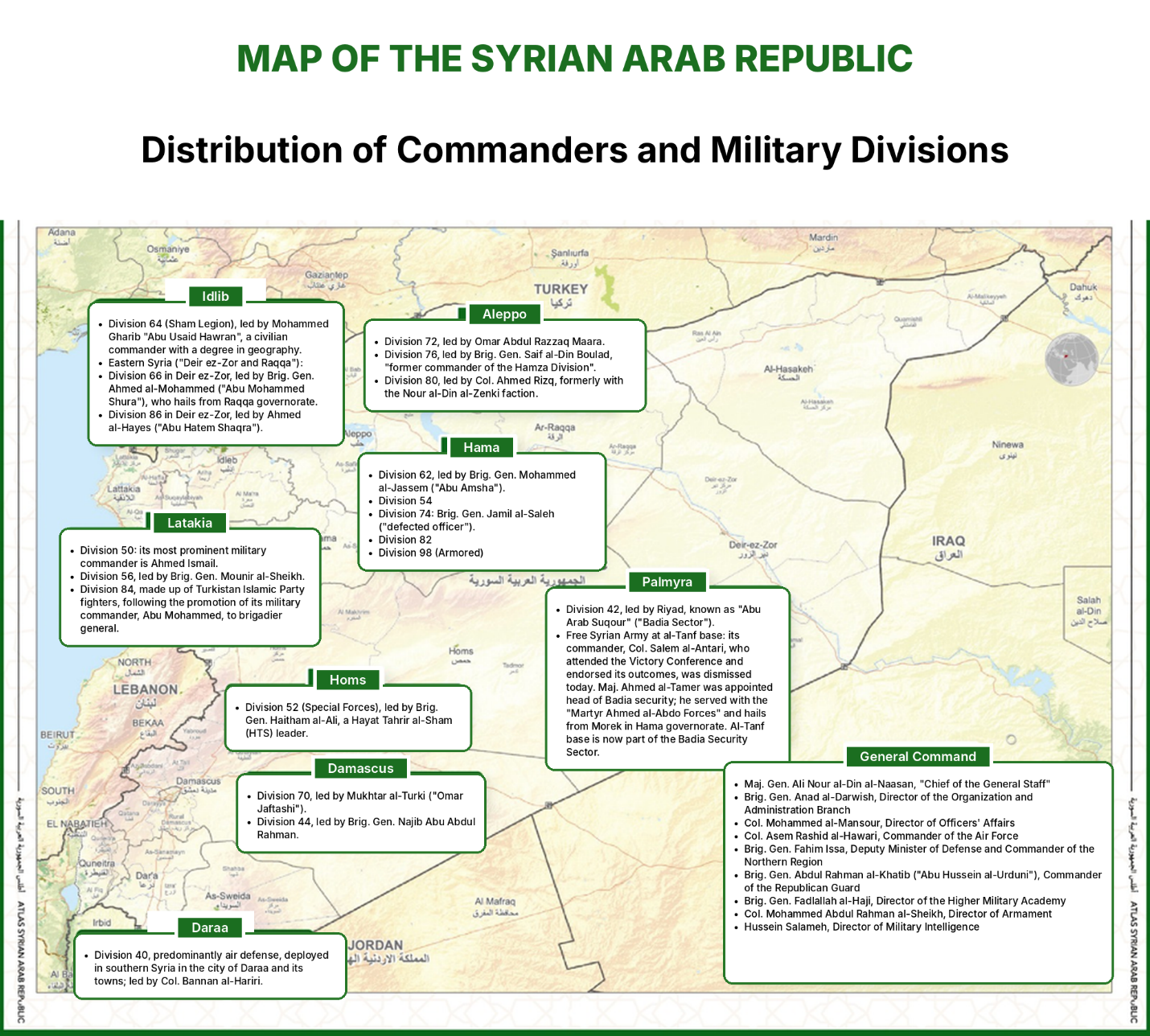
Endnotes
- Caroline A. Hartzell, “Mixed Motives? Explaining the Decision to Integrate Militaries at Civil War’s End”, in New Armies from Old: Merging Competing Military Forces after Civil Wars, ed. Roy Licklider (Washington, DC: Georgetown University Press, 2014), 13–38. ↩︎
- Jérôme Drevon, “Integration Without Representation: Bureaucracy, Depoliticization, and Military Formation in Post-Civil War Syria”, APSA Preprints, working paper, 3 September 2026. ↩︎
- Ronald R. Krebs and Roy Licklider, Misplaced Faith in Military Integration after Civil War (Cambridge, MA: Belfer Center for Science and International Affairs, Harvard Kennedy School, March 2016). ↩︎
- Sabine C. Carey and Belén González, “The Legacy of War: The Effect of Militias on Postwar Repression”, Conflict Management and Peace Science 38, no. 3 (2021): 247–269. ↩︎
- Paul Staniland, Networks of Rebellion: Explaining Insurgent Cohesion and Collapse, Cornell University Press, 2014. ↩︎
- Hussam Jazmati, “Decentralisation in Syria: Revolution and Liberation”, Syria TV, 29 September 2025, available at https://www.syria.tv/اللامركزية-في-سوريا-الثورة-والتحرير ↩︎
- International Crisis Group, Restoring Security in Post-Assad Syria: Lessons from the Coast and Suweida, Middle East Report no. 253 (Brussels: International Crisis Group, 26 November 2025); Caroline A. Hartzell and Matthew Hoddie, The Art of the Possible: Power Sharing and Post–Civil War Democracy (Cambridge: Cambridge University Press, 2015). ↩︎
- Nicholas Sambanis, “Political Order and Civil War Recurrence”, International Organization 70, no. 4 (2016): 1–35. ↩︎
- Interview with senior security official, Damascus, 3 February 2025. The interlocutor requested anonymity given the sensitivity of ongoing integration negotiations. ↩︎
- Agence France-Presse, “US Mediating Prisoner Exchange Talks between Damascus and Druze: Source to AFP”, Arab News, 24 February 2026, available at https://www.arabnews.com/middle-east/us-mediating-prisoner-exchange-talks-between-damascus-and-druze-source-to-afp-2634286 ↩︎
- Stathis N. Kalyvas, The Logic of Violence in Civil War (Cambridge: Cambridge University Press, 2006). ↩︎
- Malik al-Hafiz, “The Decisive Test for Syria’s Transitional Authority”, Asharq Al-Arabi, 21 August 2025, available at https://www.asharqalarabi.org.uk/الاختبار-الحاسم-للسلطة-الانتقالية-السورية_ad-id!558573.ks ↩︎
- Malik al-Hafiz, “The Decisive Test for Syria’s Transitional Authority”, Asharq Al-Arabi, 21 August 2025, available at https://www.asharqalarabi.org.uk/الاختبار-الحاسم-للسلطة-الانتقالية-السورية_ad-id!558573.ks ↩︎
- Paul Staniland, Networks of Rebellion: Explaining Insurgent Cohesion and Collapse (Ithaca, NY: Cornell University Press, 2014). ↩︎
- Nicholas Sambanis, “Civil War Recurrence”, in The Oxford Handbook of Peacebuilding, Statebuilding, and Peace Formation, ed. Roger Mac Ginty (Oxford: Oxford University Press, 2020), 304–322; Ronald R. Krebs and Roy Licklider, Misplaced Faith in Military Integration after Civil War, Policy Brief (Cambridge, MA: Belfer Center for Science and International Affairs, Harvard Kennedy School, March 2016), International Security Program. ↩︎
- Elisabeth Jean Wood, “The Social Processes of Civil War: The Wartime Transformation of Social Networks”, Annual Review of Political Science 11 (2008): 539–561. ↩︎
- Volker Boege, Anne Brown, Kevin Clements, and Anna Nolan, “Hybrid Political Orders, Not Fragile States”, Peace Review 21, no. 1 (2009): 13–21. ↩︎
- Sam Whitt, Michael Findley, Joseph K. Young, and Daniel L. Nielson, “Bargaining, Violence, and the Fragmentation of Authority in Postwar Societies”, Journal of Conflict Resolution 65, no. 6 (2021): 1048–1078. ↩︎
- Nicholas Sambanis, Power-Sharing and Peace-Building, ERF Working Paper No. 1396 (Cairo: Economic Research Forum, 2020). ↩︎
- Rahaf Aldoughli, “Syria Needs Security: Can Al-Sharaa Build a United Army to Provide It?” The World Today (Chatham House), March 2025, available at https://www.chathamhouse.org/publications/the-world-today/2025-03/syria-needs-security-can-al-sharaa-build-united-army-provide ↩︎
- Nicholas Sambanis, “Civil War Recurrence”, in The Oxford Handbook of Peacebuilding, Statebuilding, and Peace Formation, ed. Roger Mac Ginty (Oxford: Oxford University Press, 2020), 304–322; see also Bumba Mukherjee, “Why Political Power-Sharing Agreements Lead to Enduring Peaceful Resolution of Some Civil Wars, but Not Others?” International Studies Quarterly 50, no. 2 (June 2006): 479–504. ↩︎
- Rahaf Aldoughli, “Shifting Loyalties: Understanding Fighter Motivations in Syria’s Transitional Phase”, XCEPT Briefing Paper (London: King’s College London / ICSR, 17 March 2025), available at https://www.xcept-research.org/publication/shifting-loyalties-understanding-fighter-motivations-in-syrias-transitional-phase/ ↩︎
- Michaela Mattes and Burcu Savun, “Fostering Peace after Civil War: Commitment Problems and Agreement Design”, International Studies Quarterly 53, no. 3 (September 2009): 737–759. ↩︎
- Caroline Hartzell and Matthew Hoddie, “Institutionalizing Peace: Power Sharing and Post–Civil War Conflict Management”, American Journal of Political Science 47, no. 2 (April 2003): 318–322. ↩︎
- Interview with Ministry of Defense official, Damascus, 28 January 2025. ↩︎
- Interview with former SNA commander now serving in the new Ministry of Defense structure, Aleppo, 14 February 2025. ↩︎
- Rahaf Aldoughli, “Fighting Together: Emotionality, Fusion, and Psychological Kinship in Syrian Armed Groups”, Small Wars & Insurgencies 35, no. 7 (2024): 1179–1211; Rahaf Aldoughli, “‘The End of the Revolution but Not Revolutionaries’: Insights from Syrian Fighters”, Conflict, Security & Development 24, no. 5 (2024): 489–518. ↩︎
- Shelly Liu, Governing After War: Rebel Victories and Post-war Statebuilding, Oxford University Press, 2024, pp. 44–45. ↩︎
- Jeffrey M. Kaplow, “The Negotiation Calculus: Why Parties to Civil Conflict Refuse to Talk”, International Studies Quarterly 60, no. 1 (2016): 38–46. ↩︎
- Interview with senior armed-faction commander, Idlib, 7 April 2025. ↩︎
- Jai Kwan Jung, “Power-Sharing and Democracy Promotion in Post–Civil War Peacebuilding”, Democratization 19, no. 3 (2012): 486–506; Kristen Kao and Mara Redlich Revkin, “To Punish or to Pardon? Reintegrating Rebel Collaborators after Conflict in Iraq”, working paper, 23 June 2018. ↩︎
- Sabrina Karim, “Relational State Building in Areas of Limited Statehood: Experimental Evidence on the Attitudes of the Police”, American Political Science Review 114, no. 2 (2020): 536–551. ↩︎
- Rahaf Aldoughli, “Shifting Loyalties: Understanding Fighter Motivations in Syria’s Transitional Phase”, XCEPT Briefing Paper (London: King’s College London / ICSR, 17 March 2025), available at https://www.xcept-research.org/publication/shifting-loyalties-understanding-fighter-motivations-in-syrias-transitional-phase/. See also Rahaf Aldoughli, “Fighting beyond Borders: Transnational Fighter Motivations in Syria’s Civil War”, Defence Studies (2025), online first, DOI: 10.1080/14702436.2025.2461832. ↩︎
- Jeffrey M. Kaplow, “The Negotiation Calculus: Why Parties to Civil Conflict Refuse to Talk”, International Studies Quarterly 60, no. 1 (2016): 38–46. ↩︎
- Ben Oppenheim, Abbey Steele, Juan F. Vargas, and Michael Weintraub, “True Believers, Deserters, and Traitors: Who Leaves Insurgent Groups and Why”, Journal of Conflict Resolution 59, no. 5 (2015): 794–823. ↩︎
- Sam Whitt, Jonathan Hall, Jacob Aronson, Vera Mironova, Paul Huth, and James Igoe Walsh, Power-Sharing versus Power-Grabbing in the Aftermath of Civil War: Evidence from Public Opinion in Mosul, Iraq, HiCN Working Paper no. 354 (Households in Conflict Network, October 2021). ↩︎
- Al Jazeera, “Deterrence of Aggression: A Military Operation Launched to Overthrow the Assad Regime” (in Arabic), 29 November 2024, available at https://www.aljazeera.net/encyclopedia/2024/11/29/ردع-العدوان-عملية-عسكرية-أطلقتها ↩︎
- “Al-Fath al-Mubin Operations Room: A Military Coalition”, Al Jazeera Encyclopedia, 29 November 2024, available at https://www.aljazeera.net/encyclopedia/2024/11/29/غرفة-عمليات-الفتح-المبين-تحالف ↩︎
- Ibrahim Hamidi, “Murhaf Abu Qasra on Building a New Army and Syria’s Future”, Al Majalla, 24 January 2025, available at https://en.majalla.com/node/324021/politics/murhaf-abu-qasra-building-new-army-and-syrias-future ↩︎
- “Al-Fath al-Mubin Operations Room: A Military Coalition”, Al Jazeera Encyclopedia, 29 November 2024, available at https://www.aljazeera.net/encyclopedia/2024/11/29/غرفة-عمليات-الفتح-المبين-تحالف ↩︎
- “Dissolving Factions and Integrating Them into Syria’s New Army: A Map of Opportunities and Challenges”, Asharq Al-Awsat, 25 December 2024 (accessed 6 January 2025). ↩︎
- Rahaf Aldoughli, “Syria’s New Rulers Are Working To Unify Military Power”, New Lines Magazine, 25 February 2025, available at https://newlinesmag.com/reportage/syrias-new-rulers-are-working-to-unify-military-power/ ↩︎
- Fajr al-Hurriya (“Dawn of Freedom”) was established through a trilateral arrangement involving Turkey, HTS leadership, and SNA command structures. Unlike Fateh al-Mubin, whose primary operational axis was directed against regime forces, Fajr al-Hurriya was oriented principally against Kurdish-controlled areas in northern Syria. Its formation reflected the convergence of Turkish strategic interests in containing Kurdish autonomy with HTS’s tactical interest in managing and co-opting SNA factions without formally absorbing them. The arrangement allowed HTS to exercise indirect influence over Turkish-backed factions while preserving a degree of operational and financial separation. Interviews with SNA commanders and HTS-affiliated figures, Syria and Turkey, January-February 2025 and April 2025. ↩︎
- Johanna Moore, Alexandra Braverman, Annika Ganzeveld and Nick Carl, “Iran Update 7 December 2024”, Institute for the Study of War, 7 December 2024, available at https://www.understandingwar.org/backgrounder/iran-update-december-7-2024 ↩︎
- Abdel Wahab al-Gendy, “Who Is Ahmad al-Awda, Commander of the Eighth Brigade, and Why Did He Align Himself with the New Order?” (in Arabic), Youm7, 23 February 2026, available at https://www.youm7.com/story/2026/2/23/من-هو-أحمد-العودة-قاد-اللواء-الثامن-ووضع-نفسه-عهده/7316128 ↩︎
- Abdel Wahab al-Gendy, “Who Is Ahmad al-Awda, Commander of the Eighth Brigade, and Why Did He Align Himself with the New Order?”, Youm7, 23 February 2026, available at https://www.youm7.com/story/2026/2/23/من-هو-أحمد-العودة-قاد-اللواء-الثامن-ووضع-نفسه-عهده/7316128
https://www.youm7.com/story/2026/2/23/7316128↩︎ - Haid Haid, “Syria’s 8th Brigade disbands: a blueprint for military consolidation?” Al Majalla, 20 April 2025, available at https://majalla.com/node/325228/opinion/syrias-8th-brigade-disbands-blueprint-military-consolidation ↩︎
- “Al-Sharaa Issues the Text of the Constitution”, 7al.net, 29 January 2025, available at https://7al.net/2025/01/29/الشرع-يلقي-خطاب-النصر/aghiad-a/سياسة/
https://7al.net/2025/01/29/الشرع-يليقيف-النصر/aghiad-a/سياسة/↩︎ - See Rahaf Aldoughli, “Syria’s New Rulers Are Working To Unify Military Power”, New Lines Magazine, 25 February 2025, available at https://newlinesmag.com/reportage/syrias-new-rulers-are-working-to-unify-military-power/ ↩︎
- Mazen Ezzi, “Secret Negotiations to Break the Siege of Sweida” (Arabic), Daraj Media, 9 August 2025, available at https://daraj.media/المسارات-الخفيـة-لاختراق-السويداء/ ↩︎
- See Osama Abu Zaid, “A Shari‘a Defector from Jabhat Fatah al-Sham: The Group Transgressed against Other Factions without Legitimate Justification”, Syria Direct (Arabic), 31 January 2017, available at https://syriadirect.org/ar/شرعي-منشق-عن-فتح-الشام-الجبهة-بغت-على-الفصائل/ ↩︎
- Interview with Ministry of Defense official, Damascus, 29 January 2025. The interlocutor confirmed that the decision to absorb rather than reconstitute reflected both capacity constraints and political calculations about factional buy-in. ↩︎
- Interview with former HTS military commander now serving in the new army structure, Idlib, 8 April 2025. ↩︎
- “Syrian Defence Minister Announces the Integration of Assault Forces”, Asharq Al-Awsat, 17 March 2025, available at https://asharq.com/politics/135976/وزير-الدفاع-السوري-يعلن-دمج-كافة-الوحدات-العسكرية/ ↩︎
- Interview with divisional commander, northern Syria, 16 April 2025. ↩︎
- Interview with military source, Damascus, 15 January 2025. ↩︎
- Interview with senior Ministry of Defense official, Damascus, 4 February 2025. ↩︎
- Khaled Yacoub Oweis, “Syria has recruited half of planned 200,000-strong army, military sources say”, The National, 3 June 2025, available at https://www.thenationalnews.com/news/mena/2025/06/03/hts-brings-in-100000-men-into-new-syrian-army ↩︎
- Joseph Holliday, “The Syrian Army Doctrinal Order of Battle”, Institute for the Study of War, February 2013, available at https://understandingwar.org/research/middle-east/the-syrian-army-doctrinal-order-of-battle-2 ↩︎
- Interview with brigade-level commander, Hama, 3 February 2025; interview with former SNA commander integrated into new divisional structure, northern Syria, 17 April 2025. ↩︎
- Ahmad Sharawi, “Kurdish-led Syrian Democratic Forces Announce Its Dissolution”, Long War Journal, August 2026, available at https://www.longwarjournal.org/archives/2026/08/kurdish-led-syrian-democratic-forces-announce-its-dissolution.php ↩︎
- Interview with Ministry of Defense administrative official, Damascus, 18 August 2025. ↩︎
- Interview with security sector analyst, Damascus, 20 August 2025. ↩︎
- Despite my close and sustained engagement with military and security commanders over the past two years, keeping track of the ongoing institutional restructuring and administrative reshuffling within the Syrian army remains a considerable challenge. Commanders are continuously reassigned, replaced, and moved between positions, making it increasingly difficult to keep pace with the rapidly evolving command structure. ↩︎
- Syria TV, “Exclusive: Restructuring the Syrian Army into Five Corps and Appointing Their Commanders”, Syria TV, 29 June 2026, available at https://www.syria.tv/خاص-إعادة-هيكلة-الجيش-السوري-ضمن-خمسة-فيالق-وتسمية-قياداتها ↩︎
- Al-Modon, “Iʿadat haykala wasiʿa lil-jaysh al-suri: sitta fayaliq badalan min al-firaq” [A broad restructuring of the Syrian army: six corps instead of divisions], 6 August 2026, available at https://www.almodon.com/arabworld/2026/08/06/إعادة-هيكلة-واسعة-للجيش-السوري-ستة-فيالق-بدلا-من-الفرق. This was also supported and confirmed by multiple interviews with Ministry of Defense personnel. ↩︎
- Interview with Ministry of Defense records official, Damascus, 2 February 2025. ↩︎
- Interview with former regime military officer now cooperating with the transitional administration, Damascus (online), 14 March 2025. ↩︎
- Interview with Ministry of Defense records official, Damascus, 2 February 2025. The interlocutor described the destruction of personnel archives as systematic rather than incidental. ↩︎
- Interviews with Ministry of Defense officials, Damascus, 25 August 2025. ↩︎
- Interview with Ministry of Interior officials, Damascus, 25 February 2025. ↩︎
- To read more on HTS ideological transformation, see Orwa Ajjoub, “Legitimizing the Prohibited: Interactive Framing Processes in Intra-Jihadi Violence in Syria,” Studies in Conflict & Terrorism, published online 4 February 2026, available at https://doi.org/10.1080/1057610X.2026.2623891 ↩︎
- Interview with civil society actor working on security sector reform, Damascus, 16 January 2025. ↩︎
- Interview with former HTS Shari’a officer, Idlib, 9 April 2025. ↩︎
- Interview with moral guidance official, Ministry of Defense, Damascus, 30 January 2025. ↩︎
- Ibid. ↩︎
- Ministry of Higher Education and Scientific Research, admissions table (mufāḍala) for the National University for Defense Sciences and the Syrian University for Security Sciences, signed by Minister Marwan al-Halabi. See Syrian Ministry of Higher Education and Scientific Research, “Announcement of Registration for the Admission Competition” (in Arabic), official Facebook page, 1 September 2026, available at https://www.facebook.com/SyMOHEASR/posts/1497698545721479/ ↩︎
- Interview with moral guidance officer, 11 October 2026. ↩︎
- Rahaf Aldoughli, “Fighting beyond Borders: Transnational Fighter Motivations in Syria’s Civil War”, Defence Studies (2025), online first, DOI: 10.1080/14702436.2025.2461832. See also Rahaf Aldoughli, “Fighting Together: Emotionality, Fusion, and Psychological Kinship in Syrian Armed Groups”, Small Wars & Insurgencies 35, no. 7 (2024): 1179–1211. ↩︎
- Rahaf Aldoughli, “‘The End of the Revolution but Not Revolutionaries’: Insights from Syrian Fighters”, Conflict, Security & Development 24, no. 5 (2024): 489–518. ↩︎
- Rahaf Aldoughli, “Shifting Loyalties: Understanding Fighter Motivations in Syria’s Transitional Phase”, XCEPT Briefing Paper (London: King’s College London / ICSR, 17 March 2025), available at https://www.xcept-research.org/publication/shifting-loyalties-understanding-fighter-motivations-in-syrias-transitional-phase/ ↩︎
- Rahaf Aldoughli, “Fighting beyond Borders: Transnational Fighter Motivations in Syria’s Civil War”, Defence Studies (2025), online first, DOI: 10.1080/14702436.2025.2461832. ↩︎
- Interview with security official, Ministry of Defense, Damascus, 16 August 2025. ↩︎
- Interview with senior Ministry of Defense security official, Damascus, 17 August 2025. ↩︎
- Interview with senior SNA commander, northern Syria, 13 April 2025. The commander requested anonymity, citing ongoing negotiations with the Ministry of Defense. ↩︎
- Interview with SNA central commander, online, 22 March 2025. ↩︎
- Interview with SNA faction leader, northern Syria, 14 April 2025. ↩︎
- U.S. Department of State, Syria Sanctions, available at https://2021-2025.state.gov/syria-sanctions/. Read CNN interactive investigation at Tamara Qiblawi, Allegra Goodwin, and Sarah El Sirgany, “As Syria’s President Preaches Human Rights, New Evidence Details Abuse Allegedly Carried Out under One of His Key Commanders”, CNN, n.d., available at https://www.cnn.com/interactive/asequals/syria-army-commander-women-abuse-as-equals-intl-invs/ ↩︎
- U.S. Department of the Treasury, “Treasury Sanctions Syrian Regime Prisons, Officials, and Syrian Armed Group”, press release, 28 July 2021, available at https://home.treasury.gov/news/press-releases/jy0292 ↩︎
- Firas Karam, “Articles of the Syrian Army on Disbanding the National Factions in Syria”, Asharq Al-Awsat, 12 October 2022 (accessed 5 February 2025). ↩︎
- Khaled Yacoub Oweis, “Syria Has Recruited Half of Planned 200,000-Strong Army, Military Sources Say”, The National, 3 June 2025, available at https://www.thenationalnews.com/news/mena/2025/06/03/hts-brings-in-100000-men-into-new-syrian-army ↩︎
- “Excerpt from the Statement of Ahrar al-Sham After the Capture of Sama”, Al Jazeera Arabic, 10 September 2014 (accessed 8 February 2025). ↩︎
- “Syrian Army Reconciliations and Surrenders”, Al Jazeera Arabic, 4 January 2019 (accessed 8 February 2025). ↩︎
- The Peace Spring enclave is the strip of territory between the border towns of Ras al-Ayn and Tal Abyad, roughly 3,500 square kilometers in area, captured by the Turkish Armed Forces and the SNA during Turkey’s Operation Peace Spring in October 2019 and held under Turkish control since. ↩︎
- Interviews with senior SNA and Ministry of Defense commanders, Damascus and northern Syria, 13-15 April 2025. See also Rahaf Aldoughli, “Syria’s New Rulers Are Working To Unify Military Power”, New Lines Magazine, 25 February 2025, available at https://newlinesmag.com/reportage/syrias-new-rulers-are-working-to-unify-military-power/ ↩︎
- Interview with Ministry of Defense official responsible for SNA integration files, Damascus, 19 April 2025. ↩︎
- Rahaf Aldoughli, “Fighting beyond Borders: Transnational Fighter Motivations in Syria’s Civil War”, Defence Studies (2025), online first, DOI: 10.1080/14702436.2025.2461832. Interview with SNA field commander, northern Syria, 16 April 2025. ↩︎
- Interview with former SNA commander, northern Syria, 18 April 2025. The interlocutor described the internal debate over integration as unresolved at the time of the interview. ↩︎
- Interview with SNA commander from Deir ez-Zor, online, 12 June 2025. ↩︎
- This account was also supported by Sultan al-Kanj, “al-Jaysh al-Suri al-jadid… taghyir musammayat am iʿadat haykala muʾassasatiyya?” [The new Syrian army: a change of names or institutional restructuring?], Asharq al-Awsat, 15 September 2026, available at https://aawsat.com/في-العمق/تحقيقات-وقضايا/5318537-الجيش-السوري-الجديد-تغيير-مسمّيات-أم-إعادة-هيكلة-مؤسساتية؟ ↩︎
- Ibid. ↩︎
- Author interview with central commander, 25 August 2026. ↩︎
- Al-Araby Al-Jadeed, “Rebuilding the Syrian Army: Obstacles Complicating the Task” (in Arabic), 23 August 2025, available at https://www.alaraby.co.uk/politics/إعادة-بناء-الجيش-السوري-عوائق-تصعّب-المهمة; Al-Modon, “Abu ʿAmsha bi-mansib jadid.. hal jarat tanhiyatuhu ʿan qiyadat al-Firqa 62?” [Abu Amsha in a new post: has he been removed from command of the 62nd Division?], 5 August 2026, available at https://www.almodon.com/arabworld/2026/08/05/أبو-عمشة-بمنصب-جديد-هل-جرى-تنحيته-عن-قيادة-الفرقة-62 ↩︎
- Alhurra, “Suriya.. istinfar wa-taghyirat ʿaskariyya wa-‘Abu ʿAmsha’ fi qalb al-mashhad” [Syria: an alert, military changes and “Abu Amsha” at the centre of the scene], August 2026, available at https://alhurra.com/32100 ↩︎
- Enab Baladi, “Bi-marsum riʾasi.. Ramadan mudiran li-Hayʾat al-Istithmar al-Suriyya khalafan li-l-Hilali” [By presidential decree: Ramadan appointed director of the Syrian Investment Authority, succeeding al-Hilali], 5 August 2026, available at https://www.enabbaladi.net/819731/; al-Iqtisadi, report on Decree No. 162 of 2026, available at https://manhom.com/aliqtisadi/?p=2276344 (on Ramadan’s position as chairman of Isra Portfolio Management, registered with Turkey’s Capital Markets Board). At the time of editing this report, on 18 November 2026, Ahmad Rawad Ramadan was appointed Minister of Commerce. ↩︎
- Interview with a member of the Syrian Investment Authority, online, 15 August 2026. ↩︎
- Interview with senior former SNA commander, 15 September 2026. ↩︎
- Interview with senior former SNA commander, Lebanon, 2 October 2026. ↩︎
- This figure was confirmed to me by two former SNA commanders and a Ministry of Defense official, 28 September 2026. ↩︎
- These accounts do not establish the distribution of departures across former SNA, SDF or other units, and the reported total should be treated as an interview-based estimate rather than a verified administrative count. ↩︎
- Text of the 10 March 2025 agreement between the Syrian government and the SDF, available at https://www.aljazeera.net/encyclopedia/2025/3/10/نص-الاتفاق-بين-الدولة-السورية-وقوات ↩︎
- Al Jazeera Net, “Masar min al-tafawud wa-l-maʿarik.. hakadha iktamala indimaj Qasad bi-l-dawla al-Suriyya” [A path of negotiation and battles: how the SDF’s integration into the Syrian state was completed], 26 August 2026, available at https://www.aljazeera.net/news/2026/8/26/مسار-من-التفاوض-والمعارك-هكذا-اكتمل ↩︎
- FDD, “Third Time Lucky? Syrian Government and Kurdish-Led SDF Announce Latest Agreement”, 30 January 2026, available at https://www.fdd.org/analysis/2026/01/30/third-time-lucky-syrian-government-and-kurdish-led-sdf-announce-latest-agreement/; Middle East Council on Global Affairs, “How Damascus Reclaimed Syria’s Northeast, and What Integration Now Means”, 4 February 2026, available at https://mecouncil.org/blog_posts/syria-sdf-integration-agreement-2026-analysis/ ↩︎
- Interviews with SDF political figure and Kurdish commander, Erbil, 17-18 November 2025. ↩︎
- Interviews with Arab tribal leaders and SDF Arab component commanders, northeast Syria (online), 2-5 December 2025. ↩︎
- Al-Majalla, “How the US Got the SDF to Capitulate to Damascus”, Al Majalla, March 2026, available at https://en.majalla.com/node/329476/documents-memoirs/how-us-got-sdf-capitulate-damascus; “Implementing the Damascus–SDF Agreement: A Gradual Path Tested by the Field”, Al-Araby al-Jadeed, 26 February 2026. ↩︎
- SANA, “Comprehensive Agreement Between Syrian Government and SDF for Full Integration”, 30 January 2026, available at https://sana.sy/en/politics/2293263/; Enab Baladi, “Abdi Reveals Deal Details with Damascus”, 30 January 2026, available at https://english.enabbaladi.net/archives/2026/01/abdi-reveals-deal-details-with-damascus-says-he-will-not-take-office/ ↩︎
- Interview with senior SDF figure, Erbil, 20 November 2025. The interviewee confirmed that the 30 January terms had been contested internally within the SDF political bureau before acceptance. ↩︎
- Enab Baladi, “Government Source: 6,000 SDF Members Join Syrian Army”, 2 July 2026, available at https://english.enabbaladi.net/archives/2026/07/government-source-6000-sdf-members-join-syrian-army/ ↩︎
- Al Hadath, [Kurdish Commander: Approximately 10,000 SDF Fighters Integrated into the Syrian Army], YouTube, 26 August 2026, available at https://www.youtube.com/watch?v=W1IlJcisamE ↩︎
- Mina Aldroubi, “SDF Integration into Syrian State Marks Milestone but Key Tensions Unresolved, Experts Say”, The National, 21 August 2026, available at https://www.thenationalnews.com/news/mena/2026/08/21/sdf-integration-into-syrian-state-marks-milestone-but-key-tensions-unresolved-experts-say/; Enab Baladi, “Al-Hasakah Protesters Call for Full Government Control”, 3 October 2026 (on Abdi’s appointment as adviser to the presidency). ↩︎
- Ahmad Sharawi, “Kurdish-led Syrian Democratic Forces Announce Its Dissolution”, FDD’s Long War Journal, 25 August 2026, available at https://www.longwarjournal.org/archives/2026/08/kurdish-led-syrian-democratic-forces-announce-its-dissolution.php ↩︎
- Interview with YPJ commander, online, 22 October 2026. ↩︎
- Interview with SDF military figure, Erbil, 19 November 2025. ↩︎
- Interview with senior SDF political figure, Erbil, 21 November 2025. ↩︎
- Syria Direct, “Hasakah at a Crossroads: Real Integration, or Recreating ‘Security Squares’?” February 2026, available at https://syriadirect.org/hasakah-crossroads-real-integration-or-recreating-security-squares; Enab Baladi, “The Damascus–SDF Agreement Enters into Force Tomorrow, as Interpretations Diverge”, 1 February 2026, available at https://english.enabbaladi.net/archives/2026/02/the-damascus-sdf-agreement-enters-into-force-tomorrow-as-interpretations-diverge/ ↩︎
- Interview with SDF security commander, northeast Syria, conducted via secure channel following the 30 January 2026 agreement announcement. Original Arabic: “وجود قوات الشرع في الحسكة و القامشلي هو رمزي و سيكونون موجودون فقط في مربعات امنية محددة ليس اكثر.” ↩︎
- Al Jazeera Net, “Masar min al-tafawud wa-l-maʿarik”, 26 August 2026 (statement by Hasakah deputy governor Ahmad al-Hilali); Sharawi, “Kurdish-led Syrian Democratic Forces Announce Its Dissolution.” ↩︎
- Sharawi, “Kurdish-led Syrian Democratic Forces Announce Its Dissolution.” ↩︎
- Interview with SDF security commander, northeast Syria, conducted via secure channel, February 2026. ↩︎
- Author interview with a tribal notable (wajīh) from the Sharabin tribe, Ras al-Ayn, 29 September 2026. ↩︎
- Enab Baladi, “Al-Hasakah Protesters Call for Full Government Control”, 3 October 2026, available at https://english.enabbaladi.net/archives/2026/10/al-hasakah-protesters-call-for-full-government-control/ ↩︎
- Salam Hassan, “اعتداء على مهجّرين أكراد في تل أبيض عند محاولتهم استعادة ممتلكاتهم”, Al-Araby Al-Jadeed, 26 October 2026, available at https://www.alaraby.co.uk/society/اعتداء-على-مهجّرين-أكراد-في-تل-أبيض-عند-محاولتهم-استعادة-ممتلكاتهم
https://www.alaraby.co.uk/society/↩︎ - European Center for Constitutional and Human Rights, “Crimes in Syria: The Neglected Atrocities of Afrin”, available at https://www.ecchr.eu/en/case/crimes-in-syria-the-neglected-atrocities-of-afrin; Human Rights Watch, “Everything Is by the Power of the Weapon”: Abuses and Impunity in Turkish-Occupied Northern Syria (New York: Human Rights Watch, 29 February 2024), available at https://www.hrw.org/report/2024/02/29/everything-power-weapon/abuses-and-impunity-turkish-occupied-northern-syria ↩︎
- Tugba Altun, Gokhan Celiker, and Ahmet Kartal, “Fidan: Final Warning Issued to the Terrorist Organisation YPG”, Anadolu Agency, 8 January 2025, available at https://www.aa.com.tr/ar/3444290/تركيا/فيدان-توجيه-إنذار-نهائي-لتنظيم-واي-بي-جي-الإرهابي ↩︎
- Aldroubi, “SDF Integration into Syrian State Marks Milestone”; on the YPJ, Sharawi, “Kurdish-led Syrian Democratic Forces Announce Its Dissolution.” ↩︎
- Syrian Ministry of Interior, “Comprehensive Restructuring and Appointment of Deputies and Provincial Internal Security Commanders,” 25 May 2025, reported by SANA (@SanaAjel), 25 May 2025; Al Jazeera Arabic, “Al-Dakhiliyya al-Suriyya tuʿayyin qadatan amniyyiyin ʿaqiba iʿadat haykalat shamila,” 25 May 2025, available at https://www.aljazeera.net/news/2025/5/25/الداخلية-السورية-تعين-قادة-أمنيين-عقب
https://www.aljazeera.net/news/2025/5/25; Al-ʼaraby al-Jadeed, “Al-Dakhiliyya al-Suriyya tuʿlin ʼan taʿyinat li-qadat al-amn fi al-muhafazat,” 25 May 2025, available at https://www.alaraby.co.uk/politics/الداخلية-السورية-تعلن-عن-تعيينات-لقادة-الأمن-في-المحافظاتhttps://www.alaraby.co.uk/politics. The restructuring established four deputy posts: Maj.-Gen. ʿAbd al-Qadir Tahan (security affairs), Maj.-Gen. Ahmad Muhammad Latuf (police affairs), Brig.-Gen. Ziyad Fawwaz al-ʿAyish (civil affairs), and Brig.-Gen. Basim ʿAbd al-Hamid al-Mansur (administrative and legal affairs). Internal security commanders were simultaneously appointed in 12 of Syria’s 14 provinces; the appointments explicitly excluded al-Raqqa and al-Hasakah, where SDF control remained in effect. According to Agence France-Presse, several of the provincial appointees previously held security responsibilities within HTS during the “Deterrence of Aggression” offensive. ↩︎ - William G. O’Neill, Police Reform in Post-Conflict Societies: What We Know and What We Still Need to Know (New York: International Peace Academy, April 2005). ↩︎
- Interview with senior Interior Ministry official, Damascus, 16 August 2025. See also Rahaf Aldoughli, “Syria Needs Security: Can Al-Sharaa Build a United Army to Provide It?” The World Today (Chatham House), March 2025, available at https://www.chathamhouse.org/publications/the-world-today/2025-03/syria-needs-security-can-al-sharaa-build-united-army-provide ↩︎
- Interview with former Ahrar al-Sham commander now serving in the Internal Security Command, Damascus, 18 August 2025. ↩︎
- North Press Agency, “Syria’s President Appoints Senior Officials to Security Posts”, 19 July 2026 (citing SANA), available at https://npasyria.com/en/?p=139285 ↩︎
- Author interview, 26 June 2025. ↩︎
- Lucía Tiscornia, “Police Reform in the Aftermath of Armed Conflict: How Militarization and Accountability Affect Police Violence”, Journal of Peace Research 61, no. 3 (2024): 383–397, available at https://doi.org/10.1177/00223433221128846; Pádraig McAuliffe, “The Conceptual–Contextual Gap between Non-recurrence and Transformative Police Reform in Post-Conflict States”, Policing: A Journal of Policy and Practice 15, no. 1 (2021): 348–361, available at https://doi.org/10.1093/police/paaa009 ↩︎
- Author interview with a Ministry of Defense official from within the Directorate of Moral Guidance, 25 March 2025; 20 August 2025 and 12 October 2026. ↩︎
- Information provided by the Ministry of Defense official, 20 and 22 October 2026. ↩︎
- Information provided by the Ministry of Defense official, 23 October 2026. ↩︎
- Hasan Dagim (@Hasan_Dagim), post on X (formerly Twitter), 29 October 2025, available at https://x.com/Hasan_Dagim/status/1983613110414950900. It must be clarified though that the influence of SNA moral guiders is much less than that of the sheikhs previously affiliated with HTS. ↩︎
- Interviews with moral guidance officers, Hama, 4 February 2025; 18 August 2025; 10 October 2026. Interview with senior official, Directorate of Moral and Religious Guidance, Damascus, 31 January 2025. The interlocutor provided comparative detail on the Assad-era guidance structure that has not been published in open sources. Interviews with moral guidance officers, northern Syria, 13-14 April 2025. Information provided by the Ministry of Defense official, October 2026. ↩︎
- Interviews with moral guidance officers, Damascus, January-February 2025, April 2025, and 23 August 2025. This account, with the same details, was confirmed in a piece by Hussam Jazmati, “Days in the Syrian Army’s Moral Guidance Training Course” (in Arabic), 28 October 2025, available at https://aljumhuriya.net/ar/2025/10/28/أيام-في-دورة-التوجيه-المعنوي-للجيش/ ↩︎
- Interview with army officer attending moral guidance training, Damascus, 18 August 2025. ↩︎
- Hussam Jazmati, “Days in the Syrian Army’s Moral Guidance Training Course” (in Arabic), 28 October 2025, available at https://aljumhuriya.net/ar/2025/10/28/أيام-في-دورة-التوجيه-المعنوي-للجيش/; information provided by the Ministry of Defense official, October 2026; interview with moral guidance curriculum developer, Damascus, 21 August 2025. Curriculum documents were shown during the interview but not retained for reproduction. ↩︎
- Interview with moral guidance officer, Idlib, 10 April 2025. The residential training structure was described as recently formalized following earlier pilot courses. Jazmati, “Days in the Syrian Army’s Moral Guidance Training Course.” Jazmati reports that participants who objected to the content of the course he attended, which had more than 50 participants, most of them former HTS Shari’a officials, were expelled, and that such courses were later halted. ↩︎
- Interview with author, Damascus, 19 August 2025. The Qasiyoun Center’s “Umma Project” and the backgrounds of its non-Syrian staff were confirmed in a separate interview with a Ministry of Defense cultural affairs official, Damascus, 20 August 2025. The interlocutor’s identity is withheld at their request. See also Rahaf Aldoughli, “Fighting Together: Emotionality, Fusion, and Psychological Kinship in Syrian Armed Groups”, Small Wars & Insurgencies 35, no. 7 (2024): 1179–1211; and Rahaf Aldoughli, “Fighting beyond Borders: Transnational Fighter Motivations in Syria’s Civil War”, Defence Studies (2025), online first, DOI: 10.1080/14702436.2025.2461832, for analysis of the ideological and solidarity dimensions of fighter motivation in Syrian armed groups. ↩︎
- Jazmati, “Days in the Syrian Army’s Moral Guidance Training Course.” ↩︎
- Interviews with moral guidance officers, Damascus, August 2025; information provided by the Ministry of Defense official, October 2026. Interviews with two former SNA commanders and a Ministry of Defense official, September-October 2026; see Section IV.C(ii). ↩︎
- Ibid. See also Khaled Yacoub Oweis, “Syria Has Recruited Half of Planned 200,000-Strong Army, Military Sources Say”, The National, 3 June 2025, available at https://www.thenationalnews.com/news/mena/2025/06/03/hts-brings-in-100000-men-into-new-syrian-army. On kinship-based recruitment carried over from Idlib, interview with former HTS Shari’a officer, Idlib, 9 April 2025. ↩︎