




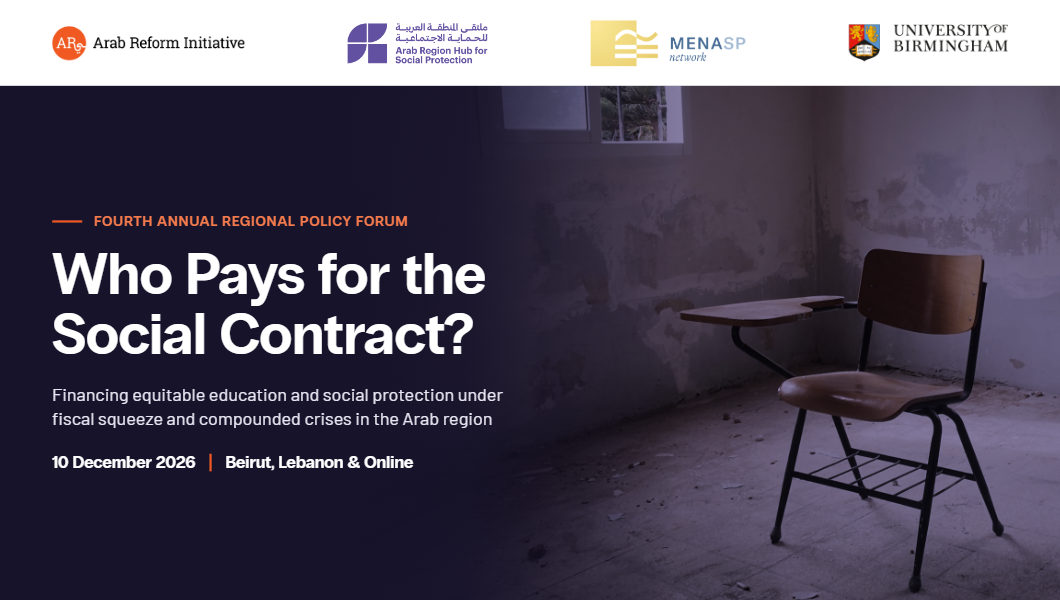
Who Pays for the Social Contract? Financing Equitable Education and Social Protection under Fiscal Squeeze and Compounded Crises in the Arab Region
About the forum
Across the Arab region, active war, mass displacement, deepening macroeconomic shocks, sovereign debt crises, and acute austerity are converging to unravel existing social contracts. Social protection systems, already weak and largely tied to formal employment, are eroding as a result, leaving both the most vulnerable groups and a growing “missing middle” excluded from contributory schemes and narrowly targeted assistance.
At the center of this crisis sits the complex relationship between education, labor markets, and social protection. Challenging the assumption that educational attainment automatically yields formal jobs, educated unemployment and demand-driven informality remain structural features of many Arab economies. Education as currently structured often exports skilled graduates to the Gulf or Europe, while rapid digital and green transitions threaten to widen divides in skills. At the same time, as indebted states withdraw from public services, the cost of schooling shifts directly onto households, deepening poverty and straining fragile social safety nets.
Moving beyond diagnosis, this Forum opens a prospective space to ask how education and training systems can be reimagined, and how public institutions might serve as anchor sites for social protection, social mobility, and formalization. Above all, it asks a central question: who pays for a renewed social contract, when shrinking international aid and regressive taxation are no longer enough?
What the forum will explore
Joining academic evidence with lived experience, the Forum bridges educational studies, macroeconomics, political economy, sociology, law, and social policy to:
- Interrogate how public education decay, privatization, and household out-of-pocket costs interact with demand-side informality, educated unemployment, and the erosion of social protection.
- Evaluate the fiscal space, feasibility, risks, and distributive impact of progressive domestic taxation alongside alternative financing mechanisms, such as diaspora bonds and remittances, blended finance, and GCC development funds.
- Examine how foundational schooling, TVET, universities, and adult retraining can be reformed and linked to social protection amid conflict, debt, digitalization, and decarbonization.
- Analyze the systemic, financial, and physical barriers facing marginalized groups, including women, low-income households, refugees, displaced populations, and persons with disabilities, to design rights-based links between inclusive education and social protection.
Who takes part
The Forum brings together academic researchers from Arab and European universities; technical and middle-level policymakers from Ministries of Education, Labor, Social Development and Affairs, and Finance across Lebanon, Egypt, Tunisia, Jordan, Morocco, Syria, and the GCC; civil society organizations, trade unions, and policy advocacy groups; organizations representing marginalized communities, including disability rights organizations, youth advocates, and refugee support networks; and regional and international development partners.
Expected outcomes
By engaging researchers directly with technical policymakers, civil society coalitions, and rights advocates, the Forum will co-design actionable policy briefs, institutional roadmaps, a Regional Policy Consensus Note, and a flagship multi-country collaborative research agenda.
Attend
The public conference takes place on 10 December 2026 in Beirut and online, with the agenda set to Beirut time.
To register for in-person attendance click here.
For online reregistration via Zoom, click here.