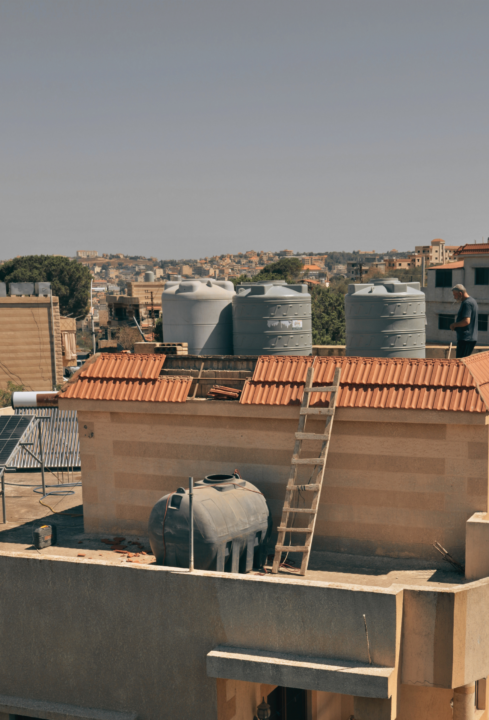
In Lebanon’s domestic water sector, a central contradiction structures everyday life: Households pay an annual flat fee for formal water connection, yet cannot rely on a predictable, safe, and accountable service. Many households remain formally connected while organizing daily life around uncertainty: Irregular network supply, pumping constrained by electricity availability, water storage management, and periodic recourse to trucked or purchased water. As a result, the household water bill is not experienced as a single tariff, but as a stacked burden combining formal payment with recurring coping costs. This is the condition captured by the phrase “paying more, getting less”.
The contradiction is not simply the result of scarcity or infrastructure failure. It is produced by a service regime in which billing is tied more to connection status than to measurable and enforceable service delivery. The result is a persistent gap between being connected and being served. Households must therefore assemble water access through hybrid coping pathways that combine public supply, informal and private markets, storage, pumping, and other household-level adjustments. These pathways are functional, but they are also unequal: They shift costs, risks, and practical responsibility onto users, with especially severe implications for affordability, safety, and accountability. This paper treats Lebanon’s flat-tariff water regime not as a technical detail, but as a governance arrangement that explains how water injustice is lived.
The analysis focuses on domestic water service in Lebanon and draws on 52 semi-structured interviews with households, municipal actors, Water Establishment personnel, informal water providers, experts, researchers, and civil society practitioners, alongside a targeted desk review. It employs a water justice lens to understand the impacts on people and their livelihoods. Rather than treating service failure as a temporary crisis, the paper traces how it becomes routine in everyday life and how households compensate for it through repeated coping practices. The emphasis is on lived service outcomes: Reliability, affordability, safety, and accountability.
The paper proceeds as follows. It first examines how the legacy flat-tariff regime bills access instead of delivery and how this shapes the connection–service gap. It then analyzes how households cope with intermittent supply through hybrid provisioning, focusing on affordability, accountability, and safety. Finally, it turns to three practical service improvement cases to identify what limited but meaningful gains are possible under constraints.
The views represented in this paper are those of the author(s) and do not necessarily reflect the views of the Arab Reform Initiative, its staff, or its board.