An old Indian folktale: a group of bandits arrives at a river carrying ropes and weapons. The boatman knows they intend to raid a village on the other side. Yet he ferries them across. By dawn, houses on the opposite bank are burning, and people are dead. When the survivors confront the boatman, he defends himself – he killed no one; he merely took passengers across the river. The villagers disagree. One of them replies: the river would not have carried them without your boat. The hand that strikes may bear the greater guilt, but the hand that knowingly arms it cannot be free of blame. The relevance is not historical.
Prime Minister Narendra Modi stood with Israel since the Hamas attacks of 7 October, making India one of the few governments in the Global South to do so without qualification. In the months that followed, India made its alignment with Israel plain through its voting record on United Nations resolutions calling for a ceasefire. Indian official statements did not once use the word "occupation" or "Israeli blockade." Prime Minister Modi, addressing the Israeli Knesset in February 2026, declared that "nothing can justify terrorism" – drawing a parallel with the November 2008 Mumbai attacks while leaving Israel's conduct in Gaza unnamed. The language of "terrorism" deployed by official statements and amplified through the Indian media ecosystem coheres with the diplomatic syntax of Washington and Tel Aviv.
India’s active support for Israel has attracted substantial commentary. Analysts have pointed to the convergence of Hindutva nationalism and Zionist settler-colonial ideology, both built on the logic of a threatened majority – in India, the demonization of Muslims as an internal minority threat, and in Israel, the elimination of the Palestinian Arab population as a demographic and security problem. Others have noted the long arc of India’s de-hyphenation policy – the strategic decision initiated under former Indian Prime Minister Narasimha Rao in 1992 and accelerated under Modi to decouple the India-Israel relationship from the India-Palestine relationship, treating them as separate bilateral tracks rather than as ethically entangled positions. Still others have drawn out the electoral logic: a BJP government that has made anti-Muslim sentiment the cornerstone of its domestic mobilization finds in the settler-colonial state of Israel a useful self-validation – a state that has institutionalized precisely the kind of Muslim-excluding ethnonationalism long promoted by the Rashtriya Swayamsevak Sangh (RSS), the ideological parent organization of the BJP and the institutional backbone of Hindu nationalist politics in India.
All of this is true. None of it is sufficient. What is missing from the dominant analysis is the question of material participation. India is not merely watching the horrors in Gaza or the ongoing settlement of the West Bank from a diplomatic distance. It is not simply failing to condemn – it is actively supplying important parts of Israel’s military infrastructure. Through the Adani-Elbit joint venture, under the banner of the Make in India initiative, drones manufactured at a facility in Hyderabad are being used by Israeli forces in their attacks on Gaza. Through a formal Labor Mobility Agreement signed in November 2023 and expanded in February 2026, tens of thousands of Indian workers have been sent to Israel to replace Palestinian workers in the occupied West Bank who were stripped of their permits in the aftermath of 7 October. Through these two mechanisms – private capital in the defense supply chain and state-facilitated labor export – India has made itself a participant in the material infrastructure of the occupation.
This article does not ask whether India bears responsibility. That question has already been answered by the drones over Gaza and the workers on Israeli construction sites. It asks instead what India’s material complicity means – for its historic self-understanding as a post-colonial, non-aligned power, for its legacy of solidarity with the occupied and dispossessed people of Palestine, and for what remains of that legacy once the boats have already crossed the river.
The Ideological Foundation – Hindutva-Zionism and the Post-2014 "Natural Alliance"
The relationship between Hindutva nationalism and Zionism is neither accidental nor recent. Its intellectual and cultural roots run through the early twentieth century, when both movements were constructing narratives around their foundational mythologies in the shadow of European nationalism. V.D. Savarkar, the ideological father of Hindutva, admired the Zionist project explicitly, describing it as a model for how a dispersed people could reconstitute themselves as a majority through territorial control. In early 1923, Savarkar had publicly supported the Jewish people’s right to regain what was described as their ancestral country. He wrote in his seminal pamphlet Hindutva: Who Is a Hindu? “If the Zionists’ dreams are ever realized, if Palestine becomes a Jewish State, it will gladden us almost as much as our Jewish friends.” The logic was the same: a Hindu homeland for Hindus, a Jewish homeland for Jews, and in both cases, the existing population that does not belong to that group was rendered a demographic and security problem.
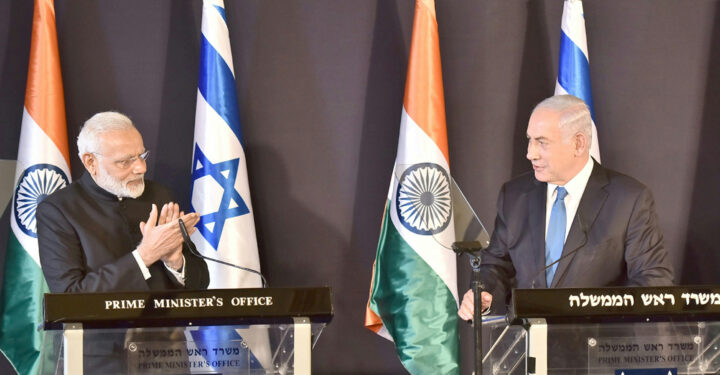
What was intellectual sympathy in the colonial era has become operational alignment in the Modi era. Since 2014, the RSS-backed BJP government has systematically upgraded its romance – not with the state of Israel per se, but with the "idea of Israel". This aligns, with uncomfortable precision, with the RSS-BJP’s own idea of India – a Hindu Rashtra (Hindu-Nation), a civilizational state organized around the religious identity of its majority. Both parties generally refrain from admitting this officially, but the relationship has been projected as "natural," and it has deepened across every domain: defense procurement, intelligence sharing, agricultural technology, cyber-security, and counter-terrorism doctrine. Modi became the first Indian Prime Minister to make a standalone visit to Israel in 2017, a symbolic break with decades of distance rooted in the principle of anti-colonialism. Netanyahu reciprocated and visited India in 2018. In one of his media interviews, Netanyahu remarked, half in jest, that he has more followers from India than from Israel. The two leaders performed the language of a "natural alliance" with evident relish, portraying their states as democracies under existential threat from Islam – a threat both had spent years politically cultivating.
The ideological convergence operates at many complex levels. At the level of threat construction, both movements have built their political identities around the figure of the Muslim as internal enemy: the demographic threat, the terrorist sleeper, the cultural contaminant. The Gaurakshak – a vigilante group in India dedicated to protecting cows from slaughter and operating under the ideological sanction of Hindutva – roaming the highways of Uttar Pradesh and the Israeli occupation soldier making raids on Palestinian homes in the West Bank are not merely mirror images; they are cousins, both produced by the politics of states that have made the minority body a permanent site of suspicion, legislation, and manageable violence. At the level of settler logic, both projects are premised on the prior claim of a majority people to land that is currently contested. The RSS-BJP claim to Hindutva and the Zionist claim to Eretz Israel share a common grammar: superiority, divine mandate, entitlement, and the illegitimacy of those who arrived later or converted to the wrong faith.
This is not merely rhetorical. The alignment has material consequences, and nowhere are those consequences more visible than in the military nature of their friendship. Israel has emerged as India's third-largest arms supplier, accounting for 15 percent of the country's major arms imports during 2021–2025. Indian security forces have drawn on Israeli equipment, training, surveillance, border-management technologies, and counter-insurgency doctrines in Kashmir, including practices of collective punishment, home demolition, and the use of pellet guns against civilian protesters. Following the Mumbai attacks of 2008, sections of India's strategic community drew comparisons with Israel's security doctrine, arguing that India should adopt a more forceful retaliatory posture toward Pakistan – a debate that reflected the growing influence of Israeli counterterrorism thinking within Indian strategic discourse. The transfer is not of weapons alone but of a philosophy – one in which a Muslim population is treated as a threat to be neutralized rather than a citizenry to be governed.
Domestic Posturing – Gaza as Electoral Resource
Foreign policy under Modi is inseparable from domestic electoral calculation, and this is visible in the government’s handling of the genocide in Gaza as well as in all the statements made in tune with Israel’s policy. The BJP’s political model rests on the continuous production of the Muslim-other: whose presence in India is constructed as threatening, whose loyalties are presumed to be foreign or anti-national, and whose suffering elsewhere in the world is either made invisible or vilified. When Indian Muslims express solidarity with Palestinians, they are accused of divided loyalties, whereas non-Muslim critics of India’s policy toward Israel are often branded as anti-national. When opposition politicians criticize India’s abstentions at the UN, they are accused by BJP leaders and sections of the media of sympathizing with Hamas or providing cover to terrorist organizations. The government has deployed this framing with considerable skill: any critique of Israel’s conduct in Gaza is recast as support for terrorism, and any expression of sympathy for Palestinian civilians is recast as evidence of the Muslim community’s inherent disloyalty to the Indian state. This is not incidental to the Gaza policy. It is the point of the Gaza policy.
This creates a feedback loop between foreign policy and domestic politics that makes any recalibration extremely difficult. To criticize Israel would be to validate the political claims of Indian Muslims. To acknowledge the occupation would be to undermine the Hindutva narrative of Muslim aggression. The government is therefore structurally committed to a position of complicity, not because it has carefully weighed the strategic interests of the Indian state, but because the alternative threatens the communal architecture on which it has built its power.
The consequences of this official policy have also permeated public discourse. This was evident during a televised debate where a former Indian ambassador Deepak Vohra made a call for mass retaliation against Palestinians. The significance of the remark lay less in the individual than in what it revealed about the wider political environment, one in which Palestinian life had been so thoroughly devalued that an explicit call for mass killing could be made on prime-time television with little public or institutional censure. Vohra was not an aberration. He was a symptom of an ecosystem in which pro-Israeli sentiment had curdled, in significant sections of the Indian media and political establishment, into something closer to a rhetoric of collective punishment and erasure toward Palestinians.
The Adani-Elbit Nexus – Hyderabad, the Hermes 900, and the Geography of Complicity
Indian capital is enmeshed in the infrastructure of Israeli military power, and the thread runs through a facility in Hyderabad. In 2018, Adani Defence & Aerospace, which is one of India’s largest private defense manufacturers, entered into a joint venture with Elbit Systems, Israel’s largest private defense contractor. The resulting entity, Adani-Elbit Advanced Systems India Limited, established what it described in its own words as “the first Hermes 900 production facility outside Israel” at the Adani Aerospace Park in Hyderabad. The venture was presented as a flagship of Modi’s Make in India defense initiative – a program designed to indigenize military manufacturing through partnerships between Indian capital and foreign technology. What the initiative did not advertise was where the hardware would end up.
The Hermes 900 drone is far more than a conventional military platform. It has become one of the most recognizable symbols of Israel's contemporary aerial warfare capabilities – manufactured by Elbit Systems, which supplies approximately 85% of the combat drones used by the Israeli Air Force. It is a medium-altitude, long-endurance unmanned platform with an endurance of 36 hours and a payload capacity of 420 kilograms. It has been used extensively by the Israeli occupation forces in Gaza, the West Bank, and Lebanon – for surveillance, target acquisition, and the delivery of guided munitions. By June 2026, as Justice Srinivasan Muralidhar, the retired Indian jurist chairing the United Nations Independent International Commission of Inquiry on the Occupied Palestinian Territory, presented his commission’s findings that Israel had deliberately targeted Palestinian children in what the report described as genocide, the Hermes 900 remained fundamental to the IDF’s operational architecture over Gaza. The irony is not incidental: an Indian jurist concluded at the United Nations that a genocide was being committed, while the Indian state continued to honor the contracts that sustain the machinery of that genocide.
The evidentiary record of India’s role in this architecture is unusually solid, because much of it comes from Adani’s own communications. In a press release dated 6 February 2020, Adani Defence announced that its Hyderabad facility had “started exporting Hermes 900 Unmanned Aerial Platform to international customers,” describing the exports as a “successful” milestone in the joint venture’s international expansion. The release confirmed that the Hyderabad complex was expanding further, to include the export of mini UAV systems. In February 2024, Shephard Media, a specialist defense publication, reported that Adani-Elbit had delivered over twenty Hermes 900 platforms to Israel, assembled in Hyderabad from carbon composite aerostructures manufactured at the Adani facility, with Elbit supplying sensors, engines, and other critical systems. The Wire’s subsequent investigation found that a source at Adani confirmed the exports had taken place. When The Wire contacted Elbit Systems directly, a company spokesperson confirmed on the record that Elbit “collaborates with Adani, which is a supplier to our UAS supply chain.” Middle East Eye, citing defense analysts in India, reported that it was "highly likely" that drones manufactured through the Adani-Elbit venture would be deployed in Gaza, with Hermes 900 platforms described as being used "to bomb defenseless civilians in the Gaza Strip and the West Bank". The Business and Human Rights Resource Centre summarized the available evidence as establishing that Adani-Elbit had exported Indian-made aerostructures and subsystems purpose-built for military use, for over twenty Hermes 900 UAVs, if not complete drones, to Israel between 2019 and 2023. A 2024 policy review by the Council for Strategic and Defence Research independently documented the Adani-Elbit joint venture as an established public-private contract that Indian officials felt compelled to address diplomatically amid the Gaza offensive, even as they continued to honor it. In this arrangement, the geography of production shifts, but the machinery of war does not. What is assembled in Hyderabad enters the same fleet that the Israeli Air Force has operated continuously over Gaza since October 2023.
The political dimension of this relationship was brought into sharp relief by India’s own conduct at the United Nations. In December 2023, India voted in favor of a General Assembly resolution calling for an immediate ceasefire in Gaza. Four months later, in April 2024, it abstained on a UN Human Rights Council resolution that called for both a ceasefire and an arms embargo on Israel. The reversal was, by any reading, triggered by the arms embargo clause. A government prepared to call for a ceasefire is not prepared to call for an embargo on the very weapons it is producing. The abstention and the production are not two separate things. They are the same policy expressed in two different registers.
This is the point at which the language of diplomatic abstention breaks down entirely. A country that abstains from a ceasefire resolution can still claim, however implausibly, that it is merely declining to take sides. A country whose private capital manufactures components for the weapons systems used to conduct the operations from which a ceasefire is being withheld cannot make that claim. The Adani connection adds a further layer of significance. In the Modi era, the Adani Group has come to occupy a space where the distinction between corporate capital and state power grows increasingly indistinct. Its expansion has been enabled by government contracts, regulatory accommodation, and a political environment that has consistently favored its growth. When Adani Defence partners with Elbit, it is not simply a private commercial decision. It is an expression of state policy conducted through private capital, deniable in form but directional in substance.
The international community has not remained indifferent to this issue. In February 2024, a group of United Nations experts warned that the transfer of weapons or ammunition to Israel was likely to violate international humanitarian law and called for such transfers to cease immediately. Belgium, Italy, Spain, and the Netherlands suspended arms transfers to Israel in the months that followed. The United Kingdom, in September 2024, suspended 30 of its 350 arms export licenses to Israel after a legal review found a clear risk that certain military exports might be used in violations of international humanitarian law. India has taken no such step. The Adani-Elbit relationship continues. The Hyderabad facility continues to operate. The Hermes 900 continues to be produced.
Labor Replacement – 42,000 Indian Workers Sent to Israel
In the immediate aftermath of the 7 October attacks by Hamas, Israel revoked the work permits of approximately 150,000 Palestinian workers who had been employed in construction, agriculture, and services inside Israel and in the illegal settlements. This mass revocation was not a security measure directed at specific individuals with identified connections to Hamas. It was a collective punishment of the Palestinian workforce; an economic sanction visited on an entire population.
The Israeli economy, particularly its construction sector, faced immediate labor shortages as a result. The government of India obliged. Through a formal bilateral agreement facilitated by India’s Ministry of External Affairs and its Ministry of Skill Development and Entrepreneurship, India agreed to supply replacement workers. Under a bilateral agreement concluded in 2023, India and Israel agreed to facilitate the employment of up to 42,000 Indian workers in Israel's construction and caregiving sectors. Recruitment drives followed across states, including Haryana, Uttar Pradesh, Telangana, and Maharashtra. The promise of wages far exceeding those available at home drew many economically vulnerable Indians into the very economy that the war had reshaped.
The ethical implications of this arrangement are stark and have been almost entirely ignored in mainstream Indian commentary. The Palestinian workers who were dispossessed of their permits had held those positions, in many cases, for years or decades. Their removal was an act of collective economic punishment carried out in the context of a military campaign that multiple UN bodies and international legal experts have characterized as crimes against humanity and genocide. Indian workers were recruited explicitly to fill the gaps created by this dispossession.
This cannot be seen as a neutral act of simple labor migration. It is participation in the structural logic of the occupation. The occupation of Palestinian land requires the management of the Palestinian population: confining it, controlling its movement, limiting its economic options, and, when necessary, replacing it. The labor replacement program is a small but precise instantiation of this management. Indian workers, many of them from very marginalized backgrounds in states that have been systematically neglected by the same government that sent them, were placed in a labor market position that exists because Palestinians were removed from it. They are, without necessarily knowing or intending it, instruments of a policy of demographic and economic dispossession.
Trade unions, civil society organizations, and scholars of labor migration have raised these concerns with limited uptake. The government has framed the program as an opportunity for Indian workers to access higher wages and acquire skills. Every vacancy has a history. In this case, it was written through the exclusion of Palestinian workers during Israel's war on Gaza. To step into that space without confronting the violence that created it is not merely an economic decision; it is a moral one.
The Cost – Global South Credibility and Anti-Colonial Legacy
From Gandhi's conviction that Palestine belonged to the Palestinians to an India willing to deepen strategic ties even as Gaza is undergoing a genocide and reduced to rubble, the country's foreign policy reveals more than a shift in alliances. It reveals a transformation in the ideological and moral imagination of the state. Nehru’s Non-Aligned Movement was an attempt to hold open a political space between the two imperial blocs of the Cold War, to build a solidarity of the colonized and formerly colonized against the logic of great power domination. Palestine was central to this project. India was among the first countries to recognize the Palestine Liberation Organization. India's opposition to the 1947 partition of Palestine was more than a diplomatic vote. It reflected a postcolonial imagination in which the Palestinian struggle was seen as inseparable from the wider history of anti-colonial liberation, a people living under occupation and seeking the political freedom that India had only recently secured for itself.
This legacy has not simply been revised under Modi. It has been actively liquidated. The consequences are visible across the Global South. At the Non-Aligned Movement's Kampala summit in January 2024, 120 member states adopted a resolution condemning Israel's campaign as genocidal and calling for an immediate ceasefire – a consensus from which India stood apart. When a UNGA ceasefire resolution came to a vote in June 2025, every country in Asia except India and Timor-Leste voted in favor. For a country that built its international standing on the claim of speaking for the formerly colonized, being the lone dissenter in its own region on a question of occupation and mass killing is not a diplomatic position – it is a betrayal. Countries that looked to India as a counterweight to Western power in international institutions have watched it align itself with the Western bloc on the question of Palestinian rights. The credibility that India spent decades building as a voice of the formerly colonized is being spent down, rapidly, on a political alignment that serves domestic electoral interests and the business interests of a giant conglomerate.
There is also the question of what this does to India’s internal moral architecture. The Indian Constitution is explicit in its commitment to the dignity of the person, to anti-discrimination, and to the rule of law. The founding generation of Indian leaders understood that these commitments were not divisible: a country that championed the rights of the colonized abroad while oppressing minorities at home was a country in contradiction with itself, and the contradiction would eventually surface. The current government has made a related but inverted bet: that championing ethnonationalism at home while supporting a settler-colonial state abroad will be electorally profitable, and that the historical legacy of solidarity can be safely discarded. The bet may prove electorally rewarding. Its consequences are more likely to outlast its rewards.
Conclusion: The Silence and What It Costs
When Nehru addressed the Constituent Assembly in 1946, he spoke not simply of diplomacy but of inheritance. India's freedom, he suggested, imposed an obligation to recognize the struggles of other people still living under domination. Foreign policy was to be an extension of that ethical memory. The question today is not whether India has acquired greater strategic influence. It is whether, in acquiring it, the country has forgotten the moral language through which it once understood the world. India would oppose colonialism in all its forms. It would refuse to be neutral between the oppressor and the oppressed. The speech was aspirational, as founding documents tend to be, but it named something real: a set of commitments that gave Indian foreign policy a moral content, a claim to be something other than the pursuit of raw national interest dressed in the language of international law.
That claim is now available to be made only ironically. A country whose private capital manufactures the drones that surveil and strike a besieged population, whose government facilitates the export of labor to fill positions vacated by the collective punishment of that same population, and whose diplomats sit on their hands at UN votes calling for the killing to stop, is not a country that stands with the oppressed. It is a country that has chosen, quietly and with the full knowledge of what it is choosing, to stand with the oppressor.
The silence of the Indian state on Gaza is not simply the silence of diplomacy. It is the silence that accompanies a profound reordering of political priorities, where strategic interest has displaced historical memory and moral responsibility. What is at stake is not only India's foreign policy, but the ethical imagination through which it once understood freedom itself.
That ethical imagination has not gone entirely uncontested – and the challenge, when it came, arrived from an unexpected quarter. Justice Srinivasan Muralidhar, a former Indian judge now chairing the United Nations Independent International Commission of Inquiry on the Occupied Palestinian Territory, has urged the Indian government directly to reconsider its stance: "If we fail to act on evidence as stark as this, we cannot redeem ourselves for the future." An Indian jurist, at the United Nations, is asking the Indian state to look at itself – the irony is not incidental. It is the measure of how far India has traveled from what it once said it stood for.
History does not forgive silences as easily as governments hope. The question of what India did and did not do when Gaza burned will be asked, and it will be answered, not by the government’s press releases but by the documented record of drones, contracts, and workers. That record already exists. The only remaining question is whether India will reckon with it before others do it for them.
The views represented in this paper are those of the author(s) and do not necessarily reflect the views of the Arab Reform Initiative, its staff, or its board.