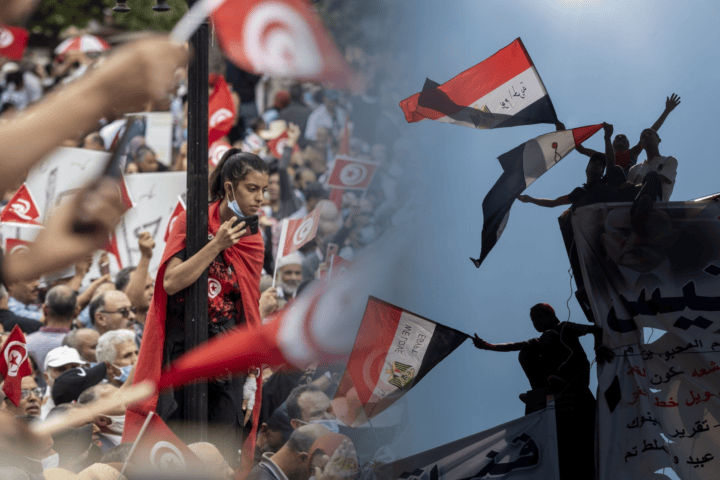
This interview brings together two leading human rights activists from the region who have led critical thinking and action during their tenures as executive directors of the Tunisian Forum for Economic and Social Rights (FTDES) and the Egyptian Initiative for Personal Rights (EIPR), on how to bridge socio-economic and political rights struggles. A statement by Alaa Talbi reflects a simple yet extremely difficult reality:
“The human rights movement cannot lay the foundations for genuine societal change, whether in the realm of social justice or in matters of freedoms, without joint action and without taking into account the full spectrum of society’s orientations. One cannot address socio-economic issues at the expense of freedoms, nor defend freedoms at the expense of social and economic rights. What is required is an integrated approach that bridges the two dimensions, and this must be the basis for our collective action.”
The question of bridging the struggle for personal and political rights with the struggle for socio-economic rights has long been considered one of the greatest challenges, and even potential failures, of human rights movements in the region, from the 2011 revolutions to the autocratic restorations that followed. Many attribute the failures in sustaining democratic transitions to the inability to anchor and translate people’s economic and social demands into the heart of the political processes that followed the fall of the regimes. Today, as we live in a moment of reflection, where many of the celebrated gains of the past decade are either being retracted or facing serious threats, we believe that building on the experiences of those who genuinely, and in practice, attempted to confront this divide can help guide the way forward.
The choice of highlighting these two organizations was intentional, as they followed distinctive trajectories toward engagement with socio-economic rights, each shaped by its experience, context, and organic response to different national realities. Their approaches evolved over the years through internal learning, engagement with civil society and local movements, and interaction with the broader global human rights movement. Both organizations also operate in countries that witnessed a revolution, regime change, a period of greater openness for civil society, and, ultimately, an autocratic restoration. Their distinct trajectories, which nevertheless led them to converging conclusions, therefore offer two important cases through which to reflect on the enduring challenge of bridging socio-economic rights with personal and political rights.
The FTDES’s early engagement with social movements and labor organizations made socio-economic struggles central to its work from its earliest days, reflecting Tunisia’s relatively mature tradition of labor organizing compared with other countries in the region. From this foundation, the FTDES broadened its engagement with the human rights movement, forging links between socio-economic rights and individual, political, and civic rights. EIPR followed a different trajectory. It began by advocating for personal and individual rights before organically expanding its work to include the right to health as a fundamental basis for their realization. This evolution led to a critical, integrated approach that understands the struggle for rights as simultaneously a struggle for individual freedom and social justice.
We interviewed Alaa Talbi, former executive director of the Tunisian Forum for Economic and Social Rights (FTDES), and Hossam Bahgat, executive director of the Egyptian Initiative for Personal Rights (EIPR), separately, but their reflections are presented side by side to highlight common struggles and distinct approaches to advancing socio-economic rights within the broader human rights movement amid shifting political landscapes.
Can you tell us about your organization’s early engagement with socio-economic rights?
Alaa Talbi
Our presence goes back to before the 2011 revolution. At first, we worked informally, as a committee supporting social movements, mainly the textile workers’ strike in Monastir in 2000. Over the years, this grew into broader support for protests and grassroots struggles around economic and social rights. In 2005, we organized the first public discussion on the social cost of globalization, at a time when Tunisia’s rights movement was focused almost exclusively on civil and political freedoms. At the time, we believed that socio-economic struggles had the power to shake the system. This was confirmed to us with the 2008 revolt in Gafsa’s mining basin, which we still consider a decisive moment in contestation in Tunisia, as it showcased how socio-economic demands can form the base of a wider political movement.
As the revolution erupted in 2011, with its strong socio-economic dimension, we already had legitimacy and a proven track record of work with social movements. That year we officially established the FTDES, with a mandate aiming at combining activism and social movement accompaniment, research, and solidarity with marginalized groups. Our core idea has always been that democracy remains fragile if social and economic issues are ignored.
Hossam Bahgat
We were founded in Egypt in 2002, originally focusing on what we called “personal rights,” specializing in human rights in the private sphere, which included issues of privacy, freedom of belief, bodily integrity, sexual and reproductive rights, and the right to health. The choice was based on our assessment of the genesis of the [human rights] movement in Egypt back then, with its focus on public liberties and human rights in the public sphere, so we felt the need for increased attention to rights in the private sphere.
This work quickly and organically pushed us into the socio-economic field, since health rights were inseparable from questions of access to medicines, health insurance, and public spending. At the time, over 60% of health costs in Egypt were paid directly by citizens, and only 50% of the population were covered by any of the different health insurance schemes that primarily targeted public employment, the private sector, and university students. We initially started working on health-related discrimination covering HIV/AIDS, mental health, and hepatitis C. And this quickly expanded to work on the health system.
By the late 2000s, we were the only human rights group in Egypt with a dedicated health program, which included serious engagement pushing for a universal health insurance system in Egypt. Around 2010, anticipating political change, we decided to expand beyond health into broader economic and social rights, namely, housing, labor, environment, food, and macroeconomic justice. This expansion, motivated by the wave of protests and strikes that started in 2007, ended up preparing us for the 2011 revolution.
How did your strategies shift across different political phases, specifically before the 2011 revolution, during its course and immediate aftermath, and later under the autocratic restoration?
Alaa Talbi
Before the revolution, our strategy was primarily one of solidarity with and support for social movements. We were not a formal organization yet, but we supported workers’ protests and local struggles by helping them. Our efforts were modest, but they gave us credibility with movements that often felt ignored or stigmatized. Before 2011, our strategy in supporting grassroots movements relied on several tools: strengthening networks, support in breaking through media blackouts, and conveying the voices and demands of protesters abroad. With the regime’s violent response, especially in 2008, we also began supporting the defense of imprisoned activists in collaboration with Tunisian and international lawyers, and with backing from international organizations. This led to our first experience forming a committee to defend political prisoners. The committee, together with the movement, succeeded in breaking the media blackout by networking with both local and international journalists, as well as global trade unions and social movements. Many of these came to Tunisia and stood in solidarity with the movement. This generated a breakthrough and became a turning point for us, a key experience that remains a model worth studying.
After 2011, when we formally established the FTDES, we faced the challenge of moving from protest to institution-building without losing touch with the streets. Our approach developed along three levels. First, we focused on accompanying movements on the ground: providing legal aid when clashes with the authorities erupted, ensuring media coverage to amplify their voices, and offering concrete policy alternatives for negotiations when needed. Second, we worked to counter the stigma that often portrayed social movements as chaotic or illegitimate. We did this through trainings, summer schools, and capacity-building efforts that helped activists articulate their demands, strengthen their leadership, and engage more confidently with the public. Third, we sought to overcome the isolation of local struggles by creating national spaces for dialogue and coordination, most notably through annual conferences that brought together movements from different regions and sectors. This dual commitment, combining grassroots support with research and analysis, has guided our strategy since then.
Hossam Bahgat
Looking back, our strategies unfolded in three broad phases, each shaped by the political context. In the years before 2011, our work on socio-economic rights centered on the right to health, where we relied on research, advocacy, and litigation to challenge government policies. The courts became the battlefield, with citizens, organizations, and movements bringing court cases against the government in several areas, including socio-economic rights. That was the period when we won one of our most significant victories, blocking and overturning the government’s plan to privatize the national health insurance organization. The focus then was on using the courts as a space for resistance, and on showing how economic and social rights could be defended through legal reasoning and international standards. This was made possible back then by an increasing tendency by a growing number of judges to rule independently.
The revolution opened a completely different chapter. Between 2011 and 2014, we expanded rapidly. We established an economic and social justice division, which incorporated the right to health program, but also added new programmatic areas of focus, including the right to housing, environmental justice, labor rights, corruption, and macroeconomic justice. In parallel, we created local offices across the country. For the first time, our work was not only about research, legal aid, and litigation but also about movement-building, community organizing, and direct support to local struggles. It was a period of experimentation and growth, when the openness of the political moment allowed us to think boldly and act widely. But this expansion also revealed how difficult it was for an organization shaped in the Mubarak years to suddenly transform into one embedded in grassroots activism.
That process came to an abrupt halt in 2014, with the new military regime starting to crack down on all forms of activism. We were forced to shut down local offices, let go of staff, and scale back programs. In that phase, we retreated to Cairo and concentrated on a smaller set of issues: health, environment, and macroeconomic justice. Much of our work shifted into policy analysis and advocacy, which was safer to sustain than community organizing. Yet even under these constraints, we managed to keep openings alive, for instance, by contributing to the drafting of Egypt’s first universal health insurance law in 2017. That experience confirmed for us that socio-economic rights work can sometimes survive repression if framed as technical expertise that the state itself needs.
How did you perceive or experience the challenge of linking rights-based demands for freedoms and individual rights with socio-economic demands?
Alaa Talbi
One of our main strengths was that the Forum’s founders came from diverse backgrounds: academic researchers, trade unionists from the Tunisian General Labour Union, and human rights defenders from the Tunisian League for the Defense of Human Rights. This mix allowed Forum activists to develop a shared vision, that the accumulated work of social movements can drive change, and in fact is essential and central to achieving it, even if it takes years. Our idea of solidarity stemmed from the belief that social movements are not “chaotic” or aimless, but rather movements with demands, vision, and actors who can be engaged with to become an effective force of pressure for changing public policies and the state’s socio-economic outlook. We were also in a unique position to succeed in these efforts. First, because of our legacy in working with social movements for years before the revolution, a legacy that allowed for relationships to be sustained even as individuals or leadership changed. The second reason came from our approach and the nature of the relationship we have built. The guiding principle of our engagement with social movements always was: we are neither ahead of these movements nor behind them, imposing conditions; rather, we maintain a respectful distance that safeguards their autonomy of action and decision-making. When this autonomy is recognized, trust deepens, the scope for collaboration expands, and the prospects for achieving meaningful goals and outcomes become significantly stronger.
However, in reality, in Tunisia, the rights movement was divided into two separate streams, one that focuses on the struggle for personal and political rights and the other mobilizes for economic and environmental rights. The issue is that, even though the FTDES was open to both streams, this was not the general situation within the movement’s landscape. For example, the Forum was a member of the National Coalition for the Defense of Individual Rights, and this membership came from a position of support for the struggle even though it was not directly under our mandate. Even within the FTDES, we had different positions regarding this involvement, with older generations advocating for the centrality of the socio-economic questions, while others, including myself, believed in the need to bridge between both streams. I remember that we had an internal debate and decided on the approach of openness and collaboration. As a result, the first march organized by the queer community in Tunisia in 2013 took place on the margins of the World Social Forum, hosted by the FTDES, an experience of collaboration and intersectionality that was first of its kind. However, we always felt that the personal and political rights movement was not as ready to support the grassroots movements usually mobilizing around socio-economic issues. We always find ourselves alone in our engagement with these movements. In my opinion, this comes from an elitist attitude that dominates the personal and political rights movements. The stigma that I mentioned before is that social and grassroots movements are “chaotic” or “violent.” In parallel, we were also aware that social movements are often conservative and do not embrace a broad ceiling of individual freedoms.
Hossam Bahgat
When we first began engaging with local communities and social movements, we carried a certain elitism into the relationship. We approached this work as experts who possessed the knowledge, assuming our role was to help communities become more effective in organizing, articulating their demands, and shaping their strategies. What we did not fully grasp was that many of these communities were already far more aware of their struggles than we were, and often more organized and resilient in the face of adversity. This was a wake-up call that forced us to rethink our approach.
In those early years, we also reproduced some of the same harmful dynamics we had criticized in international organizations and donors. For example, even though we were careful to recruit staff locally in the areas where we opened offices, we offered Cairo-based salaries that were higher than what local community organizations could pay, which unintentionally created hierarchies and distorted local activist ecosystems. In practice, our presence sometimes looked like “parachuting in” with resources and expertise, rather than being embedded in the daily struggles of the people we worked with.
How did you address these silos? Do you have any experiences of successfully bridging the gap?
Alaa Talbi
We fully realized the truth of this divide a little late, specifically in 2021, which we consider a pivotal year in the history of struggle in Tunisia. Politically, we lost the battle after 25 July [2021], when there was a coup against the constitution, and we paid for it with our freedoms and other hard-won gains. In January 2021, social uprisings erupted in working-class neighborhoods. They found support only from the FTDES and a few of the usual classic actors. At that point, we understood that we were very late in addressing the intersection of rights. That is why it was essential to create a mutual dialogue: social movements had to accept the demands of individual freedoms, and movements for individual freedoms had to root themselves in the depth of social struggle.
We drew inspiration from earlier experiences, for example, what happened in Britain during the 1980s, when the gay rights movement stood against Margaret Thatcher’s policies with their high social cost. So in 2021, we selected figures from the individual freedoms movement who also had histories of activism in environmental and social struggles, and we established a committee to prepare for a national conference bringing together social movements, individual freedoms movements, and civil society. The experience was unique, as it allowed people to confront themselves, their weaknesses, their conservatism, their elitism, and their contempt for others. They did indeed gather in a large conference held at the end of 2021. Unfortunately, it did not happen earlier, but we consider it an important starting point. Since then, the momentum has continued: in December 2024, Lawyers Without Borders organized a conference entitled “Solidarity and Commitment,” building on what we had launched in 2021. This too brought together social movements and individual freedoms movements, and participants spent a full five days in a camp where they exchanged discussions and engaged in dialogue.
The most important conclusion from this is that this lack of connection weakened both sides. We now understand that bridging the two is essential. Social movements, even when conservative, need to engage with questions of individual liberties, while rights-based movements must root their claims in people’s daily struggles for dignity and survival. Building such bridges is not easy, but it is the only way to create durable and meaningful change.
Hossam Bahgat
Our broad and generalist mandate has helped us to navigate this divide. Communities we worked with did not always share our positions on issues of personal freedoms, but because we treated all rights as equally important, we gained credibility and respect. Our experience shows that it is possible to engage with diverse groups, even those that may hold conservative or ambivalent views, if we approach them without imposing a hierarchy of rights. The legitimacy of our work came from showing consistently that whether we are defending health rights, political rights, or religious freedoms, we view them as part of the same struggle. That credibility allowed us to work with communities that might otherwise have been suspicious of a rights-based organization.
Additionally and most importantly, over time, this experience taught us that solidarity must replace the language of “capacity-building.” Our work today is less about treating communities as beneficiaries of our technical support and more about standing beside them as companions in their struggles. Research, advocacy, or legal support only has meaning if it is grounded in solidarity and shared risk. This shift, from providing expertise to practicing accompaniment, is one of the most important transformations we have undergone as an organization.
What lessons does your experience offer the broader human rights movement?
Alaa Talbi
For us, the Tunisian experience underscored that democracy without social justice is an empty promise. Political rights may flourish for a time, but they remain vulnerable if economic grievances are ignored. We also learned that social movements cannot survive alone. When protests remain isolated in one town or sector, they are easily contained or dismissed. Building networks and solidarity across geographies and demands is essential to transform scattered struggles into a collective force. Another lesson was about the dangers of elitism. For too long, human rights discourse was shaped by urban elites, while grassroots anger was treated as illegitimate. But disruptive protests, even when messy, are often the only language available to marginalized groups. Finally, we learned that victories cannot be sustained in one country alone. After 2011, movements across the region retreated into isolation, and the broader momentum was lost. What is needed is solidarity across borders, so that local gains feed into regional change.
Hossam Bahgat
Our main lesson has been the importance of constant learning and adaptation. We made mistakes, sometimes serious ones, but those failures forced us to evolve. One of the hardest truths we faced was the need for humility. Expertise and technical tools matter, but they should never come at the expense of solidarity with the communities we serve. We also learned that even under repression, there are always small openings that can be used to achieve real progress. Our contribution to drafting Egypt’s first universal health insurance law in 2017, even while our staff were under investigation and travel bans, is a case in point. But perhaps the deepest reflection is about the model of the human rights organization itself. The traditional NGO model, centralized, professionalized, and donor-dependent, has limits. To meet today’s challenges, we need to rethink how we organize, how we are funded, and how we communicate.
What do you see as the priorities for the future of socio-economic rights advocacy?
Alaa Talbi
Looking to the future, we believe the priority is to rebuild trust and dialogue between movements for freedoms and those for social justice. In Tunisia, one of the main failures was the inability of these two strands of activism to work together. The challenge now is to create spaces where they can meet, exchange, and support one another. Without that, we risk repeating the same cycle of fragile victories that quickly collapse. What is needed is not just short-term wins, but cultural and structural change that is rooted in solidarity and collective struggle. Only by building bridges between different movements can we lay the foundations for a democracy that is both free and socially just.
Hossam Bahgat
For us, the starting point is an acknowledgment that the current model is no longer working. We often say that the house is on fire, and this means we must be willing to reimagine everything. That includes how we work, how we are structured, how we are funded, and how we speak to the public. It may even require moving beyond the traditional NGO model of small, professionalized organizations to explore new forms of organizing that are more democratic and resilient. The key is to begin from a blank slate, as if building a movement from scratch, and to ask what structures and practices are best suited to today’s crises. For EIPR, the future lies in this act of collective reimagination, grounded in solidarity and responsive to the urgency of the moment.
The views represented in this paper are those of the author(s) and do not necessarily reflect the views of the Arab Reform Initiative, its staff, or its board.