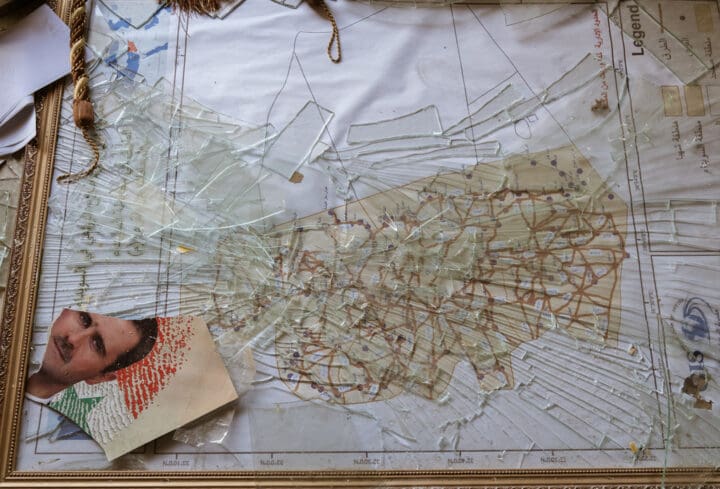
After destruction, recovery sounds like a promise. Yet in contexts marked by war, authoritarianism, displacement, and uneven reconstruction, recovery is never neutral. It is one of the moments when power reorganizes itself most forcefully. Land records are reopened, contested, or erased. Property claims are accepted, delayed, or denied. Neighborhoods are classified as safe, illegal, strategic, damaged beyond repair, or ready for investment. Infrastructure is restored in some places and withheld in others.
In Syria, post-conflict recovery is not a technical phase after violence, but a spatial struggle over land, return, memory, infrastructure, and political authority. Housing, land, and property rights are central to displacement and return, especially where documentation, tenure, or ownership claims are contested. The question is not only how destroyed cities and villages are rebuilt, but who is allowed to return, who is recognized as having a claim, who controls reconstruction, and what kind of future is produced from destruction.
Decoloniality challenges Western-centric knowledge, imported planning models, donor-led expertise, and the false neutrality of development. Quijano shows how colonial domination outlived formal colonial rule through knowledge, economy, and political authority. Mignolo similarly insists that decolonial thinking must change the terms through which knowledge is produced, not simply add excluded voices into existing frameworks.
Yet post-conflict recovery poses a harder test. In Syria, the problem is not confined to dominant knowledge imposed through technocratic expertise. Recovery can also reactivate the internal mechanisms that made authoritarian dispossession possible in the first place: property law, security clearance, documentation regimes, selective rehabilitation, and sectarian sorting. A decolonial approach to recovery therefore has to do more than replace external models with a language of local authenticity. It must confront how reconstruction itself can reproduce authoritarian spatial orders and decide who is allowed back into land, housing, services, and the future. As Tuck and Yang warn, decolonization loses its force when it becomes detached from land, sovereignty, and material restitution.
This commentary argues that decolonial critique of post-conflict reconstruction should not be abandoned but made materially accountable. Focusing on Syria, it asks whether post-conflict recovery can move beyond critique toward reparative spatial justice: the right to return, reclaim, rebuild, access infrastructure, remember violence, and participate in shaping the future.
What Decoloniality Helps Us See, and Where It Falls Short
Decoloniality remains valuable because it unsettles the claim that planning, development, and reconstruction are neutral technical practices. It asks where dominant concepts come from, whose histories they erase, and which institutions are authorized to define damage, need, heritage, resilience, and recovery. In post-conflict settings, these questions are vital: reconstruction can appear humanitarian while reproducing external priorities, preserve heritage while ignoring displaced residents, or celebrate resilience while normalizing precarious survival.
For Syria, this critique matters because reconstruction has often been framed through stability, modernization, investment, and return, while questions of land, documentation, security, and displacement remain unresolved. Critical planning scholarship reminds us that planning is often part of the institutional machinery through which land, property, legality, and mobility are reorganized. Decoloniality helps expose this machinery by showing that maps, master plans, damage assessments, and recovery frameworks actively produce what becomes visible, fundable, legal, and governable. Without it, recovery risks returning to a technical language in which reconstruction is reduced to infrastructure, services, growth, or heritage management. Such language hides the politics of repair.
Yet this does not mean accepting decoloniality as a ready-made answer. Calls to provincialize dominant knowledge on issues such as urban planning remain important because they challenge the assumption that concepts generated from Western experiences can travel everywhere as universal models. However, as Al-Kayyal argues, the value of postcolonial critique does not lie in turning politics into a simple opposition between Western domination and non-Western subjectivity. Its value lies in asking how power, identity, nationhood, and belonging are produced, and how they can also reproduce exclusion.
For Syria, this distinction is crucial. The problem is not that Syrian recovery is “colonial” in a simple external sense, nor that Syrian authorities necessarily use the language of decoloniality. Rather, Syria reveals a tension inside recovery debates: reconstruction may be shaped by external models, donor priorities, and technocratic vocabularies, but these tools are also adopted, translated, and weaponized by national and local power holders. The task, then, is not to replace technocratic reconstruction with a romantic language of local authenticity, but to examine how identities, institutions, laws, property regimes, and spatial orders can reproduce exclusion after destruction.
This is where the limitation begins. If decoloniality shows that recovery knowledge is political, it does not automatically tell us how to transform the material systems through which recovery is implemented. The critique of expertise must therefore be followed by harder questions: who changes the law, redistributes land, secures return, funds infrastructure, protects tenants, compensates loss, and prevents rebuilding from becoming another round of dispossession?
The limitation, then, is not epistemic critique itself. Knowledge matters. But the critique of language must be connected to the mechanisms that make language operational. In the field of post-conflict recovery, this concretely means addressing the spatial machinery that allows reconstruction processes to become instruments for the reproduction of domination and subalternity within the Syrian polity.
Recovery as a Spatial Apparatus
Post-conflict recovery is often presented as a sequence: emergency relief, damage assessment, rubble removal, infrastructure repair, housing reconstruction, return, and long-term development. This sequence gives recovery an appearance of order. It suggests that violence has ended and that planning now enters as a corrective force. But in Syria, recovery begins while power is still deciding who may return, what may be rebuilt, which losses are recognized, and which futures are made possible.
For this reason, recovery should be read as a spatial apparatus, not only as a technical phase. It works through documents, maps, contracts, permits, security procedures, compensation files, infrastructure priorities, and classifications of damage. These instruments may appear administrative, but they distribute rights and vulnerabilities. They determine whether a destroyed home is treated as a legitimate property claim or an informal structure outside compensation. They decide whether return is safe, conditional, delayed, or impossible. They shape whether reconstruction restores a community or opens land to new forms of accumulation.
To call recovery a spatial apparatus is to insist that the politics of reconstruction lies in the details usually treated as technical. Land registries, zoning categories, proof of ownership, inheritance rules, security clearance, tenant protections, rubble contracts, infrastructure phasing, and donor conditions are not secondary to justice. They are where justice either becomes possible or is quietly defeated. In Syria, redevelopment laws, security procedures, rehabilitation projects, and property disputes show how reconstruction can become a means of deciding who is allowed back into the future city.
Syria: Recovery as Legal and Security Sorting
Syria shows how recovery can become a mechanism for sorting populations after violence, tied to security, loyalty, documentation, sectarian identity, and legal recognition. The right to return, reclaim property, or rebuild is distributed not according to need or harm but through shifting relations of power.
This logic was already visible in the Assad period. Legislative Decree 66 of 2012 created redevelopment zones in Damascus under the language of upgrading informal settlements but became a legal foundation for projects such as Marota City, built on areas where many residents had weak tenure, limited documentation, or histories of opposition and displacement. Law 10 of 2018 expanded this logic nationally, requiring owners and tenants to prove their claims through restrictive procedures. These instruments were widely exposed as tools that could dispossess displaced people, especially those unable to return, obtain documentation, or safely claim their property. Yet recent reporting on reconstruction proposals in eastern Damascus suggests that Syria’s new authorities may continue working through the same legal and investment logic, despite residents’ fears of disguised expropriation.
Sweida reveals a different version of the same problem. After the July 2025 violence, many residents of affected villages remained displaced, while the Syrian government’s roadmap with Jordan and the United States included plans for rebuilding damaged villages and properties. While repair is urgently needed, the problem emerges when rehabilitation is staged before displaced residents can safely access their homes, participate in decisions, or verify what is being repaired and for whom. In that setting, rebuilding becomes a political scene: proof that the state is complying with an agreement, while the people whose houses are being “recovered” remain absent from the recovery process and denied return. The risk is that reconstruction becomes a performance of stability rather than a mechanism of return.
Displacement in Sweida has not been only a question of damaged buildings. The violence produced mass displacement, insecurity, looting, road closures, and deep mistrust between communities and toward the authorities. Reporting after the clashes described large-scale displacement and little clarity over return for affected families, while humanitarian access remained constrained by logistical and security conditions. Under such conditions, the basic test of recovery is not whether houses are rehabilitated on paper, but whether residents can return safely, reclaim belongings, access services, participate in determining what repair means, and see accountability for the violence and dispossession that made recovery necessary.
A third mechanism appears in the targeting of Alawite communities through land and property claims after the fall of Assad. Some Alawite settlements were themselves produced through earlier histories of privilege, military housing, expropriation, and authoritarian redistribution. Yet recent evictions and threats against Alawite residents, including families with property documents, show how historic injustice can be answered through collective punishment rather than legal repair. Similar concerns appear in rural Hama and the Ghab Plain, where rights groups have reported forced displacement and unlawful seizure of property against Alawites after the fall of Assad. These cases complicate any simple narrative in which local, post-Assad, or anti-regime actors are automatically emancipatory. Property can become the terrain on which historical grievances, sectarian fear, and political transition are fought, reproducing authoritarian dispossession with different victims.
Syria therefore sharpens the critique of decoloniality in a specific way. The problem is not only colonial knowledge or imported reconstruction models. It is the meeting point between technocratic recovery frameworks and domestic apparatuses of power: legal frameworks, security institutions, armed groups, sectarian narratives, and investment schemes that decide who can inhabit the future. A materially reparative recovery would have to confront Assad-era expropriation laws, protect displaced people from losing claims, prevent rehabilitation from becoming political theater, and reject revenge dispossession.
Toward Reparative Spatial Recovery Beyond Decolonial Language
A reparative spatial recovery begins with land and housing as political questions, not administrative files. In Syria, housing, land, and property claims are fragmented by displacement, destroyed documents, informal tenure, inheritance disputes, fear of return, and unequal access to courts or authorities. Recovery must protect residents from losing claims because they are absent, undocumented, politically suspect, tenants rather than owners, refugees, female-headed households, or members of a stigmatized community. Housing, land, and property rights are central to whether return can be safe, dignified, and durable.
Reparative recovery also requires power over reconstruction decisions. Participation is not enough if communities are consulted only after budgets, land uses, contractors, and security conditions have already been decided. The test is whether affected residents can shape priorities, block harmful projects, demand compensation, contest expropriation, and access information.
Here, decolonial critique must move beyond the opposition between external domination and local emancipation. Syria shows that cities and territories are not rebuilt on innocent ground, but through inherited state institutions, militarized geographies, property regimes, sectarian fears, donor systems, and national narratives that may reproduce exclusion. The task, then, is not to abandon decoloniality, nor to treat it as a complete answer, but to make it materially accountable, since recovery becomes genuinely reparative only when it changes these material conditions in practice, not when it changes the vocabulary through which power speaks.
The views represented in this paper are those of the author(s) and do not necessarily reflect the views of the Arab Reform Initiative, its staff, or its board.