1. Introduction: Sweida under Assault
The July 2025 assault on Sweida did not erupt spontaneously. It was preceded by a sustained campaign of sectarian incitement that reframed the Druze community as an “internal enemy” and normalized violence against it. Beginning in spring 2025, public discourse increasingly described Druze actors as “apostates” and “agents,” while religious and media mobilization cultivated a climate of hostility and moral sanction for collective punishment. Meanwhile, Druze civilians were subjected to systematic harassment at checkpoints, episodic closures of the Damascus–Sweida highway and escalating administrative and economic pressure intended to compel political compliance.
In this context, what unfolded between 13–20 July cannot be reduced to a localized security intervention or a contained tribal dispute. As Mazen Ezzi argues, the pattern more closely resembles a pogrom: organized or tolerated collective violence against a marked ethno-religious minority, preceded by sustained demonization and enacted through killing, looting, humiliation, and the destruction of homes and communal sites. Naming it as such is analytical rather than rhetorical. It foregrounds how incitement, rumor, and religious-media mobilization functioned as preparatory technologies of violence—producing a moral climate in which home invasion, summary execution, and systematic burning became socially legible and politically permissible.
Multiple independent and international human rights investigations documented how security units carried out atrocities against Druze civilians: extrajudicial executions in public squares, residential homes, schools, and even a hospital. Verified videos show men in military attire escorting unarmed civilians before executing them at close range, while eyewitness testimonies describe house-to-house raids that ended in killings.
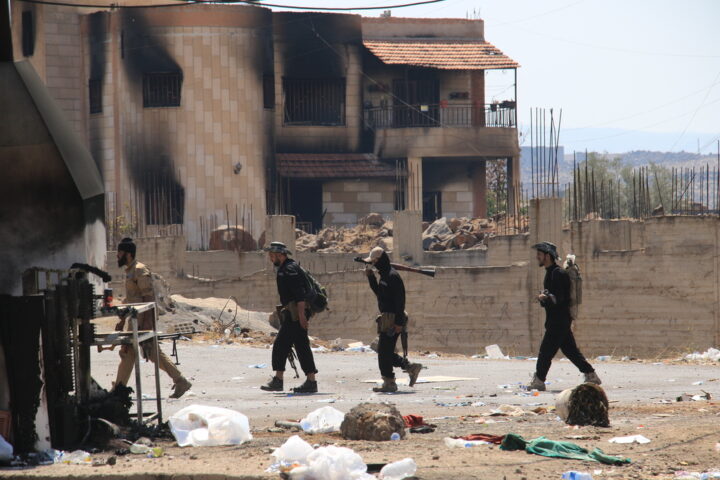
These assaults extended beyond direct violence against civilians to encompass systematic destruction: homes were torched, marketplaces looted, religious landmarks desecrated, and infrastructure sabotaged. The UN Office for the Coordination of Humanitarian Affairs reported more than 187,000 displacement movements within weeks, with families sheltering in overcrowded schools and public buildings, often without food, water, or medical services. Together, these events marked one of the gravest escalations in southern Syria since the war began, transforming Sweida from a functioning provincial center into a humanitarian emergency zone.
In Sweida’s city and villages, violence materialized spatially through artillery and drone strikes, burning of homes, systematic looting, and the sabotage of infrastructure, all executed in rapid succession. Markets and squares—the physical infrastructure of social interaction—were shattered; homes were torched or stripped; electricity, water, and telecommunications were disabled; and road closures and explosive remnants curtailed mobility. Such measures align with the concept of urbicide (the intentional destruction of buildings to erase diversity in urban life and replace it with enforced sameness) and domicide (the deliberate destruction of home and its attachments). Urbicide is not simply the loss of buildings but the dismantling of urbanity—the connective tissue that enables association, cooperation, and dissent. Domicide severs belonging and memory by burning, stripping, and rendering dwellings uninhabitable; it also includes the banal and ongoing extraction of materials and utilities that foreclose return.
Crucially, Sweida’s assault also weaponized environmental conditions. Years of drought (2006–2011 and after) had already stressed water and agro-ecosystems; the 2025 hostilities amplified this precarity through tactics whose effects outlast combat. Reading these environmental hostilities through Nixon’s notion of slow violence , they are incremental, spatially diffuse harms that erode the possibility of return even after bombardment ceases. In this sense, ecocide—the deliberate production of environmental uninhabitability—appears not as collateral but as a governance technique that extends urbicide and domicide into the ecological sphere.
The Syrian experience demonstrates how spatialized violence recurs across time, regions, and ruling actors. In earlier phases of the conflict—under Assad’s rule—sieges, bombardments, and post-conflict legal-administrative erasures were deployed to entrench oppression and dispossession. As discussed later in Section 2, in Sweida, under the Al-Sharaa regime, the same repertoire reappeared in overlapping form, producing equally devastating outcomes. While the modalities varied in sequence and institutional depth—due to the different underlying reasons and perpetrators—their core logic was consistent: to render homes, neighborhoods, and landscapes uninhabitable, fracture social solidarity, and discipline territory through control of movement, services, and temporal horizons.
Read through Lefebvre’s Right to the City, which insists that space is actively produced through power, and the spatial justice literature which calls for interrogating the uneven geographies of harm, Sweida illustrates how authoritarian rule systematically spatializes injustice across all spatial justice dimensions. Here, control over space is also control over access to life-sustaining resources—water, food, mobility, electricity, and safety. It is the sovereign power to regulate circulation, to impose siege-like conditions through checkpoints and closures, and to transform infrastructure into an instrument of punishment and coercion.
From a spatial justice perspective (distributive, recognitional, procedural), these dimensions overlap, revealing the intersectionality of injustice in Sweida. Distributively, spatial control determines who gains access to housing, infrastructure, and protection—and who is cut off through checkpoints, road closures, and targeted destruction. Procedurally, it dictates who is allowed to participate in reconstruction and governance—and who is excluded under coercive conditions. Recognitionally, it decides whose cultural landscapes and collective memories are preserved—and whose are erased.
This commentary proceeds from three propositions. First, urbicide and domicide are not episodic excesses but modalities of governance that weaponize the built environment and the home to suppress collective life. Second, ecological harm is integrated into this repertoire: through emissions from the burning of homes, persistent rubble and waste pollution, groundwater stress under siege, and the disabling of agro-infrastructure, ecocide becomes a slow mechanism of control. Third, addressing Sweida’s crisis demands justice-oriented recovery that links urban reconstruction to ecological repair—clearing and safely managing rubble, rehabilitating wells, supporting replanting and soil recovery, restoring cultural landscapes, and ensuring inclusive, transparent procedures that do not reproduce exclusion. The analysis below connects these propositions to reported facts and theoretical frames. Drawing on humanitarian reporting, mixed-media analysis, and eyewitness interviews, the central question guiding this study is: how does authoritarian violence weaponize both urban space and ecology to enforce control and erase resistance, and what would a spatial-environmental justice response require?
All interview claims cited here were cross-checked against time-stamped local media reports and, where possible, geolocated videos to ensure consistency and reliability.
2. Urbicide and Domicide: Destruction of Space and Home
The July–August 2025 assault on Sweida unfolded as a direct attack on the material and symbolic foundations of collective life. The three anonymized interviewees—a local journalist documenting developments on the ground, a practicing lawyer familiar with legal and property violations in the governorate, and a recently displaced resident directly affected by the assault—provide complementary professional and lived perspectives. According to these interviewees (Residents 1–3, personal interviews, July–August 2025), artillery and drone bombardments struck residential quarters, markets, schools, and hospitals—spaces central to civic interaction and mobility. Rather than focusing on military sites, the targeting of civilian infrastructure exemplifies what Coward defines as urbicide: the deliberate targeting of the built environment to destroy heterogeneity and the conditions of political life. By disabling marketplaces and squares, bombardment dissolved the connective tissue of urbanity, making collective life precarious.
Alongside this, countless videos circulating on local media outlets showed that homes themselves became instruments of punishment. Civilians were executed in their residences, while others saw their houses deliberately set ablaze before being stripped of furniture, wiring, and fixtures. Such practices resonate with Porteous and Smith’s definition of domicide as the deliberate destruction of home. In Sweida, different forms of domicide overlapped: spectacular acts of arson coexisted with systematic looting, ensuring that homes were simultaneously destroyed and emptied of their material and symbolic value.
The symbolic dimension of domicide was especially pronounced. The burning of churches, shrines, and communal landmarks was an assault not only on physical structures but on the cultural and mnemonic anchors of place. The government and affiliated forces also engaged in acts of symbolic humiliation, such as forcibly shaving Druze men’s moustaches, a gesture deeply tied to communal pride and identity. These practices sought to degrade not only individuals but the collective dignity of the community. Lefebvre’s notion of the city as a collective oeuvre helps explain the violence of such acts: they aimed to sever the cultural identity and lived memories inscribed in space, dismantling the very foundations of belonging.
Together, urbicide and domicide in Sweida functioned not as isolated wartime atrocities but as systematic modalities of governance. Their purpose was to reconfigure territory by dismantling the social and material infrastructures that sustain collective life. Comparable patterns have appeared in Homs during the Syrian conflict, where siege, bombardment, and the destruction of housing preceded demographic reengineering, as well as in Bosnia in the 1990s and currently in Gaza, where the targeting of homes and infrastructure rendered space progressively uninhabitable. In terms of spatial justice, these tactics denied communities distributive rights by stripping away access to housing, markets, water, and essential services. They eroded procedural agency by excluding residents from decisions about survival, recovery, and the possibility of return. They also violated recognitional justice by attacking cultural landmarks and symbols of dignity, erasing the very identities inscribed in space. The cumulative effect was to fracture solidarity, foreclose return, and entrench displacement as a durable condition—transforming Sweida into an uninhabitable terrain of authoritarian control.
3. Ecocide and Environmental Slow Violence
The violence in Sweida unfolded against the backdrop of Syria’s protracted environmental crisis. Since 2006, the country has endured one of the worst droughts in its modern history, marked by multi-season crop failures, falling groundwater tables, and mass rural displacement. Scholars remain divided over the role of climate change in sparking the 2011 uprising, but there is a broad consensus that prolonged drought deepened vulnerabilities and placed enormous strain on agricultural livelihoods.
In 2025, these environmental stresses were deliberately weaponized in Sweida through acts of ecocide. Orchards and croplands were torched, destroying subsistence bases while releasing toxic smoke. An interviewee, a member of the volunteer documentation team, noted that chemical accelerants were used in arson, producing unusually severe emissions and long-lasting contamination. Entire residential blocks were set alight, generating hazardous dust and rubble that continues to blanket streets and soils. Strategic facilities were also sabotaged and burned, including the main grain mill, crippling food processing capacity across the governorate.
Water infrastructure was likewise targeted. In the thirty-five villages controlled by government forces, wells were systematically looted, sabotaged, or buried, eliminating essential sources for households and agriculture alike. With central networks disabled, residents were forced to depend on private wells and diesel generators, accelerating groundwater depletion while creating new burdens of noise, air pollution, and fuel scarcity. As one interviewee explained:
“The attack, followed by the siege, has had a devastating impact on residents. Water is extremely scarce, as wells in the western villages have been made inaccessible; in some cases, they were deliberately sabotaged through looting and burial. Even when water is technically available, the absence of fuel prevents it from being pumped. Electricity is almost entirely absent—supplied only every six or seven hours for no more than 45 minutes—forcing households to rely on private generators to access water.”
Other testimonies corroborate these tactics. Resident 3, from a village still under government control, described leaked footage showing government and affiliated forces felling trees around his home and warned that, with fuel scarce under siege, residents fear being forced to rely on remaining tree cover for survival. These dynamic risks accelerating the already permissive cutting that has long depleted Sweida’s greenery, further thinning its fragile urban–rural canopy and making additional losses environmentally catastrophic.
These pressures compounded broader ecological collapse. The looting of agricultural machinery and the paralysis of cultivation heightened the risk of soil degradation and long-term food insecurity. War remnants—including landmines and unexploded ordnance—rendered orchards, grazing lands, and rural roads unsafe, foreclosing recovery and sustaining displacement. Eyewitnesses recounted bodies and uncollected garbage in the streets, while livestock were slaughtered unsustainably due to the lack of fodder. Medical waste piled up untreated. Residents reported that the intensity of the fires—evident in the melting of glass and structural elements—suggests that prohibited chemical materials were used by the government and affiliated forces to ignite houses, releasing toxins with severe and lasting environmental consequences.
These tactics embody what Nixon terms Slow Violence: incremental, attritional harm that extends long beyond the spectacle of bombardment. Unlike the immediate visibility of executions or artillery strikes, ecocide’s impacts—poisoned air, buried wells, mined orchards, felled trees, and toxic waste—are insidious, unfolding over years. In Sweida, drought is not merely a natural crisis but is harnessed as a political opportunity: authoritarian violence magnified ecological collapse to transform scarcity into an instrument of control and displacement. Here, the term ecocide is used analytically to describe the deliberate production or amplification of environmental uninhabitability as a strategy of displacement. It is not invoked as a formal legal claim, but to capture how environmental degradation was mobilized as a modality of authoritarian governance—eroding livelihoods, exhausting agricultural capacity, and rendering return materially untenable.
4. Spatial Erasure and Environmental Justice
The convergence of urbicide, domicide, and ecocide in Sweida reveals a broader logic of spatial erasure. Violence against homes, infrastructure, and ecological systems did not merely disrupt daily life; it dismantled the material, cultural, and symbolic foundations that tie people to place. Markets and squares, the sites of exchange and encounter, were bombarded and looted, fracturing social interaction. Houses were torched or stripped, severing attachments to memory and belonging. Orchards, soils, and wells were degraded, eroding the ecological basis of return. Together, these measures converted Sweida from a lived environment into a landscape of dispossession.
This dynamic echoes Lefebvre’s insight that space is not a neutral container but actively produced through relations of power. In Sweida, authoritarian power was inscribed through the deliberate rendering of the city and the countryside uninhabitable. Importantly, this was not only material but also symbolic. The burning of churches, shrines, and communal landmarks, combined with acts of humiliation such as the forcible shaving of Druze men’s moustaches, directly attacked cultural identity and collective dignity. These humiliation practices were not merely symbolic; they operated as techniques of spatial domination, meant to break communal dignity and render presence in place precarious. As Mazen Ezzi argues in his reading of Sweida through the lens of a pogrom, public degradation—together with pillage and arson—formed part of an organized repertoire that recast the targeted community as a legitimate “internal enemy” and normalized its expulsion. In this way, spatial erasure extended beyond structures and infrastructure to target memory, ritual, recognition, and the very legitimacy of belonging.
Seen through a spatial justice lens, these practices illustrate profound inequities in the distribution of harm and survival. Environmental degradation, rubble pollution, and groundwater depletion fell overwhelmingly on civilians, while government and affiliated forces retained control over strategic infrastructure and resources. Procedurally, communities were excluded from decisions over aid, mobility, governance, and recovery. From a recognitional justice lens, the erasure of symbolic sites denied the legitimacy of Druze identity and attachment to place.
In Sweida, therefore, environmental destruction cannot be treated as collateral to urbicide and domicide; it was their extension into the ecological and symbolic spheres. Recognizing this interrelation is essential to grasping both the depth of the violence and the scale of justice required for recovery.
5. Resistance and Possibility of Recovery
Despite the scale of destruction, Sweida has not been reduced to silence. In parallel with authoritarian attempts to dismantle home, city, and environment, communities have mobilized everyday practices of resilience to defend both place and ecology. Residents have worked collectively to safeguard remaining wells, ration and share scarce water resources, and replant damaged orchards, seeking to restore a measure of food security and continuity of life under siege. At the same time, protests and assemblies articulated a demand for the right of self-determination, linking material survival to political autonomy. As one local lawyer interviewed for this study explained, the movement “grew from the suffering itself; it was a way of insisting on existence and resisting erasure despite attempts to frame it otherwise”. This insurgency illustrates that recovery begins not with external interventions but with localized efforts to sustain life under siege and to imagine futures beyond authoritarian control.
Authoritarian destruction and grassroots repair thus emerge as competing spatial projects. Where one seeks to erase memory and displace populations, the other strives to maintain continuity through care, cultivation, and collective stewardship of land and infrastructure. This tension is central to understanding the politics of recovery: repair is not only technical but also political, as it reclaims the right to remain, return, and rebuild. Community repair also became a defense of dignity—countering the same humiliations and erasures that, as Ezzi notes, are central to the pogrom-like repertoire of violence. It also embodies what Miraftab calls “insurgent planning” and what scholars describe as radical hope—the capacity to envision just futures in the very midst of devastation.
Community-led resilience forms the foundation of recovery, yet it must be systematically supported and scaled up through a comprehensive approach. Sustainable recovery requires deliberate strategies of ecological repair: reforestation and replanting programs, rehabilitation of polluted water and soils, and protection of cultural landscapes as repositories of memory. These efforts must be embedded within broader frameworks of justice, ensuring that reconstruction does not reproduce exclusion but instead restores rights to home, environment, belonging, and ultimately, to self-determination.
6. Conclusion: Sweida as a Case of Spatial and Environmental Justice
The assault on Sweida demonstrates how authoritarian violence operates across multiple scales: the city as a collective space, the home as a site of belonging, and the environment as the foundation of survival. Urbicide, domicide, and ecocide were not collateral byproducts of war but deliberate strategies of control, designed to dismantle livelihoods, memory, and the very conditions of return.
Grasping this layered destruction is essential for shaping recovery. Reconstruction must extend beyond rebuilding houses and infrastructure to address the distributive, procedural, and recognitional injustices embedded in Sweida’s devastation. Justice-oriented recovery requires not only physical repair but also ecological restoration—clearing rubble safely, rehabilitating wells, replanting orchards, and protecting cultural landscapes as repositories of memory and identity.
Equally, Sweida underscores that community-led resilience and demands for self-determination are not peripheral but central to recovery. Acts of care, cultivation, and collective stewardship exemplify insurgent practices and radical hope: the capacity to envision just futures amid devastation. Supporting and scaling up these grassroots practices is vital if reconstruction is to move from technical rehabilitation to transformative justice.
Defending the right to home and memory in Sweida, therefore, also means defending the ecological systems that sustain them. Linking spatial and environmental justice is imperative, not optional. Only through such an integrated approach can recovery resist authoritarian erasure and lay the groundwork for equitable return, collective resilience, and durable peace.
The views represented in this paper are those of the author(s) and do not necessarily reflect the views of the Arab Reform Initiative, its staff, or its board.