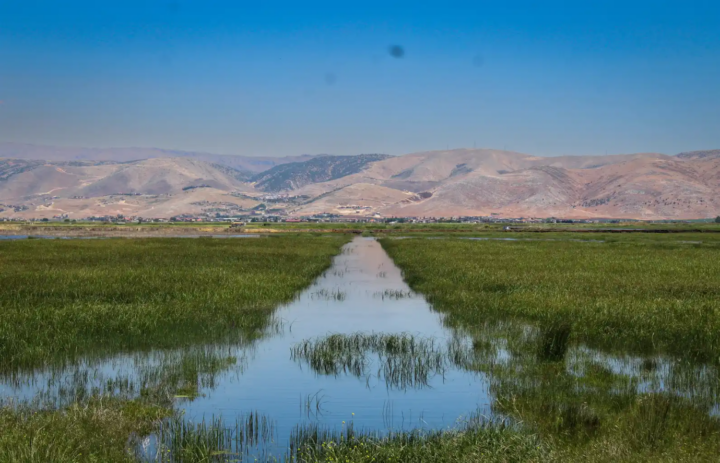
How does the Israeli invasion of South Lebanon – the site of 25% of the country’s agriculture – and the ongoing Israeli attacks on the Beqaa, known as Lebanon’s breadbasket, threaten disruptions to agricultural production in Lebanon? Are there better and worse case scenarios we should be thinking about?
What Israel is doing in South Lebanon can and should only be referred to as planned and intentional ethnic cleansing, with systematic destruction of homes and infrastructures aimed at delaying any potential return of the local population. Israel is also intentionally committing an ecocide: a war on ecosystems, land, forests, and water.
To understand the disruptions to agricultural production, we need to understand the nature of agriculture systems in South Lebanon. For several historical and natural reasons, local food systems (except for the coastal areas) have remained traditional – a predominance of family farming, mixed livestock and crop farms, olive orchards, and agroforestry. These constitute the bases of a low-input production model that relies heavily on olive production as well as nonwood forest products such as carob, laurel, zaatar, honey, and pine nuts.
Food systems in South Lebanon have always played a key role in defining the local population’s identity and attachment to the land. They are a symbol of resistance and resilience against occupation, from tobacco production and wild zaatar harvesting to historically commonly managed water ponds (birkes).
Israel’s ecocide in South Lebanon will have devastating repercussions on local communities’ capacity to return. Its impact on the national food system and value chains, however, will be limited because the commercialization and marketing of local agricultural production remain localized and mostly aimed at sustaining local food markets. That said, the major disruption at the national level will be in the domestic olive oil supply for the coming seasons, as the area south of the Zahrani River represents approximately a quarter of Lebanon’s olive production.
The impact on agricultural production in Lebanon’s southern coastal areas is more pronounced, with significant income losses expected for citrus, banana, and avocado producers, as well as greenhouse producers, as agriculture in coastal areas is more intensive and export dependent.
As for the Beqaa, the impact of Israeli bombardment on agricultural production remains limited to date. However, there are other factors that could lead to food market disruptions. For example, if access to export roads through Syria is threatened, there is a risk of oversupply of export-dependent commodities. Export route closure would impact farmers across the country, especially export-dependent crop producers such as apple, grape, banana, and citrus farmers.
In terms of scenarios, the worst case would be an increase in the systematic and intentional destruction of forest resources in South Lebanon, combined with Israeli access to the Litani River water. The Litani irrigation systems, particularly the Qasimiyeh-Ras al-Ain network, supply irrigation water to vast areas in the southern coastal plains. In the 2024 war, Israel bombed the irrigation network infrastructure in Qasimiyeh. An extension of the Litani irrigation network is also planned to provide further irrigation to areas in Bint Jbeil and Marjayoun.
Israel would require minimal infrastructure to divert Litani water toward the upper Galilee, which would create a catastrophic situation for agriculture in general, both in terms of water supply to the region not directly under occupation and also for the capacity of local populations to return. From a political perspective, such a situation would definitely lead to long-term confrontation and armed resistance against the Israeli occupation.
There is no “better case” scenario in the current context; the ethnic cleansing and ecocide must be brought to a halt by any available means.
How is the partial closure of the Strait of Hormuz likely to disrupt food systems worldwide? How are these effects starting to be felt in Lebanon?
Modern intensive agriculture is highly dependent on fossil fuel energy. An increase in energy prices has a direct and significant impact on agricultural production costs, not only as direct energy use, but also as an input in the production of chemical pesticides, fertilizers, plastics, and machinery.
The Strait of Hormuz is typically discussed in terms of fossil fuel energy, but what is often overlooked is that about one-third of the world’s seaborne fertilizer trade also transits through the strait. We’re talking about urea, ammonia, phosphates, sulfur – the basic building blocks of intensive agricultural production. Gulf countries account for half of urea and one-third of ammonia exports. So, we are not just dealing with an energy crisis, we are dealing with the foundations of global food production being disrupted, a direct threat to the green revolution production model.
Energy, food, and water security are not separate issues. From energy to fertilizer production to planting decisions to yields to food commodity price speculation, there is a serious risk of spiraling food inflation that may lead to catastrophic results worldwide and in the region. The potential impact could be much greater than the spillover of the 2008 energy and food price crisis and its well-known role in the 2011 uprisings in Egypt, Tunisia, and Syria. The UN Food and Agriculture Organization has been quite clear about this, calling it a systemic shock affecting food systems globally, not just an energy shock.
The increase in energy prices is already being felt in Lebanon through the increase in production costs for farmers who were already struggling following the government’s decision to raise fuel prices prior to the war. The combined effect of increased taxes and the war is estimated to have increased the price of diesel fuel in Lebanon by 70%.
Furthermore, this is the third consecutive shock in input prices that Lebanese farmers have faced in the last five seasons. Already, the 2019 financial crisis, the 2022 war in Ukraine, and post-COVID inflation have driven prices of energy and agricultural inputs to extremely high levels in an agriculture sector that is highly dependent on imported inputs. Farmers have been coping with these successive impacts with different levels of success, using a mix of positive and negative coping strategies, such as reducing cultivated land area, prioritizing plant protection over plant productivity, moving to low-input models, or relying on low-quality and dangerous pesticide mixes.
There is a real risk that many small farmers in Lebanon will be pushed out of agricultural production altogether, as only large farmers and corporate farming operations may be able to withstand so many consecutive shocks in input prices.
It is also important to mention that the significant risk to food security lies mostly in terms of affordability rather than availability. Given the oligopolistic nature of Lebanon’s food system – i.e., a limited number of actors control input supply, aggregation, and trade – the increase in consumer food prices is not driven by higher farm-gate prices alone but by widening margins among nonfarming value chain actors (including transporters, storage operators, traders, and supermarkets) who are likely to adopt strategies that protect or expand their profit margins at the expense of consumers, even in time of acute crisis.
How is Lebanon’s government responding to the current situation and what should it be doing?
First, the government must act to denounce, document, and halt the Israeli ethnic cleansing and ecocide in South Lebanon. In terms of food security, government action has so far been limited to efforts to keep road, sea, and land trade routes open for the import and export of agricultural products. There are, however, several policy instruments the government could implement immediately to reduce the impact of the war. A first step would be reversing the latest increases in energy prices. Another instrument is instituting export and re-export bans, particularly for staple products such as wheat, olive oil, potatoes, and vegetables. The government’s policy of maintaining a price cap on bread was a highly successful intervention that helped Lebanon cope with the impact of the 2008 crisis; this mechanism should be reintroduced. Similarly, the direct importation of wheat by the government, implemented at the start of the Ukraine war, should also be reinstated.
Finally, the government should actively monitor food markets to prevent hoarding, stockpiling, and profiteering.
In the longer term, the overall approach to agriculture and rural development must be revisited, with a renewed focus on supporting small-scale farming, cooperatives, and farmer empowerment.
Based on your research on the history and politics of donor intervention in Lebanon’s food system – including in the form of humanitarian food aid during different crises – what types of interventions should donors avoid or pursue at this time?
In response to the 2019 crisis, donors deployed several types of interventions to support food security. A key intervention was to support farmer access to agriculture inputs through voucher schemes. This approach could have had a positive impact if price increases were solely reflected in their Lebanese pound value (prices in pounds increased due to devaluation while prices in US dollars remained stable). However, the impact of such interventions when prices are driven by direct increases in US dollar–denominated costs can be very limited and inefficient. In fact, the approach after 2019 resulted in a substantial transfer of public funds to input suppliers, further reinforcing their dominant position within agricultural value chains. Repeating this experience is not recommended.
In the immediate term, direct unconditional cash transfers and in-kind emergency interventions are likely the most appropriate and needed forms of support.
Following the Ukraine war, donors also supported the wheat value chain through direct wheat imports and support to local soft wheat production. While direct importation of wheat by the government is needed today, approaching food security purely from an availability angle would be a mistake because the key issue is affordability. Lebanon’s vulnerable populations are food insecure not because food is unavailable, but because it is unaffordable.
Medium- and long-term programs should therefore adopt a development lens, one that is overall pro-poor and farmer-centered, supporting a fairer and more transparent food system by empowering farmers politically, socially, and economically.
Generally, the review of donor intervention in Lebanon has shown that the long-standing export-oriented model and support for agricultural intensification are imposing an unsustainable and fragile system that is highly vulnerable to shocks, as the past five years have clearly demonstrated. Support to local food dynamics, improvements in food system governance, and policy changes should be key priorities, and they would require a significant paradigm shift compared to previous approaches.
In the context of postwar South Lebanon, the approach requires shifting from short-term, fragmented agricultural assistance toward longer-term localized support that strengthens territorial food systems. Priority should be given to reinforcing local food dynamics and capitalizing on traditional agroecological systems to support population return. This would require supporting farmer cooperatives and producer networks and investing in storage, irrigation, and local processing infrastructure without altering agroecological traditional systems, but rather further strengthening their sustainability. Policy change would also entail revising Ministry of Agriculture–donor programming models so they support resilient local production, decentralized water and land management, and farmer-centered food sovereignty objectives, rather than export-oriented support schemes and humanitarian approaches.
There has been an active grassroots movement on food in Lebanon of late, including the creation of the Agroecology Coalition in Lebanon (ACL) and the coalescing of diverse groups to oppose a draft law on seeds. As a member of the ACL yourself, how are the coalition and others operating amid the war and what are the main challenges they face? How can this movement continue to prioritize support to small-scale farmers at this difficult time?
ACL members are fully engaged in supporting displaced populations coping with the impact of the war. This includes active involvement in community kitchen initiatives, food parcel distribution, and kitchens set up directly within displacement centers. These initiatives are being carried out through crowdfunding and members’ own resources. Funding unfortunately remains limited, and ACL members are actively seeking support from alternative donors to sustain and scale these community efforts.
ACL members are also working to address microlevel value chain disruptions, reconnecting supply and demand where the war has broken existing links. This includes support for small-scale farmers who remain on their land but rely on input supplies or markets from war-affected areas. For example, farmers who previously sold to restaurants and markets in Beirut’s southern suburbs are being helped to find new buyers and distribution channels, including through the community kitchens.
Beyond the direct emergency response, the ACL has a clear political responsibility to denounce the reality of what is being inflicted on Lebanon and its people. What is unfolding in South Lebanon is a deliberate and systematic campaign of ethnic cleansing and ecocide destroying homes and infrastructure, targeting agricultural land and forests, and denying people access to livelihoods. The ACL stands firmly with the farmers, agricultural workers, and rural communities bearing the consequences of Israeli aggression. Their voices must be heard, their losses documented, and their rights defended.
Defending farmers’ rights is at the core of the ACL’s actions, as well as that of other farmer and activist organizations such as the Agricultural Movement in Lebanon. Local livelihoods and resilience in South Lebanon are firmly anchored in small-scale farming practices. Far from romanticization, supporting small farmers to recover from the impact of the war and restore traditional mixed farming and agroforestry systems in South Lebanon is key to support population return and to reverse Israeli ecocide and ethnic cleansing attempts.
Are there specific resources or organizations you would recommend readers follow if they are interested in learning more about the current challenges facing Lebanon’s food system?
On the economic consequences of the war, including its impact on food and agriculture, alternative media outlets such as Megaphone and Sifr are doing valuable reporting and analysis.
For those seeking to better understand the reality facing farmers in Lebanon, the ACL and the Agricultural Movement in Lebanon are excellent sources of information and offer ways to support farmers and war-affected populations.
The views represented in this paper are those of the author(s) and do not necessarily reflect the views of the Arab Reform Initiative, its staff, or its board.