Introduction
In Kfarkela, beekeepers place their hives near the border strip, taking advantage of almond orchards in the occupied Palestinian territories where bees graze. Many tree types are found in Kfarkela, including eucalyptus, olive, walnut, citrus, thyme, and thorn trees, which produce the highest quality honey. In the lakes and ponds of the fertile Khiam plain, near Kfarkela, geese carry fish eggs from Lake Tiberias. These fish grow in the lakes of the meadow, turning lakes into a fishing destination for the people from surrounding areas. Bees and birds move around without regard for borders and dividing walls. Nature knows no borders and does not recognize them.
This may be reflected in natural situations involving humans. The residents of Kfarkela, Upper and Lower Zouk, Houla, and al-Mutallah in Palestine have a long history of trade and farm in overlapping fields. Kfarkela was one of the southern crossings to the plains of Palestine through customs and public security checkpoints. The residents of Kfarkela also have land inside occupied Palestine, for which they still hold title deeds. However, the borders, as we know them today, are nothing more than the product of a colonial era that sought economic and political gains, drew arbitrary lines on maps, took control of lands that did not belong to it, and led to the isolation of parts of the land and peoples from each other. This brings us to the issue of border and southern villages in general, and what is known as Jabal Amel –bordered by the Awali River and Jezzine to the north and Palestine to the south – and has historical trade relations with the people of Palestine. These areas continue to suffer from the consequences of a colonial border legacy, adjacent to an occupying Zionist entity.
In a quick review of some of the minutes of the Lebanese Parliament, we note several discussions about Israeli attacks on border villages. In 1949, during a speech by Representative Adel Asiran, the House was informed of a tragedy in which “after the Jews expelled the people from these [border] villages, they found a trench in the village of Houla, where they placed most of the villagers alive and then shot them all,” adding, “The situation of the people of Houla is precarious because they were unable to plant their land this year, and many used to make a living from farming land located in Palestine.” That same year, Israelis attacked shepherds near Kfarkela and stole cows, donkeys, and mules. In 1952, the people of Rmeish submitted a petition to protest against Israeli police officers for stealing their sheep and goats from the Marj al-Afush al-Taroush area. In 1953, a resident of Bint Jbeil sent a telegram to protest against Israelis looting their livestock after entering Lebanese territory. In 1961, MP Khaled Shihab confirmed in his speech: “there are 7,000 Lebanese citizens whose money has been stolen in Israel, amounting to no less than 100 million pounds sterling, property that has been seized by Israel.” In 1968, the residents of Mays al-Jabal sent a telegram condemning the Israeli attack on their town and demanding that the villages be fortified and reinforced with shelters and hospitals. Ten telegrams were also sent from various regions and organizations protesting the Israeli attack on the village of Houla and demanding that border residents be armed and compulsory conscription be implemented.
In a speech delivered in 1969, Deputy Ali Madi said:
Seven farms on the border with Lebanon are currently under Israeli occupation, and 4,000 Lebanese are displaced and unable to earn their daily bread, as their homes on the farms have been destroyed. The inhabitants of these vast lands have been prevented from exploiting them because it is dangerous for their lives and because they are exposed to enemy bombardment.
On 30 June 1970, residents of border villages demonstrated to demand increased fortifications and better protection from Israeli raids. Similarly, in 1974, MP Hamid Dakroub addressed the issue of:
The ongoing Israeli bombardment that affects border villages from Naqoura to Arqoub without exception, striking indiscriminately and destroying agricultural crops. The agricultural yield is completely destroyed, as the enemy aims to empty Lebanon’s southern region by isolating farmers from their land.
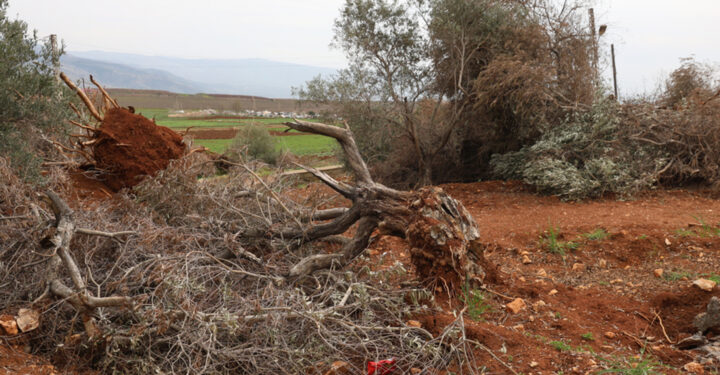
This is an example of the continuous, systematic, and organized Israeli attacks that border villages, in particular, and southern villages, in general, have been subjected to since the Palestinian Nakba in 1948, followed by invasion and occupation until 2000. More than 25 years after the withdrawal of Israeli forces, the same scene continues to repeat itself, with even greater brutality. Since 8 October 2023, with the start of the Israeli war on Lebanon, its expansion on 23 September 2024, and the Israeli invasion on 1 October 2024, lead to what became known as the ceasefire agreement that began on 27 November 2024. To this day, with Israel’s daily violations, southern regions are witnessing vicious attacks. Israel has targeted homes, infrastructure, public, health, and educational facilities; heritage, cultural, and religious landmarks; and forests and agricultural land, causing severe damage to trees, crops, soil, and water, as well as damage to the local economy. Border villages have been nearly decimated. This, in effect, constitutes deliberate ecocide and spatial erasure.
In this paper, we address the ecocide suffered by southern villages in Lebanon. The aim is to develop policy recommendations on how the Lebanese state, local authorities and communities, and relevant CSOs can engage in addressing Israel’s devastation.
We begin by highlighting, in general, the most affected border villages that suffered various types of attacks and destruction compared to other areas. We then focus on the border town of Kfarkela as a case study of these towns. We also seek to draw lessons from the environmental interventions carried out by the Lebanese state following the July 2006 war, and assess the current frameworks and policies for reconstruction and recovery, as well as local community initiatives from a conservational perspective, in order to identify various stakeholder responsibilities. Finally, we offer policy recommendations in line with the environmental needs and priorities of southern villages, supporting safe return, reconstruction, and environmental recovery.
In producing this paper, we relied on monitoring and documenting Israeli attacks and ceasefire violations on various Lebanese territories through an interactive map, analyzing the nature of targeted locations, and a participatory workshop on perceptions of return and recovery in the town of Kfarkela. We conducted a series of interviews with relevant official bodies, environmental experts and activists, institutions, associations, and initiatives, in addition to reviewing a wide range of relevant references and monitoring recovery efforts after the Israeli war on Lebanon: surveys, debris removal, compensation, reconstruction funding, policies, projects, initiatives, displacement, and return. In addition, we held a group discussion bringing together affected citizens/farmers and activists, CSOs, researchers, and decision-makers with the aim of developing joint recommendations that prioritized return, reconstruction, and addressed ecological harm.
The views represented in this paper are those of the author(s) and do not necessarily reflect the views of the Arab Reform Initiative, its staff, or its board.