




The U.S.-Israeli war against Iran has led to a dramatic rise in oil and gas prices on global markets. The blockade of the Strait of Hormuz, as well as the deterioration of oil and gas infrastructure in countries such as the United Arab Emirates and Qatar, has had an immediate impact on prices. A common assumption in this type of situation is that other oil-producing countries must be rubbing their hands with glee, as they will be able to take advantage of the price hike to boost their budget surpluses and strengthen their diplomatic leverage with their partners and customers. It is from this perspective that the situation in Algeria is often viewed. Already, during Russia’s invasion of Ukraine, all eyes turned to Algiers, which had suddenly become an indispensable partner for a Western Europe dependent on Russian gas. However, while at first glance the price hike benefits Algeria from a budgetary standpoint, the country’s situation – particularly in diplomatic terms – appears more complicated than it was in February 2022, when Russia invaded Ukraine.
This article aims to provide a more nuanced understanding of the Algerian situation in the areas of energy, diplomacy, and politics. It is based on an online discussion held in April 2026 with three Algerian experts. These experts have experience in domestic politics, international relations, and economics. During the meeting, participants discussed the Algerian economy – particularly the gas and hydrocarbon markets – as well as domestic politics and diplomatic relations, notably with the United States and Morocco. The article also draws on a review of the literature regarding Algeria’s international stance since the start of the war against Iran. To analyze this situation, we will first address the energy issue and the opportunities it presents for Algeria, then examine the country’s international standing – particularly its relationship with the United States, which positions itself as judge and arbiter in the negotiations over Western Sahara between Algeria, Morocco, and the Polisario Front. Finally, we will discuss the country’s domestic situation. The overall picture shows an Algeria that, although it benefits from the turmoil in the Persian Gulf in terms of its hydrocarbon and gas exports, is unable to derive optimal benefit from this due to internal constraints (high domestic consumption and aging infrastructure) that can only be addressed over the long term. Given its strengths, particularly in terms of land area and sunshine, Algeria would benefit from focusing on its energy transition. Algeria has also faced diplomatic challenges since Donald Trump’s second term: it has had to break with long-standing tenets of its foreign policy on the Palestinian issue and has made a notable about-face regarding Iran. Finally, Algeria suffers more generally from a crisis of vision and coherence: the current regime does not yet seem to have succeeded in shaping a future Algeria that is attractive to its people.
Algeria and Energy
There is no doubt that Algeria is reaping significant fiscal benefits from the situation, as evidenced by the IMF’s upwardly revised growth forecast (from 2.9% to 3.8%),1 but this must still be qualified. As an expert interviewed by ARI explains: “The rise in hydrocarbon prices is a purely cyclical phenomenon from which Algeria consistently benefits in the short term, but which consistently reveals the country’s structural weaknesses since its economy is based on cyclical factors: when there’s a crisis somewhere and oil prices hover near or exceed $100, that’s great, but as soon as conditions return to normal, with oil hovering around $60, there’s no longer any question of a budget surplus.”
In fact, although non-hydrocarbon exports have tripled since 2017, hydrocarbons continue to account for the lion’s share of total exports, averaging 83% between 2020 and 2024. They also represent nearly half (46%) of budget revenues.2
Furthermore, Algeria has limited export capacity, which restricts its ability to maximize profits from rising prices. For one thing, domestic electricity consumption is constantly increasing (+80% between 2010 and 20233), which limits the amount of gas available for export – especially in the summer. But there are also infrastructure and maintenance constraints that prevent Algeria from increasing its production by a quarter or half overnight. As evidence, the Transmed pipeline, which connects Algerian gas fields to Italy, was operating at only 62% of its capacity in 2025.4 Although Sonatrach has launched a $60 billion investment program for the period between 2025 and 2029,5 these investments will take years to translate into increased Algerian production capacity.
However, Algeria could still capitalize on the situation by leveraging the increased dependence of Europeans, who are seeing their energy supply chains destabilized for the second time in five years. For while it cannot meet the entire demand of countries such as Italy or Spain, it offers a secure, stable supply, shielded from geopolitical tensions and rising maritime insurance costs, as Algeria’s gas fields are directly connected to Italy and Spain via pipelines.6 Italy and Spain, for example, could be encouraged by Algeria to invest in Algeria’s energy transition, which, in the short term, would increase the immediate export capacity of Algerian gas to these countries. But in reality, one of our analysts noted that renewable energy projects, such as the Desertec project, have struggled to come to fruition: in 2020, only 10% of the targets set by the national strategy were met, so that even today, the share of renewable energy in Algeria’s energy mix remains below 1%.7
In the medium term, Algeria’s outlook faces two challenges. First, Algeria will have to deal with the consequences of the United Arab Emirates’ withdrawal from OPEC. The UAE’s withdrawal paves the way for it to sell its oil reserves without quotas, which risks driving down oil prices to the detriment of other members such as Algeria and Iraq, which rely on a high floor price to maintain their economic and social stability – particularly given their large populations. Furthermore, since Europe is the main market for Algerian hydrocarbons, these exports risk becoming less and less profitable as the EU implements carbon import taxes to achieve its carbon neutrality goal.8 This challenge also affects Algeria’s non-hydrocarbon exports, which, although they have tripled in less than 10 years, remain undiversified (fertilizers, cement, iron, steel)9 and are themselves subject to carbon taxes.10
In short, while Algeria has been able to benefit financially from this war, its profit margin remains limited by its production capacity and domestic consumption. Nevertheless, such budgetary windfalls must not dampen Algeria’s determination to move away from a rentier model that will become increasingly difficult to sustain with each passing year. This transition should prioritize renewable energy, an area where Algeria has some of the highest potential in the region.
A Multi-Alignment That Feels Like a Dead End
The major difference between Algeria’s situation today and its situation after the Russian invasion of Ukraine in February 2022 is the return to power of a Trump administration that is more aggressive than ever. Although Algeria, like its neighbors, is no stranger to “multi-alignment” – that is, a certain flexibility aimed at balancing opposing camps in its diplomatic alliances, as it demonstrated during the war in Ukraine – the aggressiveness of the new Trump administration is a factor that complicates Algeria’s position on several levels.
Multilateralism and Multipolarity
The clearest manifestation of the challenge posed by the Trump administration to Algerian diplomacy was its unprecedented stance regarding the U.S.-Israeli attack on Iran. Whereas in June 2025, Algeria had not hesitated to condemn the Israeli attack on Iran as a violation of international law, the United States’ entry into the fray alongside Israel – and Iran’s attacks on Arab countries – led to a complete reversal: condemnation of Iran for its attacks on Gulf countries, accusing it of attacking brotherly and friendly Arab nations,11 and silence regarding the U.S. offensive.
Yet, prior to this about-face, Algiers was one of the few Arab regimes to maintain good relations with Iran, which has consistently supported the Polisario Front against Morocco. Cooperation between the two countries had seen a notable resurgence, particularly through a state visit by former President Ebrahim Raisi to Algiers in March 2024 and that of Iranian Foreign Minister Abbas Araghchi a year later. But the United States’ entry onto the scene and the attacks on Gulf countries led to a cautious realignment on Algeria’s part.
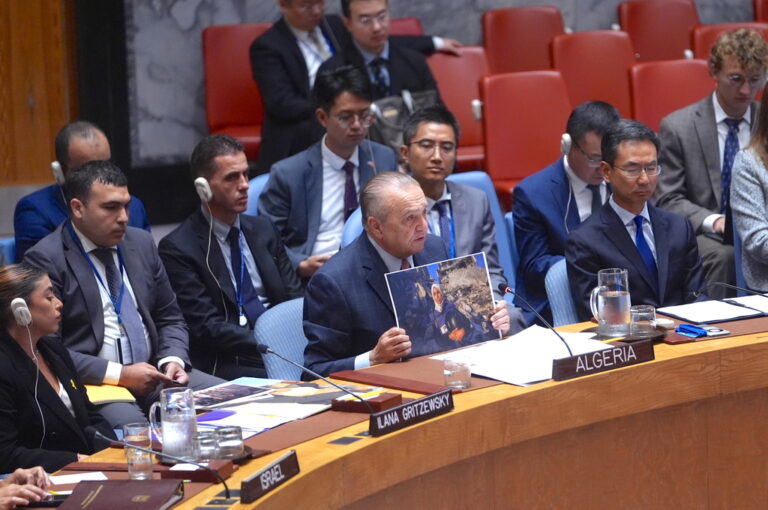
This approach had already been evident in November 2025 at the UN Security Council, where Algeria served as a non-permanent member. After taking pro-Palestinian stances and playing an important role in ensuring Palestine’s voice was heard in the Council, Algeria nevertheless voted in favor of the Trump Plan for Gaza.12 This plan, however, runs counter to Algeria’s historic position on the Palestinian issue – namely, the right of Palestinians to self-determination and the categorical rejection of any form of normalization with the State of Israel. While this departure from Algeria’s principle may be understandable in the face of an unscrupulous Trump administration, one of the analysts we consulted noted that Algeria still failed to make the most of its diplomatic engagement on behalf of Palestine: “Algeria could have taken the initiative to organize a summit on the Palestinian issue at the UN, by joining forces with a country like Spain. We would have had an event organized by two countries with strong positions in support of Palestine. The fact that such an event was organized by France and Saudi Arabia represents a missed opportunity for Algerian diplomacy.”
These displays of caution stand in stark contrast to Abdelmadjid Tebboune’s first term, during which he had banked on a relative resurgence of an anti-imperialist and Third Worldist tradition – one that had made Algiers, during the 1960s and 1970s, “the Mecca of Revolutionaries.” This rhetorical revival of Third Worldism took the form of state visits such as that of Venezuelan President Nicolás Maduro in 2022. It also crystallized around Algeria’s bid to join the BRICS group. After months of lobbying, Algeria’s attempt to join ended in failure. Of course, it is clear to our panelists that the anti-imperialist stance is largely rhetorical and that the current strategic reality is one of multi-alignment, where it is necessary to maintain good relations with the United States, Russia, and China alike. However, this reveals a problem that extends far beyond Algeria. “Although there is increasing talk of multipolarity and de-Westernization, no new power is capable of assuming the kind of moral and political leadership that the Soviet Union once exercised vis-à-vis the United States – a leadership that would allow historically non-aligned countries like Algeria to stand up to Washington, particularly on the Palestinian issue,” according to one of the panelists.
The Sahara Issue and Morocco’s Upper Hand
Algeria is also facing challenges on another key diplomatic issue – Western Sahara – which has been straining its relationship with Morocco since the 1970s. In fact, the United States – which recognized Western Sahara as Moroccan territory in 2020 in exchange for normalizing relations with Israel – is determined at all costs to “strike a deal” between Morocco, the Polisario Front, and Algeria. These U.S.-led negotiations are putting Algeria’s back against the wall. Algeria cannot refuse to negotiate, but the talks are being conducted under the auspices of a falsely neutral party, since the United States has already declared that, in its view, Western Sahara is Moroccan. Furthermore, the UN Security Council currently favors the Moroccan autonomy plan13 over the option advocated by Algeria, which is the traditional one based on the right to self-determination – that is, the right of the Sahrawi people, including those in exile, to decide their own fate – which opens the door, among other possibilities, to independence. According to the analysts we consulted, “the Security Council is thereby violating international law, a practice that, beyond this specific case, reinforces the notion of the death of international law that we have been witnessing since 7 October 2023.”
According to one of the analysts, “the U.S. approach has the merit of holding everyone accountable and attempting to end the status quo. But if it is too heavy-handed and fails to take into account the expectations of all parties, it will only exacerbate the problem. Because from the Algerian perspective, the issue of Western Sahara is inextricably linked to the issue of Moroccan expansionism, whether real or perceived.”
Algeria is now coming to the negotiating table while doing its utmost to play for time, hoping for a new, less abrasive U.S. administration, according to an expert consulted by ARI. He does, however, qualify the centrality of the Western Sahara issue for the United States: “The Americans aren’t going to attack Algeria just because Algeria has refused to negotiate on the Sahara; their leverage remains fairly limited,” especially since investments by U.S. companies in the oil industry are on the rise. However, the United States is holding out the threat of designating the Polisario Front as a terrorist organization as a potential lever.
For our panelists, the conflict over the status of Western Sahara is merely the tip of the iceberg when it comes to the problems between Algeria and Morocco. The greatest point of tension between Algeria and Morocco today is Morocco’s normalization of relations with Israel and the public display of deepened ties, particularly in the area of security. Algeria views this closeness as a security threat, which has notably led to the reimposition of visa requirements for Moroccan citizens – visas that had been mutually waived in 2005 during a thaw in relations between the two countries.
Generally speaking, the simmering conflict between Morocco and Algeria is the clearest illustration of the inherent weakness caused by the lack of regional integration. For example, Morocco is seeing its fertilizer production slow down due to disruptions caused by the closure of the Strait of Hormuz, which has affected its sulfur imports – a mineral that neighboring Algeria produces. In fact, Morocco’s alliance with Israel ignores the country’s immediate neighbors, isolating it and causing it to miss out on both political and economic opportunities. Both countries favor “narrow bilateralism” rather than regional alliances. This puts them in direct competition, particularly on issues where they would benefit from collaboration, such as security – especially in the south, where the Sahel is increasingly destabilized by jihadist groups.
This competition in the Sahel stems primarily from the invitation extended to landlocked countries, such as Mali and Niger, to take advantage of the coastal access provided by the two regional powers of the Maghreb. Algeria is nearing completion of its section of the trans-Saharan highway connecting Algiers to Lagos via Niger. This 5,000-km highway would position Algeria as a Mediterranean transit hub for Sahelian goods bound for Europe. For its part, Morocco is building a deep-water port in Dakhla, in Western Sahara, and plans to connect it to Mali, Niger, and Burkina Faso. The Kingdom is offering access to its Atlantic coastline to countries whose usual West African shipping routes have been disrupted by tensions between the military juntas of the AES (Alliance of Sahel States) and members of ECOWAS (Economic Community of West African States).
Lack of an Overarching Vision
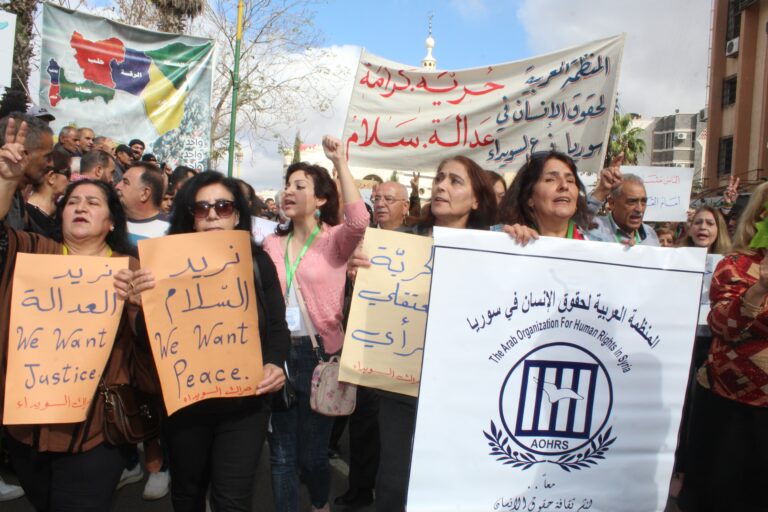
Domestically, Algeria is experiencing a “counterrevolutionary situation that appears to have been successfully carried out,” with civic space reduced to almost nothing. Repression has silenced the voices of the Hirak, the independent media, and public intellectuals. But the post-Hirak consolidation of power is by no means stable. The regime monopolizes the political scene while sorely lacking a coherent long-term vision for the country: “It is capable of scoring a few positive points, such as Pope Leo’s visit, which portrays the country as tolerant and a bearer of peace, but immediately afterward, it bans the sale of a book. Similarly, regarding the economy, there is talk of a country that wants to be attractive to foreign direct investment but changes the rules of the import regime overnight without providing the slightest detail.” Algeria still struggles to project a coherent and attractive image internationally but also domestically, particularly among its own educated youth, who continue, at least in part, to prefer emigration – as uncertain as it may be in an increasingly closed West – to staying and building their future in the country. In fact, like its neighbors, Algeria suffers from its inability to offer career opportunities to the graduates who leave its universities each year. Unemployment among graduates can be a major source of tension, a tension to which the regime responds by buying social peace, notably through increased unemployment benefits.14 But here again, the economy lacks diversification: it is too heavily reliant on hydrocarbons to offer enough skilled jobs in industry or services for its graduates.15
The regime also suffers from a lack of consensus on its next candidate for the presidency, even as Tebboune’s second term is set to end in 2029. One of our sources notes in this regard: “The regime has no clear vision of who will govern Algeria after Tebboune, and this lack of consensus on a successor may lead to domestic political upheaval, exacerbated by socioeconomic difficulties, the rise of organized crime, and political polarization between pro- and anti-regime factions. We are gradually moving toward a situation that closely resembles that of 2017 and 2018.” In 2019, this lack of a consensus alternative within the Algerian nomenklatura led to the decision to field Bouteflika – who was incapable of exercising power – for a fifth term, which sparked the Hirak. However, unlike in the pre-Hirak era, the constitution adopted in 2020 prohibits amending the articles on the maximum number of terms for the president, which is limited to two. To remain within the legal framework it has imposed on itself, the regime must find a successor fairly quickly.
Conclusion
In short, while Algeria has cards to play in the energy and diplomatic spheres, it is going through a difficult diplomatic period with a heavy-handed Trump administration that has sided with Morocco on the Western Sahara issue. This difficulty is only partially offset by the budgetary windfall resulting from the closure of the Strait of Hormuz and the leverage it provides on the international stage. It does, however, open an interesting window of opportunity to accelerate Algeria’s energy transition, which is still lagging behind announced targets. But for that to happen, the regime would need a vision on a national scale – something that still seems to be lacking: the regime, while it appears to have completed its counterrevolution, suffers from a lack of coherence and consensus at the top, which – in addition to slowing the pace of reforms – foretells further procrastination as the next presidential election approaches. This new energy supply crisis is therefore unfolding at a very different time than the invasion of Ukraine. While Algeria is once again the center of attention – particularly in Southern Europe – and may come out ahead in terms of export agreements, its room to maneuver, particularly on the diplomatic front, is less favorable than in the past.
Endnotes
- African Development Bank, “Economic Outlook for Algeria,” African Development Bank, African Development Bank Group, 29 January 2019, available at https://www.afdb.org/fr/countries/north-africa/algeria/algeria-economic-outlook ↩︎
- “Algeria | World Bank Group,” accessed 26 October 2026, available at https://www.banquemondiale.org/ext/fr/country/algeria ↩︎
- “Algeria | World Bank Group,” available at https://donnees.banquemondiale.org/indicateur/EG.USE.ELEC.KH.PC?locations=DZ ↩︎
- Eco Times, “Gas Exports: Algeria to Account for 32.8% of Italy’s Gas Imports in 2025,” ECOTIMES, 25 February 2026, available at https://ecotimesdz.com/algerie-32-pourcent-importations-gaz-italie-2025-2026/. 20 billion cubic meters of gas exported to Italy, while the Transmed pipeline’s capacity is 32 billion cubic meters. ↩︎
- Editorial staff, “Sonatrach Launches Its 2026-2030 Plan to Support Gas Investments,” energynews.pro, 31 December 2025, available at https://energynews.pro/sonatrach-lance-son-plan-2026-2030-pour-soutenir-les-investissements-gaziers ↩︎
- “Algeria’s Chokepoint Opportunity,” Middle East Council on Global Affairs, n.d., accessed 26 October 2026, available at https://mecouncil.org/blog_posts/algerias-chokepoint-opportunity/ ↩︎
- Agence Ecofin, “Renewable Energy: Despite Clear Political Will, Algeria Is Still Far from Its Goals,” Agence Ecofin, accessed 26 October 2026, available at https://www.agenceecofin.com/actualites/1908-130830-energies-renouvelables-malgre-une-volonte-politique-perceptible-l-algerie-est-encore-loin-de-ses-objectifs ↩︎
- “Carbon Markets—EU ETS 2 | Ministries of Ecological Transition, Land Use Planning, Transportation, Urban Development, and Housing,” accessed 26 October 2026, available at https://www.ecologie.gouv.fr/politiques-publiques/marches-du-carbone-seqe-ue-2 ↩︎
- “How Algeria Is Shaping Its Economic Future,” accessed 26 October 2026, available at https://www.banquemondiale.org/fr/news/feature/2025/04/18/how-algeria-is-crafting-a-dynamic-economy-for-tomorrow ↩︎
- Vincent Lequeux, “Climate: How Does the ‘Carbon Tax’ Work at the European Union’s Borders?” Touteleurope.eu, 9 September 2026, available at https://www.touteleurope.eu/environnement/climat-comment-fonctionne-la-taxe-carbone-aux-frontieres-de-l-union-europeenne/ ↩︎
- “Algeria Abandons Its Iranian Ally and Shows Solidarity with Arab Countries,” JeuneAfrique.com, accessed 26 October 2026, available at https://www.jeuneafrique.com/1770186/politique/lalgerie-lache-son-allie-iranien-et-se-solidarise-avec-les-pays-arabes/ ↩︎
- Adlène Meddi, “Resolution on Gaza: Algeria’s Vote Sparks Controversy,” Le Point.fr, 24 November 2025, available at https://www.lepoint.fr/monde/le-vote-algerien-de-la-resolution-sur-gaza-provoque-la-polemique-24-11-2025-2603858_24.php ↩︎
- “Sahara: Morocco’s Historic Success at the UN – IRIS,” accessed 26 October 2026, available at https://www.iris-france.org/sahara-succes-historique-du-maroc-a-lonu/ ↩︎
- “Unemployment Benefits Raised to 18,000 DA,” accessed 26 October 2026, available at https://www.aps.dz/fr/presidence-news/mim7ei1s-l ↩︎
- Agence Ecofin, “Algeria Launches a Tool to Boost the Employability of Its Graduates,” accessed 26 October 2026, available at https://www.agenceecofin.com/actualites-services/1906-139428-lalgerie-lance-un-outil-pour-renforcer-lemployabilite-de-ses-diplomes ↩︎