27October
2026Webinar Morocco’s Political Realignment: A New Coalition, A New Opposition?
2026
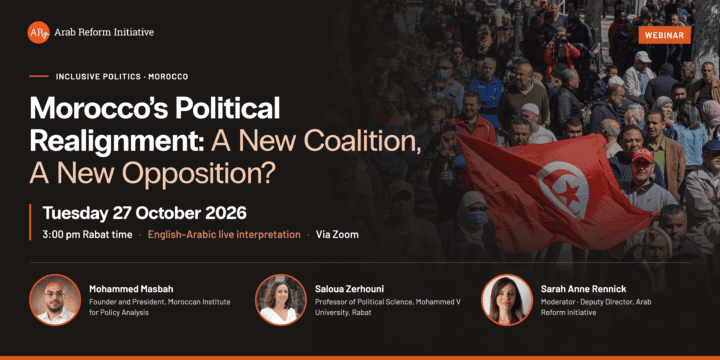
You can register to attend by following this link. You will receive a Zoom confirmation email should your registration be successful. Alternatively, you can watch the event live here on our Facebook page.
The announcement on Friday, 16 October 2026, of the new coalition government in Morocco represented a surprising development in the country’s party politics. Alongside the Authenticity and Modernity Party (PAM), the four-party coalition announced by Head of Government Fatima Ezzahara El Mansouri sees the return of the Koutla to power, the historically democratic bloc consisting of the nationalist Istiqlal Party, the Socialist Union of Popular Forces (USFP), and the Party of Progress and Socialism (PPS) that formed part of the 1998 Alternance coalition under Head of Government Abderrahmane Youssoufi but that fragmented due to inter-party rivalries and ideological differences in the aftermath of the 20 February movement and the subsequent rise of the PJD. The reintegration of the Koutla not only places the National Rally of Independents (RNI) unexpectedly into the opposition, marking a sharp political rupture, but also grants the head of government a much slimmer majority. What factors figured into the political calculations that allowed for the emergence of this particular government, and what does this configuration reveal with regards to the priorities of the monarchy?
Through a combination of expert analysis and debate, this webinar will provide various lenses through which we can read the new Moroccan political configuration, seeking to answer the following broader questions:
- What domestic and international contextual factors help explain the coalition configuration, and what political calculations likely underscore the decision to reintegrate the Koutla and exclude the RNI?
- How might opposition forces be reconfigured in the current conjuncture; what new cartography of opposition could emerge, and what kind of opposition can we expect?
- What room for maneuver does this coalition configuration open up or foreclose for the head of government, and what does it signal about the monarchy’s public policy priorities?
- What are the capacities of the new Parliament in terms of legislation and government oversight? And to what extent can it serve as an effective institutional channel for the widespread social and political grievances currently being directed at the government?