Introduction
Before writing this piece, I posed a simple question on my public Facebook profile: Since the fall of the Syrian regime, which women have been targeted by online hate campaigns? The responses were immediate and telling. Eight women commented, “Me”. Another wrote, “All of us”. A third offered a stark correction: “You should flip the question. Who hasn’t been attacked?”
In the wake of the collapse of the Assad regime in December 2024, digital spaces – particularly Facebook and Telegram – have become deeply polarized, volatile, and profoundly unsafe, especially for those who defy simplistic, binary social, sectarian, and political narratives. For decades, the paralyzing fear of the Mukhabarat, Syria’s security intelligence, which once jailed citizens for a single Facebook “like", kept Syrians in check. Now that this fear has vanished, many have rushed into social media to speak freely. But they are navigating this newfound liberty without guardrails, oversight, or protection.
Many online spaces continue to reproduce the dynamics that pioneering activists claim to oppose, including silencing, dehumanization, sectarianism, misogyny, and the policing of acceptable opinions.
Since the fall of the regime, I have tracked coordinated online smear campaigns targeting 20 Syrian women across various professional fields, each attacked under different pretexts. These assaults deploy the well-documented playbook of digital character assassination: highly sexualized language, explicit threats of rape, the distribution of non-consensual images, and coordinated mobs flooding their profiles with hate speech and sexist slurs. Increasingly, these tactics are augmented by AI-generated, gendered disinformation campaigns meticulously designed to destroy their reputations. In addition, engagement-driven algorithms on social media platforms let extreme actors – from all sides – weaponize platforms to incite violence.
To further understand this trend in Syria, I interviewed (either in person or online) 13 women from different backgrounds, 11 of whom are based inside Syria and two abroad. Some resisted the campaigns and decided to stay online, while others had to leave. Ten of them I interviewed, also as part of my work with the Women Journalists Alliance (WJA). Their stories reflect a broader reality, that of Syrian online spaces that have become even more misogynistic and hostile.
Regardless of their background and “revolutionary legacy”, Syrian women have been the main target of the hate campaigns led and initiated by the rising social media influencers, especially the campaigns where gender intersects with sect. Women’s fear that this online violence would turn into real offline attacks has handicapped them and forced them to impose harsh self-censorship or completely disengage from Syrian public affairs.
Anatomy of a Hate Campaign: Targets, Tactics, and Toll
No Woman Is Shielded
Nothing seems to protect any woman from being targeted, not even their “revolutionary status”. Among those attacked are pioneering revolutionary figures such as Marwa al-Ghamian, who was the first woman to be arrested by the Syrian regime on camera, in the Hariqa neighborhood on the first day of the uprising on 15 March 2011, and Rima Flihan, who was the spokesperson of the Local Coordination Committee of Syria. Many attackers label these women as “Feloul” (regime remnants).
Among these women is Reem Assil, who faced intensified hostility following the regime’s fall. "When I wrote about the massacres committed against Alawite civilians in the coastal region, I experienced a coordinated attempt at silencing", she explains. "More than 1,200 accounts attacked me, many of which appeared to be newly created", describing what she faced in those campaigns as “harassment, bullying, intimidation, character assassination, all of a gendered nature”.
Nour Al Ahmad, an independent journalist and one of the few Syrian women activists who produces video commentary, notes that the online attacks occur regardless of her actual message. “They have an issue with my very existence", she explains. “I am a woman who used to wear a headscarf, and I speak publicly. I am also a Sunni countering hate speech against the Druze and Alawites”.
The cyberattacks targeting Nour violently breached her private life, deploying sexually objectifying language, fabricated chat logs, and deepfake imagery in an effort to silence her.
These recurring tactics serve to reinforce patriarchal norms by policing women's presence in both public and digital spaces – a phenomenon a UN report described as a "chilling effect". The report found that nearly half (49%) of women internet users in the Arab States report feeling unsafe from online harassment.
The Intersection of Hate: Gender, Sect, and Politics
Since the fall of the Assad regime, violence and score-settling have run along sectarian fault lines. Sectarian tensions have been on the rise in the last two years, as crimes committed by the regime were exposed widely, along with the sectarian nature of the forces Assad counted on in ruling the country. This hit its peak with the massacres committed by armed forces linked to the new authorities in the coastal areas (in March 2025) and the Sweida (July 2025), along with the conflict with the Kurdish forces in Aleppo.
The targeting of individuals from the Alawite community in Homs is being reported weekly, and many Druze are too scared to leave their province, Sweida, to come to Damascus for fear of sectarian violence.
When the gendered attacks intersect with sectarian, ethnic, or political polarization, the threat to women becomes exponentially more severe.
This is precisely what I uncovered while working on a report for the Women Journalists Alliance this year. I interviewed 10 Alawite journalists living in Latakia, Hama, and Damascus whose work ranges from managing editors to freelancers. They all used pseudonyms for security reasons. None of them are social media influencers, yet every single one has received direct messages labeling them as "Sabaya Al Ataa", "Assad's orphans", or "whores", alongside explicit threats.
Sectarianism adds another layer of fear for women. Doaa (not her real name), a 40-year-old journalist in Latakia, explains the grim reality: "I'm worth a bullet to any person who dislikes something I post on Facebook. He could kill me, knowing that he will not be held accountable in the complete absence of mechanisms of justice".
The lack of accountability for the crimes committed against Alawites in March 2025 and for the killings that continued to happen later and were labeled as “individual cases” by the state media made many Alawites share the same feeling as Doaa.
From Online to Offline
The online attacks on Syrian women align with the international trend, as seven in 10 women human rights defenders, activists, and journalists report online violence, according to a UN Women’s report published in 2025. While online violence spills offline for four in 10 of the women globally, in Syria, nearly half of the women experience real-world consequences from online abuse. This gap is indicative of how thin the wall that separates offline and online is in a country with collapsed institutions and armed actors in each faction.
Despite living abroad, Nour Al Ahmad has faced harassment directly tied to her online presence; people even showed up at her family’s home in northeast Syria, demanding they "shut her up". While she refused to bow to her family's pressure to stop, she acknowledges the severe risk she would have faced at home: "It still would have been much harder for me if I were still living inside Syria".
While writing the final paragraph of this piece, my uncle – who does not use social media – sent me a screenshot of a post I had published the day before on Facebook, criticizing the government for preventing students in Sweida from taking their exams in their home province. He forwarded it with the message he got reading: "You know she could disappear as easily as a drop of water", echoing a common Arabic proverb.
Yet, this digital terror often contrasts with physical reality. Zeina Shahla, an independent journalist living in Damascus, notes that Syrians offline are far less violent than their social media personas would suggest. "There is sectarianism and violence, but not to the extent you see on Facebook. Most people are busy with their everyday lives", she says.
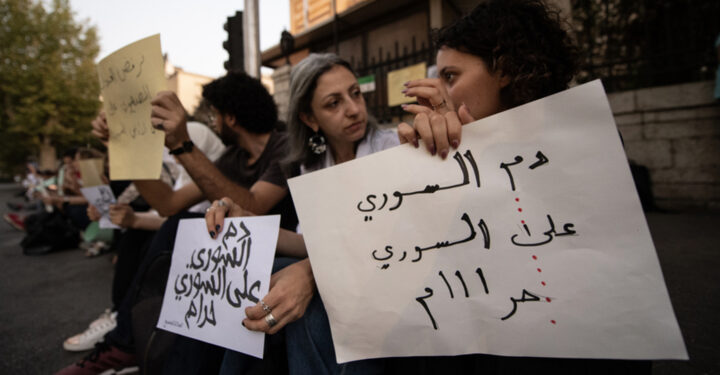
The online attack on Zeina was initiated by an assailant who filmed himself harassing her while he and a group of others disrupted a sit-in dubbed "Syrian blood is sacred to all Syrians"
The sit-in was held in response to the July 2025 aggression in Sweida. After a video of Zeina being verbally assaulted went viral, it escalated into a massive online campaign against her. "It was undoubtedly an organized campaign", Zeina says. "Within a minute of posting anything, I would get 100 comments, mostly copy-pasted sexual insults".
Zeina’s case seems to be an exception, and that could be for many reasons. Firstly, she was filmed being attacked while speaking nicely to the man, so she wasn’t challenging or criticizing any status quo. The sit-in itself was generally against killing any Syrian, so in theory it wasn’t supposed to be controversial, but it was for those supporting the attacks on Sweida.
Online and offline attacks seem to explain each other. Online, anonymity and the near-total absence of accountability embolden attackers to do what they would not risk doing face to face, with coordinated groups multiplying the threat far beyond a single aggressor. Offline, the danger works mainly as a chilling effect, knowing that one post could cause real violence – a bullet, as Doaa fears, or a man who films himself harassing you, as it happened to Zeina – is enough to silence women even when the threats never leave the screen.
More Afraid of the Audience than the State: Between Self-censorship and Coping Strategies
Every one of the 13 women I interviewed confirmed that the fear of online harassment and social media incitement is the primary driver of their self-censorship and their greatest current concern. Their testimonies reveal a striking reality: dealing with the central government is often easier than confronting unregulated online actors who operate with impunity.
Jumana, an independent journalist in Damascus, explains: "I am now more afraid of the audience than of the state. There are well-known individuals who engage in defamation and have large followers. What frightens me most is that my turn may come and that the attacks will extend to my family". Alia, an independent journalist in Damascus, adds, "My fear of them exceeds my fear of arrest. I can negotiate with the Ministry of Interior, but if someone publishes my photos online, there is nothing I can do".
While Nour Al Ahmad insists on maintaining her online presence, Reem Assil has chosen to step aside – not because she has stopped caring, she explains, but because she has finally started caring for herself. "I continue to believe deeply in accountability, human dignity, and transformational justice", Reem says. "I simply no longer believe that I am obligated to sacrifice my well-being in order to advocate for them".
For Samar (not her real name), an independent journalist in Latakia, the primary fear revolves around her family. She asks: "Why should I put myself in a position where my family and I face a vicious online campaign calling me the 'Alawite slut' or worse? Why should I put myself in that position? No… it is better to disappear".
Zeina Shahla, on the other hand, has sought a middle ground. She deactivated her Facebook page but maintained her Instagram account. She describes the Facebook ecosystem as "awful, exhausting, and draining", prompting her departure despite the platform's importance to her work. Instagram presents similar challenges, albeit to a lesser degree. Even there, Zeina echoes Reem’s sentiment, questioning the trade-off: "How effective is what we do on social media if it means risking being attacked again for it? In many cases, I decide not to express my opinion; I would rather invest my energy elsewhere".
The Rise of the E-Dictators: Influencers as State Instruments
In December 2024, just two weeks after the fall of the Assad regime, the new president, Ahmed al-Sharaa, hosted a high-profile meeting with journalists and content creators. The attendees included prominent Jordanian creators Qasim Hattou, known as "Ibn Hattouta", and Jihad Hattab, known as "Joe Hattab", alongside media activist Jamil al-Hassan – who is close to the new authorities – and several other media figures aligned with the new administration. This gathering signaled the dawn of a new era for social media influencers, who are now granted greater access to information and locations than traditional journalists and civil society actors.
This was followed by the Influencers for Syria Conference in Aleppo on 1 September 2025, with Arab influencers coming to attend and meeting the new president, as reported by Al-Ekhbaria. Establishing what has become a recurring pattern, al-Sharaa hosted another gathering of journalists and influencers in March 2026.
At a local level, the governors of Damascus, Latakia, and Aleppo have also invited content creators to official meetings, in what appears to be a comprehensive media strategy aimed at reshaping public discourse in post-Assad Syria.
All of this reflects a clear intention to use bloggers and influencers as instruments to build the legitimacy of the new authorities to avoid the scenario where they would be challenging them and holding them accountable for their actions, as journalists should do. This does not mean that there is a deliberate coordination of each attack. However, the fact that the authorities elevate these influencers by granting them access, audience, and even proximity to the president, and then look away when they attack women, leaves those who were targeted bearing the cost of abuse alone. Empowerment with impunity seems to signal a degree of complacency with the acts of these attackers.
These newly state-empowered influencers, who appear to enjoy near-total impunity – including a prominent inciter of hate being recently hired by a major Qatari-funded media outlet – have effectively been given carte blanche. They are free to defame, attack, or discredit any woman they disagree with, capable of launching a devastating smear campaign with a single Facebook post.
The names of five well-known influencers with millions of followers were mentioned by the women as the most “scary”; one post from any of them could turn their lives upside down. The names of these influencers were deliberately withheld. As shown in the cases below, these figures are now using Syria’s defamation law against any who names them, so identifying them would expose both these women and me to legal harassment.
One of those influencers, who has over 2 million followers, also became known for using the Assad-made Cybercrimes Law to harass those who speak against him under personal defamation cases. Using the law against journalists and content creators by people like him adds yet another layer of fear for women.
He commented on a post I wrote this week criticizing his use of the Assad laws to oppress freedom of expression, claiming that I do not understand the context, and my criticism is personal. After this, over 150 people came to support his comment with sexualized and aggressive comments targeting me.
I am privileged to be from the province of Idlib, considered now as the heart of the revolution, and being Sunni with a track record of participation in the revolution from day one; I am also a journalist with an international passport. Had it not been for all of these, he could have silenced me with only seeing his name on my page.
Another influencer who lives in the Netherlands and is named as Top Hater by the Hate Radar of the Women Journalists Alliance has already initiated at least two campaigns against women, forcing them to leave the digital space altogether. His name is now being used as black humor by comments on women’s posts: “Be careful not to turn into a post at ***’s Facebook page”.
In the first campaign, in May 2025, he asked his followers bluntly to attack a woman activist, describing her as a whore because she criticized a video on President al-Sharaa. In the same year, he shared a fabricated chat of another woman activist and initiated a bullying campaign against her.
Beyond Legislation: Addressing Gaps and Building Safer Digital Futures
Lawyer Fadi Al Rahhal, who has specialized in cybercrime law since 2015, notes that there are precedents in Syria where women have successfully obtained rulings in their favor in cases involving online defamation, fabricated videos, or cyber extortion, such as a young woman being blackmailed for money by a man who fabricated naked pictures of her.
However, most of these cases – even those cited by Al Rahhal – involve financial fraud, blackmail, or the exploitation of young girls, with virtually no precedents addressing coordinated, gender-based harassment campaigns.
Zeina, for example, filed a formal complaint with the Criminal Security Department regarding the orchestrated online harassment campaign she endured this year, but so far, nothing has come of it. "I don't know whether that's due to limited capabilities on their part or because many of the accounts involved are fake", she says. "Either way, I'm determined to keep pursuing the matter".
Reclaiming the Digital Spaces
Nour emphasizes the critical need to activate the existing legal framework against cybercrimes. She argues that when perpetrators are held accountable – whether through hefty fines for defamation or actual imprisonment – “it will be safer for Syrian women to be present online”.
In the current cybercrimes law of 2022, there are two articles clearly addressing online defamation (24), calumny, and degradation (25). However, there is no gendered perspective added to them, and the same law that was enforced by Assad has another article (28) criminalizing “Undermining the prestige of the State", which is a broad accusation used to oppress any critics of the state. Hence, the laws are being imposed as a tool of oppression, not to protect women and marginalized communities.
Taken together, the women and the lawyer interviewed for this piece point to a single demand: enforce defamation provisions that already exist, write an explicit gendered lens into the law, and repeal Article 28 of the cybercrime law.
Reem echoes this need for systemic support, adding, “First and foremost, women need safety. We also need stronger cultures of solidarity and accountability. Too often, women are left to navigate abuse alone”.
Zeina highlights the delicate balance required to achieve this: holding perpetrators accountable without jeopardizing freedom of expression, which she notes is essential for women to feel truly safe in digital spaces.
However, legal frameworks alone are insufficient when tech platforms actively enable abuse. In deeply polarized or post-conflict societies, algorithms that prioritize engagement over safety empower both state and non-state actors to incite violence. Expecting Facebook to self-regulate in a country that generates no direct revenue for the company is highly unrealistic. This is especially true given the company’s broader trend of laying off regional staff instead of hiring and empowering moderators who understand nuanced local contexts.
Because Meta will not do this voluntarily, the demand has to be backed by external pressure from regulators, advertisers, and sustained civil society campaigning. As the primary social media platform in Syria, Meta must instead establish a regional, community-driven Feminist Emergency Response Channel. This mechanism would allow targeted harassment campaigns to be reported directly to a specialized team capable of swiftly removing harmful content, penalizing hate-inciting influencers, and limiting their reach.
Concurrently, feminist networks like the Women Journalists Alliance have begun adopting regional solidarity campaigns. Under this model, if a woman is attacked online in any country, a journalist from another country can respond on her behalf, such as the campaign against Egyptian journalist Iman Adel. When she was speaking against the deportation of Syrians from Egypt, journalists from across the region were responding on her behalf, and the WJA issued a release supporting her as well. This not only takes the burden off her shoulders but also reinforces her resilience. Such grassroots regional networks can provide immediate digital security triage, legal referrals, psychosocial support, and a coordinated "counter-narrative" to drown out hate speech.
What has changed since December 2024 is not that Syrian women are newly afraid, but that the source of the fear has changed. The Mukhabarat’s single watcher has now been replaced by a crowd and amplified by platforms that reward sensational outrage and by influencers that new authorities elevate but do not control. Zeina is right that the street is calmer than social media feeds, but as the women make it clear in this piece, the threat does not have to be carried out to silence the person it targets.
As Reem Assil noted, women should not have to sacrifice their well-being to advocate for equity and peace. True transformational justice in post-Assad Syria cannot be achieved if half the population is systematically silenced, threatened, and driven out of the digital public square.
The views represented in this paper are those of the author(s) and do not necessarily reflect the views of the Arab Reform Initiative, its staff, or its board.