Next week, the Arab Reform Initiative (ARI)’s Social Protection Program is officially launching its campaign for the upcoming IMF-World Bank Group Annual Meetings in Bangkok, taking place from October 13 to 16, 2026. This forthcoming campaign is the latest iteration of a comprehensive, multi-year advocacy process ARI has been leading since 2023, building directly on the momentum and demands of the last, Spring 2026 campaign in Washington, D.C.
To drive its agenda, ARI is bringing a large, unified delegation to the Annual Meetings, consisting of our staff and Arab Region Hub for Social Protection partners. Seven delegates will be advocating on the ground in Bangkok: Farah Al Shami, Diala Ahwach, and Ishac Diwan (ARI); Anas El Hasnaoui (L'Espace Associatif); Firas Zakraoui (Al-Bawsala); Ahmad Awad (Phenix Center); and Zahra Bazzi (ANND). They will be joined by a robust online delegation, including Ghassan Al-Daoud (ARI), Safa Al-Jayoussi (Oxfam), Samir Nassar (AUB-IFI), and Marco Shaefer (ESCWA and the Regional Collaboration Initiative on Social Protection in Crisis Times), among others. Beyond public sessions at the Civil Society Policy Forum (CSPF), this delegation will hold strategic, closed-door meetings with IFI officials to push for actionable policy reforms.
Our Core Substantive Demands
Our advocacy in Bangkok is heavily evidence-based, focusing on the systemic vulnerabilities exposed by overlapping regional and global crises and the role of multilateralism therein. Based on new qualitative and quantitative data, ARI and partners are prioritizing the following structural reforms:
- Rejecting Austerity and "Rebuilding Buffers": We are challenging the current lexicon of "rebuilding buffers," which operates as fiscal consolidation and austerity in practice. As rising defense spending and energy prices make essentials unaffordable, new global data shows how adjustment measures, such as capping wage bills, eliminating subsidies, and expanding user fees, shift costs onto households and deepen social and gender inequalities. We are advocating for financing alternatives that allow governments to increase fiscal space and social resilience.
- Closing Financing Gaps with Rights-Based Alternatives: Drawing on the Finance4All project in Tunisia, Lebanon, Morocco, and Jordan, we are confronting the distance between current public policy and what communities actually demand and need. We propose domestically-driven, rights-based alternatives to conventional, debt-reliant financing models that currently shape IFI social protection channels.
- Adapting to Digital and Green Transitions: Rapid digital transformations, the green energy transition, and neoliberal economic policies are profoundly reshaping labor markets and exposing the fragility of current social protection models. Utilizing original findings on Egypt and Lebanon from the Forward project, we outline tailored policy reforms required to transition fragmented frameworks into adaptable, forward-looking universal systems that protect vulnerable and informal workers.
- Protecting Platform Workers from Algorithmic Management: Unregulated platform business models undermine labor rights, shift social security obligations, and weaken contribution financing. We are urging the World Bank to support the ratification and implementation of ILO Convention No. 193 to establish safeguards on employment status, algorithmic management, and social security.
- Ensuring Rights-Based Reconstruction: We are critically examining how the World Bank Group’s 2026-30 Fragility, Conflict, and Violence (FCV) Strategy operationalizes its "Deliver as One on Jobs" commitment through public investment, guarantees, and procurement. We aim to advance safeguards, including labor rights, gender- and climate-responsive assessments, and transparent contracting to ensure reconstruction financing is equitable.
- Financing State-Led, Shock-Responsive Systems: In fragile and conflict-affected States, crisis assistance frequently fragments when donors and IFIs create parallel humanitarian assistance systems without incentivizing or strengthening national social protection. We are calling on IFIs to connect humanitarian responses with national frameworks to mobilize resources, empower vulnerable populations, and foster stability through universal, State-led protection.
New Evidence & Publications
Three foundational papers are already available as part of this campaign to ground our advocacy in concrete data:
Additional publications and regional briefs will be released over the coming days. Stay Tuned!
ARI at the Civil Society Policy Forum (CSPF)
ARI is deeply involved across the wider CSPF agenda. We will be leading, participating in, and co-sponsoring the following sessions:
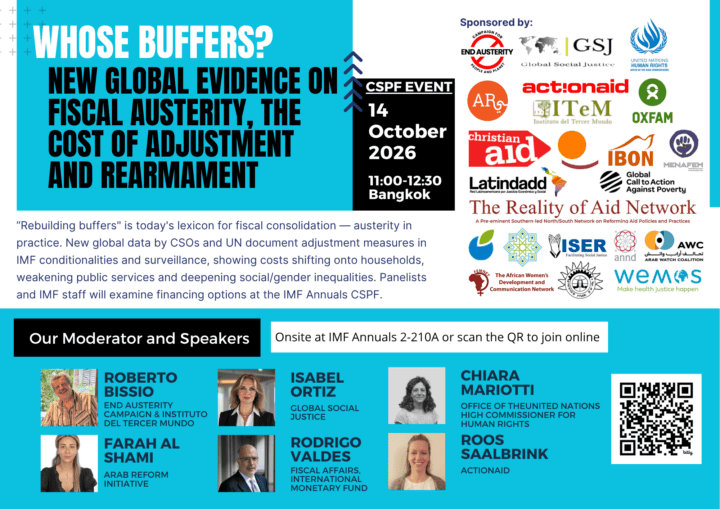
This moderated roundtable examines adjustment measures worldwide and their impacts on households, public services, and gender equality. The session will examine financing options to expand fiscal space in direct dialogue with IMF staff.
ARI’s Farah Al Shami will present new evidence from the Finance4All project on alternative financing for universal social protection, featuring original survey data from Egypt and Lebanon, with findings from Tunisia, Morocco, and Jordan.
This session is also being held one day prior in the People’s Assembly where ARI’s Diala Ahwach will present the same new evidence.
To join online: https://imf.zoom.us/j/99274032131?pwd=aQffir3hQq7hvmrxwuDabR4TqD0YeW.1
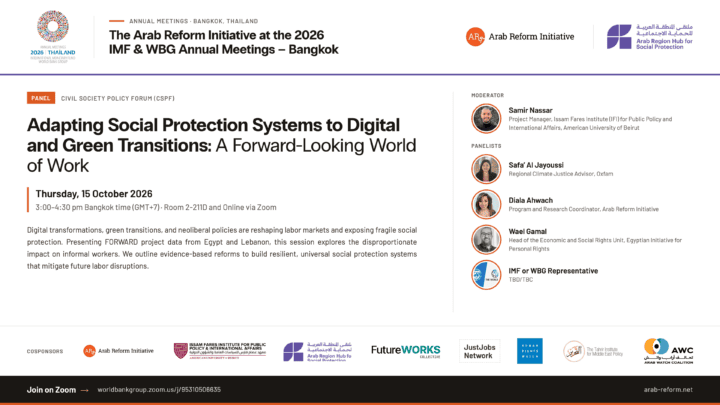
This session examines how systemic transitions disproportionately impact vulnerable and informal workers, presenting new empirical evidence from the FORWARD research project.
ARI’s Diala Ahwach will present new evidence on Egypt and Lebanon from this project.
To join online: https://worldbankgroup.zoom.us/j/95310506635?pwd=doguD6Ov4aSezP9f3LItv6xzSQ8dZZ.1
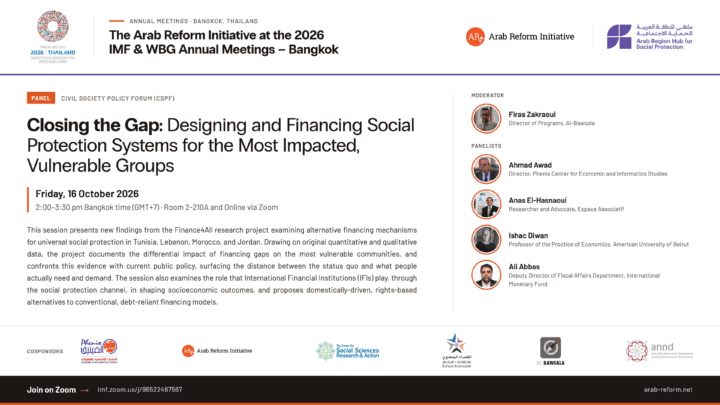
Ishac Diwan and Finance4All partners will be presenting new findings from the Finance4All research project on the differential impact of financing gaps on the most vulnerable communities across the Maghreb and Levant, and exploring the role of IFIs in shaping socioeconomic outcomes.
To join online: https://imf.zoom.us/j/96522467567?pwd=kI7CRlO4ifmm3ZUf5EL6mMbL6kH0lH.1
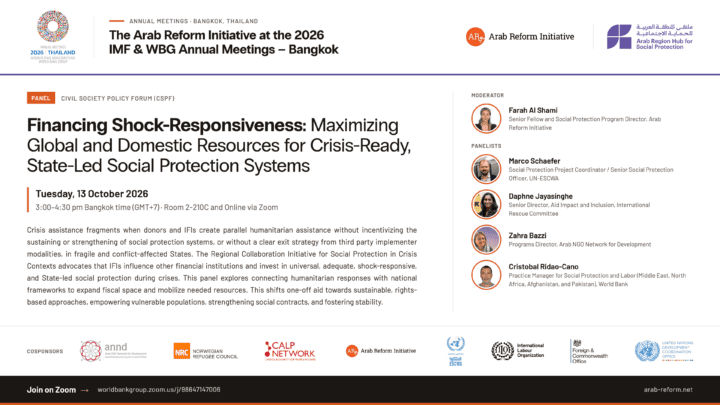
This panel explores how IFIs can create incentives to support and sustain national social protection systems in coordination with humanitarian actors during crises to eliminate parallel systems. It will be moderated by ARI’s Farah Al Shami and will feature representatives and presentations from the Regional Collaboration Initiative on Social Protection in Crisis Times.
To join online: https://worldbankgroup.zoom.us/j/98647147006?pwd=VN2bHdbw9CqM8QTD3NagGitYYIwSqu.1
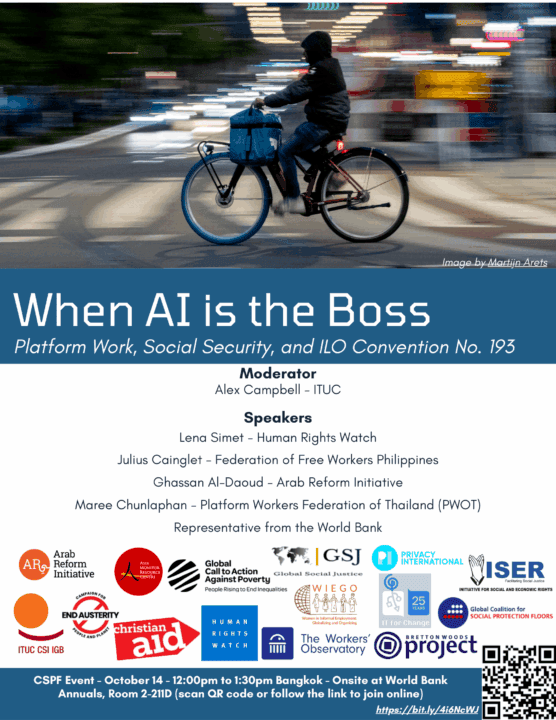
Connecting the newly adopted ILO Convention No. 193 to World Bank policy advice, financing, and country engagement to ensure new technologies do not come at the expense of labor rights.
ARI’s Ghassan Al-Daoud will speak in this session, also featuring findings from the FORWARD project.
To join online: https://worldbankgroup.zoom.us/j/98092990163?pwd=aCRIZfIBbebmy641tJy5yctkaYOvHT.1
Drawing on Lebanon, Syria, and comparative FCV cases, the session will examine how investment and procurement rules determine who receives contracts, who carries risk, and who captures the returns.
To join online: https://worldbankgroup.zoom.us/j/95743942585?pwd=ABm8x78u2RhildImp4S6fnnKsrM0ni.1
This session addresses the critical gap between the severe economic destruction caused by war and the lack of country-specific political expertise among IMF staff. It examines how international financial institutions frequently encourage potentially destabilizing economic policies in fragile and conflict-affected states.
To join online: https://imf.zoom.us/j/92977126262?pwd=McGGw7VBtZTaEulg1Q4ruyDdmDQM3h.1