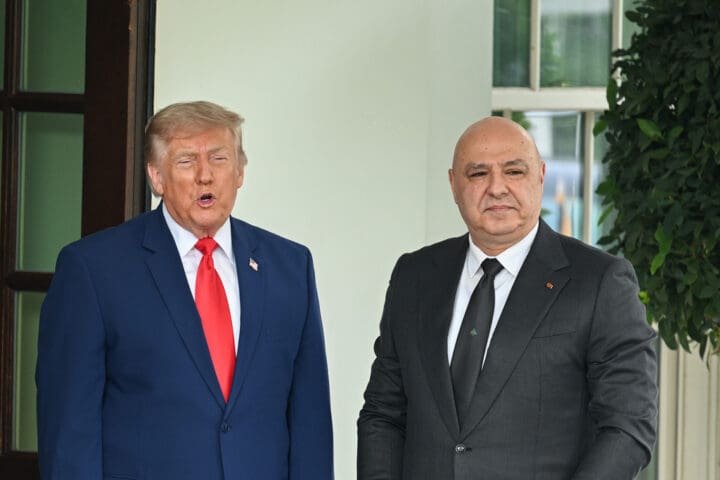
Lebanon’s two competing external dependencies have reached their limits. Hezbollah has no exit strategy from the two wars it entered in support of its allies since 2023 beyond waiting for the outcome of US-Iran dynamics, while President Joseph Aoun has no clear horizon after seven rounds of negotiations with Israel beyond hoping that Donald Trump would ultimately constrain Israeli expansionist policies. With no breakthrough expected between Washington and Tehran any time soon, new internal dynamics are required to break the deadlock.
Calibrated hedging offers a policy framework to gradually broaden Lebanon’s options and recover greater strategic autonomy from its dual dependencies on the US and Iran. It is not neutrality between competing powers, but a gradual effort to reduce external dependencies, diversify partnerships and return national security decisions to state institutions. This paper traces how Lebanon arrived at dual dependency, explains why neither alignment is sustainable, sets out what calibrated hedging would mean in practice, and identifies the conditions it requires.
From Single to Dual Dependency
Lebanon’s foreign policy dilemma reflects not simply ideological differences but the absence of a coherent foreign policy capable of reconciling Lebanon’s domestic political divisions with an increasingly competitive regional environment. Since the withdrawal of Syrian regime forces in 2005, Lebanon has tried to reclaim its sovereignty without succeeding in acquiring strategic autonomy. Foreign policy instead became fragmented between competing centers of power pursuing different external partnerships and security priorities. Lebanon moved from single external dependency under Syrian tutelage toward dual dependency on the United States and Iran. The result was two contradictory foreign policy orientations within the same state.
Between the November 2024 ceasefire and the resumption of fighting between Israel and Hezbollah in March 2026, neither President Aoun nor Hezbollah had resolved the challenges on the southern border or closed the widening trust gap between them. Israel was not conceding on its demands or its readiness to pursue them militarily. US envoy Tom Barrack’s proposed initiative, which sought a step-by-step approach to trade Hezbollah disarmament for Israeli withdrawal from five occupied hills, hit an impasse that paralyzed the monitoring mechanism established by the 2024 ceasefire agreement co-chaired by the US and France. Hezbollah used this period to regroup and restore its supply lines, while Aoun did not translate “positive neutrality” into an approach capable of overcoming the Lebanese impasse without triggering political instability.
Both Aoun and Hezbollah, representing different external orientations, gave up much of their margin of maneuver after the US-Iran war began in March 2026. Following the assassination of Iran’s Supreme Leader Ali Khamenei on 28 February, Hezbollah abandoned the restraint it had shown since the November 2024 ceasefire, launching six rockets toward Israel in retaliation. Aoun, meanwhile, moved away from his presumed “positive neutrality” toward closer alignment with Washington.
Israel subsequently expanded its occupied Lebanese territories from five hills to the entire area south of the Litani River, with wider operational control extending to areas north of the river. Since the November 2024 ceasefire, Hezbollah had shifted from operating as a quasi-army that holds territory to guerrilla warfare. By the time the US-Iran Memorandum of Understanding produced a ceasefire in June 2026, Hezbollah lacked the capacity to hold territory and had not established prior coordination with the Lebanese Armed Forces (LAF), which had withdrawn from several positions in southern Lebanon amid Israeli advances, shelling and evacuation demands.
Starting 9 March 2026, Aoun increasingly pushed for direct negotiations with Israel to avoid further Israeli attacks and unilaterally authorized the signature of a framework agreement in June 2026, which in effect places the Lebanese and Israeli authorities on the same side against Hezbollah. He gradually bet on close alignment with the United States as the principal route toward ending Israeli attacks and securing Israeli withdrawal. Yet the framework agreement does not resolve the underlying disarmament/withdrawal dilemma between Hezbollah and Israel, despite Israel’s overwhelming military superiority.
Hezbollah continues to view itself as an integral part of Iran’s regional network and rejects any security arrangement that could weaken Tehran’s regional influence. Firing six rockets at Israel in retaliation for Khamenei’s assassination was a major miscalculation driven more by external and ideological considerations than by a cost-benefit analysis of Hezbollah’s, let alone Lebanon’s, interests. Despite major strategic losses in south Lebanon, MP Hussein Hajj Hassan affirmed on 12 September that Hezbollah “belongs to the axis that triumphs at Bab al-Mandab and in the Strait of Hormuz”.
Why Neither Alignment Works
Neither alignment offers a sustainable foreign policy. Exclusive reliance on Washington exposes Lebanon to shifts in American domestic politics, US-Israeli dynamics, and regional priorities, while risking the identification of Lebanese interests too closely with US strategy. Continued dependence on Iran leaves Lebanon vulnerable to regional escalation and limits the state’s ability to exercise sovereignty over conflict management and foreign relations. Both reduce Lebanon’s room for maneuver and deepen domestic polarization.
Each of the two bets has a strategic rationale, but neither gives Lebanon control over the outcome. Aoun depends heavily on Washington’s willingness and ability to translate its leverage over Israel into withdrawal and limits on Israeli military operations, a bet that has not yet delivered. Hezbollah depends on Iran’s capacity to sustain it militarily and politically and assumes that continued resistance can impose costs on Israel without exposing Lebanon to another destructive confrontation. In both cases, crucial decisions ultimately depend on calculations made outside Lebanon.
The two approaches do not have to be fully identical toward Israel and Iran, but without agreed limits they work against each other. Hezbollah’s unilateral military action can undermine diplomatic negotiations and expose the country to escalation; excessive dependence on US mediation can leave Beirut with few alternatives when Washington is unwilling or unable to secure Israeli concessions.
Aoun’s meeting with Donald Trump on 21 July and his subsequent dependence on US goodwill illustrate this dilemma. By contrast, Iraqi Prime Minister Ali al-Zaidi visited Tehran days after meeting Trump at the White House, meeting President Masoud Pezeshkian and delivering a de-escalation initiative to the Iranian leadership. Aoun received a phone call from Iranian Foreign Minister Abbas Araghchi on 14 October, but diplomatic contacts alone do not constitute a strategy of hedging. Regardless of whether such a move would have been effective, Lebanon has not appointed a representative to the Lebanon mechanism established under the US-Iran Memorandum of Understanding and led by US Vice President JD Vance. Instead, Lebanese authorities have placed their bets on Secretary of State Marco Rubio’s framework agreement track. Hedging does not appear to be an option, even within the Trump administration itself.
The objective should not be to replace Tehran with Washington or Riyadh as the dominant external reference point, but to increase the number of relationships through which Lebanon can pursue its interests. The immediate challenge is establishing enough domestic consensus to prevent either relationship from determining Lebanon’s foreign policy.
What Calibrated Hedging Would Mean in Practice
Calibrated hedging would not require Lebanon to distance itself equally from Washington and Tehran, suspend negotiations with Israel, or proclaim neutrality. It would seek to prevent any single external relationship from determining Lebanese foreign policy. In practice, this means maintaining necessary partnerships with the US and Gulf states while preserving state-to-state relations with Iran, separating bilateral disputes with Israel from the broader US-Iran confrontation, and gradually bringing security decisions under state authority.
Lebanon should continue negotiations with Israel when they serve clearly defined Lebanese objectives while reducing the risk of renewed conflict. Negotiations should remain focused on concrete security and territorial issues rather than becoming a vehicle for broader strategic alignment. They should be conducted by state institutions based on an agreed Lebanese position, without committing Lebanon to the regional priorities of either Washington or Tehran, as the early phase of Lebanese-Israeli negotiations in Washington risked doing.
Lebanon also cannot realistically exclude Tehran from its regional diplomacy while Hezbollah remains closely tied to the Iranian security structure. The state should develop its own bilateral channel with Iran rather than allowing Hezbollah to remain the principal intermediary. Beirut should engage Tehran directly on issues affecting Lebanon, including ceasefires and economic relations, rather than leaving one domestic actor to manage a relationship with implications for the entire country.
With Washington, Lebanon should preserve close cooperation without treating US policy as synonymous with Lebanese national interests. US military assistance to the LAF, diplomatic mediation, and support for reconstruction remain important, but Beirut should resist linking every bilateral issue with Israel to the broader American objective of weakening Iran and Hezbollah. Cooperation should be issue-based rather than amounting to irreversible strategic alignment, and Beirut should maintain alternative diplomatic channels when American and Lebanese priorities diverge. Relations with the Gulf states should likewise strengthen state capacity rather than create another form of dependency, and external support for the LAF should not be conditioned on confronting Hezbollah militarily.
Hedging also means widening the circle of partners beyond Washington and Tehran. France, which participated in the 2024 ceasefire mechanism, and the European Union more broadly offer diplomatic and financial channels that are not tied to the US-Iran confrontation, while Egypt and Qatar have played mediating and support roles in Lebanon. Yet, Lebanon has not consistently capitalized on these options. Beirut relinquished a French role in south Lebanon and did not resist pressure in August 2025 to end the UNIFIL’s mandate in Lebanon before later regretting that decision, and has not engaged with Egyptian and Saudi mediation to facilitate a domestic understanding over Hezbollah’s weapons. Cultivating these relationships more actively would diversify Lebanon’s external support, reduce its dependence on any single actor and give Beirut greater diplomatic flexibility when the priorities of its international partners diverge.
Hedging also requires rebuilding relations with Syria on a state-to-state basis. The new political order in Damascus creates both risks and opportunities. Lebanon should resist returning to a relationship in which Syria exercises political tutelage, while recognizing that border security, refugees, trade, smuggling and regional diplomacy, notably coordination on Israel, make stable relations unavoidable. The practical objective should be functional cooperation on bilateral issues without allowing Damascus, or any other external capital, to regain a privileged role in Lebanese decision-making.
Economic policy offers immediate room for hedging. Economic diversification should become an explicit foreign policy objective beyond the Gulf and Europe. The objective is not economic equidistance but reducing the political vulnerability to external actors that can determine Lebanon’s access to financing, reconstruction and energy. Sovereignty is as much internal as external: dependence on foreign assistance for economic survival, reconstruction and LAF deployment in the south does not amount to genuine sovereignty.
Institutionally, these policies cannot work if foreign policy continues to depend primarily on individual leaders. Strategic decisions should be coordinated through the Council of Ministers, supported by a permanent inter-ministerial mechanism involving the presidency, prime minister’s office, foreign and defense ministries, and relevant security institutions. Under the Lebanese Constitution, decisions on war and peace fall within the authority of the Council of Ministers, not individual leaders or armed groups. Without such coordination, Lebanon’s national security policy will continue to be improvised and lack strategic coherence.
Creating the Conditions for Calibrated Hedging
Lebanon cannot implement such a strategy simply by declaring it. Its ability to hedge is currently constrained both by domestic divisions and by an external environment in which the United States, Iran, and Israel have strong incentives to push Lebanon toward clearer choices. The immediate policy objective should be to create greater room for maneuver rather than attempt to achieve strategic autonomy at once.
The first requirement is achieving a limited but shared domestic understanding over the boundaries of foreign and security policy. Hezbollah and its opponents do not need to agree on relations with Iran, the United States or Israel. They need agreement on narrower rules: Lebanon should not enter a regional war without a state decision; negotiations affecting Lebanese territory and sovereignty should be conducted by the government; external assistance should reinforce state institutions rather than parallel structures; and no domestic actor should use an external relationship to impose regional alignment on the country or strengthen its position at the expense of other domestic actors. An independent mediation commission could facilitate indirect talks between Lebanese authorities and Hezbollah in an attempt to reach a broader framework for the gradual transfer of security responsibilities from Hezbollah to the LAF.
Hezbollah is central to such an understanding. The party is unlikely to relinquish its weapons simply because the government or external powers demand it, particularly while Israel continues to occupy Lebanese territory and conduct military operations inside Lebanon. Yet preserving its current autonomy also carries growing costs. A gradual arrangement could link Israeli withdrawal, reconstruction and an expanding state security with negotiations over the future of its weapons, allowing Lebanese authorities to demonstrate that diplomacy can produce tangible security gains. A negotiated transition would also require Hezbollah to acknowledge that its previous military role along the border cannot be restored and demonstrate a credible commitment to transfer security responsibilities to the state, rather than using the process to preserve its military autonomy indefinitely.
The government would also have to move in parallel to avoid replacing Hezbollah’s dependence on Iran with state dependence on Washington. Beirut should continue using US mediation where it can produce results, but maintain alternative diplomatic channels when American and Lebanese priorities diverge.
External actors also shape the space necessary for hedging. Washington would need to accept a Lebanese strategy that seeks to reduce Iranian influence gradually rather than requiring Beirut to treat Tehran as an enemy or Hezbollah exclusively as a security problem that can be resolved if enough firepower is used.
Iran is unlikely to voluntarily surrender one of its principal sources of influence in the Levant. But an arrangement preserving relations with Iran and Hezbollah’s political role may be preferable to renewed war, further degradation of Hezbollah or an attempt to exclude Iran entirely from Lebanon.
Israel poses the most difficult external constraint. Hedging cannot succeed if Israel insists on Hezbollah’s complete disarmament before withdrawing from Lebanese territory while simultaneously reserving unrestricted freedom to conduct military operations inside Lebanon. A workable transition would require reciprocal steps between greater Lebanese state authority and Israeli withdrawal. Military action alone cannot produce a sustainable outcome unless its results are translated into political understandings.
None of these conditions is fully present today. Hedging should be understood as a direction of travel rather than an immediately available doctrine. In the short term, the priorities remain preventing renewed war, securing Israeli withdrawal, strengthening the LAF and restoring state authority in the south.
Strategic autonomy ultimately requires the Lebanese state to exercise authority over decisions of war and peace, and Hezbollah would have to accept that its military decisions cannot continue to expose the entire country to regional conflicts without state authorization. This is the hardest part of hedging, because it requires a minimum understanding between Lebanese authorities and Hezbollah. The objective cannot realistically be rapid disarmament of Hezbollah by force, but rather the gradual expansion of the LAF’s security responsibilities while limiting Hezbollah’s ability to act independently. The government, for its part, should avoid treating disarmament primarily as an externally imposed condition or a purely military and logistical exercise. It is also a political question involving structural problems of power sharing and the direction of Lebanon’s foreign policy.
Conclusion
President Aoun’s turn toward Washington reflects the difficult circumstances Lebanon faces rather than an irrational foreign policy choice. The difficulty arises when a necessary partnership becomes an indispensable one. If Lebanon’s ability to secure its territory, finance reconstruction, or strengthen its armed forces depends overwhelmingly on decisions taken in Washington, the state remains vulnerable to changes in US priorities and to differences between American and Lebanese interests. The same applies more starkly to Hezbollah’s relationship with Iran: Iranian support has provided capabilities the Lebanese state could not provide, but it has also tied decisions affecting Lebanon’s security to a wider regional confrontation over which Lebanese institutions exercise little control.
Lebanon faces a false choice if its foreign policy debate is reduced to alignment with Washington or continued reliance on Tehran. Replacing one external dependency with another would not restore sovereignty. Nor would declaring neutrality resolve the underlying problem when the state lacks the institutions and capabilities required to enforce it. The more realistic objective is to progressively increase the number of options available to Lebanese decision-makers while reducing the ability of any external power to determine the country’s choices. This is the purpose of calibrated hedging: cooperating with Washington without automatically adopting its regional priorities; maintaining relations with Iran while rejecting an autonomous Iranian-backed military strategy; and negotiating with Israel without making a broader realignment of Lebanon’s domestic and foreign policies a prerequisite for resolving border security disputes.
The most difficult transition concerns Hezbollah’s weapons. None of this can be achieved quickly. Lebanon currently lacks both the domestic consensus and the external freedom of action required for a fully developed hedging strategy. The immediate task is to lay the groundwork for a new foreign policy and national security doctrine that expands Lebanon’s strategic autonomy and commands at least a minimum degree of domestic consensus. Unless Lebanon takes steps in this direction, external factors will sooner or later dictate its future, whether through military confrontation or a political settlement, most likely at the expense of Lebanese interests.
For Lebanon, strategic autonomy is not a matter of reclaiming an elusive sovereignty but a process that has to be built over time. The measure of success will not be whether Lebanon stands at an equal distance from competing powers, but whether its government can cooperate with one without becoming dependent on it, engage another without becoming its proxy, and shape foreign relations according to Lebanese interests.
The views represented in this paper are those of the author(s) and do not necessarily reflect the views of the Arab Reform Initiative, its staff, or its board.