Introduction
A review of the 2026 budget shows that the government has sought to prioritize social spending by increasing the financial allocations for social protection, education, and health. However, this quantitative increase does not, in and of itself, indicate a serious commitment to developing the public sector’s role in providing social services and meeting the basic needs of the population, as an analysis of the spending items reveals no qualitative shifts in program design or a realignment of priorities, let alone a roadmap – even a preliminary one – to strengthen the state’s welfare role as a fundamental pillar of a robust social contract between the state and the population.
The bulk of the increases was spent on covering operating expenses, redistributing pension contributions, and financing services related to the operation of the military and security institutions, and capital investment in infrastructure remained weak, particularly in the education and healthcare sectors. This has kept the state closer to being an administrative apparatus – preoccupied with ensuring its own continuity and managing its day-to-day operations – than to an active institution capable of renewal and investment in its own capabilities.
The expenditure items reveal a state of stagnation in the government’s performance and the limitations of its ability to take the initiative and act in response to changing circumstances, as evidenced by the meager spending on programs aimed at caring for the most vulnerable groups and those severely affected by successive crises, as well as on programs related to reconstruction and recovery in the wake of the Israeli aggression against Lebanon.
The analysis concludes that improving the efficiency of social spending and building a renewed, proactive welfare state capable of halting the erosion of the social contract cannot be achieved merely by redistributing financial allocations; rather, it requires efforts that go beyond the rules governing the decision-making process of successive governments. This includes lifting the constraints of fiscal austerity policies that run counter to the interests of the majority of the population, and reforming the tax system to enable the mobilization of more equitable revenues, making taxes a tool for representation and accountability, not merely a means of collection. It also requires a reevaluation of spending priorities, based on the reality that Lebanon is facing the repercussions of an ongoing war – a conflict from which the state and its institutions are not detached, but rather are striving to protect the population and assure them that they are not left to bear the cost of the war and its consequences alone.
Objective and Methodology
This paper aims to assess the extent of the government’s commitment to improving social spending – both in terms of quantity and quality – and to incorporating it among the public policy priorities in the 2026 budget. This budget is of particular importance because it is the first to be prepared entirely by the current government, whereas the 2025 budget was prepared by the previous government, and the current government’s role was limited to approving it by decree.
Thus, the 2026 budget is not merely another financial plan for spending and revenue collection, but a pivotal milestone that warrants careful consideration to understand the social and welfare policies the government may pursue in the coming years, and to assess the extent to which its spending priorities align with its ministerial statement. In it, the government presented itself as the “Government of Reform and Rescue” in February 2025 – a commitment it established as the foundation of its legitimacy before a population whose living conditions it hopes to help improve after years of war and economic crisis.
Therefore, a comparison was made between the 2025 and 2026 budgets based on two classifications:
- The functional classification of expenditures, a framework that divides government spending into ten main functions according to the objectives it seeks to achieve. The analysis focused on three functions considered most closely linked to social spending and internationally recognized development indicators: social protection (Function 10), education (Function 9), and health (Function 7).
- The administrative classification, based on the allocation of appropriations by budget sections and ministries, particularly the Ministry of Public Health and the Ministry of Education and Higher Education.
The analysis relied on a breakdown of the expenditure items related to these functions and ministries in the 2025 and 2026 budgets, including both a quantitative comparison and a qualitative assessment of the content.
Overall Analysis
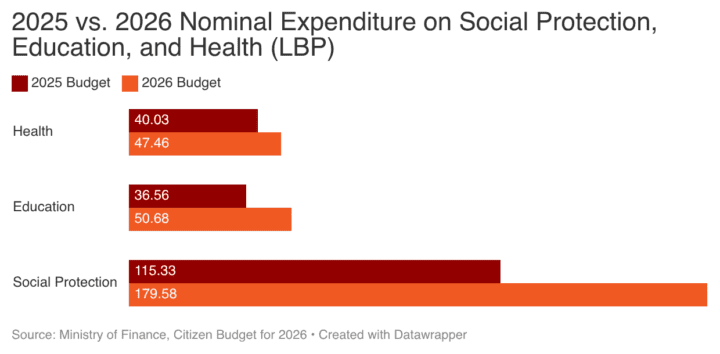
Figure 1 shows an increase in nominal spending on social protection, health, and education in the 2026 budget compared to the 2025 budget, giving the initial impression that the government has given greater priority to social spending and may have directed its fiscal policy toward improving and strengthening social services.
Figure 1. Nominal Expenditures on Social Protection, Health, and Education (by Functional Classification) (in billions of Lebanese pounds)
Source: Ministry of Finance, General Budget for Fiscal Year 2025 and General Budget for Fiscal Year 2026
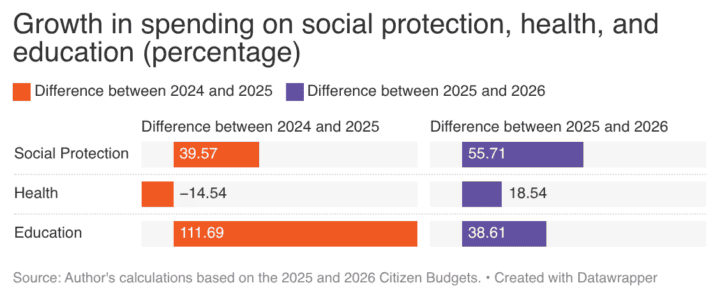
Figure 2, which compares spending growth rates between the 2025 and 2026 budgets, confirms the initial impression shown in Figure 1 regarding the shift in spending priorities between the two budgets. At the same time, however, it reveals a clear disparity in the pace and direction of this shift across the three functional categories.
Spending on social protection accelerated significantly in the 2026 budget, while health spending returned to a growth trajectory after a previous decline in allocations; however, the pace of increase remained well below that recorded for social protection. As for education, despite the increase in spending in the 2026 budget, it experienced a notable slowdown compared to the previous year’s budget.
Figure 2. Growth in Spending on Social Protection, Health, and Education (%)
Source: Author’s calculations based on the 2025 General Budget and the 2026 General Budget
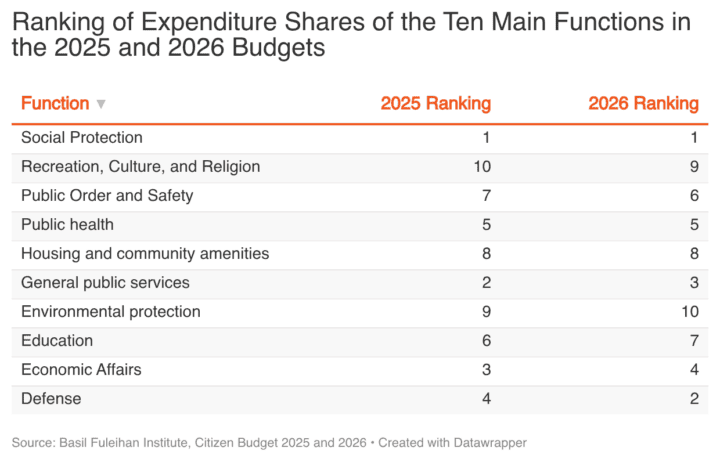
However, the most accurate method for measuring the extent of the government’s focus on social spending – and for tracking whether this priority is advancing or declining within its spending hierarchy – is to track the ranking of the three social functions (social protection, education, and health) among the ten core functions in the budget, while also monitoring their combined share of total government spending.
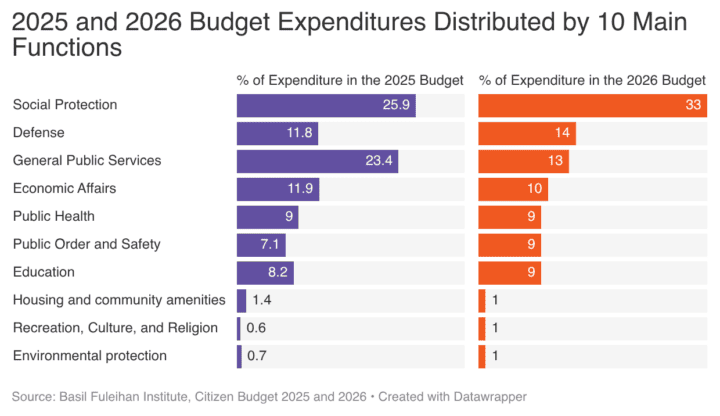
According to Figure 3, the share of social protection rose from 25.9% in the 2025 budget to 33% in the 2026 budget – an increase of 7.1 percentage points – which reinforced its position as the largest spending category in the budget, with its allocations now more than double those of the second-largest spending function (defense).
In contrast, the shares of education and health – and their ranking within the spending priorities – remained virtually unchanged, indicating that there was no clear reorientation of the budget toward strengthening these two sectors. It appears that the increase in allocations for defense, law enforcement, and public security limited the possibility of increasing their relative weight within the spending distribution.
Figure 3. Ranking and Spending Shares for the Top Ten Functions in the 2025 and 2026 Budgets
Source: Basil Fuleihan Institute, Citizenship and Citizen Budget 2025 and 2026
In conclusion, based on the three charts above, it can be said that the focus on social protection was the most evident, whereas the same cannot be said with certainty about the education and health sectors. However, this general comparison – without breaking down each spending function and analyzing its components – is insufficient to reach a definitive conclusion regarding the budget’s priorities, or even a preliminary conclusion regarding efforts to strengthen the state’s welfare role, which will be addressed in detail in the following sections.
Detailed Analysis and Specific Policy Recommendations
1. How Were Social Protection Allocations Spent?
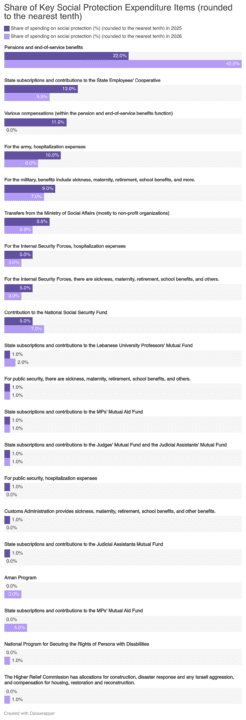
To dissect the social protection allocations in the 2026 budget, we identified all budget items functionally classified under “Function No. 10: Social Protection,” which totaled 146 items. To identify the most significant items among them, those accounting for more than 1% (rounded to the nearest tenth for simplicity) of total spending allocated to social protection were selected.
Figure 4. Key Social Protection Items in the 2026 Budget
 Source: Author’s calculations – based on the 2026 budget
It turns out that social protection spending is concentrated in a limited number of budget lines: just 16 lines – or about 11% of the total number of lines classified under social protection – account for approximately 95% of total spending allocated to this function (97% if not rounded to the nearest tenth).
When the 2025 budget is also limited to the top 16 line items – to facilitate comparison – it becomes clear that spending is concentrated in a limited number of line items as well, with these items accounting for about 95% of total spending, as shown in Figure 4.
Accordingly, the first 16 items in each budget can be considered, approximately, representative of total spending on social protection in the 2025 and 2026 budgets, which obviates the need for an in-depth analysis of the other items when comparing the two budgets, as they are marginal to the analysis.
Upon analyzing these items and comparing them in terms of their nature, their share of total social protection spending, and their alignment with social protection objectives, the following observations emerge:
- The spending structure in the 2025 and 2026 budgets reveals that the lion’s share of social protection allocations goes toward benefits linked to employment rights – that is, entitlements that beneficiaries receive by virtue of holding a job in the public or private sector, such as retirement pensions, end-of-service compensation, and benefits for military personnel in the armed forces and security agencies.
Although employment-related social benefits are a right enshrined in domestic and international laws, holding a job cannot be the sole condition for receiving social protection. International covenants, including Article 22 of the Universal Declaration of Human Rights, generally recognize that “everyone, as a member of society, has the right to social security,” while Article 25 states that “Everyone has the right to a standard of living adequate for the health and well-being of himself and his family, including food, clothing, housing, medical care, and necessary social services.”
However, it is clear that the allocations set aside in the 2025 and 2026 budgets for the other type of social protection – namely, programs targeting the most vulnerable groups, i.e., those provided to individuals based on their social status rather than their employment status, such as the “Aman” program and programs supporting people with disabilities, among others – account for a very limited share of total spending on social protection.
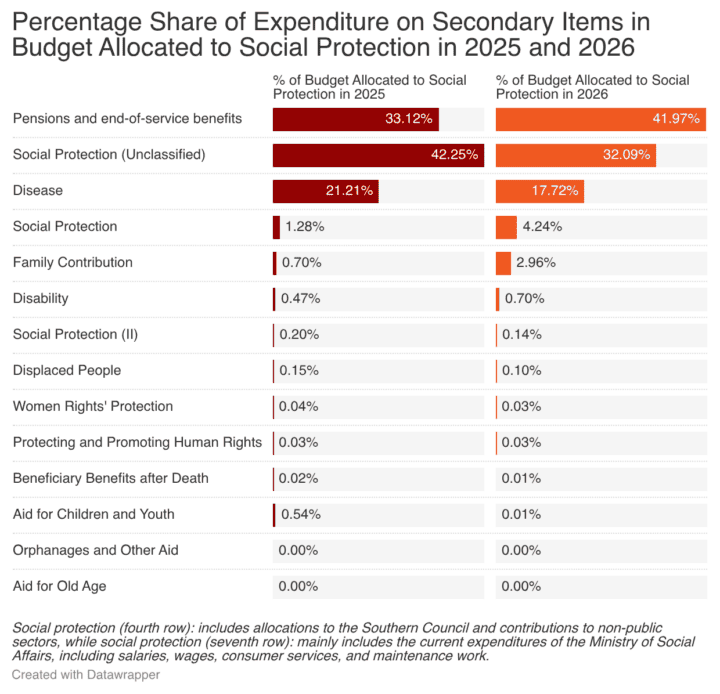
This becomes even clearer when analyzing social protection spending according to the secondary functional classification (i.e., according to the secondary functions classified under main function No. 10, which are numbered 10.11, 10.12, etc.): the share of secondary social protection functions directed toward the most marginalized groups – such as people with disabilities, displaced persons, the protection of women’s rights, and old-age benefits – does not exceed 1% each of total social protection spending, as shown in Figure 6.
Figure 6. Shares of Expenditures on Secondary Functions as a Percentage of Total Expenditures Included in the Primary Social Protection Function in 2025 and 2026
Source: Author’s calculations – based on the 2025 and 2026 budgets
This reflects the impression that the primary purpose of job-related benefits, particularly in the public sector, is not so much to provide comprehensive social welfare as it is to offer the minimum incentives needed to keep public sector employees in their jobs, after they lost a significant portion of the value of their pensions and compensation due to the financial and banking crisis, thereby ensuring the continued operation of state institutions and preventing their complete collapse.
- It appears that a large portion of social protection spending is allocated to sustaining the state’s military and security apparatus, as social benefits for military and security personnel – including medical and maternity expenses, educational benefits, retirement pensions, and others – continue to account for approximately 20% of total social protection spending in the 2026 budget.
Although this share has declined compared to 2025, the decrease remains nominal, as it is primarily due to the significant increase in the share of the first category – compensation and retirement pensions – which has overshadowed the other categories.
These allocations cannot be treated as social protection spending as an end in itself; rather, they are, to a large extent, a cost associated with maintaining a relatively bloated military and security apparatus, as it constitutes a fundamental part of the employment system on which the state relies to generate its political legitimacy.
Although it is important to maintain a large and efficient civil service in the public sector to manage vital sectors, available data indicates that the security and military forces account for approximately 60% of all public sector employees, while there remains a severe shortage of human resources within many other public administrations and institutions, which suffer from widespread vacancies and a chronic shortage of staff.
- It is evident that 42% of the spending classified under social protection in the 2026 budget is concentrated in allocations to the Pension Fund (compared to 33% in the 2025 budget, distributed across two line items). Since the fund is essentially self-financing, these allocations are more akin to the recycling of accumulated mandatory contributions and the payment of members’ benefits than to new social spending financed by the general budget and based on fair tax redistribution.
- Programs targeting the most vulnerable groups raise a fundamental issue that goes beyond the limited appropriations allocated to them and concerns their ability to achieve the objectives for which they were established. Foremost among these is the “Aman” program, which seeks to provide cash transfers and social services to tens of thousands of Lebanese families living below the poverty line.
According to documentation by the CAMEALEON coalition, which evaluates social protection programs in Lebanon, multiple and overlapping crises have repeatedly disrupted social assistance programs – particularly the “Aman” program – depriving the most vulnerable families of support at a time when they needed it most.
The coalition also points out that barriers to access – including limited digital literacy, lack of internet connectivity, high transportation costs, and a limited number of aid distribution points – exclude the most vulnerable groups, particularly the elderly, women, and residents of remote areas. At the same time, although political and social networks may facilitate access to aid, they reinforce a sense of unfairness and perpetuate perceptions that aid is politicized.
Furthermore, these programs – which place a heavy burden on the state budget and the balance of payments – continue to rely heavily on external financing. Since 2021, Lebanon has financed the Aman program through foreign loans, securing a $246 million loan followed by another $300 million loan, while additional financing of $200 million is currently under consideration, which would bring the total loans associated with the program to approximately $746 million.
- It is clear that part of the increase in social protection spending in the 2026 budget is due to allocations for reconstruction following the Israeli aggression against Lebanon; however, the value of these allocations (approximately $72 million at most, as shown in Figure 4) remains extremely modest compared to the scale of destruction caused by the war and the actual needs for reconstruction, recovery, and relief for those affected. The World Bank has estimated the cost of reconstruction and recovery following the Israeli aggression against Lebanon at $11 billion, of which $3.9 billion is allocated for 2025 and $4.5 billion each for 2026 and 2027.
This significant discrepancy reveals that the budget did not account for the shifts imposed by the security and humanitarian realities, nor was it prepared as an emergency response tool for a country facing an ongoing war and extensive reconstruction needs; rather, it appeared more like a budget prepared under normal financial and administrative circumstances.
This confirms that the 2026 budget is almost entirely devoid of any line items with designations that reflect the reality of war, such as “war,” “aggression,” “displacement,” or “emergency shelter.” In addition to the allocations set aside for the Council of the South, as shown in Figure 4, only approximately $22 million was allocated to the Higher Relief Commission, listed under the heading “Compensation for shelter, structural restoration, reconstruction, and related matters” – a very modest sum that was also classified under the “social protection” function, as if the war were nothing more than a sub-item of that function.
It should be noted that classifying reconstruction allocations under “Main Function: Social Protection” is not self-evident, and according to Sabine Hatem, an economic expert at the Basil Fuleihan Institute, the inclusion of these allocations under the social protection function clearly does not align with accepted standards and requires broader discussion and a clearer classification framework – unless their classification is based on the fact that they are considered housing support.
This raises a fundamental question: Was the war, in the eyes of the budget drafters, such a marginal issue that it did not merit being included (or allocated) under the appropriate functional classifications? These functional classifications are not merely a formal arrangement of figures; rather, they were established in the first place to ensure that public spending achieves its intended objectives.
2. What Solutions Are Proposed to Improve Spending on Social Protection?
- Adopting a Tax System That Supports the Most Marginalized Groups: The government should increase the share of appropriations allocated to empower the most vulnerable groups – particularly the poor, people with disabilities, children, the elderly, and women – within total social protection spending. This does not necessarily mean reducing allocations for other social protection programs; rather, this increase can be financed through a restructuring of the tax system.
According to the International Labor Organization, “Countries such as Lebanon have multiple options for expanding the fiscal space allocated to social protection. In the medium term, increasing revenues through progressive taxation (such as income tax reform and a wealth tax) and reallocating public spending – whether within the social protection sector or outside it (such as reforming the social security system in the public sector) – to provide the resource base needed to finance a minimum level of social protection on a sustainable basis.”
- Institutionalizing the “Aman” Program as a National Social Safety Net: In this context, a study by the CAMEALEON coalition presents a set of recommendations aimed at enhancing the coverage, transparency, and responsiveness of social assistance programs in Lebanon to the needs of beneficiaries.
These recommendations include improving data integration and coordination among relevant stakeholders, enhancing the fairness of beneficiary targeting, strengthening monitoring mechanisms and channels for receiving complaints and feedback, and linking assistance to sustainable livelihood pathways. The study also calls for long-term structural reforms, including the adoption of a progressive tax system, the establishment of a unified social registry, and a shift from an approach that targets poverty exclusively to one based on rights and the life cycle in the design of the social protection system.
- Rationalization and Restructuring of the Public Sector: Review the allocation of human and financial resources within the public sector, including rationalizing hiring and redirecting personnel and appropriations toward vital civil service departments and institutions that suffer from acute staff shortages.
- Reforming the Pension System and Enhancing Its Financial Sustainability: Continue reforming the pension system by implementing the regulatory decrees associated with Law No. 319, which was passed by the House of Representatives in 2023. This must be accompanied by strengthening the system’s funding sources, so that they are not limited to contributions but also include progressive tax sources.
- Launching a Serious and Systematic Process of Reconstruction and Recovery: A comprehensive national assessment of the damage caused by the Israeli aggression against Lebanon should be conducted, enabling the identification of recovery and reconstruction priorities based on the extent of the damage, the level of social and economic needs, and existing security constraints. This requires the completion of the necessary decrees and executive decisions to facilitate reconstruction and recovery efforts, in parallel with mobilizing domestic and international financial resources and channeling them according to clear priorities. An independent reconstruction fund should also be established, subject to clear frameworks for governance, transparency, and accountability, to ensure the sound management of resources and their delivery to the most affected areas and groups.
Furthermore, spending allocated for reconstruction and recovery during and after the war should be classified in the general budget according to its purpose and function, rather than being included entirely under the social protection function. For example, spending on the reconstruction of roads, bridges, electricity and water networks, and other productive infrastructure can be classified under “Economic Affairs,” while the reconstruction of hospitals falls under “Health,” schools under “Education,” housing rehabilitation under “Housing and Community Facilities,” and assistance to displaced families and affected populations under “Social Protection.” As for demining operations, security enhancement, and the rehabilitation of public institutions, these fall under the categories of “Regulation and Public Safety,” “Defense,” or “Public Authorities and Services,” depending on the nature of the activity.
3. How Were Education Allocations Spent?
The 2026 budget allocated 55 trillion Lebanese pounds to the Ministry of Education and Higher Education – slightly more than $612 million – representing a 45% increase compared to the ministry’s allocation in the 2025 budget. According to the functional classification, “Function No. 9: Education,” the appropriations allocated to the education function amounted to 51 trillion Lebanese pounds, a 39% increase over the previous year.
The differences between the two classifications are not substantial with regard to education. The functional classification does not include social protection allocations disbursed through the Ministry of Education, while the ministerial classification does not include educational programs and activities implemented by other ministries and departments, such as certain programs in the Ministries of Finance and Health or training programs for security agencies. Since the impact of these differences is limited and affects only a small portion of total spending, either classification could be used to conduct an analytical comparison between the 2025 and 2026 budgets.
Therefore, the two budgets were first compared in terms of the distribution of the Ministry of Education and Higher Education’s appropriations between Parts I and II. Part I includes current and routine expenditures necessary for the ministry’s ongoing operations, while Part II is allocated to investment spending and capital formation in the education sector – that is, expenditures of a developmental nature.
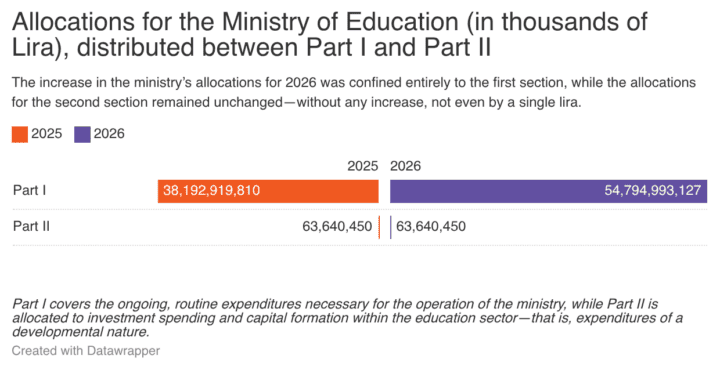
This breakdown (as shown in Figure 7) reveals that the increase in the ministry’s allocations for 2026 was entirely concentrated in Part I, while the appropriations for Part II remained unchanged – without even a single-pound increase. This means that the rise in education spending was not accompanied by any expansion in investment spending or capital formation, indicating a lack of a clear direction toward developing the educational infrastructure or strengthening the sector’s long-term capabilities.
Figure 7. Ministry of Education Allocations (in thousands of Lebanese pounds) Broken Down by Part I and Part II
Source: Author’s calculations – based on the 2025 and 2026 budgets
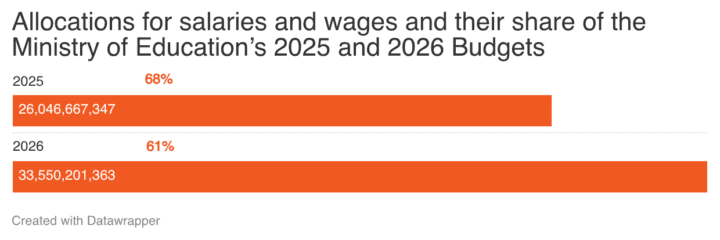
Moving on to an analysis of the components of Part I, it becomes clear that the items classified under “Salaries, Wages, and Related Benefits” – which include the incomes of public education sector employees such as principals, teachers, and counselors – account for about two-thirds of the Ministry of Education and Higher Education’s total allocations in the 2025 and 2026 budgets, with a slight decrease in their proportion in 2026, as shown in Figure 8, although they increased in absolute terms.
Figure 8. Allocations for Salaries, Wages, and Related Benefits and Their Share of the Ministry of Education’s Expenditures
Source: Author’s calculations – based on the 2025 and 2026 budgets
However, this percentage does not reflect the full extent of wage-related spending, as there are other budget items that include expenditures of a similar nature, such as the “transfers” item, which includes, for example, a contribution of 12 trillion Lebanese pounds for salaries and wages in higher education. When these additional allocations are factored in, the share of spending related to salaries and wages in the Ministry of Education’s 2026 budget rises to more than 80% of the ministry’s total allocations in the 2026 budget.
Meanwhile, other expenditures in Part I are distributed among support for public school funds and social benefits for sector employees (which can also be considered part of wage spending), as well as consumables and services necessary for the ministry’s operations, such as fuel, water, electricity, and minor maintenance and repairs to facilities.
Ultimately, it appears that the largest portion of the Ministry of Education and Higher Education’s spending in both budgets is related to expenditures on the teaching staff that manages the sector and ensures its continued operation. To illustrate the magnitude of these allocations in a different numerical context, allocations for salaries and wages in basic education alone account for about 3% of total spending in the 2026 budget.
Human capital indeed constitutes the cornerstone of the education sector, as the quality of the educational process is largely linked to direct interaction between administrators, teachers, and students. However, spending on human resources alone – without parallel investments in infrastructure, equipment, and physical capital – limits the productive return on this spending and suggests that these allocations are driven more by clientelistic considerations than by the sector’s actual needs.
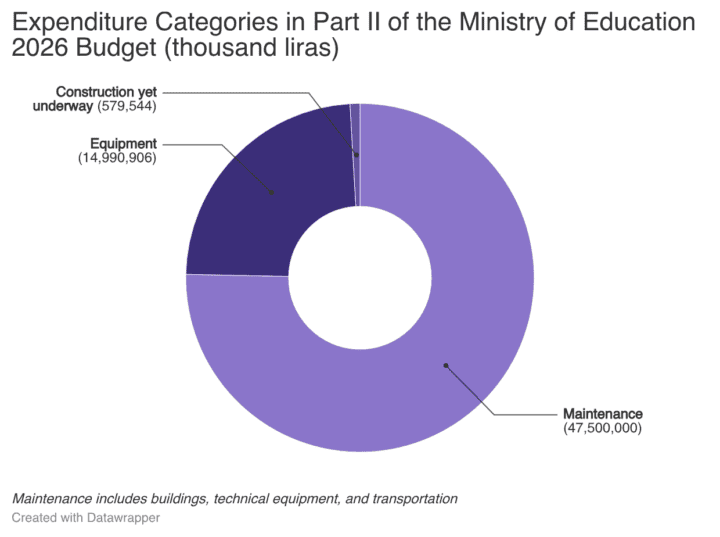
In this context, an analysis of Part II of the budget, as shown in Figure 9, reveals that the overwhelming majority of appropriations allocated for capital formation go toward maintenance – that is, the preservation and renovation of existing assets – rather than toward investing in their expansion, development, or efficiency improvements. This limits the potential to improve the work environment for staff and the quality of the educational services they provide. In contrast, appropriations for construction in progress do not exceed 1% of the total appropriations in Part II, reflecting weak investment in educational infrastructure and the absence of actual expansion in this area.
Figure 9. Expenditure Allocations in Part II of the Ministry of Education Budget (in thousands of Lebanese pounds)
Source: Author’s calculations – based on the 2026 budget
4. How Can Spending on Education Be Improved?
In its report titled “Foundations for Building Forward Better: An Education Reform Path for Lebanon,” the World Bank presents a set of general recommendations to improve the financing of the education sector and increase the efficiency of spending within it, which can serve as a framework for better managing available resources, thereby creating greater fiscal space to redirect more spending toward the sector’s development and increase allocations for investment items (Part II).
- Restructure education sector financing to prioritize schools and the public sector, ensuring a more equitable distribution of resources, while directing support toward the poorest households, whose children face a higher risk of dropping out of school or not enrolling in school at all.
- Develop cost estimates and financial scenarios, in collaboration with development partners and in line with the objectives of the Lebanese education system, to ensure that all children have access to effective education that achieves tangible learning outcomes.
- Strengthen accountability and transparency in the use of public funds allocated to the education sector, including funds spent on private schools, to ensure their efficient use and the achievement of desired educational goals.
- Launch a public debate on the adequacy, equity, and efficiency of education spending, and identify the priorities and strategic directions for the education sector, as well as the investments required to achieve them.
- Review governance and funding mechanisms in public and private universities, and transition from the current standards-based approach to a system of results-based performance contracts, linking funding to specific outcomes, such as graduation rates and employment outcomes.
However, these recommendations focus primarily on management and governance, and their ability to bring about fundamental change remains limited unless they are accompanied by policies that secure additional financial resources for the education sector. This requires tax reform that redirects a larger share of financial resources from higher-income groups and brackets toward funding public education; this could include imposing additional taxes or contributions on the private education sector, particularly schools and universities that serve high-income families – such as a progressive tax on private schools based on their annual revenue.
5. How Were Health Allocations Spent?
Health spending across the two budgets can be compared using two approaches: either through the functional classification under Function No. 7, “Health,” and its subcategories, or through the allocations for the Ministry of Public Health within the classification distributed across the budget chapters. As is the case in the education sector, the difference between the two figures is very small, amounting to no more than 1% in the 2026 budget.
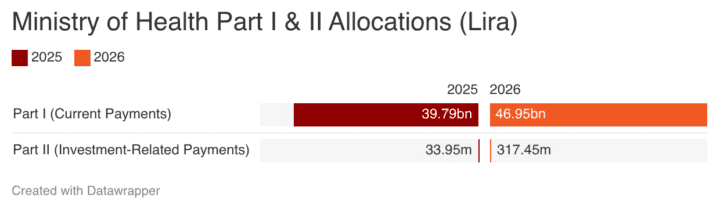
As is the case with the Ministry of Education, current expenditures (Part I) account for the vast majority of the Ministry of Public Health’s allocations, meaning that we are dealing with nondevelopmental expenditures for the health sector. Although allocations for Part II – related to investment spending and capital formation – have increased nearly eightfold compared to the previous year’s budget, this increase should not lead to exaggerated conclusions, as these allocations remain very limited and do not exceed 1% of the Ministry of Public Health’s total allocations in the 2026 budget.
Figure 10. Ministry of Public Health Allocations (in thousands of Lebanese pounds)
 Source: Author’s calculations – based on the 2025 and 2026 budgets
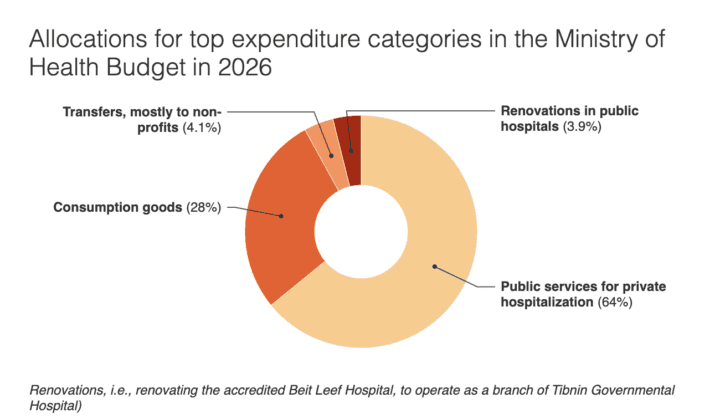
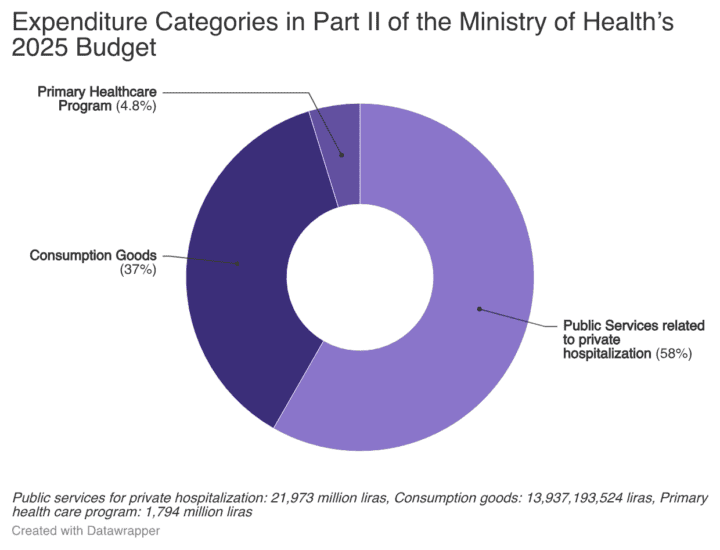
When looking at the budget items whose values exceed 1 trillion Lebanese pounds, it becomes clear that four items alone account for 97.5% of the spending in Part I of the 2026 budget, while 95% of the spending is concentrated in three of those items.
Figure 11. Allocations for the Major Expenditure Items in the Ministry of Health’s Budget for 2025 and 2026 (in thousands of Lebanese pounds)
Source: Author’s calculations – based on the 2025 and 2026 budgets
A preliminary comparison reveals a number of observations: the “consumables” category continues to account for a large share of allocations in both budgets, alongside the emergence of an additional item related to the renovation of Beit Lif Hospital in the 2026 budget. In contrast, spending on the primary healthcare program has declined sharply in the new budget, with allocations falling by approximately 90%, removing it from the list of major health spending categories.
However, the most telling observation in the analysis is that the “Public Services for Private Hospitals” line item continues to hold a very prominent position among the Ministry of Public Health’s spending priorities. Figure 11 shows that the share of this item rose from about 55% of the Ministry of Public Health’s allocations in the 2025 budget to more than 62% in the 2026 budget.
Although sufficient details about the components of this item are not available, it appears to be primarily related to coverage of inpatient services provided by private hospitals to patients at the Ministry of Public Health’s expense, reflecting the ministry’s heavy reliance on the private sector to provide a significant portion of health services.
The private sector’s share of the ministry’s spending is not necessarily limited to this item alone; the actual percentage may be higher when other related items are taken into account, such as contributions totaling 1.4 trillion Lebanese pounds to nonprofit organizations.
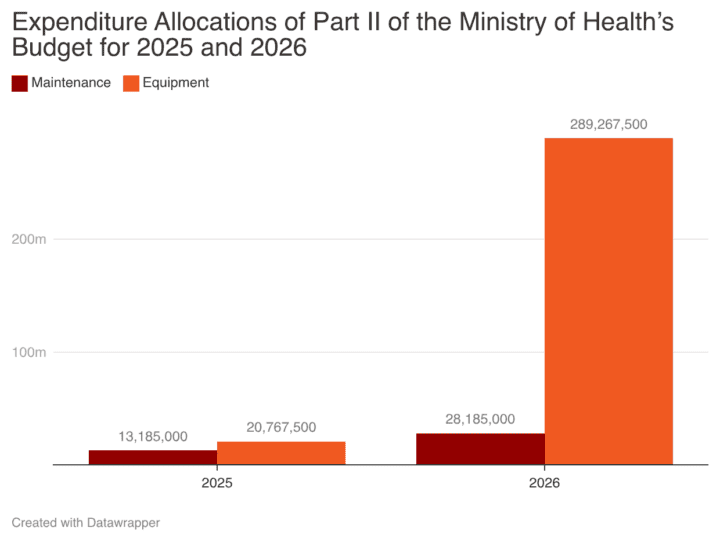
At the same time, data from Part II of the Ministry of Public Health’s budget allocations reveals the government’s continued failure to develop the public health sector and enhance its capacity to accommodate larger numbers of people seeking health services, thereby reducing the need to resort to private providers.
As shown in Figure 12, spending in Part II is primarily focused on maintenance and equipment, with no allocations for developing the health infrastructure of public facilities.
Figure 12. Spending Allocations in Part II of the Ministry of Health’s 2025 and 2026 Budgets (in thousands of Lebanese pounds)
Source: Author’s calculations – based on the 2025 and 2026 budgets
6. How Can Health Spending Be Improved?
This question can be answered by referring back to “Vision 2030,” the national health strategy launched by the Ministry of Public Health in January 2023, which established a framework for the recovery and reconstruction of the health system on more sustainable foundations following the successive crises that have exhausted it.
With regard to improving spending, “Vision 2030” called for “implementing a real increase in healthcare funding through taxes based on a political economy analysis, while allocating sufficient resources to primary healthcare and reducing out-of-pocket expenses borne by individuals.”
This would be achieved through:
- Progressive taxation.
- Taxes on capital gains.
- Taxes on harmful products (with the proceeds allocated to the health sector).
- Actively engaging with the Ministry of Finance to conduct forward-looking studies on tax issues, with the aim of using the results to increase the resources available for healthcare.
Conclusion and Policy Recommendations
1. Recommendations for the Government
The real challenge facing the government is not merely to inject more funds, but to spend them differently, bearing in mind that the budget is not merely an accounting document that tallies revenues and expenditures, but rather the truest reflection of the state’s political choices.
The recommendations outlined above regarding social protection, education, and health in the “Detailed Analysis and Specific Policy Recommendations” section constitute important steps toward achieving this goal. However, reforming social spending is not limited to addressing imbalances within each sector individually; it also requires the adoption of overarching frameworks and policies that address social spending as a whole and prompt the state to change the way it interacts with society, based on its role as a welfare state responsible for managing its financial resources efficiently and directing its spending toward what enhances the well-being of the population, strengthens its relationship with them, and reinforces the social contract.
Therefore, the following recommendations must be taken into consideration:
- Ending the Austerity Approach: Improving social spending cannot be reconciled with the austerity approach adopted by the government in managing public spending in recent years – an approach characterized by cuts in public spending, a freeze on public sector wages, and the conversion of budgets into a “cash sweep,” whose revenues are frozen at the Central Bank of Lebanon.
The government justifies this approach with concerns about avoiding the injection of more local currency into the market and the resulting inflationary pressures, as well as the need to correct balance-of-payments imbalances. However, these concerns do not necessarily warrant maintaining an austerity policy, as they can be mitigated through a measured and gradual expansion of public spending, striking a balance between preserving economic stability and addressing urgent social and investment needs.
It is worth noting that the draft budget for fiscal year 2027 – which has not yet been approved by the House of Representatives – shows no change in this regard, as the government continues to prioritize achieving a zero deficit, even if only on paper, rather than boosting public spending and adjusting the salaries and wages of public sector employees.
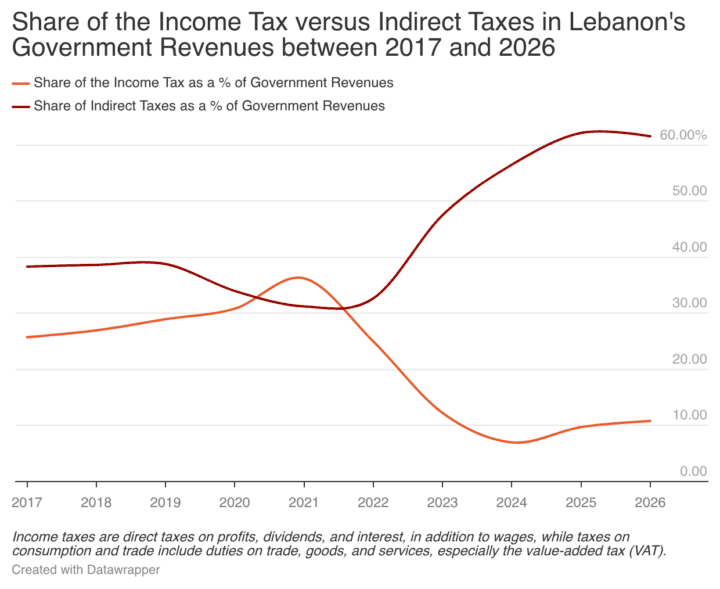
- Securing Sustainable and Equitable Sources of Funding: Social spending must be based on sustainable and equitable funding, such that the state benefits from all collectible revenues and distributes the tax burden according to each individual’s ability to pay. The current tax collection system suffers from inefficiency due to the weakness of state oversight institutions and a lack of tax justice, as it favors high-income earners and capital at the expense of lower-income groups due to the limited application of progressive taxes. Meanwhile, the poor bear a heavier burden through consumption taxes, leading them to refrain from contributing to the tax base because they feel they receive no corresponding services or representation.
Figure 13. Share of Income Taxes versus Share of Consumption Taxes in Lebanese Government Budgets between 2017 and 2026 (as a percentage of total revenue)
Blue: Income taxes (direct taxes on profits, dividends, and interest, as well as wages) – Red: Consumption and trade taxes (taxes on trade, goods, and services, particularly value-added tax)
Source: Author’s calculations – based on budgets or draft budgets from 2017 to 2026
The 2027 budget proposal does not reflect any significant change in this area either, as the government relies on value-added tax to secure more than one-third of total projected revenue. In contrast, combined tax revenues from income, profits, and capital do not exceed 12.9% of total revenue, while workers and employees bear approximately 42% of total income taxes.
- Managing Public Spending in Light of the Ongoing War: It is impossible to develop a reform program for social spending or to propose its restructuring in isolation from the security and political reality Lebanon is currently facing – namely, the ongoing Israeli aggression and the accompanying uncertainty regarding its course and repercussions. These circumstances necessitate the allocation of emergency appropriations that allow the state a margin of flexibility to respond to any new developments.
Given that the war constitutes the broader current context governing economic performance and social conditions, the redefinition of spending priorities in the health, education, and other sectors must be grounded in the nature of the current phase and adapted to the needs imposed by the war, rather than being based on stable assumptions that do not reflect the existing reality.
In this regard, there has been no fundamental change in the 2027 draft budget with respect to war-related expenditures; for example, allocations for supporting displaced persons do not exceed 1.14% of the total budget – less than $800 million – which reflects the fact that this issue continues to be treated as a marginal item in the executive branch’s calculations.
- Improving Budget Transparency: The budget should be more detailed and transparent to the public. This can be achieved by transitioning from a budget that focuses primarily on administrative items (which merely announces the allocation of a specific amount to a particular ministry or institution) to a budget based on programs and projects that clarifies each program’s objectives, costs, timeline, target groups, and expected outcomes, along with measurable performance indicators that allow for an assessment of the effectiveness of public spending.
This would enable Parliament and the public not only to assess the amount of resources the state allocates to social protection, reconstruction, or health, but also the objectives these allocations are supposed to achieve and the extent to which they succeed in producing the desired results. It also reinforces citizens’ sense that they are key stakeholders in monitoring the state’s performance, evaluating its welfare role, and assessing the extent to which it responds to their needs, aspirations, and political choices.
2. Recommendations for International Institutions and Nongovernmental Organizations
- Shifting from Response Funding to Supporting State-Building: International institutions and nongovernmental organizations should direct a larger portion of their aid toward strengthening the capacity of public institutions to deliver services, rather than establishing parallel programs that operate in isolation from the state.
- Supporting Locally Funded Social Protection: International institutions can help Lebanon gradually transition from social protection programs funded by foreign grants and loans to a sustainable national system financed by public revenues. This includes providing technical support for tax reform, broadening the tax base, and establishing a rights-based social protection system.
- Avoiding the Politicization of War-Related Humanitarian Aid: International institutions and nongovernmental organizations should ensure that aid related to the war and humanitarian needs is separated from the political calculations of donor countries, so that funding levels or distribution priorities are not subject to political maneuvering, the positions of the Lebanese government, or Lebanese political actors.
The fundamental principle underlying these recommendations is that the role of international institutions and nongovernmental organizations should not be limited to compensating for the state’s shortcomings, but should primarily focus on strengthening its institutional capacities and enabling it to perform its functions independently and sustainably, thereby gradually reducing its dependence on foreign aid and enabling it to shoulder its responsibilities toward its citizens on its own, as their primary representative.
The views represented in this paper are those of the author(s) and do not necessarily reflect the views of the Arab Reform Initiative, its staff, or its board.