On 30 August, the UN Support Mission in Libya (UNSMIL) presided over a ceremony full of pomp, circumstance, and pride. The small group they had convened, dubbed the 4+4 and comprising representatives of various Libyan institutions and influential non-state actors, was formalizing an agreement. This agreement settled legal and administrative disputes that had prevented attempts to organize new national elections since the failed national vote of 2021.
Officially, an agreement of this kind is a big step towards restarting the long-stalled political revolution Libyans began in 2011 when they rose against Muammar Qaddafi. It also follows over a year of significant engagement by the USA’s Senior Advisor for Africa, Massad Boulos, resulting in a deal on a unified budget, joint military exercises, and even a White House visit by some prominent Libyan figures. This significant investment of political capital by the world’s superpower is what initiated these formal steps towards change, while the UN’s relentless convenings have been preserving momentum.
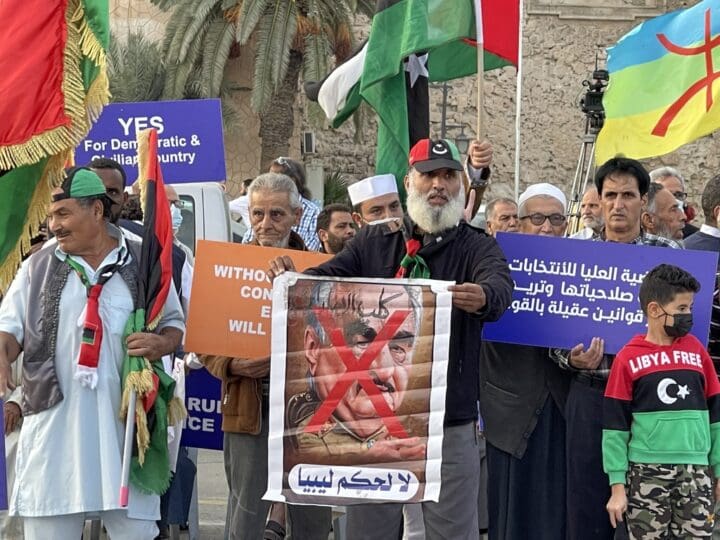
Political change is desperately needed in Libya, a country buckling under the extractivism of ruling kleptocracies disinterested in governance, and change is desperately desired by a Libyan population suffering this devolution. Yet, neither the UN nor American processes seem to be bringing all that much change. To wearily cynical Libyans surveying the detail of these processes, they seem geared towards legitimizing the current chaos and corruption, just under a new military dictatorship. A cycle Libyans have lived through before, they question whether they can survive again, and so are responding with popular protest and political sabotage while they can.
Between a Haftar and a Hard Place
Broader international interest in Libya tends to wax and wane between disinterested and messianic, leaving a few persistently intervening states like Türkiye, Russia, or the UAE able to warp multilateral processes and heavily influence broader thinking on this troubled North African state whenever others are roused to action. This larger international dynamic has conducted proceedings since the 2011 anti-Qaddafi uprising, routinely ending in civil war. Nowhere has this been more evident than with the narrative surrounding and political fortunes of the disgraced Qaddafi-era general, Khalifa Haftar.
In 2014, Haftar was provided significant military, financial, logistical, and diplomatic support for a putsch against the government of the day, subsequently rebranded as a war on terror after he failed to seize power. Haftar was gifted a continuous flow of arms by regional allies in violation of the UN arms embargo over Libya, specialist mercenaries from Russia, and special forces from France. When Libyans tried to hold him accountable for egregious war crimes, he was shielded. Instead of being punished, the French president elevated Haftar – essentially a violent non-state actor – to the political equal of Libya’s then president in a 2017 political process. That subsequent process, picked up by the UN, became all about centralizing Haftar’s demands for influence and legitimizing him in a position of official power. The idea to neutralize Haftar by giving him what he wanted was considered a worthwhile compromise by diplomats who thought they could work with him but could never quite square their notion of a good deal with the reality that Libyans rejected returning to military dictatorship. In 2019, Haftar’s patience with the UN process ran out, and he attacked Tripoli, with the quiet backing of all the UN Security Council’s permanent members, and a message from the US to “do it quickly.”
A year later, however, he had failed – despite billions in support. His army was shattered, leaving expensive equipment and mass graves behind. Again, calls for accountability fell on deaf ears, as he was instead incubated by his backers. Instead, UNSMIL promised to resolve the war’s aftermath with another process against a backdrop of nationwide protests by Libyans fearing a return to the pre-war status quo: of being stuck between corrupt and unaccountable UN-appointed institutions and Haftar’s dictatorship. The subsequent political process for a unity government, dogged by credible corruption complaints and followed by a deeply flawed electoral process, resulted in just that: a corrupt and unaccountable UN-appointed government in Tripoli led by Abdulhamid Dbeiba and Haftar’s military dictatorship in Benghazi.
The bloody, destructive battle for absolute power between these two families has defined Libya since. Beneath each family sits a vestigial parliament with more international than domestic influence, and below them are a constellation of political parties, interest groups, oligarchs, and militias who fluidly make and break alliances, forming the patronage networks that serve as either family’s powerbase. Libya’s oil revenues are the glue that holds together those patronage networks alongside the interests of those persistently intervening states.
Libya’s World of Problems
It was those same states who formed the precursor to this recent round of diplomacy, beginning by assisting the two families to co-opt Libya’s national oil company (NOC) and central bank.
The UAE orchestrated a deal convincing Haftar to lift Libya’s embargo in 2022. The oil sales re-liquidated the Libyan state, and Haftar, who as a non-state actor was largely cut out of state payment mechanisms, took control of key NOC subsidiaries in exchange. This also heightened Haftar’s utility for Russia, which could now leverage Libyan fuel imports controlled by those subsidiaries to buttress their coffers and strengthen their new alliance with Sahelian states through Libyan capital. A buoyed Haftar even had designs to seize an oil field on Libya’s western border with Algeria in 2024, an idea quashed at birth by Algiers, which allegedly threatened a military response. Haftar, who runs a closed military dictatorship and sits on top of most of the country’s oil installations with the help of foreign forces, was simply a more convenient vehicle for illegal oil trades than official institutions (despite the environment of lawlessness in Tripoli that the government operates within).
This dynamic led to a new working relationship between the two families, premised on their sharing the proceeds of Libyan oil exports via a private company — a format Türkiye then tried to solidify into the political foundations that would facilitate the development of Libyan offshore fields, which would not only bring in revenues but also help Ankara’s bid to become the eastern Mediterranean’s superpower. These states are seemingly aiming to extend the usefulness of working through Haftar to encompass the legitimizing powers of Libyan institutions and their legal authority, as well as using Libya to repair their own relationships.
These geopolitical synergies over Libya’s oil wealth and geographical utility serve as the multilateral platform that underpinned this round of diplomacy. As in 2019, it is leading to an international compromise over what can best facilitate these synergies, ignoring the mood on the ground.
Political Process of the Diplomats, by the Diplomats, for the Diplomats
Since Massad Boulos took over Libyan diplomacy in 2025, his work has nominally continued a core US Libya policy – Libyan unification. This effectively means unifying Libyan forces under a single command structure, and creating a single government, using a single budget. It’s a formula that chimes with other international machinations and is easily transplantable to Trumpian diplomacy: transactional deal-making with high financial upside and opportunity to use US weight to appease international partners while muscling in on their interests.
In this way, Libya is not dissimilar to Boulos’s other enterprises in Congo or Sudan, and unsurprisingly his Libya diplomacy is cracking in the same places. The fundamental error is one of superficiality. Considering Haftar and Dbeiba as leaders rather than proxies, Libya’s economic travails as solvable through increased oil production rather than a restoration of the rule of law, and the appeasement of the intervening states’ interests as conducive to stability is ultimately corrosive and irreconcilable in practice.
That superficial understanding, guided by international partners who are seemingly fixating on what they perceive as the path of least resistance to extracting Libya’s oil wealth, has led to a unification process that looks eerily familiar to its predecessors. Haftar, or his son Saddam in this case, is the most potentially troublesome actor given his control over oil installations, smuggling and migration routes, and facilitating Russian military expansion. Yet, he is being appeased as a “strong man” solution. The deal Boulos was encouraging a few months ago was for a unity government where Dbeiba is a powerless prime minister alongside a President Haftar effectively in control of the military, economic projects, and international relations. Following many aborted breakthroughs, Boulos tried to force progress in late June with a White House event, except Dbeiba refused to come, and the western Libyan defense representative had to rebuff Boulos’s request for Saddam to go to Tripoli, noting it could trigger a new civil war. This new unification process had ever louder echoes of 2019.
Enter UNSMIL. Led by former Ghanaian foreign minister Hannah Tetteh since January 2025, her mission was to restart Libya’s electoral process. She quickly learned that doing so meant displacing the inertia of Libya’s profiteering political elite and working through an international community more hostile than supportive of her goal. Her approach was to convene, first bringing in outsiders in an advisory committee, then, when that failed, formulating the 4+4 of insiders to agree on resolutions to the issues that were nominally preventing elections from being held. These include who runs the electoral commission, whether military officers (read Haftar) and dual nationals can run for president, and what the electoral laws will be.
Their conclusions were to allow Haftar to run without relinquishing any military influence, to allow oligarchs to run without relinquishing their escape route of alternative citizenship, to undermine the independence of the electoral commission, and to ensure that the future election will be for an all-powerful presidency, with the parliament relegated to simply writing a constitution. Given Libyans’ recent history with tyrants, the population is naturally suspicious of strong presidential systems: every election since 2011 has been for a parliament. These decisions have triggered internal protests at both Libyan parliaments, as MPs push to remove those responsible for the agreement despite heavy Turkish pressure on them to ratify the deal.
Moreover, the push for a “unity government” to prepare for these elections, under the Boulos framework, hangs as a familiar specter over Libya’s political process. The question remains: can a milieu of foreign states force a military authoritarian – who lacks control over most of Libya’s population and armed forces – into a position of power against the will of that populace?
Learning Lessons or Repeating Mistakes?
While the USA and the coterie of persistently intervening states behind them continue doubling down, others who are part of the international processes around Libya are quietly nervous yet unwilling to cross the US. Meanwhile, Libya’s status quo keeps breaking down. Protests erupted over the summer as quality of life reached new lows with 17-hour power cuts and long fuel queues (despite record oil production and high oil prices). Assassinations continue, as do covert drone attacks on key infrastructure, while the south slides back into instability despite Haftar’s claims to control the territory and its lucrative smuggling routes.
The wars that end each iteration of Libyan political processes are iteratively more destructive for the country and broader region. Europeans, as well as neighbors like Egypt and Algeria, simply cannot afford another crisis that empowers their enemies, fuels wars in neighboring states, and takes another oil producer offline. The latest pursuit of a strong-man solution to Libyan instability will almost inevitably end in destabilizing conflict, whether it’s through attempts to install Haftar as head of a nominally temporary unity government that everyone expects will become permanent or a zero-sum election for an all-powerful president in what is a volatile, well-armed polity where multiple actors backed by foreign powers compete for absolute power.
Libyans risked their lives against Qaddafi in 2011, and against Haftar in 2019, because they wanted to move from rule by person to rule by system. Building a governance system remains the only way to guarantee stability in Libya, and guarantee that all can profit from its reconstruction and energy development. Europeans, neighbors, and other African states should consider Libya as the precedent it's long been: the first Arab Spring revolution to turn violent, the first counter-revolution state to sink into war in 2014, the first theater for an expanded drone campaign in 2019… and how it could now set the tone for a new era of corsair foreign policy or be the first example of more constructive crisis management.
Such an approach would have two elements. Firstly, reducing the ease with which Libya’s wealth and land can be appropriated for the dubious foreign policy goals of regional powers. This is simpler logistically, yet usually fraught politically. It involves leveraging control over international financial mechanisms and the oversight of Libyan state spending, and using compliance with international standards to minimize the opportunities for fraud, laundering, or other forms of corruption and criminality. Alongside this, European governments can use their anti-fraud or corruption laws to pressure their companies to engage ethically. Patrols could focus on oil smuggling, and energy companies (who are the main operators in Libya) should be pressuring their governments in turn to pressure Libyan partners to ring-fence the independence of their oil companies. Finally, financial and travel sanctions can be leveraged to threaten Libyan parties that facilitate the smuggling of arms or people across borders to fuel other conflicts in Sudan and the Sahel.
The second element is stabilizing Libya’s electoral process. The key here is to ground the process in unpoliticized Libyan expertise, allowing local experts like university professors, civil society activists, or members of the judiciary to design strict mandates for the elected bodies, a political structure that ensures power is diffused through the system, candidate and campaigning regulations, and dispute resolution mechanisms. Libya might be lawless, but the Libyan state is remarkably legalistic. Libyans and the UN should be protected by other states to restore a systemic approach to selecting and managing political leadership. It won’t work perfectly, but it will dampen the excesses available to a future president and put obstacles on their path to authoritarianism.
Libya will not be stabilized through one silver-bullet policy, but through many small steps. By prioritizing the international order, whose loss is so often lamented in the age of Trump, and trying to enforce rules, whether these are arms embargoes, prosecuting transnational criminal activity, reducing oil-related fraud, or combating the use of state funds for corrupt activities, the freedom to destabilize and the attractiveness of Libya as a hub for such activity will slowly reduce, and Libyans will be freer to build the system they’ve been waiting 15 years for already.
The views represented in this paper are those of the author(s) and do not necessarily reflect the views of the Arab Reform Initiative, its staff, or its board.