When the United States and Israel launched military operations against Iran, they opened a new phase in the region’s instability, defined not only by direct confrontation but also by far-reaching and diffuse consequences. Escalatory exchanges between Iran, its allies, and their adversaries have extended across borders, disrupting trade routes, unsettling global energy markets, weakening public finances and heightening insecurity from the Gulf to the Levant.
In this widening crisis, Syria stands out for an unexpected reason. For the first time in over a decade, it has not been drawn into the centre of a regional war. So far, Damascus has avoided becoming a direct battlefield.
This relative insulation reflects deliberate policy choices. Syrian authorities have moved to distance the country from Iran and its axis of resistance, while strengthening border controls and adopting a cautious posture towards the countries involved in the war to avoid escalation. These steps have reduced the likelihood of Syria becoming another front in the war.
Yet distance does not equate to detachment. Syria is not outside the conflict. It is absorbing its consequences in less visible but equally consequential ways. Economic shocks, limited but persistent security spillover, and mounting humanitarian pressures are already reshaping the country’s fragile transition. At the same time, shifting regional dynamics have created new, if uncertain, opportunities, as Syria attempts to reposition itself as a transit corridor linking Asia, the Gulf, and Europe.
The result is a defining paradox. Syria is more insulated than in the past, yet more exposed in different ways. The central question is no longer whether it can avoid the war, but whether it can manage the pressures that accompany it.
Foreign Policy as Shield
Syria’s ability to avoid direct involvement marks a significant shift from its recent past. For much of the last decade, the country was one of the region’s main arenas of rivalry, with multiple external powers operating on its territory. Russia, Iran, Türkiye, the United States, and Israel were all directly involved in different ways, while Gulf states also exerted significant influence through supporting different actors. Today, by contrast, Damascus is attempting to reposition itself as a more neutral actor – an outcome shaped by the foreign policy approach of the post-Assad transitional authorities.
Since late 2024, Damascus has pursued a deliberate strategy to recalibrate its external relations. This has included restoring diplomatic ties with regional and international actors, adopting a “zero-problems” approach, and reducing its exposure to regional fault lines. Efforts to ease tensions with Israel, including exploratory discussions around security arrangements, reflect this broader repositioning.
At the same time, Syria has taken steps to curtail Iranian influence within its territory, including limiting the presence of Iran-aligned armed groups, tightening controls along the Lebanese and Iraqi borders, and cracking down on Iran-linked smuggling networks to choke off routes long used by Iran and its allies to move weapons, cash, and other supplies to Hezbollah. This has reduced the likelihood that Syria could be used as a platform for proxy escalation, a key factor in its current insulation.
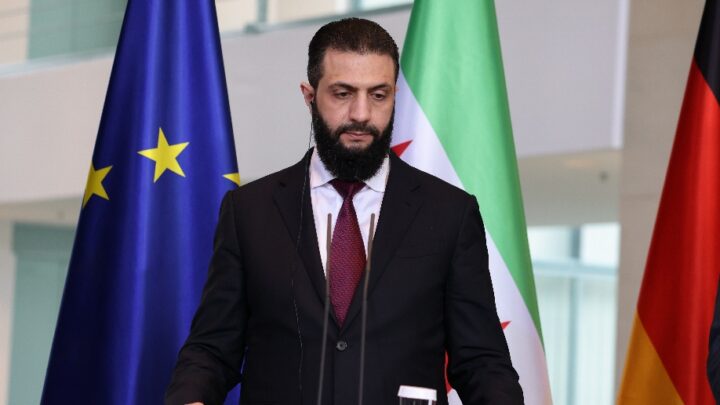
The importance of this shift has been emphasised by President Ahmed al-Sharaa, who, in remarks following Eid prayers on 20 March, framed Syria’s evolving position as the product of more effective management of regional and international relations. By avoiding alignment with any single axis and presenting itself as a pragmatic partner, the government has sought to shield the country from external shocks at a moment of heightened volatility.
This approach has continued since the outbreak of the war. Damascus has coordinated with neighbouring governments in Lebanon and Jordan while maintaining a policy of non-engagement, aiming to contain risks without being drawn into the conflict. To reinforce this stance, Syrian authorities have strengthened border security with Lebanon and Iraq by deploying additional forces and tightening controls to prevent spillover. Measures have also been introduced to curb smuggling via Syria and restrict the movement of weapons to Lebanon, reducing the risk of retaliatory strikes by Israel and preventing Syrian territory from being used as a staging ground for attacks on Israel.
This was evident in President Sharaa’s decision to reject a reported US push for Syria to take military action against Hezbollah inside Lebanon. According to Reuters, Damascus has been unwilling to open that front, citing the risks of sectarian escalation, retaliation from Iran, and further destabilisation at a time when Syria is still trying to consolidate control after years of war. Syrian officials have publicly denied plans for any offensive in Lebanon and have framed troop movements near the border as defensive.
So far, this strategy has yielded tangible results: Syria has avoided direct confrontation and remained largely outside the immediate scope of the war.
Containment Without Control
Despite its efforts to remain neutral, Syria has not been immune to security spillover. Since the start of the war, the country has experienced a series of cross-border attacks, primarily originating from Iraqi territory and targeting military sites in the northeast and south that US forces had previously used and only recently handed over to the Syrian army.
The first reported incident took place on 23 March, when rockets struck the Kharab al-Jir base currently held by the Syrian army near al-Yarubiyah. This was followed by multiple waves of drone attacks, most of them targeting installations around Hasakah, including the Qasrak base currently used by the Syrian army, as well as at least one attempted strike on al-Tanf in the south.
These attacks have been limited in scale and impact. Many drones were intercepted by Syrian air defences or by US aircraft, while others caused only material damage. No casualties have been reported. Yet their significance lies less in their immediate effects than in what they represent.
While no one claimed these attacks, they are widely attributed to Iran-aligned militias operating in Iraq. These strikes appear designed as calibrated signals, indicating a willingness to attack US forces in Syria if attacks against Iran continue, rather than attempts to inflict major damage. They serve as reminders that Syria remains within the wider geography of the conflict, even if it is not a primary battlefield.
Damascus has responded cautiously. Authorities have coordinated with Baghdad, increased alert levels, and reinforced border positions, while avoiding retaliatory actions that could escalate tensions with Iraq. President al-Sharaa has emphasised a measured approach, stressing that Syria is “calculating its steps” to prevent further escalation.
Yet the risk is cumulative. While individual incidents may be contained, repeated attacks increase the likelihood of miscalculation. A strike resulting in casualties or targeting more sensitive infrastructure could compel a stronger response against the groups involved in the attacks, potentially drawing Syria into a cycle of retaliation that it has so far avoided.
The conflict is also affecting Syria in more indirect ways. In southern regions such as Quneitra, debris from intercepted drones and missiles over Syrian skies has caused material damage, injured civilians, and disrupted daily life. Residents report explosions overhead, flashes at night, and fragments landing in homes and farmland.
Beyond the physical risks, the psychological impact has been significant. Schools have closed intermittently, and communities are living with the constant expectation that debris could fall at any moment. Even in the absence of direct targeting, these experiences underscore how the conflict continues to generate insecurity within Syria.
Economic Shockwaves
Syria’s ability to limit the military costs of the conflict has not been matched by an ability to shield itself from its economic consequences. The conflict has driven a sharp rise in global energy prices and disrupted key shipping routes, most notably through the Strait of Hormuz, sending shockwaves through already fragile economies. For Syria, which remains heavily dependent on imported fuel, these developments pose an immediate and systemic threat.
Even before the war, Syria’s energy balance was precarious. Domestic oil production has partially recovered with the return of fields in the northeast, but it remains insufficient to meet national demand. As a result, the country relies on imports for between one-third and one-half of its consumption. Although fuel prices in Syria have so far remained stable, this position is unlikely to be sustainable given limited state revenues and rising import costs.
With projections suggesting oil prices could increase from around $80 per barrel prior to the current war to between $120 and $180, potentially reaching $200 in more extreme scenarios, the pressure on Syria is likely to intensify. Unlike more diversified economies, Syria has limited capacity to absorb such shocks. It lacks the fiscal space to sustain subsidies, maintain strategic reserves, or access external financing to stabilise markets. While some regional governments have moved to cushion the impact through subsidies or policy adjustments, Syria faces the crisis with far fewer buffers.
Syrian economists estimate that domestic fuel prices could rise by 40% to more than 100%. Such increases would feed directly into broader inflation, driving up the cost of transport, food, and basic goods. Diesel anchors much of the domestic economy; as its price rises, the cost of nearly everything else follows. Food prices could increase by 40 to 100%, meat by up to 120%, and transport costs by as much as 150%.
The broader macroeconomic implications are equally severe. Higher import costs increase demand for foreign currency, placing further pressure on the Syrian pound and reinforcing a cycle of inflation and declining real incomes. As the currency weakens, with the Syrian Lira having lost nearly 10% of its value since the beginning of the war, purchasing power erodes, deepening economic hardship. For households already struggling to meet basic needs, these shifts are not abstract macroeconomic trends—they translate into reduced access to essential goods and services.
At the same time, the war threatens to undermine one of the central pillars of Syria’s recovery strategy: foreign investment. Gulf states, which have been among the most important potential investors, may adopt a more cautious approach amid heightened regional instability. Travel disruptions, including the temporary closure of Damascus International Airport and restrictions at border crossings with Lebanon, further complicate efforts to attract investors and sustain economic engagement.
Humanitarian Strain
Beyond security and economics, the war on Iran is also placing additional strain on Syria’s already fragile humanitarian landscape.
Escalation in neighbouring countries, particularly Lebanon, has triggered new population movements, including both returning Syrians and displaced individuals seeking refuge. Within a few weeks, over two hundred thousand people have reportedly crossed into Syria, adding pressure to a country already struggling to support its own displaced population. Of those, around 180,000 were Syrians and 28,000 were Lebanese.
Syria hosts millions of internally displaced persons and remains heavily dependent on international humanitarian assistance. Yet funding for aid operations has been declining, forcing difficult choices about how limited resources are allocated.
The arrival of new populations, whether Syrians returning from Lebanon or non-Syrians married to Syrians, complicates this picture further. It increases demand for housing, healthcare, and basic services at a time when infrastructure remains underdeveloped and overstretched.
This dynamic risks creating new sources of tension. Competition over scarce resources can exacerbate local grievances, particularly in areas where communities are already economically vulnerable. If the conflict persists, these pressures are likely to deepen. Additional displacement could further strain Syria’s capacity, turning humanitarian stress into a broader source of instability.
Opportunity Amid Crisis
Yet the crisis also presents potential opportunities. The disruption of maritime routes, particularly through the Strait of Hormuz and the Bab el-Mandab, has exposed the vulnerability of global trade and energy flows that depend on these chokepoints. As shipping costs rise and transit becomes less predictable, interest in overland alternatives has grown.
In this context, Syria has re-emerged as a potential land bridge linking the Gulf to Europe. Proposals include pipeline corridors transporting oil and gas from Iraq, and potentially other Gulf producers, to Mediterranean export terminals, alongside rail and road networks connecting Jordan, Syria, and Türkiye.
Early developments point in this direction. Iraq has recently reopened the al-Waleed border crossing with Syria, enabling crude oil to be transported by tanker across Syrian territory to the Mediterranean. An estimated 500 tankers are expected to pass daily via the al-Tanf crossing towards the Baniyas terminal for onward export. If sustained and expanded, these flows could generate transit revenues, create jobs in logistics and services, and help reactivate underused infrastructure.
Beyond energy and transport, the war has also accelerated interest in digital connectivity. With a large share of global data cables concentrated in the Red Sea, ongoing insecurity has revived proposals for land-based alternatives. Plans to link telecommunications infrastructure between Saudi Arabia and Syria via Jordan could offer faster and more secure data transmission, positioning Syria within emerging regional digital networks. Parallel initiatives, including potential electricity interconnection and expanded logistics corridors, further reinforce Syria’s prospective role as a multi-layered transit hub.
However, these opportunities remain highly contingent. Their realisation will depend not only on sustained regional demand for alternative routes, but also on Syria’s ability to address deep-rooted domestic constraints. Infrastructure remains degraded after years of conflict, while regulatory uncertainty, limited institutional capacity, and weak transparency continue to deter long-term investment. In addition, Syria’s political transition remains incomplete, with unresolved governance challenges and uneven security conditions across regions.
As a result, while the current crisis has created a strategic opening, it does not in itself guarantee transformation. Without sustained reform, improved governance, and a credible investment environment, Syria’s re-emergence as a regional corridor risks remaining partial and temporary – delivering short-term gains without securing a durable role in the evolving global economic order.
A Narrow Margin for Stability
Syria’s ability to remain outside direct military confrontation is a notable achievement. It reflects a deliberate effort to navigate a volatile regional environment without becoming entangled in it.
But this position is precarious. The country is not shielded from the forces reshaping the region – it is exposed to them in subtler, but no less consequential, ways. Economic shocks are deepening structural fragilities, security risks are accumulating at the edges, and humanitarian pressures are steadily intensifying. What looks like insulation is, in reality, a thinner buffer than it appears.
The real test lies ahead. As the conflict evolves, Syria will face mounting pressure to move beyond crisis management towards something more durable. The opportunities created by shifting trade routes and regional realignments are real, but they are also conditional. Without credible reforms, institutional capacity, and a degree of political stability that reassures investors and partners alike, they will remain largely unrealised.
For now, Syria sits in a narrow space between exposure and opportunity. Its ability to hold that position will depend not on avoiding the region’s turbulence, but on adapting to it. In a Middle East being reshaped by conflict, the question is no longer whether Syria can stay out of the war – but whether it can turn its relative distance into a foundation for recovery, rather than another pause before the next shock.
The views represented in this paper are those of the author(s) and do not necessarily reflect the views of the Arab Reform Initiative, its staff, or its board.