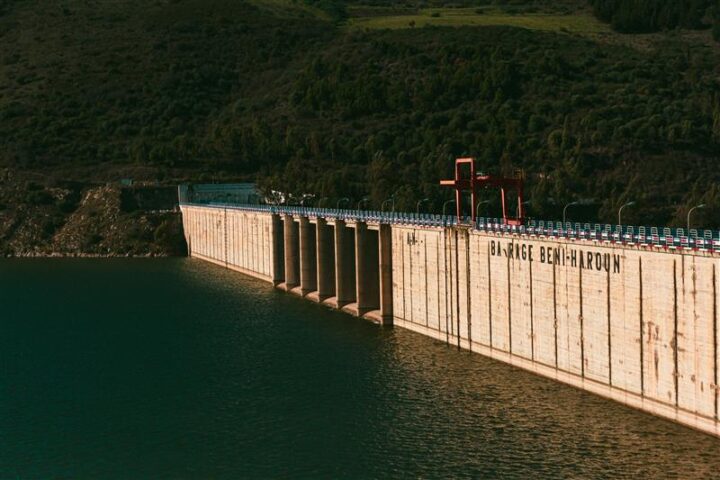
Water scarcity is a pivotal issue in Algeria, which ranks as the 30th most water-stressed country globally. It stems from a convergence of geographical, historical, and demographic factors.
Today, over 80% of the country, which spans 2.38 million km² excluding inland water bodies, consists of semi-arid and arid zones of the Sahara Desert. It is home to 47 million people, with 90% residing in the northern 10% of the territory. Although mostly arid, Algeria features diverse landscapes, including green coastal plains, chains of rocky mountains, and extensive wetland areas. It relies on various unevenly distributed freshwater resources, including surface water from rivers and dams and groundwater drawn from shallow and deep aquifers.
Understanding Algeria’s water landscape requires looking equally into its environmental history and its current policies, which are deeply influenced by its colonial past. During the French rule (1830-1962), water infrastructure, such as dams and irrigation networks, was developed primarily to serve settler populations and agricultural production at the expense of local communities. Though largely unknown and understudied, the ecological and sociopolitical harms of colonial times persist in various forms in the present day. Coupled with modern challenges – climate change, a booming population, and industrial, domestic and agricultural pollution – they continue to affect water availability and management.
Algeria’s water governance is grounded in its 2020 Constitution and 2005 Water Law. Water is recognized as a public good under Articles 14 and 20 of the constitution, while Article 63 affirms the right to access safe drinking water, charging the state with ensuring its availability and safeguarding it for future generations. )
Law No. 05-12 of 4 August 2005, “On the Use, Management, and Sustainable Development of Water Resources as a National Public Good”, guarantees the right to access safe drinking water and sanitation under Articles 2 and 3. ) It promotes integrated water resources management (IWRM) and regulates water use across sectors, emphasizing sustainability, pollution prevention, and stakeholder participation.
Algeria aligns with the Sustainable Development Goals (SDGs) of the UN 2030 Agenda, and pursues the realization of SDG 6: access to water and sanitation for all. The country committed to the UN 2030 Agenda from its adoption by the UN General Assembly in 2015, embedding SDGs in the constitution and key national regulations. ) It also boosted public spending in the sector, investing over US$45 billion in water infrastructure in the period from 2000 to 2025.
However, realizing water justice is a bigger challenge. It requires not only equitable access (distributive justice), but also accountability and citizens’ participation in policymaking (procedural justice) and repair processes (restorative justice). Fostering water justice in Algeria must therefore contend not only with physical scarcity and environmental stress, but also with historical and political structures that have shaped access and control over this essential resource. More than 60 years after becoming independent, the country still navigates the debris of 132 years of colonial occupation. It also faces, as other countries of the global south do, local policy gaps and the resurgence of foreign economic imperialism, which was once considered a relic of the past.
Scope and Methodology
This paper explores the historical, social, environmental, and economic challenges facing access to water in Algeria. It examines the colonial roots of environmental decline and water scarcity, and current policy frameworks and supply strategies. By addressing critical issues such as access, affordability, conservation, and pollution, the study highlights successes, failures, and opportunities to strengthen water governance and achieve water justice. It also considers social groups that benefit from or are negatively impacted by water scarcity or existing policies.
Drawing on research and critical analysis, this report proposes actionable strategies through which various actors, particularly civil society, can advance water justice. It is based on interviews and consultations with 30 experts. Field visits in Algiers and western and southern Algeria offered opportunities to engage with policymakers, professionals, and civil society representatives and gain valuable insight into their experiences, perspectives, and efforts to spark change. The research faced certain limitations, primarily the scarcity of recent, reliable, and publicly available data.
The views represented in this paper are those of the author(s) and do not necessarily reflect the views of the Arab Reform Initiative, its staff, or its board.