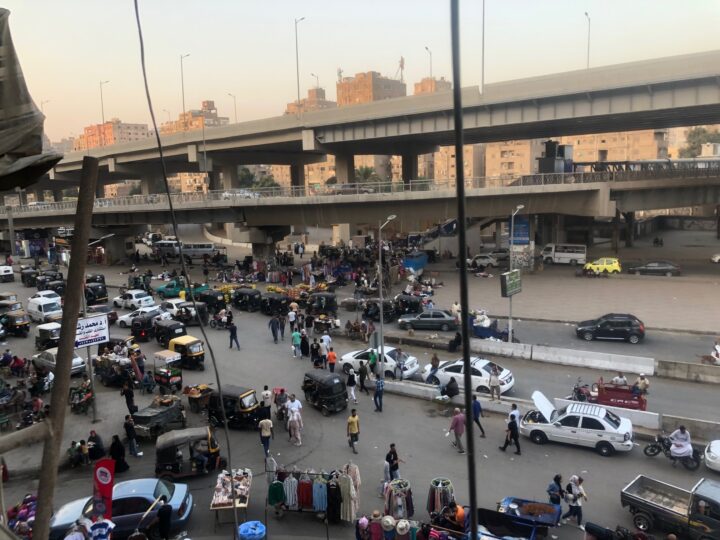
At the end of 2013, the residents of Ard El Lewa witnessed the start of the government’s work to close the Ard El Lewa crossing and replace it with two flyovers: One for pedestrians and the other for cars. The crossing was the sole level crossing of the railroad line separating Ard El Lewa from the Mohandiseen area and is seen as a key connection point that contributed to a long-standing and strong relationship between the two areas. This project came as part of the government's plan to close the level crossings as a solution to eliminate train collisions with pedestrians or cars and was implemented by the Engineering Authority of the Armed Forces with funding from the United Arab Emirates.
This sudden urban intervention led a group of residents to launch the “Don’t Isolate Us” (متعزلناش) Campaign to prevent the complete closure of the crossing but keep it open as a passage for pedestrians, while continuing to implement the flyover as an alternative for car traffic, emphasizing their support “for development” of the area.
The campaign relied mainly on collecting signatures, ultimately gathering 16,000 in total. The signature collection format was inspired by the system previously adopted by the Tamarod Campaign, which proved successful in mobilization and public influence. The campaign succeeded in drawing the attention of the executive authority to the demands of residents. Numerous meetings were subsequently held to consult and understand their grievances, leading to some gains, the most important of which was the creation of a space in which their grievances could be heard, addressed, negotiated, or even met with proposed solutions and alternatives. In doing so, the campaign secured the right to community participation in urbanization-related issues. It was also able to articulate a critical social issue that is common when looking at the structure of informal areas and their relationship with formal ones. It drew on the residents' previous experiences in dealing with geographical boundaries, such as railroads, or through their experience with other axes of movement, such as the Ring Road.
Why the “Don’t Isolate Us” Campaign
Ard El Lewa is located between the Imbaba neighborhood to the north, the Boulaq al-Dakrour neighborhood to the south, and Mohandiseen district to the west, and is administratively affiliated with al-Agouza district. It is considered an “unofficial/unplanned” area by the state.
The closure of the crossway was not unique to Ard El Lewa; it was preceded by similar closures along the railroad track because of repeated accidents. This included older, denser areas such as Boulaq al-Dakrour. Although these surface outlets were replaced with pedestrian bridges to minimize direct contact with trains, these bridges did not accommodate the traffic density of pedestrians nor did not meet the needs of special groups such as the elderly or wheelchair users.
To further illustrate this, in previous experiences such as Boulaq al-Dakrour, the width of the crossway, which ranged between 10 and 20 meters, was reduced to a bridge design that was only 3 meters wide, and was not fully dedicated to pedestrians, as half of its space was used by street vendors. This model was strongly present in the minds of Ard El Lewa residents and was explicitly formulated in the signature form. Residents experienced the effects of the repetition of the official model and were able to express broader issues, such as the marginalization of the area, the increase of “informal” or “illegal” activities, and the difficulty of access they pose for security services to control thuggery and for civil defense services such as firefighting.
The Importance of Studying the “Don’t Isolate Us” Campaign
Studying the “Don’t Isolate Us” campaign is particularly relevant in the current context, where public debate is dominated by the rapid expansion of highways and bridges at the city level. These projections affect neighborhoods and regions, creating urban and social impacts that receive little attention in official discourse. While these are often seen as means of connecting two points to reduce travel time and fuel consumption, they often overlook the interests and social needs of the surrounding communities.
This study adopted an observational approach to the activities and interactions of the “Do not Isolate Us” campaign on social media. The relationship with the campaign evolved from observations into integration and active participation in its activities by contributing to providing technical alternatives and urban and planning solutions to bridge the gap between the campaign’s perspectives and those of the implementing authorities. These contributions were made through the Cairo Urban Design and Studies Laboratory (CLUSTER), where the researcher was part of the team. This participation included attending meetings with some members of the campaign, as well as with stakeholders from the project's implementing agencies, such as the Engineering Authority, Giza Governorate, and the Ministry of Transport and Communications. The research also monitored parallel grassroots movements and assessed the impact of this communication on the project’s design and implementation. This paper also applied Eric Mouveau’s theoretical framework for analyzing social issues as public issues, which consists of five key elements: problem identification, narrative framing, justification, and solution formulation.
The Crossing as a Site of Mobilization and Movement Concentration
The crossing had long been the focus of many community initiatives aimed at improving its conditions until it was closed as a surface crossing in early 2015. Throughout its history, the crossing witnessed various events and conflicts, with the high volume of movement contributing to the spreading of diverse activities in its vicinity, most notably commercial activities and transportation services. These were concentrated in several waiting areas, both officially and unofficially. Repeated train accidents prompted previous initiatives, such as the one carried out by the Dostour Party in 2012, to fix the manual locking gate. Therefore, the campaign was not the first community-driven effort to come into contact with urban challenges or to propose solutions through grassroots initiatives.
The crossing played a pivotal role in the visual and collective memory of the area's residents, who were shocked by the news of its closure. This announcement prompted them to organize the “Don’t Isolate Us” campaign, in which they explicitly demanded that the crossing remain open to preserve the direct connection to the Mohandessin area and maintain a surface crossing for pedestrians. Residents proposed a compromise that retained the official plan to close the crossing to cars and build a flyover for vehicles while installing electronic gates that would close during train crossings to ensure pedestrian safety and prevent recurring accidents.
Here is what the campaign went through as a model for turning a social issue into a public one:
No to segregation and urban segregation as a demand for the everyday person
Although there were many comments and concerns about the drawbacks of the urban crossing before 2013, the campaign focused on the impact of spatial segregation on connectivity. The central issue was the difficulty of movement and transportation, compounded by the loss of the visual extension that had been a source of pride for the residents of Ard El Lewa. This visual connection contributed significantly to enhancing the urban value of the area, a value now at risk of being lost due to the construction of a wall that obscures the view behind it.
Despite the community's ongoing suffering from train accidents, residents recognized that the complete closure of the crossing posed a major issue, drawing from the experiences of neighboring areas that had undergone similar changes, resulting in further degradation and loss of services. The way the issue was framed – reflecting a deep understanding of the broader geographical context, where areas consider themselves part of the city – was no accident. It stemmed from the multiple experiences that residents of the area have gone through. These experiences were shaped by frequent changes in administrative affiliation between different departments and districts. Ard El Lewa was initially affiliated with Osim Center, a village in Giza Governorate, reflecting its old agricultural roots until the late 1960s. However, with the expansion of construction and housing, there was a need to change its administrative affiliation to a closer neighborhood. It first became part of the densely populated Boulaq al-Dakrour neighborhood, known for limited services. In 2009, it was reassigned to Agouza district, where it remains today.
From rejecting and demanding to offering alternatives for implementation
The areas adjacent to Ard El Lewa, where surface crossings were replaced by bridges and pedestrian overpasses, suffered from various forms of degradation. The rise of drugs and thuggery, along with increasing isolation due to the difficulty of police or ambulance access, became major issues. While some may argue that a car bridge alleviates physical barriers to security coverage, the real concern lies in the blending of formal and informal spaces. These spaces facilitate direct movement, often under the full view of the various social classes who use Sudan Street.
The “Don’t Isolate Us” campaign highlighted a new dimension of marginalization, as it focused on denouncing the difficulty of moving using stairs and bridges, especially for vulnerable groups such as the elderly and people with disabilities. The area’s high population density made it particularly challenging to use a single four-meter-wide staircase, creating significant obstacles for those trying to enter or exit the area.
The Campaign’s Methods of Deployment and Mobilization
- Collecting signatures: The campaign successfully gathered 16,000 signatures from residents, according to its leaders. These signatures were the starting point and the main strength of the campaign in expressing the public's opinion, especially considering the absence of local administration and parliamentarians after the dissolution of the People's Assembly in 2012.
- Activating channels of communication with the executive authorities: Negotiations with the executive authorities were facilitated through former parliamentarians, with former MP, Dr. Amr Shobaki, playing a pivotal role.
- Focusing on communication with officials: The campaign focused on communicating with officials in implementing agencies such as the Giza Governorate, the Engineering Authority of the Armed Forces, the Railway Authority, and the Ministry of Transportation. The goal was to accept the development to prevent train accidents while making adjustments that take into account ease of movement and preserve the visual continuity with the neighboring areas.
- Communicating with the media: The campaign clarified the issue through the media, where residents were allowed to provide input through various television programs. Youssef Al-Husseini responded to their invitation to attend a seminar in the area to discuss the issue.
- Providing planning and design alternatives: The campaign presented various planning alternatives and design proposals through specialists, and these proposals changed according to events on the ground, as the project was already underway.
Initially, the alternative planning proposal presented to address the campaign’s concerns aimed at convincing the executive authorities to maintain the crossing as a pedestrian-only surface walkway, equipped with electronic gates. However, this proposal was rejected due to concerns it would not completely prevent accidents. The gates could malfunction, and electronic solutions were seen as difficult to sustain due to repair and maintenance requirements. As the project continued, a new proposal emerged that integrated the formal plan with solutions to address community challenges. This proposal featured tiered and elevated plazas, making use of the large area of the crossing. Ramps were incorporated to facilitate the movement of special groups alongside, and plazas were designed to accommodate commercial activities that could later be rented out as an alternative to informal ones. These activities were distributed along the movement path, which was designed with sufficient width to accommodate the intensity of the foot traffic.
On the other hand, the designer commissioned by the Engineering Authority proposed a solution that partially addressed the residents' demand for better mobility for the elderly incorporating escalators and elevators. Although this solution was deemed unsustainable for similar reasons as the rejected electronic gates – due to the need for periodic maintenance – it was accepted and implemented. This addition was seen as a gain for mobility, as escalators were only available in the region on the subway. This was not the only gain from the campaign. The width of the pedestrian bridge was also doubled by adding an adjacent bridge in response to the heavy congestion observed during the trial opening. Traffic jams were especially severe when children were leaving their schools in Mohandessin and heading toward Ard El Lewa, an issue raised during discussions with the responsible authorities. Unfortunately, this concern was not incorporated into the official design.
This Is Not the First Time Residents Have Said “Don’t Isolate Us”
Urban segregation is not limited to the closure of way crossings. Between February and April 2011, after the 25 January Revolution, the same area witnessed another form of expression of the desire for more connectivity to the city, with the construction of the “Mouatamadia House” as ramps and parking for cars and pedestrians on the Ring Road, to connect Ard El Lewa and Mouatamadia to the Ring Road. In this period, the local community participated with its resources and capabilities, whether financial, or through donations of materials and equipment, labor, and expertise, taking advantage of the political absence of governmental control and political fluidity.
This state of community empowerment, which represents the highest degree of community participation, was completed by gaining official legitimacy, as the project was presented to the governor of Giza, who was invited to officially inaugurate it. This contributed to further development and improvement of the project through the governorate later on.
According to one of the leaders contributing to the initiative spearheaded by “Mouatamadia Baladna”, the main challenge facing Mouatamadia was the difficulty of accessing the city center. Residents had no choice but to pass through the already congested Ard El Lewa crossing, despite the presence of the Cairo Ring Road that surrounds the city, to which Mouatamadia has no access.
This highlighted transportation difficulties and challenges in connecting to the city were key issues for the community. The rapid mobilization of local resources and the successive construction of the ramps and access points that the decision was driven by the specific historical circumstance of creating these ramps. The idea was raised and discussed in the context of the local community, which contributed to building a base of supportive audiences who seized the moment from their own perspective.
How Does This Case Turn into a Public Demand?
The “Don’t Isolate Us” campaign failed to accomplish its objectives and the plan to completely close the way crossing was carried out. However, the campaign produced the first model that recognized the need of the elderly and people with special needs for accessible and comfortable crossing, by adding an escalator and elevators. While the solution was successful at the beginning of the project, the escalators broke and became inoperable for most of the year due to the lack of maintenance.
The implementation of this model prompted other neighboring areas, such as Boulaq al-Dakrour, to demand the addition of an escalator to their pedestrian staircase. This request, put forward by the local MP, was approved and eventually implemented.
In the current context, despite the challenges of organizing on-the-ground campaigns or initiatives, some demands continue to be voiced on social media platforms or through the personal motivation of some MPs and community leaders who, though rare, remain able to communicate and advocate. This has sparked occasional minor debates.
Examining models of new road axes, such as the Kamal Amer axis east of Ard El Lewa, which comes from Moneeb heading to Rawd al-Farag, reveals that car traffic density from Ard El Lewa on this axis is much lower, despite the presence of both an entrance and exit from the area. This can be attributed to the fact that residents' primary destinations are further away from the immediate local destination and their daily commuting needs.
So far, mass transit has not been introduced on the new axis, despite the likelihood that many of the area's users may require it in the future. This raises questions about the axis’s readiness to support mass transit, particularly regarding the availability of safe routes and well-planned connection points. Furthermore, concerns arise about the efficiency and capacity of the local mass transit network beneath the axis. It is crucial that this network can handle future demand while ensuring comfort and safety to prevent the emergence of informal parking and unauthorized stops on the surface of the new axis.
Therefore, these axes need to strengthen their integration with local contexts and address the socio-economic needs of the communities they traverse. This alignment should correspond with residents' daily lives, fostering a sense of inclusion and connection to the broader urban fabric.
Conclusion: Lessons learned
Although the local press has widely celebrated the use of public spaces beneath the road axes for commercial activities – highlighting their role in providing job opportunities for many young people – less attention has been given to their social impact, particularly in terms of marginalizing and isolating communities. Despite some objections to the high rental costs, which range from EGP 10,000–15,000 per month on average and reach up to EGP 30,000 in premium locations – an indication of strong demand – public discourse has largely overlooked their broader social consequences.
The social impact becomes evident when examining the experiences of the “Don’t Isolate Us” campaign and the developments around the ramps and houses in Mouatamadia, both situated within the same geographical context of the Ard El Lewa district in Giza Governorate. However, these two cases unfolded under different political contexts that shaped the relationship between the state and society. Each case reflected varying degrees of public engagement, ranging from opportunities for dialogue, communication, and negotiation to phases of exclusion, marginalization, and unilateral decision-making – often disconnected from the needs, challenges, and priorities of local communities.
The value of focusing on these urban and spatial cases lies in the attempt to understand their complex social dimensions, particularly by re-examining the relationship between residents of informal, “unplanned” communities and the city as a whole. This includes exploring how they perceive their place within the city’s diverse urban fabrics and how they strengthen their connection to it. Additionally, it requires analyzing how spaces for negotiation and opportunities for participation, which existed in previous periods, can be leveraged to foster a sense of empowerment among residents – enabling them to influence decisions and advocate for an urban environment that acknowledges and responds to their often-silenced needs.
More broadly, when considering the reality of Cairo, a critical gap emerges: the city lacks urban design interventions that address challenges at the scale of the street or urban square as fundamental local planning units. Instead, national projects and large-scale strategic visions dominate the urban agenda. However, such approaches risk marginalizing residents, who should be recognized as key stakeholders in the decision-making process—capable not only of proposing alternatives but also of participating as active partners in shaping their urban environment.
Although the repercussions of this situation continued for several years – ultimately contributing to the emergence of the “Don’t Isolate Us” campaign – the community’s ability to influence decisions gradually diminished. Despite achieving outcomes that fell short of its ambitions, the campaign succeeded in opening spaces for proposing visions and alternatives. Looking forward, it is crucial to anticipate the unspoken local priorities that reflect the social dimensions of communities – priorities that have not yet reached the stage of articulation or collective formation. This requires creating avenues for community organization and participation, where visions can be shaped, discussed, and translated into actionable proposals.
The views represented in this paper are those of the author(s) and do not necessarily reflect the views of the Arab Reform Initiative, its staff, or its board.