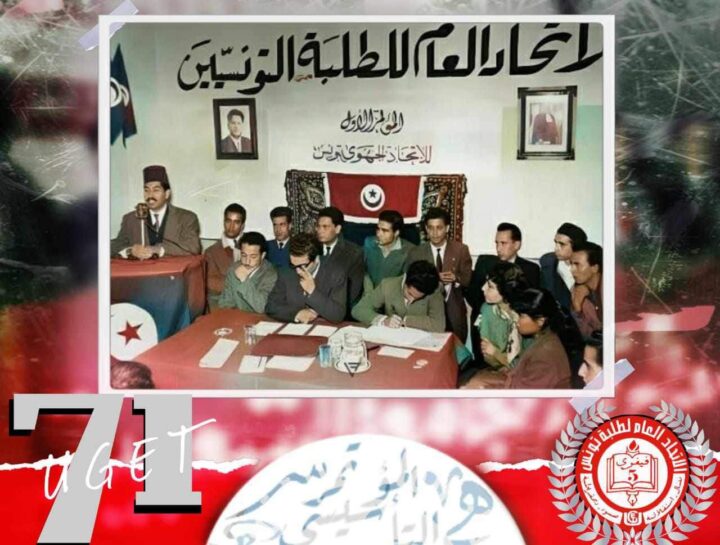
In Tunisia, student unionism has always served as a gateway to the political world in historical opposition to various regimes. Following the 2011 Revolution, this sphere has undergone significant changes, both in its internal dynamics and in its relationship with politics. Moutaa Amine El Waer dedicated his university thesis to analyzing these political shifts within student unions. Drawing on his experience at one of these unions during his time as a student where he analyzed the relationship of the two Tunisian student unions – the General Union of Tunisian Students (UGET), historically linked to the left, and the Tunisian General Union of Students (UGTE), historically Islamist – to politics, both as a cradle of political socialization and as counterparts to certain political parties. Against a backdrop of resurgent authoritarianism, the role of student unions – historically central to the opposition – is no longer as clear-cut as it once was.
Moutaa Amine El Waer is an assistant professor in the Department of Sociology at the University of Toronto. He holds a PhD in sociology from the University of Montreal.
Can you tell me how important student unions have been in the Tunisian political landscape?
When we talk about the importance of student unions, the first thing to note is that this importance is undisputed among political actors. For them, it’s absolutely obvious. For me, too, it was obvious at first: When I started, I also worked on my own trajectory as a former member of one of the two student unions, UGET, before 2010. What struck me at first was the dysfunctional nature of that space. But little by little, I began to question this widely held belief that university is the essential starting point for any entry into revolutionary or radical politics.
Here, I can illustrate my point with an anecdote. A few years ago – I think it was four or five years ago – I presented a paper at a conference organized by an association of former activists. It focused on the student mobilization of February 1972. In the audience were activists from that era, activists from later generations – including people who had just graduated from college – and finally, current activists on campus. It was a very diverse audience and an interesting one for presenting these reflections to. I remember my hesitance in discussing my questions regarding this assumption – regarding universities as a critical entry point – but I told myself there couldn’t be a better time to present this reflection. In my presentation, I critiqued what February 1972 represents for today’s generation, trying to bring back the idea that we need to question this assumption that activism must begin at university. I try to explain that this assumption is problematic on several levels. However, I received hostile reactions. But it’s a hostility for which I have a lot of empathy because it’s the hostility of someone who feels attacked from all sides, and who thinks to themselves, “Even this guy who’s with us, who’s the son of UGET, of this organization, is starting to ask strange questions.” One of the comments I received was that even when there’s no problem with UGET, people try to invent one, to say it doesn’t work – yet that’s actually the one thing at UGET that works very well. Activists get involved in politics through university, and that’s a good thing. It’s not even conceivable that things could happen any other way.
Of course, to an audience unfamiliar with Tunisian universities, this might seem like a strange situation, but what you need to know is that the student movement has essentially helped give rise to virtually all political opposition groups. Some groups in a very direct way: they were founded at the university, operated there for a long time, and then sought to expand their activities beyond campus. But this is true even for movements that did not originate at the university, such as the Islamists. Ennahda, for example, which was known as the Islamic Tendency Movement (MTI) at the time, was shaped by the activism of its first generation of students. They have much in common with the left, with pan-Arabists, and with liberals.
What are the consequences of the university’s central role in recruiting Tunisian political parties, particularly those on the left?
First, it creates a certain way of socializing, a certain way of connecting with others, but it also creates or reinforces – it’s difficult to establish a causal link – a certain relationship with society. This relationship will have consequences once students leave university. It also has a significant impact, I think, on how left-wing parties present themselves as political actors. So, there are at least these three dimensions I can mention.
Socialization: What we need to understand is that generally, student unionists, when they enter university, are not isolated; they are not people with limited social relationships (friends, family, etc.). But they leave university isolated. So, I asked myself, is it the university? Is it the student movement? And here I’m talking about left-wing forces and, to a lesser extent, pan-Arabists.
What happens is that during their first or second year, students get involved in the student movement; they join the group, and a gradual separation takes place. Strangely enough, the first separation occurs from their fellow students. When they become student activists, they have many friends on campus. Generally, they have a large network at the university, which is what attracts UGET “recruiters”, by the way. They make friends in their lecture halls, in their tutorials, and in the student lounges. They have friendships that sometimes go back to high school, to their hometown, or to wherever they come from.
At the same time, they join UGET. What actually happens is that little by little, they start spending more and more time with UGET activists – both from their own generation and older members. They gradually integrate into these circles and spend less time with the rest of their social circles. And the further these young unionists progress in their studies – taking into account grade repetitions that “disconnect” them from their graduating classes – the more they will come to associate exclusively with UGET activists. In practical terms, this manifests as a very high number of hours spent together during the day, which can reach 10 or 15 hours. This is something I experienced in the 2000s, and I wanted to verify whether it was still the case during my ethnographic research. The days spent together were long; they would meet for the first time at nine or 10am and stay together until 10pm.
What is happening is that interactions within this particular network are becoming more frequent, while other relationships are significantly weakened. This creates the sense of isolation that they experience without necessarily realizing it or being alarmed by it. On the contrary, they feel they are opening up to a world of social relationships that is very attractive, dense, and numerous through the union. In particular, it gives them access to the alumni network. These are people who have left university and are active in civil society, the Tunisian General Labor Union (UGTT), or opposition parties. And there is something fascinating for a first- or second-year activist about being in contact with or associating with – even if only rarely – a well-known activist, lawyers, doctors, and so on.
Relationship with Society: This gives rise to a certain relationship with society that takes root in the relationships they develop with their fellow students. And here, I’m borrowing Pierre Bourdieu’s expression that one way to live with our constraints is to “make a virtue of necessity”. These isolated individuals will try to come up with a reasonable and acceptable explanation for their isolation. And to explain their isolation, they will draw on the strong social legacy of the relationship between the elite and the university. Within this legacy, people who have received a university education have historically maintained a very condescending relationship with the rest of society. The mission of the university, in general, has been understood as a civilizing mission toward the rest of society. This relationship is reproduced not only in relation to society but also within the university itself. Politicized students are conscious students (wa’in), while the rest of the students are labeled as ignorant – people who are unaware of the grave dangers facing the country. Politicized people are thus conscious individuals, endowed with the ability to guide and lead others.
This narrative will be extended to society at large, and it is effective because it is not new; it is already the state ideology. This condescending academic attitude toward the rest of society dates back to the 1960s, or even earlier, because the elite – the victorious elite of independence – was largely composed of university graduates who had emerged from what was called “modern education” at the time, as opposed to religious education. This elite imbued the new state and its ideology with its own ideology, with its own legitimized discourse. And within this worldview, the university became the place where knowledge about society is produced, where solutions for society are also produced, and the place where a certain contempt is cultivated. The activists from the 1990s and 2000s with whom I worked during my master’s program, and those from the post-2011 era during my doctoral studies, continued to fuel this discourse because it gave meaning to their isolated realities. The two phenomena feed into each other. This position serves to legitimize a state of affairs.
What is interesting when we turn to political parties is that when left-wing parties analyze the difficulties their side of the political spectrum faces in expanding within society, or the left’s difficulty in having a discourse that resonates with the public, they adopt this very discourse. Their analysis always leads to the idea that their discourse is too complicated for the public, who are supposedly unable to understand it, and to whom a simplified discourse must therefore be offered. This is not a discourse unique to the left; it is found just as much among liberals, Islamists, and pan-Arabists. This narrative explains why “the people” do not follow us. They do not follow us because they do not understand, because we struggle to adapt our sophisticated discourse. As a result, the content is not questioned, and the issue is reduced to a communication problem.
Ultimately, it creates a fatalistic ethos in which the left is seen as the bearer of enlightened knowledge that is supposed to be ahead of society, but one that society cannot see or understand. In effect, we turn isolation into destiny. It’s somewhat prophetic, actually; it boils down to the idea that “no one is a prophet in their own land”. The effect of this isolation at the national political level is that left-wing parties internalize this marginality and believe that left-wing ideas can never prevail. They are convinced that left-wing ideas can never gain broad appeal and that what we contribute to society is, in fact, necessarily marginal.
My intuition is that this fatalistic ethos explains a pattern that regularly repeats itself on the left: that, failing to impose its political agenda, it allies itself with or relies on a powerful actor to carry it out. Of course, no one theorizes it in these terms, and I’m exaggerating the point myself, but at its core, that’s what it comes down to. The left is always on the lookout for a political force capable of implementing its program, which it will then support – albeit critically (we see parallels with support for Kais Saied) – or else it will oppose a force that, while it fully understands the left’s position, must adopt this program. So, we will continue to challenge this force because it does not adopt this program. So, we see ourselves only as auxiliaries to other forces.
In your work, you draw a distinction between current profiles that you describe as “activist profiles” within student unions, which differ from those you yourself encountered as a unionist at UGET. How do you characterize this new profile, and what is its relationship to politics?
In fact, the biggest distinction between the two groups is how they actually perceive themselves. It’s mainly a matter of perception, because when reflecting on this distinction between “militants” and “activists” – particularly in the Francophone context – one is tempted to think of it as a normative distinction, meaning that militants are those who engage in activism in a selfless manner, while activists are people who are there to build a resume that will help them land a job later on. This would make it a form of individualistic activism.
I don’t make that distinction. What I’m trying to show is that there’s been a shift in the ethos. Previous generations were raised in a context where they had to appear selfless. It was also a partially self-interested form of activism; activism has been and still is partially self-interested. What is changing today with the new generation is that they are more open to legitimizing this self-interested aspect. We are no longer required to hide or reject self-interest.
And this coincides with a significant shift that has taken place in society. The two groups were socialized in different contexts. The old militant socialization, while it still persists, is less inspiring and is becoming a minority trend, based on my observations. The other form of socialization emerged gradually – I’d say around the mid-2010s – and is now becoming increasingly visible and dominant among those who are active on campus today.
There are sociological differences that affect who we recruit. In the old way of recruiting, we mainly recruited people who were expected, as I said, to become totally dependent on student activism; they found themselves in a political group-student activism dynamic. What is happening today with activists, for example, is that the student activism sphere remains a very important space because people spend a lot of time at university, but it is no longer the sole point of reference; it is one space among many. There are people today who join student activism while already being very active in civil society organizations (CSOs); at least, that was the case until the early 2020s, when I conducted my research. At this point, I don’t know what the future holds for this type of activism following the severe crackdown on CSOs, especially since 2023-2024. So, when I finished my fieldwork, I hadn’t yet noticed any difference, but I think it was still too early to observe any consequences. In any case, up until 2023, the socialization of student unionists was no longer exclusively university-based.
And how would you describe the relationship of these unionists/activists – well, of that generation, in fact – to politics or political parties?
This is an interesting dynamic because there is a growing discourse that criticizes political parties and emphasizes the value of being “independent”. This discourse is gaining significant traction and is very prominent, but it is not unique to the university. Discrediting political parties is widespread. In student unions, this will push individuals to focus on themselves as individuals rather than on their partisan or ideological affiliations. This creates visible and legitimate competition for positions. In the past, competition existed just as much, but the movement’s interests were prioritized by explaining that a particular person was the best choice for the movement. It might have been because the person was the best qualified or the one who could ensure the group’s unity – it didn’t matter. Either way, the explanations were always tied to the movement.
Today, there is a greater emphasis on the activist. It is as activists with strong resumes that candidates stand for election to scientific councils. So, as an activist, I have a strong resume, I have a solid career, and given my qualifications, it’s legitimate for me to run for a position as a student representative on academic councils. It’s a more meritocratic narrative. This reinforces a trend toward political self-entrepreneurship, where people invest in themselves to become activists with an impressive track record. In practical terms, the union member will try to run in student elections, among other things, to be able to “put that on their resume”. Many students have told me that they also seek out these kinds of positions because this experience would be valuable after they graduate.
But at the same time, these two trends do not necessarily represent a complete break with political parties. What I’ve observed is that these activists continue to be active in political groups. Some groups operate at the national level, while others are exclusively university-based political groups that have ties to political parties outside the university and are relatively autonomous. In fact, these groups still recruit the most student activists. These are people who have a political stance, a political identity, and even a clearly stated left-wing ideology; some even identify as Leninists, Marxist-Leninists, and so on. To be honest, these identifications are less prominent than before, but they’re still there.
At the level of the organization itself, these ideological identifications carry less weight in determining how we organize, how we take a stand, and which practices are acceptable and which are not. The ideological framework is present, but it plays a lesser role in shaping those decisions. Before, I felt like it was much more significant in determining those choices. Now, since we have multiple points of reference – particularly in the individual identity we want to cultivate – the political and ideological framework takes a back seat. But that doesn’t stop political parties, even left-wing ones, from continuing to recruit within these units. Union recruitment figures remain similar when I compare 2022 and 2023 to the years preceding the revolution. The real contrast is with 2011, 2012, 2013, and 2014, because during those years, people joined unions en masse. There was a post-revolutionary legitimacy to student activism, in addition to the lower cost of that activism. So, a huge number of people joined the student movement at that time. But if we exclude that exceptional period and we look at the rest of the period before and after 2010, I don’t get the impression that student unions and the political groups active within them are actually recruiting fewer members.
Do you think that today, student unions are still breeding grounds for political parties? Is it an interesting place to recruit?
I think they continue to be significant. We haven’t talked much about Ennahda, but that’s where we see some interesting developments. Starting in 2013-2014, the party began a process of relative separation from CSOs – I emphasize “relative” because the process was more complex at the university level, given the strong historical ties between Ennahda and the UGTE. Nevertheless, starting in 2014, we see a relative disconnect between Ennahda and the UGTE, while within UGTE, a dynamic of distancing from Ennahda takes hold. This is not a dynamic that necessarily originates from the leadership, but rather an organic one emerging from the activist base, driven by various political circumstances and social transformations at the national level. And UGTE began recruiting a somewhat different group of people, placing a strong emphasis on the identity of a service union, a union dedicated to academic excellence, and all that rhetoric. And this rhetoric, in fact, ended up attracting a very different type of student to UGTE than the one it had recruited, for example, in 2011 and 2012. This type of profile is gaining more and more ground, and in the 2020s, it has become very influential – I believe it has even become the majority within the organization. However, members from Ennahda remain the best organized, so they manage to maintain relative dominance overall. This dominance has been weakened significantly, especially over the last two congresses.
However, a new dynamic emerged at the start of 2021. The regime’s crackdown on Ennahda under Kais Saied has prompted voices within the party to question its decision to distance itself from the UGTE. It therefore appears there is a trend toward reengaging with the UGTE and reaffirming the organic relationship between the UGTE and Ennahda. Party activists within the union want to reclaim UGTE’s identity as a force of resistance, born out of activism against Bourguiba and later against Ben Ali, with founders who paid a very high price to ensure the union’s historical survival. They want UGTE to align itself much more closely with the opposition.
During my interviews in 2022, I could see this trend taking shape, but it wasn’t yet very clear. However, the 2023 and 2025 conventions that I observed made this much clearer. Given Ennahda’s current disastrous state of organization, I don’t know if they will be able, for example, to realign the “Ennahda Youth at the University” organization with UGTE. Because prior to that, the two organizations were in competition, a competition that the party had welcomed. It remains to be seen whether the party will push its own youth wing, which must be struggling, to focus on UGTE.
Generally speaking, the new political landscape is forcing parties facing recruitment space closures to re-engage with the university environment. And I think the university will continue to play that role in the future. That doesn’t mean mobilization will necessarily be strong at the university. In my view, it has been relatively weakened, particularly due to the dynamics that emerged after 2010, which I described, that transformed the identity of student activism and placed it in a less favorable position to engage in direct conflict with authorities. But resources are still there. Student activism remains a form of activism that is relatively well-resourced compared to others.
What was the impact of July 25 at the university?
It seems to me that at the university level, the impact is less visible than elsewhere. We do see an impact, but it is much less noticeable than in other sectors. I think it would be interesting to take a closer look at sectors directly linked to the government, such as universities, public health, and primary and secondary education, among others. We often focus on the civil society sector, but there are other actors who have not received much attention and who are still present and continue to play a mediating role despite UGTT’s dire situation – even though UGTT continues to play a mediating role. I have the impression that today, with UGTT’s diminished political role, the role of mediation could be revived, even if the acute internal conflicts currently raging within the union federation do not facilitate this.
In reality, unions at the local level, especially in the most organized sectors, continue to act and remain influential locally, but it is at the national political level that it is completely dysfunctional. For example, an interesting dynamic is the one sparked by the young doctors’ organization, which does not suffer from all UGTT's weaknesses. It reacts in a fairly dynamic and lively manner, and I get the impression that it manages to garner some support from the population. It is an organization that continues to campaign and oppose the government after July 25, despite the repressive climate we are experiencing.
At the university level as well, I haven’t observed any notable change. The two student unions protest their exclusion from the decision-making process and the lack of communication from authorities. They are protesting repressive policies. In reality, there has been no break. At the local level, in fact, they continue to hold discussions and engage in ongoing negotiations with the administration. It is at the national level that they are less influential. But even before 2021, in fact, there was significant resistance from the ministry to include them. It has included them in certain bodies; it continues to do so, albeit to a lesser extent now, but continues, nonetheless. The two organizations are not completely excluded at the national level. So, what I see, in fact, is a reduction in the inclusion of two organizations at the national level, but not a break.
The views represented in this paper are those of the author(s) and do not necessarily reflect the views of the Arab Reform Initiative, its staff, or its board.