Executive Summary
- Since the fall of the Assad regime in December 2024, Syria’s transitional authorities have placed investment at the center of their reconstruction agenda. Rebuilding has been framed less as a public recovery process shaped by social needs, open debate, and transparent priority-setting, and more as a centrally managed effort to mobilize capital, package projects, and signal progress to regional and international investors.
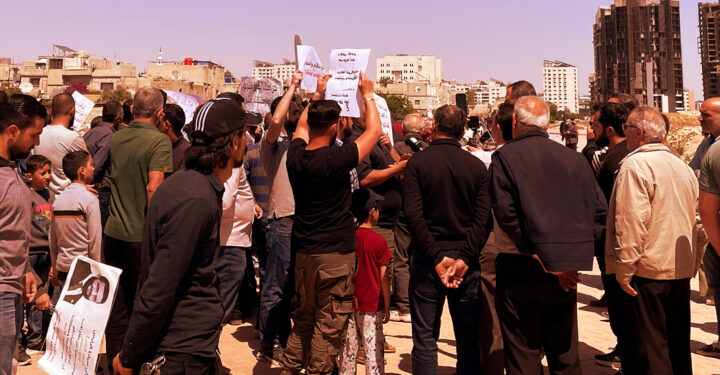
- This approach has produced a largely top-down model. Key decisions are often made within narrow official and business circles before affected communities are meaningfully informed and engaged. The assumption appears to be that political authority, administrative approval, and visible delivery will be enough to secure public acceptance. Yet in a country where property rights, displacement, and urban redevelopment remain deeply contested, this is a risky calculation. When projects are announced before residents are consulted, and grievances are addressed only after opposition emerges, initiatives presented as recovery can quickly become flashpoints.
- The cases examined in this report show how these tensions play out across different settings. In Homs, Boulevard al-Nasr illustrates how privately funded redevelopment can revive older grievances when it intersects with unresolved histories of expropriation and displacement. In Aleppo, the reconstruction of the Haydariyyah neighborhood highlights the risks of restarting stalled Assad-era redevelopment plans without transparency, participation, or credible safeguards. In Damascus, Marota City and Basilia City show how wartime redevelopment frameworks are being repackaged as investment opportunities, risking the normalization of past injustices rather than their resolution.
- Other cases point to related but distinct concerns. In Jobar and Qaboun, controversy centered on a financing model that appeared to require residents to surrender part of their property rights in exchange for reconstruction, making rebuilding feel less like a return than renewed dispossession. Al-Jahiz Park, also in Damascus, shows that investment-led rehabilitation can also trigger pushbacks when it appears to alter access to, or control over, shared public space.
- These cases do not suggest that opposition to reconstruction is inevitable, uniform, or widespread. Rather, they identify the conditions most likely to generate friction: limited early engagement, unclear rules, weak safeguards, unresolved rights claims, and the perception that communities are being asked to accept decisions made without their consultation.
- The report argues that community pushback should not be dismissed as a series of isolated local disputes. It is a warning sign of a deeper weakness in Syria’s emerging reconstruction model: the failure to meaningfully involve those most affected by redevelopment. A process detached from local needs and priorities risks reviving old grievances, creating new forms of exclusion, and legitimizing outcomes that many communities experience as imposed rather than shared.
- As Syria’s transitional authorities reshape the country’s urban and economic landscape, today’s decisions will determine who is able to return, who gains from reconstruction, whose rights are acknowledged, and whose voices are excluded. A reconstruction process that sidelines affected communities cannot lay the foundations for peace, stability, or prosperity.
Introduction
Since the fall of the Assad regime, reconstruction has quickly and understandably become a central priority for Syria’s transitional authorities. They present rebuilding as both an economic necessity and a marker of national recovery. Investment conferences have been organized, redevelopment plans unveiled, and major projects showcased as signs that the country is starting to recover from years of war.
Yet rebuilding in Syria does not take place in a neutral setting. The country is emerging from conflict with weakened institutions, limited public resources, extensive physical damage, and widespread displacement. At the same time, communities engage with reconstruction against a backdrop of unresolved grievances, disputed property claims, legal uncertainty, and longer histories of coercive urban change and dispossession. Notably, community fears are reinforced by the recent memory of Assad-era reconstruction efforts, which remain very present and shape concerns that new rebuilding plans could reproduce earlier patterns of exclusion and dispossession.
In such a context, reconstruction is not only about restoring physical infrastructure. It is also about rebuilding the relationship between people and the state. Roads, housing, utilities, and public facilities matter, but they are not enough on their own to restore confidence in public authority or create a sense of shared recovery.
Yet, the prevailing official approach has been largely top-down and investment-focused, with decisions made by central authorities without much input from affected communities. Reconstruction is treated mainly as a technical and financial exercise, focused on speed, visibility, and attracting capital. This often comes at the expense of public participation and the rights of residents and local communities. As a result, authorities have pushed projects forward before deeper grievances have been adequately addressed.
This dynamic has created a growing disconnect between official narratives and lived experience. At the policy level, reconstruction is framed as a pathway to economic revival and modernization. On the ground, however, it is often associated with uncertainty, risk, and unresolved claims, particularly around ownership, displacement, compensation, and access to public space.
Reconstruction projects appear to be designed and agreed upon within limited official and investor circles before being presented to affected communities. With little opportunity to influence decisions early on, residents are left facing unclear outcomes regarding compensation, property rights, and the ability to return to, or remain in, their areas. As a result, rebuilding is not always perceived as a process of recovery, but frequently as a source of concern and dispute.
This helps explain why reconstruction projects in different parts of the country have triggered similar reactions of protest and contestation by local communities. While the details vary, responses often reflect common concerns: weak consultation, limited transparency, insecurity over rights, fears of privatization, and a sense that investment priorities outweigh local needs. When these wider social and political dimensions are sidelined in favor of visible construction and investment mobilization, rebuilding risks remaining incomplete, even where it appears successful on paper.
This report explores how reconstruction is evolving during Syria’s transition. It begins by examining the investment-led model adopted by the authorities and the logic behind it. It then looks at a set of cases from Homs, Damascus, and Aleppo to show how this approach plays out in practice, and how it is received, challenged, and reshaped by local actors. Finally, it points to the need for a shift towards a more inclusive framework that places greater emphasis on rights, accountability, transparency, and public participation.
The analysis draws on 45 semi-structured interviews conducted inside Syria between July 2024 and May 2026 with residents, civil society actors, officials, investors, analysts, and journalists, as well as others directly involved in or affected by reconstruction. Interviewees were granted anonymity to ensure they could speak openly. The report also relies on open-source material, including official statements, project documents, and local reporting.
At its core, the report argues that episodes of community pushback should not be treated simply as isolated local disputes or reactions to particular projects. Instead, they should be seen as warning signs of a deeper structural flaw in Syria’s emerging reconstruction model: the failure to engage meaningfully with the people these projects affect most.
Reconstruction that is detached from local needs and priorities risks becoming something other than recovery. It risks reproducing old grievances, generating new exclusions, and using the language of rebuilding to legitimize outcomes many communities experience as imposed rather than shared.
As Syria’s transitional authorities reshape the country’s urban and economic future, the choices made now will influence who returns, who benefits, whose claims are recognized, and whose voices remain marginal. Syria’s reconstruction cannot produce peace, stability, or prosperity if it continues to overlook the very people it is meant to serve.
The views represented in this paper are those of the author(s) and do not necessarily reflect the views of the Arab Reform Initiative, its staff, or its board.