To download the Factsheet click here
Introduction
The latest episode of violence between Lebanon and Israel began on 8 October 2023, after Hezbollah launched rockets into the Israeli-occupied Shebaa Farms, in support of the Hamas military operation of October 7. In the months that followed, Israel gradually escalated its military operations in Lebanon over a period of 13 months, 2 weeks, and 5 days. This culminated in a sharp intensification of hostilities on 23 September 2024, marking the start of a 66-day war between Israel and Lebanon. To date, Israeli aggressions have claimed the lives of more than 4,200 people and injured over 16,000 across Lebanon, reflecting a pattern of indiscriminate targeting of civilians (UNDP, 2025). Beyond the human toll, the war left behind widespread destruction of civilian infrastructure and homes, destroying the fabric of entire villages.
Reconstruction is currently estimated to take between three to five years, yet these timelines remain speculative in the absence of any substantial financial commitments or a comprehensive reconstruction plan (El Nahra, 2024; World Bank, 2025a). Since the November 2024 ceasefire, the war’s devastating destruction has been compounded by continued Israeli strikes and killings, as well as the ongoing occupation of five “strategic points” along the border (Al Jazeera, 2025). Overall, more than 4,500 Israeli ceasefire violations have been recorded (Arab News, 2025), including airstrikes, artillery fire, civilian shootings, and kidnappings, particularly in border villages, resulting in at least 267 martyrs (Chaaban, 2025a). Indeed, much of the destruction in these villages was carried out after the ceasefire, deliberately violating international humanitarian law and constituting war crimes (Amnesty International, 2025). Over 1.2 million people were displaced during the war, and as of February 2025, nearly 99,000 remain internally displaced (IOM, 2025).
The war’s catastrophic toll on Lebanon is estimated to have caused over $14 billion in total losses, with $6.8 billion attributed to damage to physical infrastructure, including severe impacts on the electricity sector (World Bank, 2025a). According to the latest World Bank assessment, $11 billion is required for reconstruction and recovery needs. The energy sector sustained losses of up to $207 million, approximately 3% of overall losses, of which $98 million reflects direct physical damage (World Bank, 2025a). This estimate is limited to the impacts on the national grid and the public utility Électricité du Liban (EDL) and excludes the widespread destruction of communal and individual solar installations, as well as informal diesel generator networks (World Bank, 2025a), which together account for a substantial share of electricity provision in Lebanon.
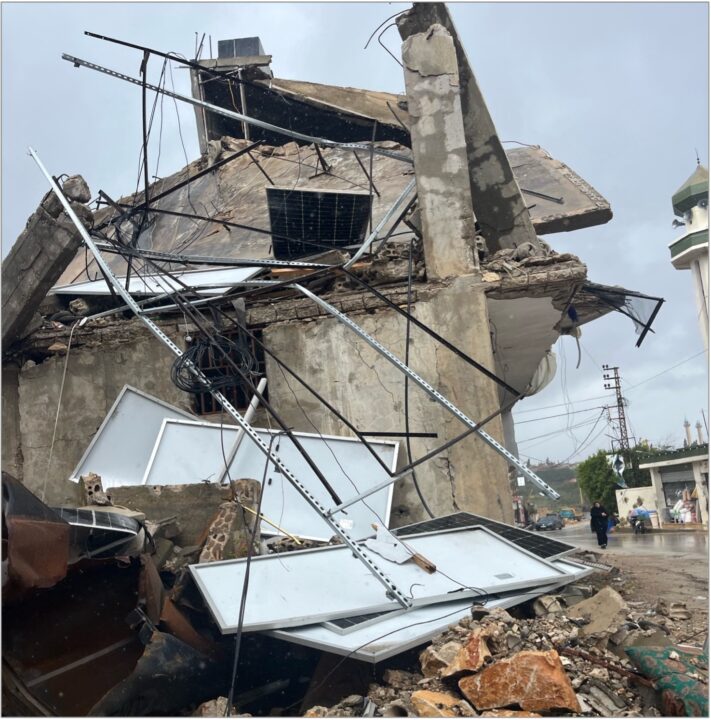
The patterns of the latest war with Israel differ from those of the July 2006 war. In 2006, primary targets included electricity, water, and essential transport infrastructure for the movement of people, food, and goods (World Bank, 2007). The Israeli Occupation Forces (IOF) – via air, sea, and land – attacked the airport, bridges, road networks, and the Jiyyeh power plant along with several substations in the south, as well as major water stations and pipelines, effectively laying a siege on Lebanon. The 2006 war’s estimated cost was $2.8 billion in direct damage to infrastructure (World Bank, 2007). In contrast, the 2023-2024 war has been significantly more destructive in terms of scale, duration, and intensity (CNRS-L, 2024). Critical infrastructure in this war has been targeted in the border villages and may have been affected secondarily in other areas. This shift appears to reflect a different Israeli military strategy focused on targeting private housing units, with housing losses accounting for 67% of total damages amounting to $4.8 million (World Bank, 2025a). These attacks have caused widespread damage across both individual and communal solar installations, alongside severe impacts to the informal diesel generator networks that sustain much of Lebanon’s power supply.
Preliminary assessments suggest that between 400,000 and 500,000 solar panels were damaged or destroyed nationwide, resulting in an estimated loss of 150MW to 200MW in installed capacity (Tsagas, 2024). A more detailed study by the CNRS-L found that in the southern suburbs of Beirut alone, 3,989 solar panels were destroyed and 32,160 sustained moderate to severe damage (CNRS-L, 2024). Given that renewable energy infrastructure is more widespread in rural or peri-urban areas, damages are likely to be significantly higher in regions outside major urban centers.
Assessing the impacts of the 2023-2024 war on Lebanon’s energy sector is not simply about recording damage; it is a necessary step toward interrogating the kind of reconstruction that is possible, and for whom. In the context of prolonged state failure (Ahmad et al, 2021), Lebanon’s energy provision has already become deeply decentralized, with communities increasingly relying on solar installations and informal generator systems. The destruction of this infrastructure and the means of its potential restoration have far-reaching implications on longer-term energy pathways in Lebanon. These challenges are compounded by the combined effects of the financial collapse and the ongoing energy crisis, which have left households, municipalities, and businesses with little capacity to absorb further shocks. This makes the present moment even more precarious and underscores the need for doubled efforts to ensure that the reconstruction and rehabilitation of electricity services do not translate into additional hardship for already strained communities. Previous reconstruction models have been unequal, unsustainable, and shaped by neoliberal frameworks that prioritized privatization and short-term solutions (Verdeil, 2008; Zbeeb, 2021). This study takes the energy sector as a lens through which to examine whether current recovery efforts risk reproducing these dynamics, and the potential for opening space for a more just, inclusive, and sustainable energy future.
Report Objectives
This study evaluates Lebanon’s energy needs for postwar reconstruction through the framework of the energy trilemma – security, sustainability, and affordability – while incorporating a fourth pillar of resilience to reflect the conflict and post-conflict context. It analyses patterns of destruction and damage in the energy sector, examining impacts on the national grid, decentralized communal renewable systems, and household renewable energy. Methodologically, the study draws on stakeholder interviews with municipal actors, energy experts, donors, renewable energy providers, journalists, and civil society organizations to capture both institutional perspectives and local experiences. Site visits were conducted during the month of March 2025 to 10 locations in the south of Lebanon and Bekaa (see section 4) where interviews were conducted with municipal actors, the electricity utility EDL, the private company Mrad Electric tasked with grid repairs, and solar distributers and installers to get preliminary insights on the extent of damage and reconstruction progress and related challenges. Following that, 15 in-depth interviews with energy experts, donors, journalists, and civil society actors provided additional perspectives on the destruction and reconstruction processes, as well as on the potential integration of renewable energy and energy justice into the broader reconstruction framework. Complementary sources of secondary data were also consulted, compiled by the founder of Takom Energy and the LSES, who provided mappings of municipal renewable energy systems for water projects and electricity. The study further assesses secondary data from CNRS-L of satellite imagery analysis to evaluate the overall destruction of solar infrastructure (including household level) across the Bekaa and south Lebanon, offering regional insight into the scale and intensity of damages.
This report also engages in a critical analysis of existing policy and regulatory frameworks to identify structural gaps, implementation barriers, and opportunities for reform. In parallel, it examines donor strategies and international recovery frameworks, with a focus on how financing instruments, conditionalities, and reconstruction priorities are shaping the postwar energy agenda. By integrating these dimensions, the study not only assesses the material impacts of the war on Lebanon’s energy sector but also interrogates the political, financial, and institutional dynamics that will influence reconstruction outcomes and the sector’s recovery. Ultimately, it seeks to provide evidence-based, justice-oriented policy recommendations to support a more equitable, resilient, and sustainable energy future.
The views represented in this paper are those of the author(s) and do not necessarily reflect the views of the Arab Reform Initiative, its staff, or its board.