Overview: energy challenges and their root causes
The energy system in Lebanon suffers chronic supply shortages, fiscal and technical inefficiencies, as well as a heavy reliance on fossil fuels, importing 95% of its primary energy in the form of fuel oil and diesel. Furthermore, the country has been suffering from a long-standing electricity crisis, stemming from interlinked political, governance, financial, and technical challenges.
The sector suffers from chronic technical deficiencies, with most power plants outdated and inefficient, operating well below capacity and dependent on costly heavy fuel oil. The transmission and distribution networks are fragile, with total system losses exceeding 40% due to aging infrastructure and poor maintenance. Meanwhile, decades of underinvestment have eroded technical expertise within Électricité du Liban (EDL), leaving the sector unable to maintain or modernize its assets. As it stands, the grid network lacks automation and real-time control, resulting in voltage fluctuations, frequent outages, and a balancing system that is essential for a modern and efficient supply system.
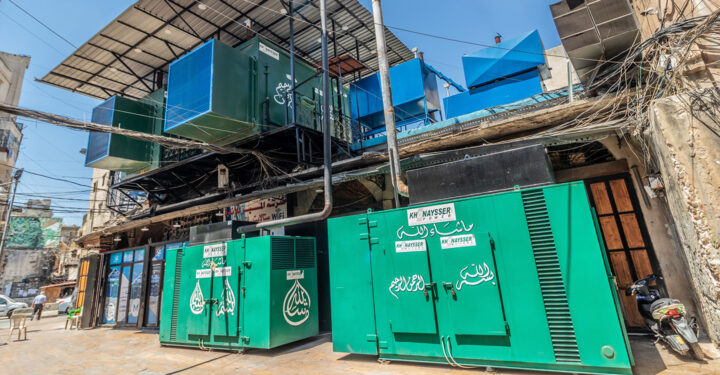
For many years, a dual energy system has been created: a formal but unreliable grid and an informal diesel-based generator services system that is expensive and largely unregulated. The fumes from the generators, often located among buildings in dense urban areas, have severe environmental health consequences and have been linked to serious respiratory illnesses.
We highlight the following as root causes for the above challenges:
Politically, Lebanon suffers from entrenched corruption of the ruling class, the sectarian quota-based sharing system, and the militia mentality that governs the actions and strategies of some local leaders. This has arguably led to political realities hindering progress in the modernization of state institutions and the extension of their capacity to effectively halt embezzlement and theft across the board.
These political dynamics have eroded institutional capacity and resulted in institutional weakness, leaving Lebanon’s governance structures unable to enforce laws or implement reforms in the energy sector. For example, Law no. 462/2002 for reforming and liberalizing the sector – ratified in 2002 – has not been implemented, with only the Electricity Regulatory Authority recently appointed (September 2025). This should signal the beginning of much-needed sectoral reforms as well as the implementation of Law no. 318/2023 for Distributed Renewable Energy Production. The subsidies that were in place were a burden on public finances and contributed to the economic collapse in 2019. The result is an electricity system that cannot meet demand, leading to frequent nationwide power outages and load shedding schedules. The port explosion in August 2020 partially destroyed the EDL headquarters, only exacerbating the problems of a fragile infrastructure service.
Lebanon’s financial collapse in 2019 and the ensuing economic crisis worsened the electricity crisis, making it very difficult to keep the lights on and culminating in a total blackout in 2021. For regular households, the price of diesel for generators soared, leaving many in the dark. This drove people (residents and businesses) to install solar photovoltaics. However, this growth in the solar market remains uncoordinated, presenting new challenges for grid stability, safety, and impact on the environment. Furthermore, access to solar-based solutions was available to the well-off, leaving behind the poorest sectors of society, footing heavy bills for basic services they need.
In the meantime, and as the sector slowly recovers, the operation of illegal micro-grids and private grids by communal diesel generators continues to dominate people’s lives. EDL is unable to control theft on the grid, and non-payment is common, especially given the lack of trust in the public utility and the sector as a whole.
These political, institutional, financial, and technical challenges, which have led to the failure to produce and distribute sufficient electricity, forced homes and businesses to rely on diesel-powered generators and, later, on individual unregulated off-grid solar systems.
Beyond internal causes, Lebanon’s electricity sector is also influenced by external factors, namely the geopolitical situation. The conflict with Israel has led to the targeting and destruction of electricity infrastructure. The influence of the former Syrian regime on Lebanon prevented the country from benefiting from the Arab gas pipeline. Currently, the political situation awaiting the full implementation of the ceasefire agreement between Lebanon and Israel , as well as the implementation of long-awaited administrative reforms, has blocked reconstruction efforts, impacting energy infrastructure and overall access to energy, particularly in the South and the Beqaa.
ARI’s principles:
ARI’s position is informed by the following principles:
- Energy Equity and Justice: Energy equity asserts the right for everyone to clean, affordable, and reliable energy. And importantly, that the costs and benefits of energy production and consumption should be fairly distributed. By following the principle of energy justice, an energy strategy would recognize and address the negative impacts on vulnerable and marginalized communities that disproportionately bear the brunt of the harmful social and environmental effects from energy infrastructure projects. An energy strategy grounded in justice must account for historical and structural inequalities – including those reinforced by post-conflict reconstruction, international financing, and elite capture – and seek to redress them. Energy justice principles promote the participation of communities in energy decision-making, whether in policies, investments, and projects that seek to benefit them or projects that directly impact their livelihoods and lands. Following the principle of energy justice, interventions, such as decentralization, will be assessed to ensure accessibility and affordability.
- Sustainability: Energy sources that have minimal environmental impact should be prioritized. Complete environmental protection should be applied to energy resource extraction and consumption, applying the principles of a circular economy whenever possible. Energy efficiency in the provision, supply, and use of energy should be followed. In addition, renewable energy development must be carefully aligned with broader environmental and social goals, ensuring it does not create new forms of competition with essential resources such as food and water. Energy systems should support, rather than undermine, agricultural productivity and water access – particularly in vulnerable and resource-scarce regions. Fossil fuel extraction, including gas exploration, should not derail efforts to decarbonize the energy system and develop feasible renewable energy-based solutions for Lebanon.
- Beyond individual choice: Our broad understanding of energy in society compels us to consider energy consumption to be the result of not merely individual choices and attitudes but of the social context, institutions, and routines that structure everyday life. This principle recognizes that consumption patterns are not just the product of individual decisions or awareness, but of the infrastructures people rely on, the services available to them, and the social norms embedded in daily practices. Rather than focusing narrowly on behavior change campaigns that target individuals, energy policy must prioritize changing the underlying social and material conditions that guide energy distribution and use. This requires governance interventions that reshape infrastructure, public services, and regulatory frameworks to enable more equitable and sustainable energy use. Shifting social norms and practices at scale means engaging with the institutions that organize daily life – not placing responsibility solely on individuals.
While espousing moral, environmental, and sociological perspectives on Lebanon’s energy system, the above principles offer ways of rectifying dominant approaches to energy management and reform (often based on technoeconomic assessments and driven by neoliberal thinking). They form the basis from which we consider broader societal imaginaries of energy to challenge the current status quo. For example, when it comes to sustainability, adopting sufficiency as a set of practices that deliver well-being within planetary boundaries. Regarding justice, we encourage a transformative view of justice that does not shy away from shifting power structures within the system to establish equitable access to energy services. Lastly, informed by feminist and decolonial perspectives that challenge existing power structures, our approach centers justice, sovereignty, and local knowledge. We, therefore, urge energy policies that are equitable, community-driven, and ecologically sustainable, that deliver not only electricity services but also power and voice.
ARI’s position
With regards to Lebanon’s energy crisis, we at ARI:
- Acknowledge the current and historical energy crisis affecting the entire country, with prolonged power outages and reliance on expensive and polluting private generators. We understand the root causes to be conflicts of interest, mismanagement, and weak institutions, and the resulting lack of investment in the energy sector, especially in light of the economic downturn from 2019. We urge action to reduce dependence on imported fossil fuels, which sinks Lebanon into further debt and exposes it to price fluctuations, as well as hindering the move to more renewable energy sources.
- Emphasize the importance of reforming the governance of the electricity sector, fully implementing Law no. 462/2002 to ensure transparency and accountability, and to integrate the private sector in energy production and distribution efforts. Benefits from investments in the national grid, including efforts to modernize or implement new and smart technologies, cannot be realized without good governance structures in place. Furthermore, reforms to ensure transparency in decision-making, particularly regarding private investments, public-private partnerships, and the exploitation of funding from international aid agencies, are imperative for a financially viable, fully operational, and resilient energy system that does not overburden the country with unsustainable debt.
- Diversify Lebanon’s energy mix by putting forward renewable energy-based solutions. Solar energy is sustainable, environmentally sound, and viable for Lebanon. Over the years, successive governments and policymakers have ignored the key role that renewable energy technologies can play in meeting Lebanon’s energy needs while circumventing the time and costs associated with fossil fuel-based investments.
ARI advocates for policies to promote the adoption of different-scale renewables such as solar farms and rooftop solar to diversify the energy mix and enable the participation of both households and private sector investors in energy production. Enforcing net-metering laws and enacting power purchase agreements will make these policies viable. We note, however, the negative aspects of the recent hyper-individualized solar boom in the country. This surge lacked public oversight or support, was self-financed by individuals, and excluded those unable to afford it. We call for the systematic integration of households and private sector initiatives into the energy sector and the energy system using effective mechanisms and laws.
- Advocate for energy equity and affordability. Any strategy will fall short of what is needed unless it provides affordable and reliable energy access to all citizens, especially vulnerable, economically disadvantaged, and historically marginalized communities. Primarily, ARI advocates for market regulation and fair, equitable investments in all areas through the regulatory authority. This should be accompanied by fair tariff structures.
On the communal and household level, ARI advocates for increased focus on community energy projects that mobilize recent net metering and the promotion of energy efficiency through the implementation of the energy conservation law and regulations for buildings and appliances to support households in their energy conservation efforts. ARI also advocates for providing microfinancing options for individual households and small businesses, ensuring financial inclusion in the renewable energy transition. This should be complemented with capacity building, like upskilling and access to resources.
Overall, we recognize the need for financial, technical, and regulatory support for both on-grid and off-grid systems (when on-grid is not feasible) for economically disadvantaged and marginalized areas so that the country’s energy system can foster society’s prosperity and well-being.
- Call for inclusive energy planning under national governance in postwar reconstruction: ARI advocates for the integration of renewable energy in the reconstruction process and for building anew with an inclusive energy strategy in mind, including energy-efficient or green buildings. Postwar reconstruction must recognize that many households and institutions now rely heavily on solar energy to meet their basic electricity needs. Although this reliance emerged under conditions that were far from ideal, it should not be seen as temporary or informal but integrated into the national recovery and in future energy planning for the country. ARI calls for a structured integration of decentralized renewable energy into the national energy system in energy planning, particularly rooftop solar, and communal projects backed by proper regulation and quality control. Furthermore, the burden of financing this transition must not fall on citizens, as it did during the unregulated solar boom. Instead, we argue that the state and its partners should facilitate access to affordable finance and invest in distributed systems that serve the public good. In areas that have been entirely destroyed – especially villages along the southern border – reconstruction plans should include the development of utility-scale solar plants to restore electricity access quickly, equitably, and sustainably.
The views represented in this paper are those of the author(s) and do not necessarily reflect the views of the Arab Reform Initiative, its staff, or its board.