To download the Factsheet click here
Introduction
Lebanon has endured Israeli aggression for decades, most recently during the war that began in October 2023, which has completely destroyed seven towns and entire neighborhoods in at least 37 southern villages. The war has so far claimed over 4,000 lives, displaced approximately 870,000 people to date, and resulted in the destruction of around 361 buildings in Beirut. Beyond war casualties, the aggression has had profound implications for Lebanon’s political and institutional landscape. It has not only weakened Hezbollah’s activity across different locations and sectors (primarily in service delivery) but also reshaped the broader political arena. Since the ceasefire in October 2024, other major events have also altered the political landscape. A new president, Joseph Aoun, was elected on 9 January 2025, ending a more than two-year presidential vacuum. This was followed by the appointment of the new prime minister, Nawaf Salam, on 13 January 2025, and the formation of the Lebanese cabinet on 8 February 2025. While some view these changes with cautious optimism, others fear uncertainty, especially when it comes to the pace and outcome of reconstruction. The question that will mostly define the success or failure of this government is its ability to end the war and lead a credible reconstruction process.
Reconstruction presents both a critical challenge and a rare opportunity to address Lebanon’s deep-rooted structural inequalities. A primary issue in this context is access to electricity, a basic service that has been unreliable for decades. The energy crisis, already existent, was exacerbated by the recent financial collapse, leaving the formal energy sector unable to provide consistent power to the majority of the Lebanese population. Decades of inadequate infrastructure, political paralysis, and economic instability have forced most people to rely on informal, costly, short-lived, and harmful energy sources, primarily neighborhood diesel generators operated by unofficial local providers.
As stakeholders begin yet another postwar reconstruction process, they will need to address a complex web of governance issues, implement inclusive energy policies, and establish proper financing mechanisms to ensure a just and resilient energy transition. A primary financial enabler in this process is international aid. While foreign aid and loans offer an opportunity, past experiences have shown that without structural reform, visionary and strategic reconstruction, transparent national oversight, and clear mechanisms of accountability, aid risks reinforcing political clientelism and social inequalities rather than enabling equitable development. There is a need to challenge this reality by relying on energy-efficient reconstruction processes that integrate renewable energy into urban environments in order to reduce dependence on fossil fuel imports.
This paper explores the challenges and opportunities for energy recovery in Lebanon’s postwar reconstruction by examining three interrelated components: (1) the actors involved in the energy sector and their fragmented strategies that influence energy provision across three timeframes (before the crises, during the current emergency, and in the near future); (2) energy-related planning regulations, with a focus on how existing and proposed laws shape the reconstruction of energy systems and the potential adoption, or hinderance, of sustainable technologies; and (3) the political economy and financial gaps in the current recovery process. It argues that Lebanon’s energy recovery must move beyond short-term fixes and rebuilding as was, and adopt a comprehensive reform agenda that integrates governance, legal, economic, and financial reforms.
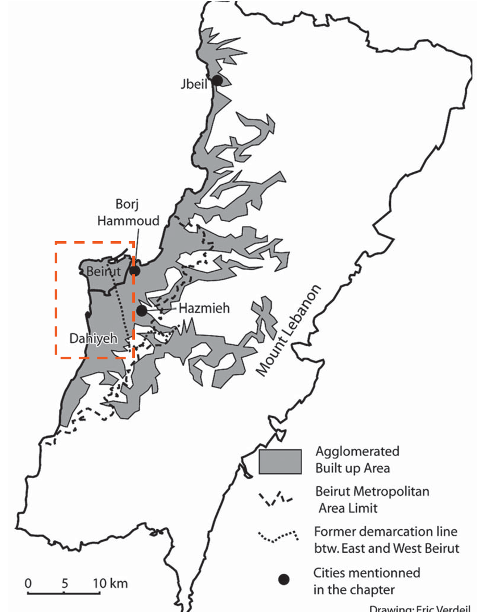
Figure 1: A map showing the location of the southern suburbs of Beirut (Dahiyeh) and Municipal Beirut within the imagined boundaries of the Greater Beirut area (Source: Eric Verdeil, edited by author).
To ground the analysis, this paper presents a case study of the southern suburbs of Beirut and municipal Beirut (see Figure 1). The southern suburbs were severely affected by the recent war (at least 417 buildings destroyed), while municipal Beirut, as the adjacent capital, experienced relatively less damage (two compounds of buildings destroyed). Exploring these two geographies in relation to each other is essential to understanding whether they have coordinated efforts toward improving services for the greater Beirut area (which includes its suburbs). Both regions are characterized by informal energy networks and monopolized diesel generator systems. This case study highlights the governance, policy, and economic challenges of achieving energy justice amid Lebanon’s volatile political and economic landscape. The purpose of this research is to seize the opportunity presented in reconstruction to establish actionable frameworks that aim to achieve efficient energy recovery nationwide. The research and stakeholder engagement conducted throughout the study further aims to contribute to a more just and inclusive reconstruction of Lebanon’s energy sector: one that ensures marginalized communities are not left behind in the country’s recovery.
Methodology
The research methodology of this paper consisted of: desk reviews of existing reports, news articles, and existing and proposed laws and decrees (e.g., building regulations, reconstruction laws, and proposed legislation); site visits to the southern suburbs of Beirut and municipal Beirut; in-depth interviews with 13 key stakeholders; and conversations with informal actors of the studied area. The interviewed stakeholders were from the public sector, syndicates, think tanks, NGOs, and standard-setting bodies (see Annex for the full list).
The collected data were analyzed thematically using the framework presented below (see Figure 2). In the governance section, associations between different actors involved in the energy sector were derived from the interviews, in which stakeholders described the types of coordination they either had or lacked with one another.
The research findings were validated through a policy dialogue involving the interviewees, members of the Arab Reform Initiative energy sector’s advisory board, and additional stakeholders involved in the sector. This dialogue also served to further develop and refine the recommendations.
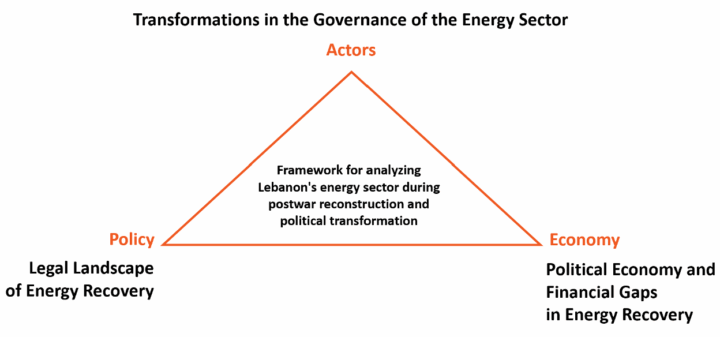
Figure 2: Analytical framework of the study during postwar reconstruction and political transformation (by author).
The views represented in this paper are those of the author(s) and do not necessarily reflect the views of the Arab Reform Initiative, its staff, or its board.