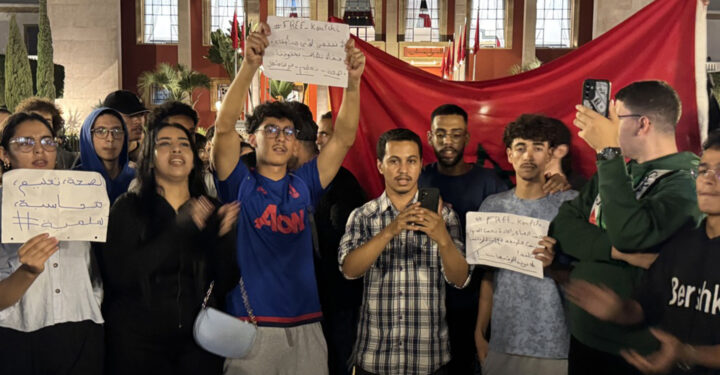
A new wave of youth-led contestations is shaking Morocco’s political landscape. Calling itself Gen Z 212 – a reference to the country’s international dialing code – the movement coalesced after a tragic series of maternal deaths in Agadir on 14 September and rapidly spread nationwide. Its core demands are concrete and build on long-standing grievances in Morocco: quality public education and healthcare, an end to corruption, and a dignified life. What distinguishes this movement is its scale and decentralization: localized mobilizations of youth groups coordinated in real time, with decisions taken horizontally and anonymity used as a shield against repression.
Organizers have leveraged Discord to crowdsource demands, circulate evidence of abuses, and refine a common platform – while borrowing proven tools such as consumer boycotts to widen participation. Fiercely committed to its independence, the movement has eschewed coalitions and avoided building any organizational networks, while making strides to organize the contributions of the more than quarter-million members currently active on its server. At the same time, they have addressed their demands directly at the monarchy – hoping for tangible solutions while risking a familiar script of grandiose promises that systematically fall short of delivering structural change. The following article traces how Gen Z 212 emerged, why its grievances run deep, what is genuinely new in its repertoire, and whether Morocco’s institutions – starting with the palace – can respond with more than empty promises and cosmetic reform.
Features of a movement: Gen Z 212 in action
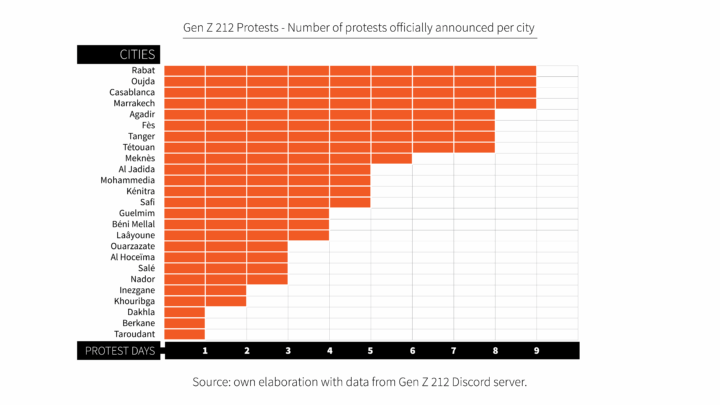
After the post-partum death of eight women in an Agadir hospital on 14 September, swaths of youth have been taking to the streets across the country since the end of September to ask for better education and healthcare, the end of corruption, meaningful accountability, and a more dignified life overall. The protests have been widespread, sustained, and decentralized. Protests have occurred both in Morocco’s main urban centers (Rabat, Casablanca, Agadir, Fez, Tangiers, Marrakech, and Oujda) and more marginalized areas (from Beni Mellal and Nador to Ouarzazate and Guelmim). As it has built momentum and support, the Gen Z 212 movement has escalated its demands to include the dismissal of the current government and is maintaining pressure on Morocco’s political system until it reaches its goals.
Young Moroccans discuss the state of the mobilization on the instant messaging platform Discord on a daily basis, taking decisions horizontally and under the cloak of anonymity. Beyond anonymity, the possibility of interacting through text, voice, and video chat, as well as its easy and free access, represent key advantages of the platform. Citizens can join the channel dedicated to their region to coordinate with local communities about where to act and how. In the same space, they can also participate in broader discussions about the movement and also share media and other resources for peer-education, as well as episodes of violence to hold authorities to account and spread solidarity with the victims. The Discord server’s admins collect the meeting points for the daily protests and post an announcement of the day’s protest locations and schedules, which are then shared widely on other social media.
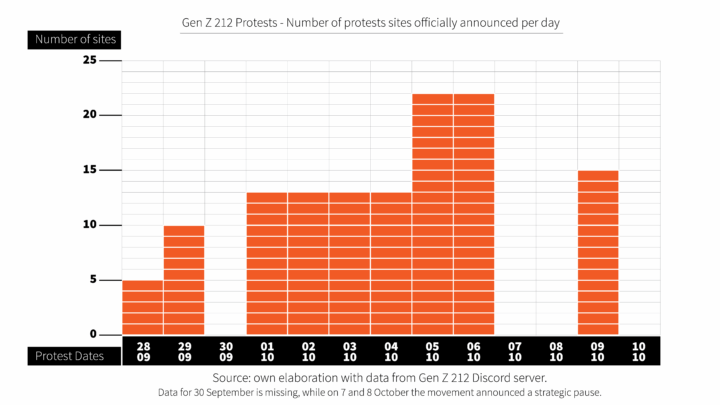
Young Moroccans gather at the prescribed location and express their demands through chants such as “dignity, freedom, and social justice”, “stadiums are here, but where are the hospitals?”, and “the government is corrupt”. The groups at the core of mobilizations are made of Gen Z, meaning youth currently in their twenties or younger, but other demographic segments have also joined the public gatherings – including “older” activists involved in the 20th February and the anti-normalization movements. The first days of protest were met by high levels of police repression, especially in cities like Rabat and Casablanca. The images of ordinary citizens being taken by police forces while talking to the media have been circulating widely and have become a powerful reminder of the limits to freedom of expression in the country. Scenes of violence ensued, with angrier crowds damaging public and private property and actively confronting police forces, which swiftly responded by escalating the use of force. The Ministry of Interior reported that more than 250 members of police forces and 23 protesters were injured during confrontations on the night of 30 September. The following night, on 1 October, the protests saw their first casualties, as three protesters were fatally shot by police forces during clashes in Leqliaâ (in the periphery of Agadir).
The anonymous leaders of the Gen Z 212 responded to such an escalation of violence by reaffirming the strictly non-violent nature of the movement. They distanced themselves from the destruction of property, explicitly disavowing any violent action. “Peace, peace, peace” became another recurring chant at Gen Z 212 protests, and the level of violence decreased substantially in comparison to the first gatherings. They also decided to limit the duration of the gatherings in order to avoid potentially violent drift. On top of ensuring that the movement remained peaceful, the Gen Z 212 organizers also started developing clear demands. Drafts were circulated on the Discord server and, once honed by members’ feedback, they were published and widely circulated on social media. These demands are directly addressed to the monarchy and include free and universal quality education, accessible public healthcare, job opportunities for youth and the reduction of unemployment, as well as the dismissal of the Head of Government, Aziz Akhannouch.
Morocco’s government tried to open the doors of dialogue, but the movement continues to firmly reject any official outreach effort. Beyond that, the Gen Z 212 organizers systematically resisted the various attempts of civic and partisan actors to engage with the movement: whenever a politician claims they are aligned with the movement, or spoke to its representatives, the server’s moderators clarify that Gen Z 212 has no leadership and its position is the one expressed in its demands. This does not mean that their demands do not evolve. On the contrary, the movement called for the boycott of the companies linked to Aziz Akhannouch and is also engaging in discussions with experts on their priority issues, developing a clear methodology to facilitate discussions and vote on concrete proposals on each issue. After a “reflection pause” on the nights of the 7 and 8 October, protests resumed across Morocco the night of 9 October – in high anticipation of the King’s speech to the Moroccan Parliament scheduled for the opening of the parliamentary session on 10 October.
Deeply rooted grievances, new strategies and methods
Although the scale and form of the Gen Z 212 movement may have surprised observers of Moroccan politics, its grievances are deeply rooted in Morocco’s socio-economic context. Public demands around employment, education, and healthcare have consistently been identified as the top priorities of Moroccans in successive waves of surveys. Yet, despite this clear prioritization of demands, these sectors remain mired in long-standing crises. Beyond the grim picture painted by recent PISA scores, scholarly research has already highlighted the never-ending crisis of Morocco’s education sector. In particular, Azeddine Akesbi showed how more than 25 years of educational reforms and emergency programs failed to address the education system’s systemic problems. The healthcare sector faces a similar situation, as not even the monarchy-led Universal Healthcare Coverage reform managed to achieve the expected improvements in this sector. Moreover, both the education and healthcare sectors have experienced increasing privatization in recent years. Private providers now account for more than one-third of schools and hospital beds, a shift that has further exacerbated socio-economic inequalities. The bleakness of Morocco’s labor market is underscored by a youth unemployment rate of 36%, which rises to 47% in urban areas.
Not only are the Gen Z 212’s demands aligned with issues faced by most Moroccans for decades, but they have also been at the core of street-level mobilizations since before 2011. Famously, “jobless graduates” have been demanding the integration of qualified youth in Morocco’s labor market since the early 1990s. More recently, teachers have been protesting against their precarious working conditions – facing especially violent repression in 2018 and 2019. In the healthcare sector, medical students spearheaded large-scale mobilizations in 2024, and doctors in public healthcare called for a general strike as recently as January 2025. Earlier waves of protests were driven by similar grievances – from the large-scale protests in the Spring of 2011 to the Hirak of the Rif in 2016-17. Central to both was an insistence on ending hogra – the pervasive sense of contempt and humiliation inflicted on society. In the context of Morocco’s Arab Spring, ending such a state of humiliation was linked to profound reforms in the political system, while the longstanding condition of socio-economic marginalization of northern Morocco embodied the hogra denounced by the Hirak Rif movement. But in both cases, the solutions brought forward by Morocco’s political elites fell short of citizens’ expectations and paved the way for this new wave of mobilization.
What, then, is new about the Gen Z 212? Many observers highlight the lack of a structured organization and the leverage of digital spaces as two novelties. This is only partly true, since spontaneous protests have been increasingly common in Morocco. Similarly, extensive research has already pointed out the fundamental role of social media in the 2011 uprisings. The partial novelty is that Discord enables a much more horizontal participation of its members, as literally anybody can join the servers and participate in its discussions. Moreover, the anonymity provided by this platform also enables its organizers to safeguard themselves from potential repression. As one moderator remarked while deflecting speculation about his identity, “I’d rather avoid 20 years in prison” – implicitly referencing the sentence handed to Nasser Zefzafi, a leader of the Hirak Rif movement. The call to boycott the companies linked to the current Prime Minister – Aziz Akhannouch – is another sign that Gen Z 212 has learned from past mobilizations, offering a lower-barrier tactic for wider participation that proved effective in 2018.
What marks a fundamental break with past mobilizations is its relationship with other social and political actors. The Gen Z 212 movement is not seeking to establish coalitions or build an organizational network around its demands (as was the case of the 20th February Movement in 2011). On the contrary, it is committed to maintaining its independence, avoiding any kind of hierarchical structuring or partisan co-optation. Interestingly, it is also remaining fairly independent of other civil society actors, which may support the movement but are also leaving it ample room for maneuver. So far, it seems that the grievances it expressed are such a core part of the collective experience of Moroccan citizens that it does not need to rely on existing networks to achieve sustained and widespread street-level mobilizations. In the absence of formalized structures and hierarchy, it has fallen to the server’s admins to make substantial efforts to organize the contributions of its active members and create clear rules of engagement as membership to their server grows. Starting with only four moderators, the server can now rely on more than 80 volunteers to coordinate bottom-up contributions.
Addressing the King, responding in the streets?
In the face of the silence of most political elites, the movement decided to address its demands directly to King Mohammed VI. Playing into the monarch’s role as ‘arbiter’, asking for direct intervention has clear pros and cons. On the one hand, the monarchy’s de facto absolute power makes it the obvious addressee: if anyone has the power to respond to the demands of Gen Z 212, it is the King. On the other hand, the monarchy proved time and time again its capacity to deflate social movements by announcing cosmetic reforms that avoided meaningfully altering the status quo. The pattern is clear: the 2011 Constitution was supposed to ensure Morocco’s democratic transition as demanded by the 20th February movement, but it locked the monarchy at the core of its political system (and outside of accountability loops); the Manarat Al-Motawassit (“Phare of the Mediterranean”) project was supposed to fill the socio-economic development gap of the Rif region outlined by the Hirak Rif, but achieved few of its objectives; the New Development Model adopted in 2021 was supposed to embody a new social contract between the monarchy and Moroccan citizens in the wake of the 2018 economic boycott, but few citizens saw a significant change in their lives.
Despite the high anticipation, the King’s speech at the opening of the parliament’s session on 10 October was astonishingly tepid. Instead of pulling another rabbit out of his hat, the King reaffirmed the need to advance and strengthen current projects of local development as established in his last speech of 29 July. He emphasized that political elites just have to ‘better communicate’ their accomplishments. Although the speech mentioned specifically the need to encourage youth employment and achieve “tangible progress” in the education and healthcare sectors, the King did not address the grievances of Gen Z 212 directly. Another not-so-subtle nod at the Gen Z 212 movement is the statement that “there should be no inconsistency or competition between national flagship projects, on the one hand, and social programs, on the other”. However, the existence of such inconsistency and competition between the two is precisely at the core of what led Morocco’s youth to take to the streets. Slogans such as “stadiums are here, but where are the hospitals?” highlight precisely the competition between the massive financial resources devoted to the development of stadiums for the world-class competitions that Morocco is set to host and the funds allocated to essential public services. When workers are moved from the construction of a new hospital to ensure the timely renovation of a stadium, such inconsistency becomes brutally tangible.
After the speech, the movement called for two more nights of pause for strategic coordination before launching an online survey on their Discord server asking when the mobilization should start again: the overwhelming majority voted in favor of taking to the streets again, and a new wave of nationwide peaceful protests has been announced for Saturday, 18 October. But while the majority of the movement is understandably disappointed by the lack of tangible response from the monarchy, it is becoming clear that the movement is reaching a watershed moment. Given the 10 October royal speech, continuing to address the monarchy directly may not be the preferred strategy since it did not produce the expected result. At the same time, directing its demands beyond the monarchy could put the movement outside of the legitimate institutional framework and at the risk of further repression – and another escalation of violence.
Regardless of how the Gen Z 212 movement will respond, it is now exceedingly clear that a large part of Moroccan youth cannot bear the staggering contrast between the projected modernity and progress of Morocco and their lived experiences. Such a painful discrepancy is manifest when the members of the Gen Z 212 movement jokingly highlight the differences between “Morocco” and “Al Maghrib” – meaning the showcase presented to international audiences and the much less glamorous and luxurious reality of their daily life. But just as the movement managed to push the red lines of Morocco’s public debate by questioning the resources allocated to the development of stadiums, they still bear the potential to stir critical and desperately needed debates about the future of the country. After so many broken promises, it is doubtful that the Gen Z 212 will be satisfied with nothing short of real change.
The views represented in this paper are those of the author(s) and do not necessarily reflect the views of the Arab Reform Initiative, its staff, or its board.