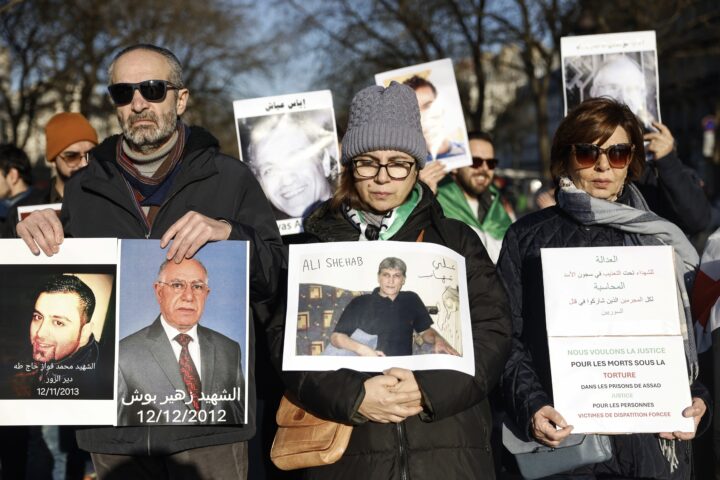
On 29 June 2023, the UN General Assembly adopted a resolution establishing the Independent Institution for Missing Persons in Syria (IIMP) to uncover the fate and whereabouts of missing persons in Syria and provide support to victims and their families. The new IIMP will be concerned with missing Syrians and non-Syrians on Syrian territory, not only the forcibly disappeared, and it will work to ensure that the families of victims, missing persons, and survivors are represented during the process of its establishment and its work. It will also consult on an ongoing basis with women’s and civil society organizations. The IIMP will be neutral toward the parties to the Syrian conflict, will not point fingers, and will communicate with all parties. It will be the central hub for collecting and collating data on the fate and whereabouts of missing persons.
The resolution also set 80 days after its issuance for the UN secretary-general with the support of the Office of the High Commissioner for Human Rights to draft the terms of reference of the new IIMP. The draft resolution was co-authored by Luxembourg, Albania, Belgium, Cape Verde, the Dominican Republic, and Macedonia. Eighty-three countries voted in favor and 11 against; 62 countries abstained, including all Arab countries except Kuwait and Qatar, which voted in favor. The voting session witnessed a debate between representatives of the member states of the General Assembly, which centered around two speeches that can be seen as a reflection of the two clashing Syrian narratives that have been in play for the past 12 years.
Those who voted for the resolution argued that the existence of such an institution would be in favor of reconciliation and sustainable peacebuilding in Syria, as the file of the missing and forcibly disappeared is one of the largest humanitarian files related to the conflict, and no serious steps have been taken over the past years. This argument is based on the narrative of the families of the disappeared and the associations of victims of enforced disappearance, for whom this decision is the fruit of years of struggle. On the other hand, those who voted against the resolution – all of them allies of the Syrian regime – argued that Syria was not consulted in the discussions leading up to the vote on the resolution, which they see as an interference in Syria’s internal affairs. This reflects the official Syrian discourse, which considers the establishment of such an organization to be a means “to interfere again in Syria’s affairs and exert more pressure on its people” . This can be seen as an extension of the official narrative that what has happened in Syria over the past decade is a “global conspiracy”.
This paper argues that the decision to establish an international organization to uncover the fate of the missing persons in Syria is a victory for the narrative of the families of the victims and the missing persons themselves, and by extension, for the general narrative of the Syrian revolution based on the fact that what happened in Syria is a “popular revolution against a brutal dictatorial regime”. The IIMP’s establishment aims to influence the general policy of enforced disappearance followed by the parties to the conflict in Syria, led by the Syrian regime, throughout the past years of the conflict, and contributes to refuting the regime’s narrative of the Syrian conflict as a conspiracy, thus denying torture and enforced disappearance and promoting the idea that regime detainees are terrorists who are dealt with legally through the correct state institutions. To do this, the paper will trace the trajectories of the two narratives during the years of the Syrian conflict, from building the argument and forming discursive alliances around it through to the dominance of the victims’ families’ narrative at the UN General Assembly.
Enforced Disappearance in Syria as Public Policy
The UN General Assembly resolution does not explicitly refer to enforced disappearance, but to missing persons, i.e., persons whose fate and whereabouts are unknown for various reasons including possibly their forced disappearance. Thus, those forcibly disappeared by one of the parties to the conflict are included in the broad concept of the missing, whose number international organizations estimate at 100,000 from the beginning of the conflict. This approach is consistent with statements by the delegates of the countries that submitted the draft resolution regarding the importance of the IIMP’s impartiality and non-accusatory stance, as a way to increase cooperation. Unlike enforced disappearance, which is considered a crime against humanity that can be leveled at all parties to the Syrian conflict, the description of the missing persons does not carry legal consequences. In their documentation of the violations, international and Syrian human rights organizations focused on detention and enforced disappearance and the subsequent files for accountability. This sparked a lengthy debate among Syrian legal experts and victims’ associations about the usefulness of the new institution, which was resolved in favor of the priority to uncover the fate of victims and their families as a prelude to justice and accountability later.
According to figures documented by Syrian human rights organizations, led by the Syrian Network for Human Rights, 154,398 people – including 5,161 children and 10,159 women – were in detention in Syria as of August 2022. As of March 2022, at least 111,907 people, including 3,041 children and 6,642 women, were still reported to be under enforced disappearance at the hands of the parties to the conflict and the controlling forces in Syria. The breakdown of who is enforcing these disappearances is as follows: 95,696 people, including 2,316 children and 5,734 women, by the Syrian regime forces; 8,684 people, including 31 children and 255 women, by ISIS; 2,071 people, including 14 children and 29 women, by Hay’at Tahrir al-Sham (the Organization for the Liberation of the Levant); 2,827 people, including 249 children and 517 women, by various armed opposition factions and the National Army since 2011 in all areas under its control; and 2,629 people, including 143 children and 107 women, by the Syrian Democratic Forces (SDF).
The numbers of the forcibly disappeared in Syria and their distribution among the various parties to the conflict highlights the difficulty of the work of the international mechanisms – especially given the adoption of the broad concept of missing persons – in terms of data collection as well as the cooperation of each of the parties concerned. The figures reflect the need for the existence of such an institution, as each case of a missing or forcibly disappeared person represents a humanitarian catastrophe and has legal consequences for their families, including death registration, disposal or disbursement of property, and identification papers. In addition, the number of forcibly disappeared, especially by the Syrian government, leaves no doubt that detention and enforced disappearance is a general and systematic policy adopted by parties to the conflict to terrorize opponents according to their areas of control, and is, therefore, a full-fledged war crime. We will describe the features of this policy for each of the parties below:
The Syrian Government: A Human Slaughterhouse
From the outbreak of protests, the Syrian government began to use violence in the face of peaceful demonstrations; detention and torture were among its main weapons to terrorize protesters and quell the movement. Peaceful demonstrations were met with hundreds of security troops firing live bullets directly at the demonstrators to disperse and arrest them en masse. Security forces also indiscriminately and systematically arrested activists, dissidents, and anyone who expressed support for the revolution. With the militarization of the revolution and the emergence of areas outside the government’s control, the arrests took on the character of collective punishment of those areas. The army, with the support of militias, carried out mass arrests (including of women and children) and identity-based arrests at checkpoints in government-controlled areas of anyone from areas outside of regime control or affiliated with a family or sect connected to the revolution. This is why the largest number of missing persons in Syria was recorded in the early years of the revolution, with the number of forcibly disappeared persons held by the Syrian government in 2015 reaching nearly 65,000.
Arrests by Syrian security and military services are carried out without any legal authority, without any identification of the arresting party or the place of arrest, and are akin to kidnapping. Syrian security services deny the existence of the detainee and isolate him or her from the world without any legal basis, thus turning more than 70% of arrests into enforced disappearances. Detainees held by the Syrian security services are subjected to systematic torture and deprived of food, water, medicine, and medical care, resulting in thousands of deaths. In detention centers, particularly the notorious Saydnaya Prison, mass extrajudicial executions are carried out followed by burials in mass graves.
Within the Syrian government’s mechanism of arrest and enforced disappearance, families of detainees have difficulty obtaining any information about their loved ones. The official channels designated by the government are useless: the Ministry of National Reconciliation was created for this purpose in 2018 and was abolished in 2020; military police branches may in some cases be provided with the names of the security branch detainees; and civil registry branches are provided with the names of deceased detainees. Relatives who try to ask about security branch detainees may also be subjected to arrest and forced disappearance. This has left the families of the victims no choice but to turn to intermediaries to obtain information in exchange for bribes, sometimes amounting to thousands of dollars, in a systematic corruption process run by the Syrian security apparatus.
ISIS
Since taking control of large parts of northeastern Syria (Deir ez-Zur, Raqqa, al-Hasakah), ISIS has used enforced disappearance as a weapon to terrorize its civilian and military opponents through large-scale kidnapping and arrest campaigns during its invasion of areas, especially those with religious or ethnic specificity. During its period of control, ISIS established at least 54 open detention centers in northeast Syria, in addition to dozens of clandestine centers. The missing persons in northeast Syria include men, women, and children; individuals from different ethnic and religious backgrounds, including Arabs, Kurds, Assyrians, and Yazidis; individuals associated with different political and military groups, depending on the successive controllers of the region; and Syrian and non-Syrian nationalities. In addition to the number of missing persons from the war on ISIS in northeastern Syria, battles between the international coalition and the SDF with ISIS have resulted in the deaths of more than a thousand civilians according to what has been announced; the remains of many of those killed by the international coalition are still missing, as the bodies were either hastily buried, or not buried at all and later disappeared.
Since the international coalition announced the capture of the last ISIS strongholds in 2019, the Autonomous Administration of Northeast Syria and its military arm, the SDF (which is holding thousands of ISIS fighters), have made no genuine efforts to uncover the fate of the missing, nor have they cooperated with victims’ families in their own attempts to investigate their loved ones’ fates.
Other Parties to the Conflict
The numbers of the forcibly disappeared are similar for the three remaining parties to the Syrian conflict, namely the SDF, the Turkish-backed opposition factions of the National Army, and Hay’at Tahrir al-Sham. These entities share similar methods of detention and enforced disappearance. Each uses detention and enforced disappearance as a tool to terrorize opponents and silence dissenting voices in their areas of control. Arrests are often carried out during security raids in specific areas or at checkpoints, without judicial arrest warrants or specific charges, even though all three parties have judicial bodies.
All of these parties have official detention centers and secret detention centers. As detainees become forcibly disappeared, their families are prevented from visiting or hiring a lawyer and are extorted in exchange for information or the release of the forcibly disappeared.
From Revolution to Narratives: Construction and Conflict
Narrative has always been an essential part of the Syrian conflict in its various stages, from peaceful protests to militarization and beyond. The streets, the traditional media, and social media were the biggest arenas for this conflict between the narrative of the Syrian government and the narrative of the opposition and the revolution. This conflict then moved to the UN Security Council, the General Assembly and its organizations, and courtrooms in Europe. Around each narrative, discursive alliances were formed across Syria’s borders between the allies of each side, and the narrative struggle became more intense and important. This section will attempt to deconstruct the structure of each narrative and go through the elements of the conflict between them, up through the General Assembly’s vote on the resolution establishing the IIMP as one of the milestones of the narrative conflict.
The Syrian Government, aka The State
From the first days of the protests, the government’s narrative about what was happening began to take shape through official statements or semi-official statements by Arab media speaking on behalf of regime allies. The first feature of this narrative was disconnecting the protests from their political meaning, describing them as a global conspiracy against the regime rather than a political crisis; this was evident in the Syrian president’s first speech after the protests began. In his subsequent speeches, he labeled the protesters as terrorists, international agents, or misled citizens with otherwise legitimate demands, a categorization that implicitly justified the use of violence against them.
With the militarization of the Syrian revolution, the Syrian government labeled all areas and people outside its control as terrorists, including civilians and armed factions, thus justifying a policy of collective punishment for entire regions. This image was reinforced through media and official discourse, and through laws issued after 2011 in the context of what the president called “reform”. These include Law No. 19 of 2012 on combating terrorism and Law No. 22 establishing a terrorism court, both of which came after the abolition of the state of emergency in Syria as a supposed reform, but in reality a legal justification for the brutal practices of the army and security services.
In this context, the Syrian official discourse, through its representatives in international forums, focused on accusing Arab and Western countries that support the revolution in Syria of funding terrorism and considered the Syrian opposition abroad “agents of foreign powers”, even when negotiating with them in Geneva.
In addition to justifying the brutality of the army and security services, the government’s narrative needed a parallel denialist context to support the conspiracy theory and establish the image of the state fighting foreign-backed terrorism. This new narrative responded to accusations that the Syrian government was committing violations that amounted to war crimes by denying the acts and accusing the other side of committing them. This was evident in how the Syrian regime and its media dealt with the issue of chemical attacks on civilians and the issue of torture in prisons. For example, Buthaina Shaaban, the Syrian president’s adviser for political and media affairs, said that the chemical weapons attack on Eastern Ghouta in Damascus, which killed 1,400 people, was “carried out by the armed opposition”, that the victims “were Alawites who were kidnapped from the Syrian coast” 380km away from Ghouta, all areas controlled by government forces, and the intent of this elaborate plot was “to kill them in Ghouta with chemical weapons and accuse the Syrian government of the attack”. The Syrian president has repeatedly denied the use of torture in his prisons during televised interviews; in one interview he said that the Caesar XX photos were photoshopped and that he had not seen them.
The Syrian government’s responses to reports by international organizations about torture and extrajudicial executions in Syrian prisons, especially Saydnaya Prison, have always been to deny them. The Ministry of Justice’s response to an Amnesty International report claiming that between 5,000 and 13,000 detainees were executed in Saydnaya Prison between 2011 and 2015 was to label the report “politicized and aimed at damaging Syria’s reputation... [to] achieve what the gangs were unable to do after the Syrian army’s victory over them”.
The Syrian government has sought to perpetuate the “terrorism” label for detainees in the amnesty decrees issued by the Syrian president since 2011. The terms “perpetrators of terrorist crimes”, “undermining the prestige of the state”, and “internal desertion” are used for military personnel who defected from the army in an attempt to perpetuate the terrorism label for all detainees on the one hand and show the state’s and president’s tolerance in dealing with detainees. This narrative was bolstered by state media interviewing those released after each amnesty, wherein each released detainee thanked the president for his generosity. In the same context, in 2022, the Syrian president issued Law No. 16 criminalizing torture for the purpose of punishment or obtaining information; this move seems intended to deny the systematic policy of torture in detention facilities and place it on the individual actions of officers and members of the security services.
The Syrian government’s political and military allies also contributed to strengthening the regime’s narrative by forming a rhetorical alliance. During the Astana negotiations, Moscow and Iran succeeded in turning the issue of detainees and forcibly disappeared persons into a prisoner exchange between the Turkish-backed opposition National Army and the Syrian army, supervised by the Russian Ministry of Defense and the Red Cross. This process, although not a true success in terms of the number of those released, favored the Syrian regime’s narrative that the two warring parties were each holding prisoners of war, not detainees of conscience. In addition, Russia has added its electronic capabilities to the promotion of the Syrian government’s narrative of events in Syria through systematic disinformation campaigns targeting global public opinion using pro-Russian Western influencers, academics, and politicians – often those associated with far-right conspiracies or the anti-imperialist left – while the Iranian media is tasked with promoting the regime’s narrative and disinformation among Arabic-speakers.
The Syrian Opposition, the Revolution, and the Brutal State
Syrians have had their own narrative about the Assad regime for decades before the revolution, as a military regime that lacks legitimacy. The events of the 1980s, which coincided with the peak of the state and state institutions’ atrocities against society, contributed to the consolidation of the image of state cruelty in the minds of Syrians; the Syrian state became, in the words of Michel Seurat, “the brutal state” during this period. The main hallmarks of that era in the Syrian narrative include the destruction of the city of Hama, the famous massacre, the arbitrary arrests of all political opponents, the Tadmor prison in Palmyra and its reputation for torture, and the various branches of the intelligence services that became so extensive that the mere mention of them became terrifying. Adding to the horror was the suffocating economic crisis, the queues at government-subsidized goods outlets, poverty, government corruption, and the regime’s sectarianism. The prerevolution Syrian narrative was passed in whispers from the parents who lived through it to their children, surviving under tight security and a one-voice media. Bashar al-Assad’s inheritance of power later added new dimensions to the people’s whispered narrative about the Assad regime: the transformation of the republic into their personal monarchy, a “legitimacy” drama related to Assad’s military and party promotions, and the amending of the Syrian constitution to specifically allow Assad to assume the presidency at age 34 and hold on to it throughout the following years.
After testing his reform promises for a decade, Syrians concluded that this regime could not be reformed. The Arab Spring was enough to transform the narrative into a movement, supported by a new element: the perception of a young generation that had not experienced the brutality of this regime, and which was convinced that the development of information technology, social media capable of reporting events in real time, and international support for the Arab Spring would curb the regime’s brutality.
From the first protests in Syria, a narrative struggle began between the regime’s media machine and the protesters on the ground, with both sides aiming to win the street; in this context, the protester narrative took a defensive stance in response to the regime’s narrative. For example, in an attempt to signal that the protests were social instead of political, the regime’s first post-revolutionary reforms were announced by presidential adviser, Buthaina Shaaban, including a wage increase. Protesters responded by chanting the slogan, “O Buthaina and O Shaaban, the Syrian people are not hungry” . Chants such as “Peaceful!” and “The Syrian people are one” were in response to the regime’s accusation that the protesters were extremists and terrorists. In addition, the names given to Friday demonstrations and other protests had connotations for all elements of Syrian society, in an attempt to win them over to the revolution and refute the regime’s narrative about the protesters.
With the army and security services using excessive violence against the demonstrations, the defensive narrative shifted from slogans to documenting the violations committed against the protesters. This started with the local organizations that coordinated each region’s demonstrations; such organizations had media committees and documented the names of victims of state violence and enforced disappearances; they communicated with media outlets supporting the Syrian revolution and international organizations and professional Syrian human rights centers dedicated to documenting violations.
The Syrian conflict – with its multiple parties and the vast numbers of victims and violations – has become one of the largest humanitarian tragedies since World War II and one of the most documented events in history. The attention and efforts of civil society have begun to focus on issues of transitional justice; more than 50 Syrian NGOs were formed to address issues of documentation, training, and transitional justice. These organizations, along with the media, contributed to the Syrian narrative of state brutality by documenting various violations and leading advocacy in international forums.
Despite the defensive nature of the narrative at that stage, it was optimistic due to the opposition’s military progress and control of large areas of land, the movement’s momentum, and regional and international support for Syrian opposition institutions. This optimism was reflected in civil society’s perceptions of democratic transition and transitional justice, for which plans were prepared based on the premise of victory. For example, an organization called The Day After presented a project called “Supporting the Democratic Transition of Power in Syria” in 2012, which laid out a comprehensive conceptualization of the democratic transition process, including the transitional justice process and its mechanisms. Similarly, in 2013 projects called “My State” and “Democratic Transition Plan” – the latter of which was prepared by the Syrian Center for Political and Strategic Studies – provided a comprehensive conceptualization of the transitional justice process.
Following the Russian intervention and the change in the balance of power in favor of the Syrian government on the ground, the military and political drivers of the Syrian conflict gradually declined: areas controlled by the armed opposition shrank, and Moscow successfully disrupted the Geneva negotiations in favor of its Astana talks. Meanwhile, the narrative of the Syrian revolution continued to be amplified by the violations committed by the Syrian army and its Russian ally. Since 2020, when the maps of military control between the parties to the conflict were drawn, the Syrian government controlled more than 60% of the territory. The area of opposition control has declined to about 11% and the military and political drivers of the conflict between the opposition and the regime have been disrupted. What remains today is a struggle between the “victor” narrative exported by the Syrian regime and an opposition narrative that has become closer to a grievance-based narrative founded on the many and significant violations over the years, the victims of which are estimated in the millions, including the use of chemical weapons, the numbers of detainees and missing persons, forced displacement and property seizures, mass deaths. This struggle is being waged by the Syrian opposition on social media and through demonstrations; by associations of victims, especially the families of detainees and missing persons; and by civil society organizations through advocacy campaigns with countries that are active and sympathetic to the Syrian revolution and in the corridors of international institution. The opposition wants to keep the case of Syria at the forefront, reminding the international community of the regime’s crimes and the impossibility of repairing and reinstating it while also pushing for accountability and transitional justice as a prelude to any future solutions.
A Subnarrative on the Centrality of the Victims: “They Are Not Numbers”
Frustrated by the decline in the military and political momentum of the Syrian case, and by the lack of real international tracks toward justice and accountability, some Syrian human rights organizations have resorted to filing lawsuits against the Syrian regime and its symbols, mainly related to torture in detention. These lawsuits are based on the testimonies of detention survivors. Naturally, family members of the forcibly disappeared into Syrian government prisons, and the families of torture victims exposed by Caesar’s photos supported this movement. Communications between survivors and victims’ families emerged, and then links were established drawing on the experiences of other countries such as Argentina and Bosnia and Herzegovina.
The associations of victims and the forcibly disappeared developed their visions, which would later turn into a victims’ narrative. These visions centered on the priority of releasing detainees, the right of families to uncover the fate and return the remains of those who died under torture, and providing psychological and social support to the victims’ families. After several meetings between various victims’ associations, a unified vision was launched in 2021 called the Truth and Justice Charter (the Charter), which was joined by five associations: the Caesar Families Association, Masar (Coalition of Families of Persons Abducted by the Islamic State), Families for Freedom, the Association of Detainees and Missing Persons of Saydnaya Prison, and the Tawafi Initiative. This number later expanded to ten associations, thus forming the first discursive alliance among the families of victims and missing persons and crystallizing the features of their own narrative.
The features of this narrative can be discerned through the principles adopted by the Charter:
- Adopting a victim-centered approach as the basis for any legal, political, or judicial action addressing or affecting victims’ rights, thereby challenging elitist or external pressures and agendas that may conflict with the victims’ needs.
- Utilizing international legal references, principles, and humanitarian standards based on the various branches of international law relevant to the situation in Syria.
- Establishing the core values of the Charter: independence; inclusiveness; impartiality; neutrality; transparency; nondiscrimination of victims based on their identity, type of violation, extent of suffering, or violating entity; and victim self-representation.
The Charter distinguishes between short-term justice, or revealing the fate of detainees, and long-term justice, represented by broader accountability, which many international and Syrian institutions are working on. This vision for victims’ families and their associations seems to be based on a reading of the reality of the work and focus of international and local institutions concerned with accountability in Syria. This vision is consistent with the results of an assessment conducted by the London School of Economics and Political Science – achieved via a survey of all current international documentation efforts and extensive interviews with 14 Syrian civil society organizations active in the field of documentation – on the current gaps in documentation efforts by international actors and Syrian civil society. The assessment found that all efforts in the Syrian case are focused on documenting violations, crimes, and investigative mechanisms that can be used in future criminal prosecutions and that these efforts, while important, are focused on criminal justice. The assessment recognizes the need for Syrian civil society groups to align their activities more closely with the needs and priorities of victims and affected communities than has been done in the past.
Through discussions among the Charter members, the need for an internationally mandated institution to address the fate of the missing in Syria was identified; this idea had its beginnings in a 2011 report by the Independent International Commission of Inquiry on the Syrian Arab Republic. To crystallize the idea, a specialized researcher named Jeremy Sarkin was commissioned to prepare a study, representing a conceptualization of the required institution. This study was released in 2021 under the title, “They Are Human Beings, Not Numbers”. The study’s launch triggered a wave of sympathy for the Charter members from countries supporting the Syrian cause and the concerned international organizations; as a result, Charter members intensified their communications and consultations with ambassadors and representatives of international organizations to advocate for their demands and develop mechanisms for achieving them. From those consultations and meetings, the idea was developed to create a neutral institution concerned with revealing the fate of the missing persons in Syria, and not to focus on regime accountability. With this concept in hand, the goal shifted to bringing the proposal before the UN General Assembly.
Following the crystallization of the idea, a long and arduous advocacy campaign began, which took advantage of international conferences on Syria and meetings of the Human Rights Council and the General Assembly, as a means of holding secondary meetings with representatives of states and international organizations. The advocacy effort led to the secretary-general directing a feasibility study on the establishment of a unified international mechanism to search for hundreds of thousands of missing and forcibly disappeared persons in Syria, based on the recommendation of the Human Rights Council and the International Independent Commission of Inquiry.
After that, consultations began between the victims’ associations and the Office of the High Commissioner for Human Rights - Syria Desk to provide it with the victims’ associations’ vision and demands regarding the desired institution, using experts to help with the preparation of a policy paper on the institution. The Charter then moved to expand its alliances with Syrian victims’ associations and relevant civil society organizations to create a unified vision between them.
Through the unified vision, the Charter’s activities were directed toward capitalizing on the experiences of other countries with similar mechanisms and building broader discursive alliances with victims’ associations in those countries, such as Argentina, Colombia, Mexico, Cyprus, Lebanon, Tunisia, and other African countries. Some of these associations later played an important role in determining their countries’ position on voting in favor of establishing the institution in Syria. In addition, the associations held intensive meetings in several stages with representatives of General Assembly member states in search of countries that would adopt the draft resolution and be the pen holder. Ultimately, an agreement was reached with Luxembourg, Albania, Belgium, Cape Verde, the Dominican Republic, and Macedonia, after which over 50 intensive meetings with delegates of member states continued before the vote on the resolution.
While the victims’ associations were engaged in their advocacy efforts at the UN, the Syrian government was launching a counter-campaign with member states in cooperation with its allies, especially Russia. Ahead of a meeting called by Germany to support the draft resolution, the Syrian delegation sent a letter to member states asking them not to attend; the letter further accused the draft resolution of being politicized and evidence of Western interference in Syria’s affairs, denied the existence of torture and missing persons in Syrian government prisons, and claimed that the Syrian government was fighting a war against terrorism. Moscow had also threatened to block the extension of the UN Security Council’s mandate for an aid access mechanism for Syria, which was to precede the General Assembly vote if the draft resolution to establish a missing persons foundation were passed. The Syrian government also took advantage of the February earthquake and the resulting path to Damascus through the gate of humanitarian aid, especially from Arab countries, to neutralize those countries and change their positions on the draft resolution, which forced the victims’ associations to conduct a new advocacy campaign on the threshold of the General Assembly vote. Ultimately, the contest between the competing Syrian narratives within the corridors of the UN ended with a majority vote in favor of the resolution.
Results
The decision to establish the IIMP was generally welcomed by Syrians; however, this welcome was tinged with reservations and criticisms, most of which are justified and reflect a state of frustration among Syrians – especially in civil society and human rights activists – due to the lack of serious international steps toward the release of detainees held by the Syrian government and other parties to the conflict, or toward accountability and disclosure. Adding to the pessimistic view of the IIMP is the despair that the parties to the conflict, primarily the Syrian government, will not cooperate with the IIMP because such cooperation implicitly condemns those parties. Despite the validity of these arguments, the purely human rights perspective remains inadequate as the only perspective, because it misses the positive points of the existence of such an institution, specifically those related to the narrative:
- The mechanism and process of reaching the General Assembly and its adoption of the resolution to establish the IIMP by a majority vote is a victory for the victims’ narrative and the narrative of the Syrian revolution. The struggle of victims’ associations during their efforts to enact the resolution, including communication and building relationships with associations of victims of enforced disappearance in other countries, contributed to establishing the Syrian experience as a global inspiration for other countries. This was reflected positively in the influence of victims’ associations that were contacted on their countries’ positions on the vote, as in the case of Mexico, Guatemala, and Argentina, or later on the IIMP itself, as in the case of Lebanon. This represents a discursive alliance that will be reflected in the future strengthening the narrative of Syrian victims’ associations and their ongoing advocacy.
- The struggle of Syrian victims’ associations and their role in shaping the contours of the IIMP, including its creation and the emphasis on victims’ representation within the IIMP, constitutes a precedent for international and local institutions concerned with missing persons and enforced disappearances. This is also evident in the Charter, which considers “challenging elitist or external pressures and agendas that may conflict with the victims’ vision” as one of the foundations of its work. This reflects an urgent need to reconsider the work of Syrian and international organizations concerned with violations, the role of victims and their associations in drawing their policies, and offers a generalizable model through the IIMP for victim’s associations to become partners at the ground level of generating strategies for addressing their needs and ensuring that action plans are created to be more in line with victims’ visions and needs.
- Although the IIMP does not explicitly mention the forcibly disappeared, nor does it explicitly place blame on any of the parties to the conflict, this may actually facilitate its work. Of course, once it begins its work in collecting data and receiving reports from the families of the missing, the results of its work will reveal that the vast majority of the missing are forcibly disappeared by the Syrian government. This will strengthen the narrative of the revolution and work to refute the government’s narrative.
- The work of the IIMP is not limited to the forcibly disappeared in government detention facilities, but includes all the missing persons held by the parties to the conflict; therefore the chances of those parties cooperating vary in terms of likelihood. While writing this paper, the Autonomous Administration of Northeast Syria announced the formation of the Committee on Missing Persons in North and East Syria in response to the creation of the IIMP. Turkey’s vote in favor of the resolution indicates that it could pressure the interim government and the factions supported by it to cooperate with the IIMP. As for the Syrian government – whose statements regarding the resolution indicate that it will not cooperate with the IIMP – the economic and political crises facing the government, and the adoption of a step-by-step process in its relationships with the UN and other Arab countries, may constitute a glimmer of hope that the state may cooperate, especially if required by the UN and Arab countries. Ultimately, the cooperation of any of the parties to the conflict with the IIMP will be an achievement.
The IIMP is not expected to produce results in the short term, as it faces many difficulties and hassles related to defining its working mechanisms, collecting and standardizing disparate data on the missing and forcibly disappeared, and communicating and cooperating with parties to the conflict; nevertheless, the existence of such an institution is a Syrian necessity in the long term. After more than a decade of conflict in Syria, the existence of a specialized institution for the missing is the beginning of a real and long-term effort to resolve this humanitarian crisis – regardless of the outcome of the conflict at the political level – and has the potential to transform into a Syrian national institution in the future if conditions are right. Based on the experiences of countries that have gone through similar conflicts, the process of uncovering the fate of the missing may take years or decades and require a bitter struggle by the victim’s families. The families and victim’s associations are aware of this and are prepared to continue their struggle for years to uncover the fate of their disappeared loved ones, drawing strength from inspiring experiences around the world.
The views represented in this paper are those of the author(s) and do not necessarily reflect the views of the Arab Reform Initiative, its staff, or its board.