Following its active participation in the IMF–World Bank Spring Meetings earlier this year, the Arab Reform Initiative’s Social Protection Program returns to Washington D.C. for the Annual Meetings 2025, deepening its advocacy around inclusive recovery and reconstruction finance, in the Arab region.
The Annual Meetings campaign continue to center two pillars of the program's strategy for this year: i) the nexus of neoliberal economic policies, the world of work, and social protection, and (ii) the broader reform and reconstruction agenda in Lebanon and Syria. It builds on previous discussions with a sharper focus on the financing and governance of reconstruction in conflict-affected states. This shift marks a transition from analyzing economic reform frameworks to interrogating who shapes and controls post-conflict recovery, a central question in the Arab region’s ongoing struggles for accountability, equity, and sovereignty in reconstruction efforts.
As part of the Civil Society Policy Forum (CSPF), ARI is co-sponsoring and speaking in one flagship session, complemented by bilateral meetings and closed-door roundtables with senior representatives from the IMF and World Bank. Together, these engagements aim to advance regional perspectives on locally owned reconstruction, social justice-oriented financing, and inclusive policy reform. ARI’s participation draws on its expanding body of research on financing social protection, fiscal justice, and reconstruction.
''As many Arab countries – including Syria and Lebanon – struggle to rebuild what years of war and conflict have devastated, the question of who shapes and finances recovery efforts has become more urgent than ever. Against this backdrop, ARI returns to Washington, D.C. for the 2025 IMF-World Bank Spring Meetings to push for a new model of reconstruction – one grounded in equity, accountability, and local ownership. ARI seeks to challenge conventional, top-down approaches to post-conflict recovery by amplifying regional voices and promoting financing strategies rooted in social justice. Through high-level engagements, ARI will press for reconstruction frameworks that are not only technically sound but also politically inclusive and reflective of the lived realities of communities most affected by conflict.'' Haid Haid, ARI's non-resident fellow on Syria.
Who owns reconstruction?
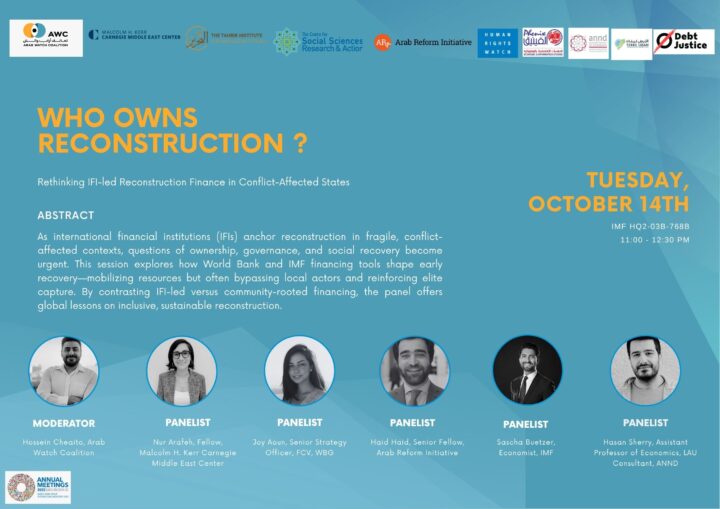
You can now watch the recording
Throughout the Annuals, our advocacy work will spotlight key findings from recent publications highlighted below.