Introduction
It is no secret that feminist movements in our region are struggling. We could debate endlessly what it means for a movement to be doing “well”, only to conclude that this is not the case today. What is undisputed, however, is that for the movement to be in good shape requires a minimum set of essentials, including the capacity to persistently wage one of the toughest and most complex global struggles and the ability to foster internal cooperation and dialogue. Today, both of these abilities are threatened by a range of factors – some of which are entirely beyond the movement’s control, while others lie within.
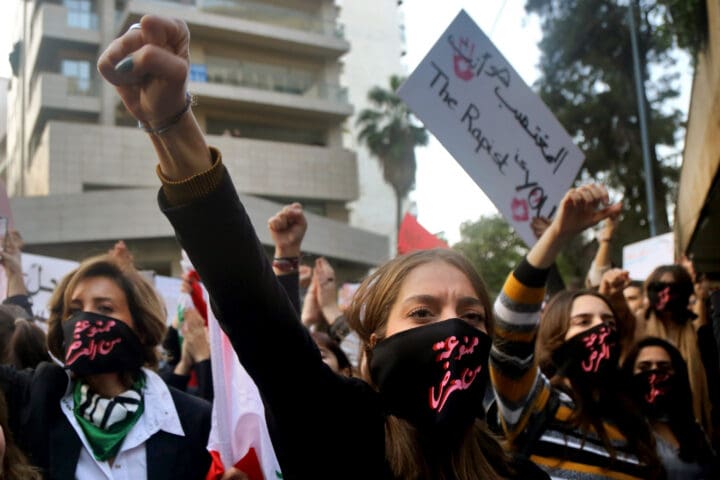
Drawing on more than a decade of significant feminist activism, particularly in Lebanon, and on interviews with independent activists and those working in local, international, and grassroots organizations, we seek to understand the reality of feminist movements today and their interactions with their hostile environment and the difficult political questions they face. We focus on two main themes. The first is the impact of donor cuts to external funding on components of the feminist movement that have long depended on it, despite receiving only a small share of available resources. The second revisits the “backlash” discussed in the years and months preceding the Gaza genocide and the war on Lebanon, which took the form of a violent counter-reaction that intensified alongside the rise of right-wing ideologies in a number of Western countries and flared up across the MENA region. Lebanon witnessed one of its most violent manifestations between 2022 and 2023.
If we look at the current context governing the region, where many countries are reeling under the weight of armed conflicts and profound political and social struggles, it comes as no surprise that we, as activists and human rights defenders, are faced with difficult questions regarding the fate of feminist agendas in light of the myriad challenges confronting our countries and societies, unprecedented in the post-World War II era. These external challenges have risen, on the one hand, from intense hostile reactions, long fueled by patriarchal and sectarian bigotry that is obsessed with quelling any new ideas and progressive gains obtained over recent decades; as well as a collapse of the foundations and ethics that have underpinned political action as manifested, for example, in the perpetuation of mass genocides in Palestine and Sudan. They also include the profound disregard shown by major powers through drastic cuts to human rights and development budgets on which NGOs and women’s groups in our region have almost exclusively relied.
Exiting the Funding System Is Not the Same as Entering It
First, it is important to recall that funding allocated to projects aimed at promoting gender equality and justice worldwide was already meager, despite the expansive official rhetoric of many governments. The Association for Women's Rights in Development (AWID), drawing on a 2024 survey of feminist and queer organizations in 129 countries, found that between 2021 and 2023, 60% of feminist groups received less than US$30,000; only 15% received between US$100,000 and US$500,000; 14% received no funding at all; and a mere 5% had a budget exceeding US$1 million. In contrast, funding for three conservative groups linked to networks hostile to gender equality and the LGBTQ+ community reached nearly US$1 billion between 2021 and 2022.
AWID had previously reported that only 0.42% of grants awarded by major funding institutions in 2022 were allocated to projects promoting women’s rights. In the summer of 2025, the Doria Feminist Fund – which provides direct grants to small feminist and queer initiatives and knowledge-production projects in MENA – announced a 78% reduction in funding allocated to small groups, and projected a further cut of approximately 30% in 2026.
A recent survey of women’s associations in Lebanon in a 2024 report by the United Nations Development Programme shows that the majority are small- to medium-sized initiatives or associations, contrary to the prevailing belief that feminist and women’s groups are limited to large, well-known organizations. Of the 64 women’s organizations interviewed between 2022 and 2023, 78% had between five and 25 members. The survey and interviews included in the aforementioned report showed that “small- to medium-sized organizations face greater funding challenges that extend over longer periods of time, which affects the continuity of their work and the sustainability of their structure”. In this context, it is clear that the organizations most affected by previous funding shortages and current cuts are mostly small- and medium-sized associations, in addition to programs addressing refugee issues and health services for refugees, as well as associations working to promote sexual and reproductive health and rights.
Francesca Al-Asmar, a feminist researcher and trainer who works with United Nations agencies and international and local women’s organizations, explains that projects related to sexual health were the hardest hit through the end of 2025. These projects had received substantial support from government sources that have since decided to cut funding, most notably the Dutch government. Some of the impacted organizations working on sexual and reproductive health were the same ones that had been subjected in 2023 to threats and raids that forced them to close their centers, particularly in northern Lebanon, amid intensifying hostility toward anything related to sexuality and gender – an issue we will address in the second section of this paper.
According to Al-Asmar, other feminist organizations are likely to feel the full impact of European funding cuts over the next two years, as they have not yet been affected by the profound changes that have occurred in the human rights and development program budgets:
because the current funding cycles have not yet ended, especially given the success of advocates’ efforts to promote feminist foreign policies and the continuation of certain opportunities provided by this framework in recent years – to which countries such as Canada and France (and, to a lesser extent, the United Kingdom) have committed – but it seems that what lies ahead will be more difficult.
On a related note, it is inaccurate to say that U.S. President Donald Trump’s decisions to freeze foreign aid and nearly completely halt U.S. Agency for International Development (USAID) operations in early 2025 were the sole and direct factors affecting women’s organizations’ work, at least in Lebanon. The U.S. government rarely provided direct support to local feminist agendas to begin with. Groups focused on gender justice have collaborated, in particular, with Scandinavian governments, the Netherlands, Canada, the European Union, and with a number of United Nations agencies, which have been the hardest hit by the U.S. funding cuts.
In this context, feminist researcher and program director at the Regional Office for Political Feminism at the Friedrich Ebert Foundation, Samantha Elia, explains that “the repercussions of Trump’s political and procedural decisions have led European governments to increase funding for their defense and military programs and to adjust their foreign policies and funding strategies,” in addition to the war in Ukraine and its political and defense implications, which preceded the U.S. president’s decisions.
According to Elia, one cannot overlook “the spread of right-wing and anti-gender ideologies in recent years, the rise of which has forced several institutions to accept certain conditions in order to continue operating”. Yet, according to Elia and other contributors to this paper, the defining event reshaping funding for feminist initiatives, and prompting many in the region to distance themselves from Western donors, remains the genocide of the Palestinian people in Gaza.
The Traditional Funding “Worm” and the “Comfort Zone”
The current funding landscape summarized above was neither surprising nor unexpected. Feminist activists have long recognized the fragility and risks stemming from traditional funding channels and their ties to shifting and unjust state policies, as well as the limitations of relying heavily on them to continue their work.
As a quick reminder, what led to this near-absolute dependence was the shift of the feminist struggle toward institutional and structural work through what has often been described as “institutionalization” or “NGO-ization”, particularly following the 1995 Fourth World Conference on Women, known as the Beijing Conference. This shift was driven by the need of feminist groups for independence from broader charitable organizations or political parties that had failed to accord the necessary importance to their issues and their efforts to establish an organizational framework that placed the issue of violence against women at the heart of an emerging civil society movement, as well as their recognition of the need to meet funding agency requirements to secure support. Thus, what feminists did at the time – that is, in the mid-1990s and early 2000s – was to swiftly embrace the new organizational framework, which offered a promising model that guaranteed their distinctiveness, survival, and prospects for achievement all at once; a model that also contributed, according to a chronological account in Reclaiming the History of Feminist Movements in Lebanon, to limiting the “cultural bourgeoisie’s” monopoly on defending women’s rights.
However, alongside the emergence and growth of the NGO sector and the increasing involvement of young women in institutionalized feminist work, some activists began sounding the alarm, stressing a need to seek alternatives to Western funding and their political and bureaucratic conditions, which drain the energy of both activists and organizations alike, but these calls gained little traction. It is worth noting that many feminists were already convinced that they could not guarantee continued funder interest in their revolutionary agenda, nor could they ignore the precariousness of their positions – a precariousness that would only increase if endless dependence persisted.
Then came 7 October 2023, which upended relations in the region between the funder who turns a blind eye to Israel’s occupation and its perpetration of genocide and ethnic cleansing in Palestine and the recipients of funds who simultaneously receive aid as well as bombs.
But before delving into this issue – which has dominated recent political and feminist discussions – we must highlight some of the underlying structural causes that have existed from the outset. This may help us understand the movement’s failure to reorganize itself and its components differently, well before 7 October and the intensive funding crisis of early 2025.
There are two fundamental reasons for this failure. First, the prevailing funding system has overwhelmed feminist groups with a deluge of responsibilities and tasks that require a comprehensive institutional structure and a diverse set of skills – a situation that has gradually contributed to the closure of intellectual space and the necessary breathing room for reflection, critique, and innovation. It has also emphasized the values of uniqueness, distinction, and professionalism, and in the process, deepened the exclusion of many women’s groups as well as poorer communities from an increasingly institutionalized and centralized human rights field. Simultaneously, this has reinforced activist reliance on the rules of the game.
Second, it lies, quite simply, in the fact that those who have adapted to the Western-funded grant system – or who have not been exposed to forms of change-making efforts from outside it – are attached to the provision of its “comfort zone”. This is particularly true for women working in large organizations that offer employment benefits, health insurance, and salaries considered generous compared to local wages. The situation was made worse by the fact that no other funding sources were directed toward women’s groups and initiatives, whether through official local or regional channels, dominated by militaristic, authoritarian, and patriarchal governments, or through private channels such as wealthy women philanthropists. Very few of the latter prioritize feminist issues; even among those who do, their support often focuses on empowerment programs rather than core feminist concerns or revolutionary initiatives.
This is precisely why many feminists fear that women’s groups will miss the historic moment that now places them at sharp and decisive crossroads. They must either seize the opportunity presented by the erosion of a traditional Western funding system, shaped by state policies and intermediary organizations’ requirements, to rethink their foundation, starting with their raison d’être and language; redefining the scale and relationship with the communities around them; and culminating in diversifying their funding sources and eliminating waste within their operations. Alternatively, they could retreat further into a passive struggle for survival, allowing gradual or sudden funding cuts to intensify the competition already embedded in the system.
Other models, however, may emerge or grow, offering examples from which to learn.
Mihad Haydar, one of the founders of the “Mayli” Library in Baalbek, says:
We never received large sums from our partners to begin with; we were simply looking for ways to cover basic expenses without incurring additional burdens that might result from taking on too many projects. So, we don’t feel that what’s happening now is radically different from what we’ve experienced before, especially since our inception – that is, in the midst of the “backlash” in 2023 – we’ve been thinking about alternative economic models that align with our identity as a local space for women, and we’re working to realize them today, knowing that many feminists shy away from “business” models. But is receiving funding really better? For us, the solution lies in a form of cooperative economy that helps us move beyond the conventional funding system.
Haydar’s account and the Mili Library’s experience reflect longstanding feminist critiques of conventional funding – namely, their unfair distribution of resources, as well as their politicization and transformation into tools of control and blackmail. Mili’s experience also echoes some of the recommendations that are now frequently directed at donors, most notably: “Providing sustainable core support to feminist, youth, migrant and grassroots groups, free from political strings or short-term project cycles,” and other recommendations summarized, for example, by the Women’s International League for Peace and Freedom (WILPF) based on dialogues with activists from Palestine and Tunisia. Other organizations, such as the “Coalition of Feminists for Social Change”, emphasize the importance of philanthropy – or private support initiatives – that fill the void created by a reduction in government and international aid, with a focus on securing multi-year, unconditional funding “that allows groups to set their priorities based on community needs rather than donor agendas”.
Life Before Gaza Is Not the Same as Life After
The deep roots of the funding crisis predate 2023. Since then, however, a number of organizations, particularly in Lebanon and Tunisia, stopped accepting financial support from Western donors, most notably Germany – which had, itself, taken the initiative to cut funding off to Palestinian organizations or those committed to the Palestinian cause. These organizations have accepted the costs of that decision rather than take “money from those with ties to the Zionists,” as Dayna Ash, executive director of the Beirut-based feminist cultural organization Haven for Artists, put it.
Dayna Ash emphasizes:
Haven has indeed lost many opportunities and is now reorganizing its work because it wants no connection with criminal regimes and does not encourage the logic of “take from them and do as you please” because it reproduces the same power dynamics, bearing in mind that the funds provided to us were originally ours, and we treated them as compensation, not as grants... But the time has come for us to break free together from the logic of this system – and the capitalism and the mindset of ease and affluence that have also permeated the “Industrial NGO Complex,” which has placed many activists in a position of passive reception, individualism, and a culture of competition that the global funding system has deliberately sought to establish – you don’t get paid unless you carry out activities; you don’t get paid unless you bring about change – so we must also redefine what it means to be an activist.
Ash continues:
Today, in the face of divisions and the cutting off or refusal of funding following the genocide in Gaza, we must seek ways to support one another as feminist groups and organizations – there is the idea of a mutual aid fund among associations, for example – and return to the cooperative concepts that have long characterized our communities and to the models of work that can emerge from them… It makes no sense to continue distributing resources as they have been distributed or to accept donations from supporters of Zionism… Discussions are taking place among us, but they are not systematic, and we do not yet know what their outcome will be.
Today, more than three years after 7 October, the extent of the rampant political division in the region and across the world is no secret – a division that is also experienced by activists and those interested in producing feminist knowledge. Indeed, it is accurate to say that they are at the heart of pivotal political debates that are filling our public and private spaces.
Over the past two years, numerous analytical and opinion pieces have been written addressing the stance of feminists toward armed Islamic organizations and reflecting on the meaning of resistance as a framework for countering regional expansionist ambitions. These texts have shed light on big political differences among various feminist schools of thought, and, at times, on genuine emotional confusion or a lack of clarity in dealing with the realities imposed upon feminists in the absence of viable alternatives. At other times, they highlighted the ease of returning to one’s community of origin, which quickly transforms from an environment against which one rebels into a safe haven that offers protection. This may have contributed to deepening the divide between many feminists, and with it, the isolation of the feminist movement from its surroundings – one of the consequences of its internal fragmentation, which we will address further in the next section.
According to Mihad Haydar:
Perhaps it was the funding and its conditions that made the liberation of some of us [i.e., feminists] appear superficial, even though, deep down, it had not actually been achieved. The proof was that some people’s sense of threat and danger – a feeling that is, of course, justified – led them back to something resembling tribalism in search of protection, which continues to be provided by the sect or the narrow community. But in my opinion, human empathy differs from a return to absolute identification, as I fear that such a process would take us back to square one.
When “Backlash” Seeps from Outside the Movement into Its Ranks
Faced with political developments on the ground and changes to the traditional funding system, activists fear that women’s organizations may survive only by compromising their political narratives and principles. Accommodating conservative social trends and shifting donor priorities could produce a subtle internal backlash, manifested in organizations abandoning some of the fundamental tenets that define the feminist struggle.
This is what researcher Francesca Al-Asmar observed when she expressed her fear that the period of survival efforts would be prolonged, and that, in parallel, wars and economic challenges would continue to escalate in our region:
Forcing feminists to endure a harsh material reality that makes it difficult for them to find space to think about alternatives and nurture internal solidarity, while the focus of this phase is on recovery and rescue efforts, which will push them to accept the conditions of new donors – including intellectual and linguistic frameworks aligned with the rise of conservative currents – and to try to circumvent them by treating them as mere formalities that allow for continued survival.
Al-Asmar continues:
We have already witnessed the beginning of this chapter with the refusal of official bodies in Lebanon to use the term “gender” in their projects. So far, the course of events suggests that organizations will be forced to accept this and may, over time, make further concessions in order to survive; indeed, there is a fear that their discourse will gradually become stripped of its political dimension and that existing divisions will deepen due to increasing competition for resources.
The issue, of course, is not limited to self-censorship within certain segments of the feminist movement or avoiding the use of the word gender or the concept of gender in training sessions organized with the Ministry of Social Affairs and other government institutions, for example. It extends to include hostile practices against anyone who does not conform to the norms of a social order fiercely defended – at intervals and on demand – by opponents of personal freedoms and rights-based agendas. These include certain religious figures concerned with “public morality”, Hizbullah supporters, members of the “Soldiers of the Lord” group, and the Catholic Media Center. This hostility manifested itself in the summer of 2023 in Lebanon through a series of violent attacks against the LGBTQ+ community and activists in what became known as the “Freedom March”, which included feminist activists.
This paper does not seek to review the many definitions of backlash developed by researchers and thinkers worldwide. These definitions vary according to political and local contexts and increasingly treat backlash as an ongoing process rather than a discrete event. For activists in Lebanon, this violent backlash consists of “various forms of structural discrimination and exclusion that are fed, incubated and fuelled by the sectarian system; and that not only fight and obstruct advocacy for rights, but more importantly, impede the possibility of progress”.
Months after this definition appeared in a 2023 study by researcher Nay El Rahi, feminist, queer, and cultural activists in Lebanon faced one of the fiercest episodes of violent societal and governmental backlash. Such attacks have become familiar: they intensify whenever the ruling system senses a crisis that could threaten its foundations and established practices, exposing its profound failure to address economic and financial hardship.
Is the Feminist Movement Still Threatened by Another Violent Upheaval Similar to That of the Summer of 2023?
Today, more than two years after witnessing the most horrific war crimes in Palestine, Lebanon, Syria, and other countries, which have naturally overshadowed domestic concerns, is the fear of a resurgence of backlash similar to the palpable brutal form it took in 2022 and 2023, or has it returned to its usual oscillating pattern between truce and “mild” escalation – a pattern that feminists have grown accustomed to living with?
There is no simple yes-or-no answer. A number of activists believe that we are currently going through a long period of adaptation and stagnation that we have reluctantly accepted because we have no other choice but to anticipate intense momentary violent backlashes in certain areas or on certain occasions, and to learn how to continue our work and coexist in what Samantha Elia describes as:
The phase in which we cannot undo the effects of what happened in 2023, because visuals and information related to gender, rainbow flags, queer spaces, and queer and trans people – who are the most vulnerable to violence – are now firmly embedded in the minds of those who previously did not attach the utmost importance to them. Such awareness has a long-term impact.
Regarding the backlash pattern of operation – with its fierce seasonal nature – and whether its next waves are imminent, feminist researcher and director of the “Knowledge Workshop” organization, Deema Kaedbey, comments:
The question of the “backlash” reminds me of how we deal with the civil war in Lebanon – a war that ended but is not truly over, and could flare up again at any moment. It’s as if the two issues are similar, because a system like ours creates such a reality. Hostile spaces and platforms are always ready to find a scapegoat and attack it. But at the same time, I ask: The sectarian and clientelist system has now restructured itself, and we are in a state of confusion and defeat – so why would it need to generate a “backlash” at a time like this?
A Multi-Layered Internal Division
As feminist groups grappled with traditional funding limitations and a violent sectarian political system that is always ready to attack those it dislikes, some feminists find themselves either tightening control over their discourse or struggling with internal conflicts. This is because the movement, as a whole, is not immune to either of these evils – neither traditional funding dominance nor the violent tools of a sectarian political system – and thus bears the internal consequences of both.
Political activist and Mada Network member Marwan Issa comments on the issue of funding, and its link to certain internal failures:
Most civil society initiatives, despite the significant positive role they played, were temporary in structure and did not contribute to the creation of sustainable social movements. For as much as they sought to introduce sustainable and intersectional “bottom-up” elements, they remained bureaucratically constrained and dependent on the whims of regimes in other countries […] What is needed today is for an intersectional feminist vision to be an integral part of the vision of any new political entity across the country, not merely a separate issue treated as an imposed add-on.
In addition to the aforementioned challenges faced by feminist initiatives, as well as emerging political organizations – which, according to Issa, have not yet succeeded in properly integrating feminist perspectives into their discourse and work – there is another significant challenge that activist Nadine Moawad has termed the process of “capture”, which feminists are subjected to under the rule of surveillance capitalism. This drives the economy of virtual platforms, and, consequently, fosters individual contribution and competition logic, rather than collective political action, which deepens a kind of soft internal backlash, or a state of chronic tension that undermines feminist work and its ability to mobilize.
On the one hand, the competitive logic of both surveillance capitalism and traditional financing systems has taken deep root in the movement; “we have been programmed to compete,” as Samantha Elia puts it. On the other hand, this logic has taken on additional dimensions with the emergence of new political divisions after 7 October that go beyond the common points of contention within feminist movements worldwide – chief among them issues of trans rights, surrogacy, and the purchase of sexual services – thereby adding a new layer of polarization that risks diminishing the chances of forming balanced pressure groups and collective negotiating blocs capable of yielding positive results, as had previously been hoped. This competitive logic and intractable political division do not merely produce internal polarization, which deepens feminist movement component fragmentation; they also lead to mutual alienation – an alienation that borders on a complete break and hostility toward those who do not share their political and intellectual orientations.
From Mihad Haydar’s perspective:
Some feminists prioritize certain narratives – such as the necessity of liberation from imperialism first – but neglect a realistic assessment of women’s conditions in marginalized areas under colonialism and under the rule of political parties, clans, and sects as well. After 7 October, I feel that our isolation is worsening. We unite against an external enemy, but at the expense of working against internal erosion... The current prevailing logic is very tribal, and therefore very patriarchal.
So, What Now?
“Now, the priority is for all of us to be OK – physically, economically, and mentally,” says Deema Kaedbey in a phrase that is eloquent in its simplicity. She adds: “Even in the worst crises, there are transformations, and people are working; the fruits of their labor may not be visible today, but we will appreciate the harvest later.”
Perhaps the idea of “being OK” doesn’t mean that a woman should set out to take care of herself and focus solely on her personal needs, given the frustration one feels due to an overwhelming inability to achieve even the most minimal desired changes, based on self-care governed by that sterile form of individualism, promoted by a culture of consumption excess and a detachment from reality. Rather, it means that people care for one another, to a certain extent, as a wise, ancient, and innate human practice that we draw on in times of human upheavals – such as those we are experiencing today on the security, climate, livelihood, and intellectual fronts. Alongside this care, it means creating spaces where political differences have room to breathe, either by scaling them back from their imagined, algorithmically-driven, and remotely constructed expectations, or by giving them precise contours and labels, and perhaps even nvitating their clearer expression. This could open the door to new ways of addressing political differences, even if only briefly, that suit current circumstances.
As Francesca Al-Asmar says, there is an urgency to meet, and only to meet: “We need to build trust that allows for genuine solidarity – in practice, not just in theory… Communication today is a priority more than ever.”
Perhaps among the sentiments expressed by participant and non-participant activists in this paper is the importance of ensuring a minimum level of dialogue and solidarity during this sensitive historical juncture. This is something that feminists previously felt, hoping for a better future from their darkest depths, after having lived through complex struggles, including efforts toward national liberation and confronting a patriarchy entrenched in their immediate and broader circles.
Despite these difficulties, many of them across the region did not hesitate to take on diverse roles, including engaging in or supporting direct armed struggle, even amid a clear disparity in power between, at the time, fighting groups and occupying forces; while others remained engaged in discussions about their rights within closed rooms, libraries, homes, and the working groups to which they belonged.
But the paradox today lies in the unprecedented scale of military and technological changes that have swept the world, and the countries of this region, affecting combat conditions and the very nature of solidarity itself. Consequently, some of those concerned with human rights and feminist issues have been confronted with difficult questions about the meaning and form of resistance today, their responsibilities in light of this intertwining structural complex of oppression, colonialism, and religious and patriarchal extremism, and the meaning of solidarity from a Global South perspective – one that is dissatisfied with global politics and its own repressive national and regional governance systems.
Does this signal the approach of a moment when feminists and human rights activists recognize the need to return to certain fundamentals – such as feminist theory itself – and attempt to answer questions that seem simple, such as: What truly unites us today as feminists? Does the feminist intellectual framework still hold an indispensable place, or has it become secondary? How do we engage in dialogue and resolve our differences? What avenues can we utilize to support those among us who are most at risk? What does solidarity look like outside the framework of surveillance capitalist algorithms? And how can we ensure that traditional funding channels do not once again ensnare us?
In short, this phase requires awareness, patience, adaptability, and a reordering of priorities – not to abandon fundamental feminist demands, but to advance them in a way that aligns with the current feminist context and its lessons.
The weight of accumulated injustices necessitates a reevaluation of approaches that have prevailed over the past three decades – approaches that, intentionally or not, have contributed to an emergence of fragmented movements, rather than cohesive or dialogue-oriented groups. However, this realization must be accompanied by modern visions led by young women actively engaged in political and human rights issues, somewhat removed from the vortex of old disputes within feminist movements: perspectives that respond to the current thorny and confusing political reality, investing more in networking with regional and international feminist and political organizations, not in genocide justification or siding with racist and colonialist forces, nor in defense of authoritarian regimes or groups in the name of anti-imperialism. Rather, share in defending a world based on just, legal, and ethical principles – a world we do not mourn today because we have not yet lost, since it has not yet been realized; a world inspired by a feminism that does not view crime and aggression as a point of view, nor masculinity and violence as a cultural issue that can be postponed in the name of grand ideals.
And of course, this discussion is far from over, because any in-depth reflection on visions of the future – which helps deepen our understanding of what we are experiencing and living through, and helps us foresee a substantive and effective form of feminist political action today – cannot be achieved through individual contemplation, but rather through collective intellectual, emotional, and imaginative exercises, wherever they may arise.
NOTE: All quotations without accompanying footnotes are drawn from interviews conducted by the author with the individuals quoted and are reproduced here with their consent.
The views represented in this paper are those of the author(s) and do not necessarily reflect the views of the Arab Reform Initiative, its staff, or its board.