Introduction
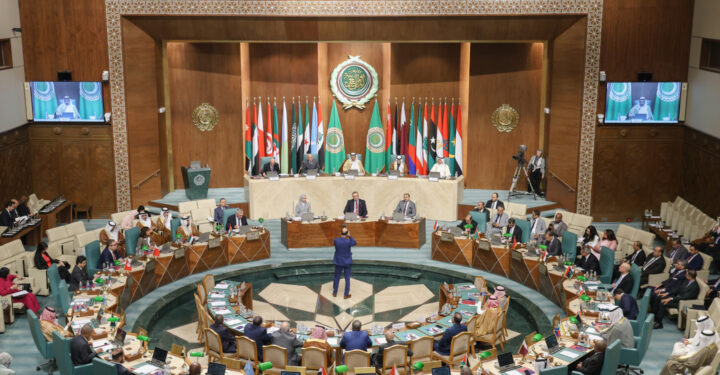
Arab collective security has a familiar scapegoat: the Arab League. The latest criticism emerged after the United States and Israel began bombing Iran in February, when attacks affecting Gulf states and regional maritime security revived questions about the absence of a credible Arab collective security framework. In moments of regional crisis, the League is criticized for being slow, cautious, or ineffective. The criticism is often justified, but risks missing a deeper problem. The weakness of the League is not separate from Arab security politics; it is one of its clearest manifestations.
Arab states are once again criticizing the League at a moment when regional security is under direct strain. Yet, the more revealing question is not whether the League has responded strongly enough; it is why member states continue to direct expectations and criticism toward an institution that they have not empowered to provide binding collective security.
The League is neither the center of regional security politics nor the only weak link in Arab collective security, but it remains the most visible one. It remains a formal arena where Arab states express collective positions, while the actual practice of security is dispersed elsewhere. Individual states rely on arrangements that are narrower, more selective, and often external to the Arab regional system, compounding the existing capabilities-expectations gap – the discrepancies between what Arab states expect the League to deliver and the authority and resources they actually give it.
This gap is the starting point of the paper. Criticism of the League fails to address the central problem: member states preserve a fragmented security system because it allows them to invoke Arab solidarity without accepting the constraints of binding collective action. The League therefore remains politically visible but institutionally weak, while deterrence, protection, and crisis management are organized through narrower and often external arrangements.
The 2026 War Exposing a Familiar Pattern
The immediate trigger for the latest round of criticism was the war that began on 28 February 2026, when the United States and Israel launched strikes on Iran. Iran retaliated with missile and drone attacks against Israeli territory and against U.S. bases and other targets in Gulf states and Jordan, including airports, energy facilities, and key transport nodes. These attacks raised immediate concerns about the protection of critical infrastructure, the security of maritime routes, particularly the Strait of Hormuz, and the stability of global energy flows.
The short-lived April ceasefire did not settle these questions. It shifted the crisis into a more fragile phase, as efforts to move from military escalation to negotiation remained uncertain. A U.S.-Iran framework agreement announced in June created a temporary basis for de-escalation, including discussions over the ceasefire, navigation through the Strait of Hormuz, Iran’s nuclear program, and sanctions relief. But the agreement did not produce a stable settlement. By late July, renewed U.S. strikes, U.S. and Saudi attacks on Iran-aligned groups in eastern Iraq, and an attack near Egypt’s Damietta port showed that the war was widening and that risks to regional energy routes remained unresolved.
The situation remains fragile, if not alarming, and any near-term agreement may do little more than reduce the immediate risk of renewed war. Wider regional security concerns remain unresolved, particularly for the Gulf states. The crisis has therefore renewed the question of whether any regional framework is capable of managing threats that affect several Arab states.
The criticism directed at the Arab League during the crisis followed a familiar pattern. From Syria and Libya to Gaza, regional crises have repeatedly been accompanied by calls for stronger Arab action and disappointment with the League when its declarations produced little visible effect. This pattern has been documented in assessments of the League’s responses to these regional crises (for instance, the Council on Foreign Relations; Arab Center Washington DC). The League became the main target of frustration because it is still expected to represent a collective Arab response, even though its member states have kept its role limited.
As the war unfolded, regional institutions responded in familiar ways. The League condemned the Iranian attacks, called for de-escalation, and reaffirmed the principles of sovereignty and regional stability. The GCC adopted a more direct security-focused tone, reflecting the fact that Gulf states were themselves exposed to the conflict. Its secretary-general, Jasem Mohamed Albudaiwi, called on the UN Security Council to take “all necessary measures” to halt Iranian attacks on GCC states, protect waterways, and guarantee international navigation, while also insisting that Gulf states be included in any negotiations with Iran. The Gulf states took the issue to the United Nations Security Council, where a Bahrain-led GCC-backed Resolution 2817 condemning Iranian attacks was adopted with broad support. While the Security Council resolution marked an important political signal, efforts to move beyond condemnation toward more robust measures, particularly regarding the protection of maritime navigation in the Strait of Hormuz, faced resistance from major powers and did not materialize.
These responses should not be dismissed. They established formal Arab and Gulf positions on sovereignty, escalation, maritime security, and the protection of regional stability. But they also showed the limits of the existing frameworks. Regional institutions could define the threat politically and express collective concern, but they could not organize a shared mechanism for protection, deterrence, or crisis management.
This gap quickly became part of the political debate. Several Arab and Gulf voices questioned whether the response matched the scale of the threat. Kuwait called for a “frank and responsible review” of the system of joint Arab action, arguing that repeated crises had exposed the limited effectiveness of existing frameworks. Gulf political discourse more broadly portrayed the response of regional organizations, particularly the Arab League, as too slow, too cautious, or too limited for a moment when member states were themselves under attack. UAE diplomatic adviser Anwar Gargash, for example, openly criticized the failure of Arab and Islamic institutions to respond effectively to escalating Iranian threats against Gulf states. This made the familiar criticism of the League more politically charged: several member states were facing direct risks to their territory, infrastructure, and maritime security.
The criticism was understandable. Statements and resolutions could establish a political position, but they could not by themselves protect territory, secure maritime routes, or manage escalation. Yet, focusing on the League alone narrows the problem. The League became the most visible symbol of collective Arab inaction, even though its ability to act depended on the authority, resources, and political consensus that its members were willing to provide.
Does the Arab League Still Matter?
The obvious objection is that the Arab League is no longer the place where Arab security actually gets organized. Gulf states increasingly rely on bilateral defense ties, external partners, and ad hoc diplomatic channels. Saudi Arabia’s strategic relationship with Pakistan, the UAE’s security and normalization ties with Israel, renewed regional engagement with Syria, and the growing role of Turkey all point to a more fragmented security landscape. These arrangements matter because they can provide access, deterrence, intelligence, military cooperation, or diplomatic leverage that the Arab League cannot offer.
However, bilateral and subregional arrangements serve a different purpose; they help states manage specific threats. The Arab League remains the only formal institution that can collectively speak in the name of Arab states. It is the arena where governments still produce shared language on sovereignty, territorial integrity, non-intervention, Palestine, de-escalation, and attacks on Arab territory. These positions do not amount to collective security in a military sense, but they define what Arab states can publicly recognize as a shared regional concern. This collective language matters in several areas. Sovereignty is one example. In the current crisis, as in earlier conflicts, Arab and Gulf responses emphasized the sovereignty and territorial integrity of states exposed to attacks. Such language establishes a shared diplomatic position against the normalization of cross-border attacks on Arab territory. De-escalation is another example. Statements by the League often call for restraint, dialogue, and regional stability. These calls can sound predictable, but they help define escalation as a regional problem rather than only as a confrontation between Iran, Israel, and the United States. Palestine is a third area where collective Arab language still matters. The League remains one of the few institutions where Arab states continue to formulate a collective position on Palestine and Gaza, even when their bilateral relations with Israel differ sharply. The reintegration or exclusion of states from the Arab regional order is another area where the League matters. Syria’s return to the Arab League in 2023 also showed that the League still matters as a site where Arab states decide who belongs to the formal Arab order.
These examples show why the League should not be judged only by whether it can deploy forces or deter attacks. Its influence is limited, but not irrelevant. It provides a formal vocabulary of Arab collective concern. The problem is that this vocabulary is not matched by a mechanism capable of turning collective positions into collective security.
Partial Alternatives, Incomplete Solutions
Repeated criticism of the League shows that Arab governments and regional political actors continue to invoke the idea of Arab collective security. Yet when states need deterrence, protection, mediation, or crisis management, they consistently turn elsewhere. The result is a persistent gap between the continued invocation of Arab collective security and its practical organization. The GCC can coordinate among a smaller group of states with shared security concerns. The UN Security Council can provide international legitimacy. Bilateral and external partnerships can offer military cooperation, intelligence, arms procurement, joint exercises, or diplomatic access. These channels matter because they give states tools that the Arab League does not possess.
But these channels do not resolve the underlying problem. The GCC cannot represent the Arab region as a whole. The UN remains shaped by global power politics. External security partnerships may help individual states address immediate risks, but they also move security provision outside regional institutional structures. In short, they do not create a collective Arab security framework.
The GCC illustrates the limits of these partial alternatives. Gulf states differ in their approaches to Iran because of their different threat perceptions, economic exposures, and diplomatic traditions. These differences shape whether they emphasize deterrence, dialogue, or hedging. Although the GCC Joint Defense Agreement formally treats an attack on one member state as an attack on all, its implementation still depends on political decisions by individual states. The Peninsula Shield Force (the GCC's joint military force, formed in 1982 but rarely deployed), the Joint Defense Council (the GCC ministerial body tasked with coordinating member states' defense policy), and the unified military command signal an aspiration for Gulf collective defense. Yet the system remains closer to political coordination than to an executable command structure. The GCC may therefore provide a more focused arena than the Arab League, but it is not a unified security actor. In a major escalation, its members are still likely to act individually, bilaterally, or in smaller groups.
The limits of U.S.-Iran diplomacy make this point clearer. Gulf commentary has argued that any sustainable settlement with Iran cannot be limited to temporary relief or a bilateral U.S.-Iran understanding. From this perspective, Gulf states need regional guarantees, accountability mechanisms, the reopening of the Strait of Hormuz to international navigation, and recognition that they are directly affected stakeholders in any agreement. This does not contradict the argument that Gulf states rely on external diplomacy. It exposes the limits of that reliance: even when de-escalation is negotiated through Washington and Tehran, Gulf states demand consultation, guarantees, and recognition as affected parties. However, these demands have not produced a binding regional security framework.
The history of the Joint Arab Force also shows that this problem is not new. The idea, endorsed in 2015 and periodically revived during later crises, reflected a recurring recognition that Arab states lack a more structured collective defense mechanism. Yet it repeatedly stalled over questions of leadership, command structures, decision-making, and the scope of intervention. These disagreements were not technical details. They went to the heart of the problem: Arab states may agree in principle on the need for cooperation, but not on how such cooperation should be organized or who should lead it. The result is an Arab security architecture that remains layered and uneven.
Why Member States Preserve the Current Arrangements
If the weaknesses of the existing system are so familiar, why have Arab states not replaced it or given the League greater authority? The answer lies in the gap between supporting collective Arab action in principle and accepting the obligations it would impose in practice.
A stronger collective security system would require governments to agree on what constitutes a threat, when joint action should be taken, who should lead it, and how decisions should be enforced. It would also require states to accept constraints on policies they regard as central to national sovereignty and regime security. Arab governments have repeatedly shown that they are willing to coordinate when their interests align, but are far less willing to bind themselves in advance to decisions that might later constrain them.
Competing threat perceptions make these commitments even harder. Arab states do not view Iran, Israel, Turkey, political Islam, or external military involvement in the same way. They also differ over particular conflicts and over their relations with the United States, China, Russia, and European powers. A collective security mechanism would have to bridge these differences before a crisis occurs. In practice, governments have preferred arrangements that allow them to respond selectively.
Bilateral partnerships, temporary coalitions, and informal alignments offer that flexibility. They allow governments to choose different partners for different problems, adjust their positions as regional conditions change, and avoid long-term commitments to states whose interests may later diverge from their own. Research on Middle Eastern regionalism describes the post-2011 order as increasingly shaped by unstable, government-led, and informal “liquid alliances,” rather than durable regional cooperation. These arrangements may be less coherent, but they give states more room to maneuver than a binding regional institution would.
The fragmented system survives because it protects national freedom of action more effectively than it provides collective security. States gain access to the political language of Arab solidarity while remaining free to choose their partners, define their threats, and decide when they will act. This is why they continue to rely on partial alternatives while avoiding the obligations that an empowered League would require.
Conclusion: Responsibility Without a Center
The 2026 war did not create the problem of Arab collective security; it brought it into sharper view. The Arab League remains the easiest institution to blame when collective Arab action fails to materialize. The Arab League does not solve Arab collective insecurity, but it cannot simply be dismissed as irrelevant. It continues to provide a formal language of collective Arab concern: it allows Arab states to condemn attacks, invoke sovereignty, call for de-escalation, and express collective positions on Palestine, Syria, and regional stability. But its statements rarely translate into binding security action, and Arab states continue to organize security through narrower, more selective, and often external channels. Until this gap is addressed, future crises are likely to reproduce the same pattern: criticism of the League, reliance on partial alternatives, and no clear answer to the question of who is responsible for Arab collective security.
Responsibility for Arab collective security rests with member states. However, they have chosen to leave its organization dispersed, narrow, and fragmented. Blaming the League obscures member states’ unwillingness to create or empower a framework that could constrain their freedom of action.
The views represented in this paper are those of the author(s) and do not necessarily reflect the views of the Arab Reform Initiative, its staff, or its board.