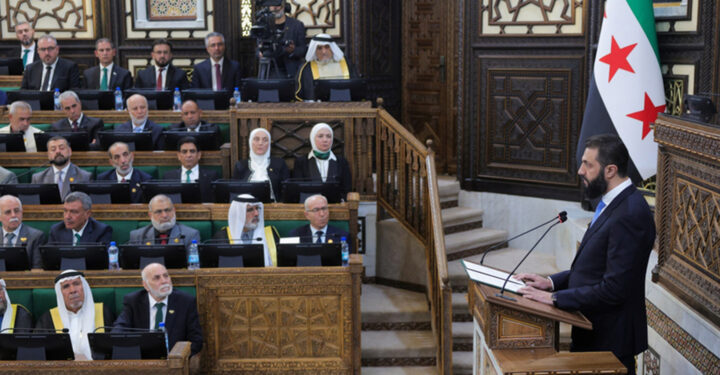
After months of anticipation, Syria’s transitional parliament has finally convened. Its first session, held on 12 July, came after President Ahmad al-Sharaa announced the names of 70 lawmakers appointed to Syria’s transitional parliament. They joined 137 others chosen earlier through an indirect election process managed by a committee also appointed by Sharaa.
The president’s list addressed some of the weaknesses in representation that arose from the indirect election. That process was criticized for being centrally managed, opaque, and vulnerable to political manipulation. It produced a legislature that was overwhelmingly male and insufficiently reflective of Syria’s diversity.
Sharaa’s appointments sought to correct some of these imbalances. They added more women and brought in more figures from religious and ethnic minorities. Yet the new legislature remains widely criticized for being far less representative than the country it is meant to serve. Women’s participation remains low; several appointees have limited ties to the communities they are meant to represent, while some key political and territorial actors remain weakly represented or absent.
But representation is only one test of legitimacy. The announcement of the full list was meant to end months of uncertainty and allow parliament to begin work. However, its inaugural session, scheduled for 7 July, was postponed without a clear explanation or a new date before eventually being held yesterday.
That delay, though brief, was more than an administrative hiccup. It was reportedly prompted by the unconstitutional procedural instructions for the first session issued by the Sharaa-appointed head of the Syrian Supreme Electoral Committee. The instructions sought to alter the rules governing how the first session would convene, including how the speaker would be elected, how the Assembly’s bureau would be structured, and when the president would be invited to speak.
Issued without a clear legal basis and beyond the committee’s mandate, they further undermined the parliament’s authority, independence, and legitimacy. Together, these episodes underscored the central test now facing Syria’s transitional parliament: whether it can become a functioning institution with real authority, or remain another body shaped by executive discretion and procedural uncertainty.
The issue now is not only about who sits in parliament. It is whether a legislature born out of an imperfect process can still become a meaningful institution. Its legitimacy will depend on whether it can give voice to the country’s wider concerns, assert its authority, scrutinize power, and engage society beyond the narrow circles through which many of its members were selected. Only then can it begin to build public trust and lay the foundations for a more inclusive transition.
Appointment as Correction
Sharaa’s list was presented from the outset as a corrective measure. Officials argued that the president’s appointees were intended to improve the inclusivity and representation of the new parliament, a claim that gained force as criticism of the indirect election process intensified. The process began in June 2025, when Sharaa appointed an 11-member Supreme Committee to oversee the formation of parliament. The committee then created district-level electoral subcommittees, which in turn formed electoral colleges of up to 50 members in each district. Only members of those colleges were eligible to stand for a seat and vote.
The process produced 137 lawmakers, but was widely criticized for its opacity, weak oversight, and vulnerability to political manipulation. Concerns deepened after the results were announced, with observers reporting electoral violations and arguing that the elected lawmakers did not adequately reflect Syria’s ethnic, religious, and social diversity. Women’s representation was also far below expectations, while voting was delayed or suspended in areas outside full government control, including Sweida and, initially, parts of the Kurdish-led north-east.
The president’s appointments addressed some of these imbalances. His list included 15 women, raising the total number of female lawmakers to 21 after only six were chosen through the earlier process. While the list included 15 religious figures, the majority of the appointees were professionals, alongside revolutionary figures, traditional leaders, and members of armed factions.
The list also improved the representation of some ethnic and religious groups. It included two Kurds, bringing to 11 the total number of Kurdish parliamentarians. It also added two Alawites and increased the number of Christian lawmakers from one to six. With the three seats allocated to Sweida still vacant because of its conflict with Damascus, the president’s list also provided the parliament’s only Druze member.
These additions make the parliament more diverse than it would otherwise have been. But they remain limited. This is especially true of women’s representation, which, despite the increase, remains low.
Diversity Does Not Mean Representation
While these additions matter, diversity on paper is not the same as representation in practice. Including figures from different religious and ethnic groups without a direct vote from those communities does not automatically mean that those communities feel represented. In such cases, representation depends largely on who those individuals are, how they are perceived, and whether they have meaningful ties to the communities or districts they are meant to represent.
Although some parliamentarians may have strong social standing and local legitimacy, many do not. The Druze figure appointed by the president, Laith al-Balouth, for example, is viewed by many Druze from Sweida as pro-government rather than as a representative of their community. With Sweida’s own seats still vacant, such appointments would do little to bridge the gap between Damascus and communities that already feel politically alienated.
Similarly, none of the Kurdish members of parliament are linked to the Syrian Democratic Forces, which boycotted the election process and were also not represented in the president’s list. This does not make those Kurdish lawmakers irrelevant, but it does limit the extent to which they can be seen as representing the main Kurdish-led political and military actor controlling large parts of northeastern Syria.
The problem is not only ethnic or religious; it is also geographic. Conversations with local communities in different parts of Syria suggest that many of those elected or appointed were displaced from their communities during the war. As a result, many do not have strong ties to the people currently living in the districts they are meant to represent.
The same applies to figures affiliated with political movements and opposition bodies. Conversations with analysts reveal that these figures were included as individuals, not as representatives of the organizations or constituencies to which they belong or once belonged. This weakens parliament’s ability to reflect organized political currents and reduces representation to a matter of personal profile rather than collective mandate.
The Performance Test
In this environment, parliamentarians will have to build legitimacy after the fact. Their performance, visibility, and engagement with the public will determine whether their ties to constituencies strengthen or weaken over time.
Their ability to perform that role will depend partly on the resources available to them. Conversations with several members of parliament (MPs) suggest that the outlook is not promising. According to these accounts, the state does not plan to allocate funding for MPs to hire staff to help them carry out their duties. Nor does it plan to provide offices where they can work, meet citizens, or engage with their constituencies.
This is not a question of privilege or prestige. Parliamentary offices and staff are basic tools of representative and legislative work. MPs are expected to review hundreds of laws, assess complex legal and policy proposals, scrutinize the executive, and respond to citizens’ needs. Many do not have the legal or legislative experience required to assess draft laws, identify risks, or ask the right questions.
Without staff, offices, or technical assistance, parliament risks becoming dependent on the executive or informal networks for information and advice. That would weaken its independence from the start. It would also make it harder for MPs to build ties with their constituencies, understand local needs, and demonstrate that they are more than names on an official list.
Some MPs may be able to hire staff or rent offices using their own resources. Many will not. This risks creating unequal capacity inside parliament, where wealthier or better-connected members are better able to act effectively while others struggle to carry out even basic responsibilities. In a transitional context, where legitimacy is fragile and institutions are still being rebuilt, such disparities could have serious consequences.
The Fight for Authority
The initial postponement of the first parliamentary session, without a public explanation or a new date, together with the reported issuance of procedural instructions by the head of the Syrian Supreme Electoral Committee beyond its mandate, underscores another major challenge: parliamentary authority and independence.
Before Syria’s new People’s Assembly convened, a constitutional dispute had already emerged over who had the authority to shape the legislature’s founding moment. Under Decree No. 143, the Supreme Electoral Committee’s role is limited to calling members to the first session within a specified timeframe. It does not grant the committee authority to organize that session, amend its procedures, or postpone it.
Yet reported instructions sent to Assembly members appear to have gone far beyond that mandate. They sought to regulate how the constitutional oath would be taken, how the speaker would be elected, how the Assembly’s bureau would be structured, and when the president could address the chamber.
Two of these changes are especially serious. First, the instructions reportedly allowed the candidate with the highest number of valid votes to be elected speaker, even without securing a majority. This would replace a majority threshold with a plurality rule, allowing a speaker to win with limited support in a divided chamber.
Second, they reportedly barred any candidate who loses one contest from running for another position during the same session. This rule has no clear constitutional or legal basis and could sharply restrict competition for leadership posts. Together, these measures suggest that a body created to manage the electoral process was attempting to write the rules of the legislature before it had even begun work.
The proceedings of the first session, held on 12 July, indicate that these procedural changes were accepted and implemented. However, it is important to highlight that Abdul Hamid Aqil al-Awak, who was elected as the speaker of the assembly, secured 99 votes and defeated the other two candidates by a comfortable margin.
Nonetheless, the risk posed by these procedural interventions goes beyond the first session. By accepting them, Syria’s transitional parliament has begun life not as an independent legislative institution, but as a body shaped by the executive. That sets a dangerous precedent, weakens the Assembly’s legitimacy, blurs the separation of powers, and makes it harder for parliament to later assert authority over legislation, oversight, and accountability. The first session was therefore not a formality; it was the moment the legislature accepted a subordinate role instead of defending its institutional autonomy from the outset.
Transparency Matters
The initial postponement of the first parliamentary session without a clear public explanation underscored another major challenge: transparency. For the new legislature to gain legitimacy, Syrians need to know not only who its members are, but also what they are debating and how they are voting.
Public access to parliamentary proceedings will be crucial. Sessions should be broadcast publicly, and agendas should be published in advance so that those interested can follow or attend. Voting records should also be documented and made publicly accessible. Citizens should be able to see which MPs are active, what positions they take, and whether they are defending public interests or merely endorsing decisions made elsewhere.
These rules should be embedded in parliament’s internal bylaws. If the body is to become more than a transitional façade, it must establish procedures that protect openness, debate, and accountability. The way it writes its own rules will therefore be an early test of its seriousness.
Transparency also matters because parliament’s authority will not be automatically recognized. Under Syria’s current transitional arrangements, real power remains heavily concentrated in the executive. If parliament is opaque, weak, and poorly organized, it will struggle to assert itself. If it operates publicly, documents its work, and engages citizens, it will be better placed to claim political and institutional relevance.
From Individuals to Blocs
Another key question is whether MPs can organize beyond their localities and personal networks. Hayat Tahrir al-Sham (HTS) may not hold a numerical majority in parliament, but it appears to be the only sizable force with the coherence, connections, and organizational capacity to act as a bloc. That could make it the de facto leading bloc in the new legislature.
If other MPs operate only as individuals, parliament will struggle to act effectively or independently. Its ability to shape legislation, demand information, summon ministers, and scrutinize government action will depend on whether members can build coalitions across regions, backgrounds, and political tendencies. This will be especially important on issues that require collective pressure, including public hearings, amendments to draft laws, demands for transparency, and oversight of executive decisions.
Coalition-building will also matter in any effort to strengthen parliament’s formal powers. At present, its ability to hold the government to account remains limited. Beyond questioning ministers, MPs will need to work collectively if they want to push for changes to the constitutional declaration or internal rules that expand parliament’s oversight role. This includes the power to conduct meaningful hearings, request documents, investigate abuses, and scrutinize not only ministers, but also senior officials who exercise real authority.
Such powers will not be granted automatically. They will have to be demanded, negotiated, and institutionalized. That requires MPs who understand their role not merely as lawmakers, but as custodians of a fragile transition.
The Stakes Ahead
Syria’s transitional parliament emerged from a deeply flawed process. It is not meaningfully representative, its formation was opaque, and its independence is far from guaranteed. Yet it is now one of the few institutions through which public concerns, legislative reform, and executive accountability could begin to take shape.
At this stage, its success will not be measured by how it was formed, but by what it does next. Its members now face the difficult task of turning a contested body with limited public legitimacy into a functioning institution capable of making credible decisions, opening space for public debate, and placing meaningful limits on executive power.
The coming months will therefore be decisive. If parliament becomes a passive body that simply endorses executive decisions, it will deepen public cynicism and reinforce the perception that Syria’s transition remains managed from above. But if it can assert its role, build coalitions across social and political divides, and produce legislation that responds to the needs of a fractured country, it could become one of the few institutions capable of increasing public trust.
The stakes go far beyond the credibility of one legislature. A functioning parliament could help move Syria away from personal rule and executive discretion towards institutional politics. If it fails, the emerging state will be left with another hollow institution where accountability should be. If it succeeds, even imperfectly, it could give Syria’s transition what it urgently needs: a public, accountable centre of political gravity capable of outlasting the men who built it.
The views represented in this paper are those of the author(s) and do not necessarily reflect the views of the Arab Reform Initiative, its staff, or its board.