These guidelines cover acceptable uses of generative AI technologies such as Large Language Models (ChatGPT, Claude, etc.), text-to-image generators (DALL-E 2, Midjourney, etc.), and AI-generated data analysis tools (CoLoop, Recollective, etc.) in the research process, writing, and/or editing of publications submitted to the Arab Reform Initiative.
- While authors can use AI, they must always review AI-generated outputs for accuracy and nuance. Accountability fully rests on the person using the AI. Authors must review all sources, check citations, and unpack any reflections that are generated by AI.
- Similarly, figures or graphs produced by or edited using AI must be checked to ensure they accurately reflect the data presented in the text. Authors must also check that any visual content produced by AI has not been plagiarized.
- AI can be used as a brainstorming or outlining tool, but should not be used to generate text itself. All authorship lies with the submitting author(s).
- AI can be used as an editing tool to improve language, readability, and copy.
- Authors must not upload proprietary information or sensitive data unless they have verified that this data is protected. Uploading data to AI platforms may incur privacy breaches if the platform’s data storage or processing is not fully secure or transparent. In addition, uploaded data could be used for purposes beyond the original research and without participants’ consent, which violates ARI’s ethical codes.
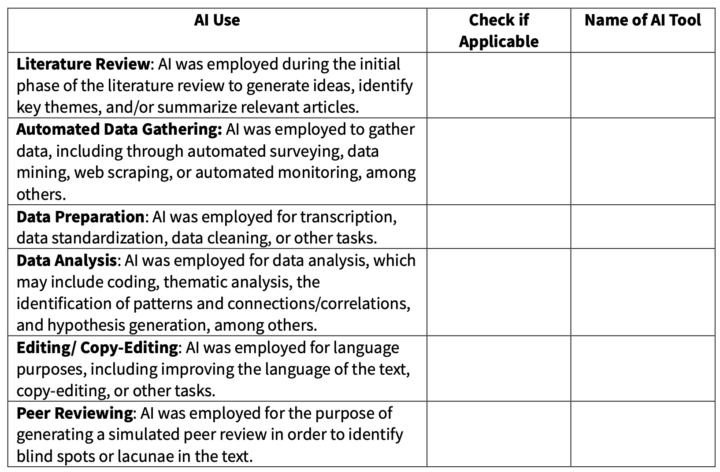
ARI requires explicit disclosure of AI use for all publications. Authors must disclose to ARI which generative AI technology was used, and for what purpose(s). As part of this disclosure, the author(s) agree(s) to fill out the disclosure form that lists how AI was used in the preparation of the manuscript. This will also be included as part of the acknowledgments on the publication itself.